The Sunsum That Did Not Come Back
c. 1850 CE · Akan oral tradition and living practice, present-day Ghana and Côte d'Ivoire · An Akan village in the forest zone of present-day Ghana — the heartland of the Asante and Fante peoples
Contents
Among the Akan, sleep is a nightly journey the soul takes away from the body — and what wanders in the dark can be attacked, stolen, or lost. When Abena wakes from a terrible dream, the okomfo must find what the night took.
- When
- c. 1850 CE · Akan oral tradition and living practice, present-day Ghana and Côte d'Ivoire
- Where
- An Akan village in the forest zone of present-day Ghana — the heartland of the Asante and Fante peoples
Every night in the Akan village, the souls leave the bodies.
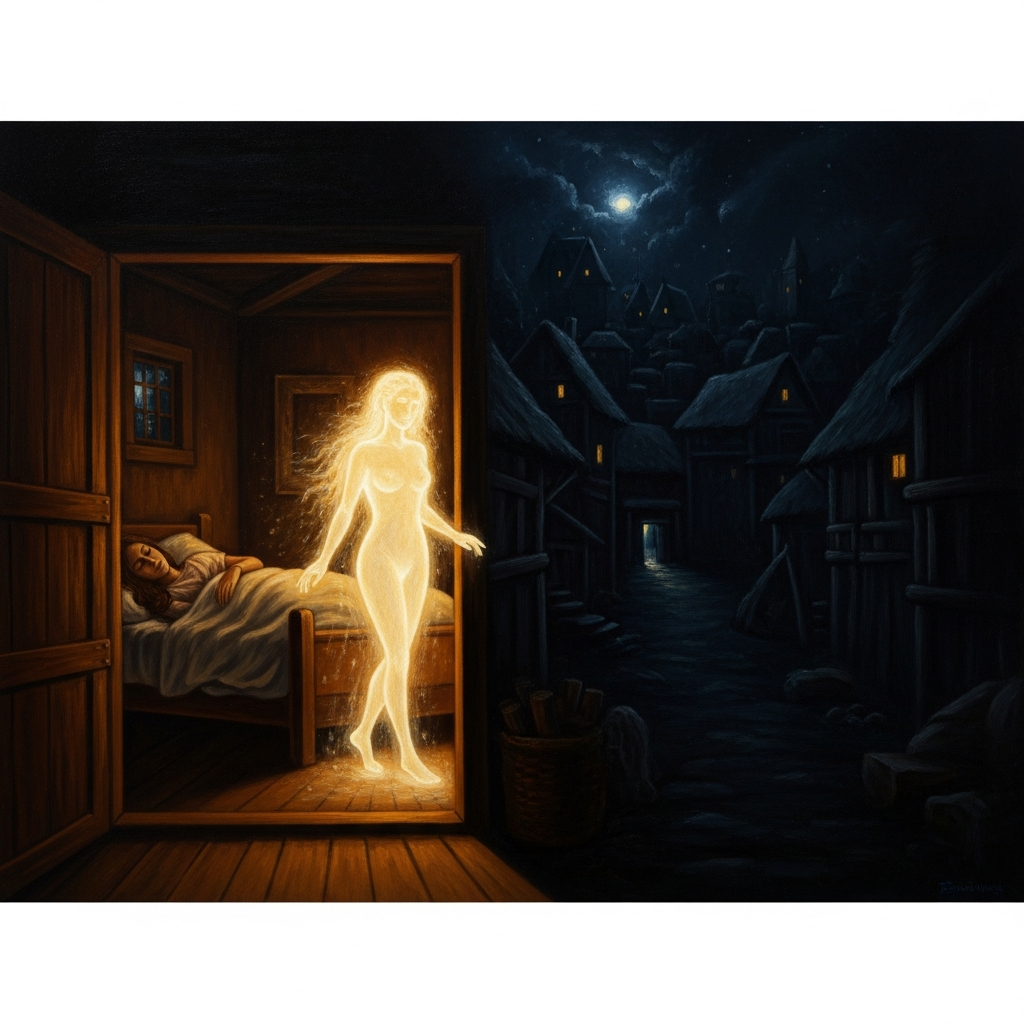
This is not poetry. It is cosmological fact, the kind of fact the Akan live with as practically as they live with the fact that fire burns and water drowns. When a person sleeps, the sunsum — the personal spirit, the animating force that gives the individual their character and their social presence — separates from the body and travels. It does not know it is traveling in the way a dreamer knows they are dreaming. It goes. It moves through the night world, which is not empty. The night world contains other sunsum from sleeping people; it contains the spirits of the dead who have not yet fully arrived in the place of the dead; it contains beings who are hungry for the kind of energy a wandering sunsum carries; and it contains, among the Akan’s most feared night-figures, the bayi — the witches who hunt in darkness and whose weapons are specifically designed for the unhoused soul.
In the morning the sunsum returns. Most mornings.
Most mornings it returns with nothing more than the residue of wherever it went — images, sensations, fragments of encounters that the waking mind assembles into what people call dreams. The community knows that some dreams are the literal memory of where the sunsum traveled. They know how to tell the difference. A dream with the quality of a genuine journey — specific location, recognizable beings, clear transactions — is a sunsum memory. A dream with the quality of confusion and dissolution is the mind producing noise. The difference matters because if your sunsum was in real trouble last night, you need to know it this morning while there is still time to do something about it.
Abena wakes before dawn.
She wakes with the knowledge that something happened.
This is not panic, not yet. It is the Akan equivalent of the feeling of checking for your wallet — the automatic assessment of presence and absence in the first moments of consciousness. She takes inventory. Her kra is intact — the kra is the soul given by Nyame at birth, the deep root of the individual that cannot be separated from the body during life and that returns to Nyame at death. The kra is her, essentially and permanently; no witch can touch the kra without killing the body outright. Her ntoro is intact — the ntoro is the paternal spirit, inherited from her father, a kind of psychic lineage-signature that connects her to all the men in her father’s line and through them to the spiritual character that runs through the family. These two are present. She can feel them the way you feel your own hands without looking at them.
The sunsum is different.
The sunsum is not absent, exactly. But it is not well. She can feel the damage the way you feel a bruise in the dark — not the injury itself but the wrong-shaped space where something was right and isn’t anymore. She had a dream she cannot fully remember except for the quality of it: a chase, a tearing, cold fingers, the sensation of being held at the edge of a darkness so complete she understood it as absence itself. She came back from that darkness, obviously — she is here in her body, awake, alive. But the sunsum that came back is not quite the same as the sunsum that left.
She goes to the okomfo at first light.
The okomfo’s compound is at the edge of the village near the river. This is intentional. The okomfo moves between the world of the living and the world of the spirits, and that work requires proximity to flowing water, which the Akan understand as a boundary zone — the place where the seen and unseen worlds touch. The okomfo is a woman in her sixties, initiated into her calling as a young woman when the god entered her during a festival and she did not fall. She has been doing this work for forty years. She has seen almost every way a sunsum can be damaged.
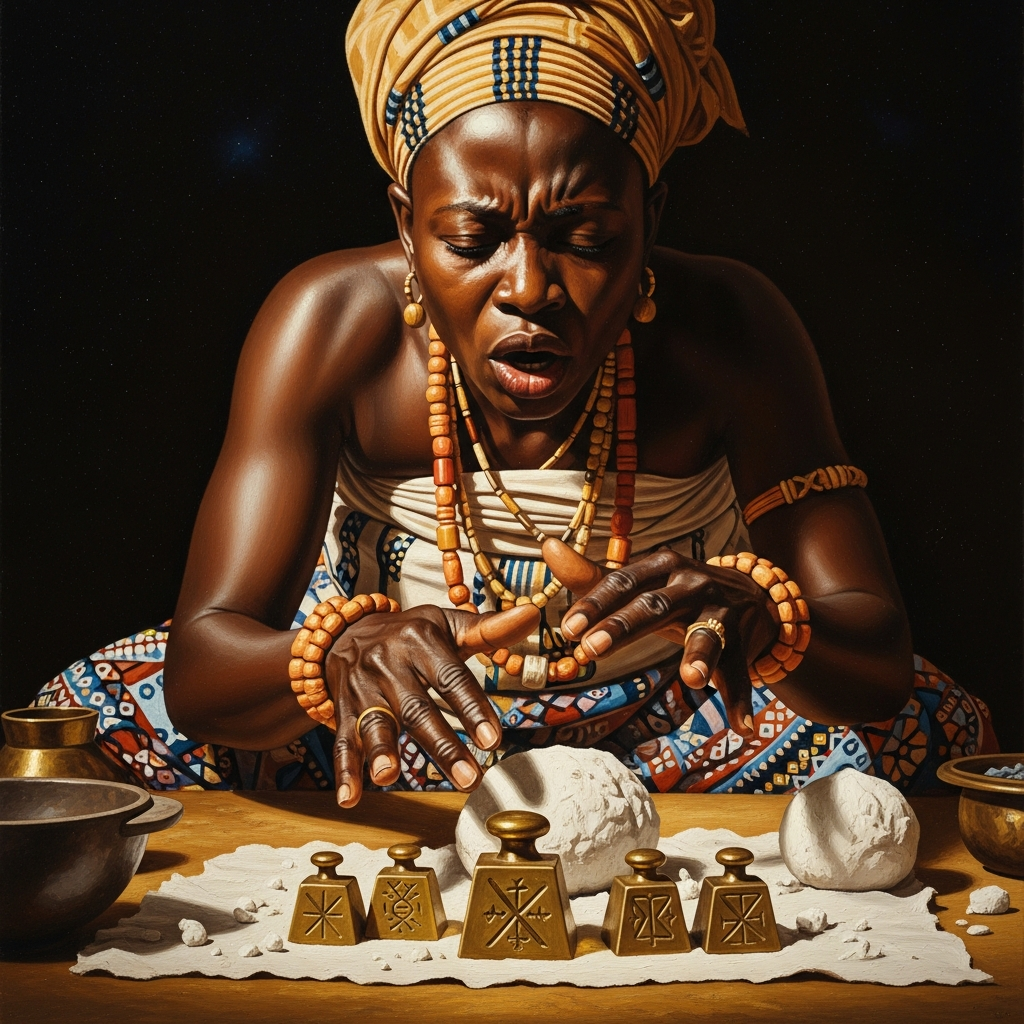
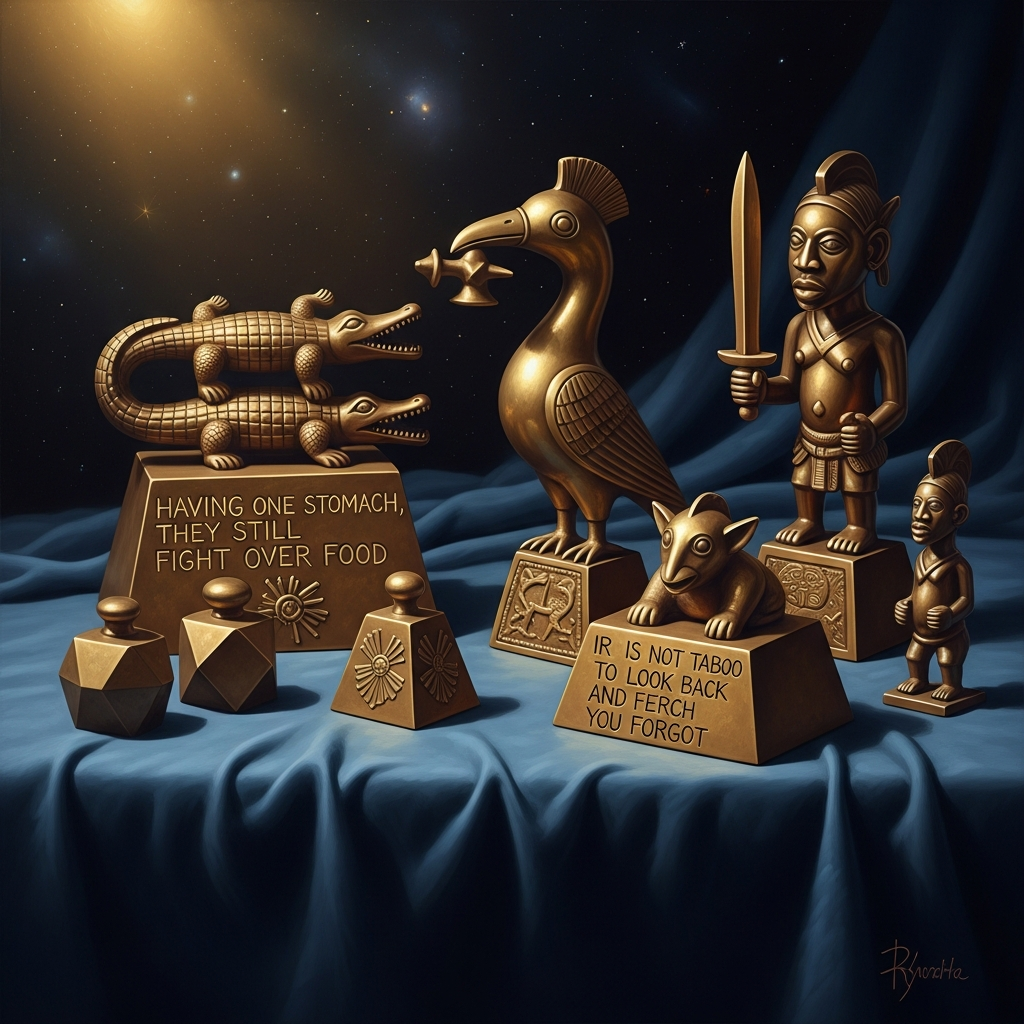
She listens to Abena describe the dream. She asks four questions, which she asks in a particular order for particular reasons that she does not explain and Abena does not ask her to. She examines Abena’s eyes, the color of her palms, the way she holds her arms against her body. She brings out her brass goldweights — the small cast figures that are simultaneously weights for measuring gold dust, proverbs in metal, and cosmological instruments. Each goldweight holds a meaning compressed to the density of a coin. She arranges seven of them on a white cloth in a pattern that the initiate would recognize as a map of the sunsum’s most common paths during sleep.
The seven goldweights form a shape. The okomfo reads the shape.
She says: your sunsum was caught. It was not eaten and it was not kept — you would be much sicker if it were kept. But it was held and something was taken from it, the way you hold a cloth and tear a strip from the edge. The cloth is still a cloth. But it is smaller.
Abena says: who held it?
The okomfo says: someone who is alive and sleeping in this village, whose own sunsum is hungry. She does not say a name. She does not say a name because naming in these circumstances is a political act with consequences that will outlast the ritual, and she is careful about that. She says: it does not matter who. What matters is getting back what was taken.
The ritual takes most of the morning.
The okomfo works with white clay and river water and a specific plant the Akan use for sunsum-healing whose name translates roughly as the one that calls back what wandered. She speaks the words that are not prayers exactly — they are addresses, direct speech to the spirit world, the okomfo in her role as the human being who can be heard on both sides of the boundary. The goldweights are rearranged twice. A small fire is lit and allowed to go out naturally. Abena sits in the center of the arrangement and is required not to speak.
The Akan understanding of what is happening during this ritual is precise. The sunsum that returned damaged is still connected, by the thinnest thread, to the piece of it that was taken. The ritual creates the conditions in which that thread can be followed and the piece pulled back — not recovered from a thief by force, but called back the way you call a child who has wandered: with enough noise and warmth and recognizability that the lost piece knows where home is. A damaged sunsum that is not treated will continue to lose pieces. The body will sicken. The person will become withdrawn, unable to feel joy, unable to be present in the community in the way the sunsum’s social energy makes possible. The Akan diagnosis for this state — chronic low vitality, social withdrawal, inability to engage — includes among its explanations the possibility that the sunsum has been repeatedly raided over many nights and has become too small to fully inhabit the person it belongs to.
This is why the ritual is a communal responsibility and not just a personal one.
When the okomfo says the ritual is complete, Abena sits quietly for a long time before speaking.
She says: is it back?
The okomfo says: most of it. These things are never complete all at once. You should sleep with your window covered for three nights and not leave the village compound alone after dark for a week. These are not mystical prohibitions. They are precautionary hygiene — the equivalent of keeping a healing wound clean. The sunsum that has been raided once is easier to raid again in the next few nights, before it has rebuilt its integrity. The covered window and the company are not magic; they are common sense applied to the spirit world the way common sense is applied to the physical one.
The okomfo also tells her: tell your neighbor women. This is the communal dimension. The community has a responsibility to protect each other’s wandering sunsum. The telling is itself protective — a community that knows one of its members has been spiritually attacked is a community that will collectively pay more attention to the night, will hold the protective space more carefully, will perhaps arrange for two or three women to sleep in the same room for the next week. The sunsum travels alone, but the community it returns to is supposed to be its defense.
Outside the okomfo’s compound, the river moves. On its surface the morning light breaks into pieces and reassembles — exactly the way a sunsum, the okomfo has always thought, does after a bad night. Not cleanly. Not all at once. Piece by piece, in the current, finding its own shape again.
The Akan do not think sleep is rest — they think sleep is the soul’s second life, the parallel existence of the spirit in a world that runs alongside this one, and that the only difference between the living and the dead is that the living come back in the morning. Most mornings.
Scenes
A sleeping woman's sunsum rises as a luminous figure from her body, stepping out into the dark village — unprotected, visible to forces the waking eye cannot see, moving through the spirit-world like a lantern in rain
 Generating art…
 The okomfo crouches over an arrangement of brass goldweights and white clay, speaking the words that call the sunsum back — her voice low and rapid, her hands moving in patterns older than the village's oldest elder
 Generating art…
 Akan goldweights cast in brass — geometric, animal, human — lie in their cloth
 Generating art…
 Echoes Across Traditions
Entities
- Sunsum (personal spirit, can travel during sleep)
- Kra (the soul given by Nyame)
- Ntoro (paternal spirit)
- Okomfo (Akan priest/priestess)
- Nyame (the Sky God)
Sources
- Kwame Gyekye, *An Essay on African Philosophical Thought: The Akan Conceptual Scheme* (1987)
- R.S. Rattray, *Religion and Art in Ashanti* (1927)
- J.B. Danquah, *The Akan Doctrine of God* (1944; 2nd ed. 1968)
- Kofi Asare Opoku, *West African Traditional Religion* (1978)
- Mary Quaicoe, 'The Concept of the Soul Among the Akan People,' *Journal of Religion and Theology* 14.2 (2007)