Orunmila and the Destiny You Chose
Mythic time and the eternal present · Yoruba oral tradition, recorded 16th–20th century CE · The space before birth and a divination compound in Yorubaland, present-day southwestern Nigeria
Contents
Before birth every soul stands before Olodumare and chooses its own life. Then it forgets. The Ifa oracle exists to help people remember. When a young man asks why his destiny has gone wrong, what Orunmila reveals is harder than he expected: nothing has gone wrong at all.
- When
- Mythic time and the eternal present · Yoruba oral tradition, recorded 16th–20th century CE
- Where
- The space before birth and a divination compound in Yorubaland, present-day southwestern Nigeria
Before you are born, you choose.
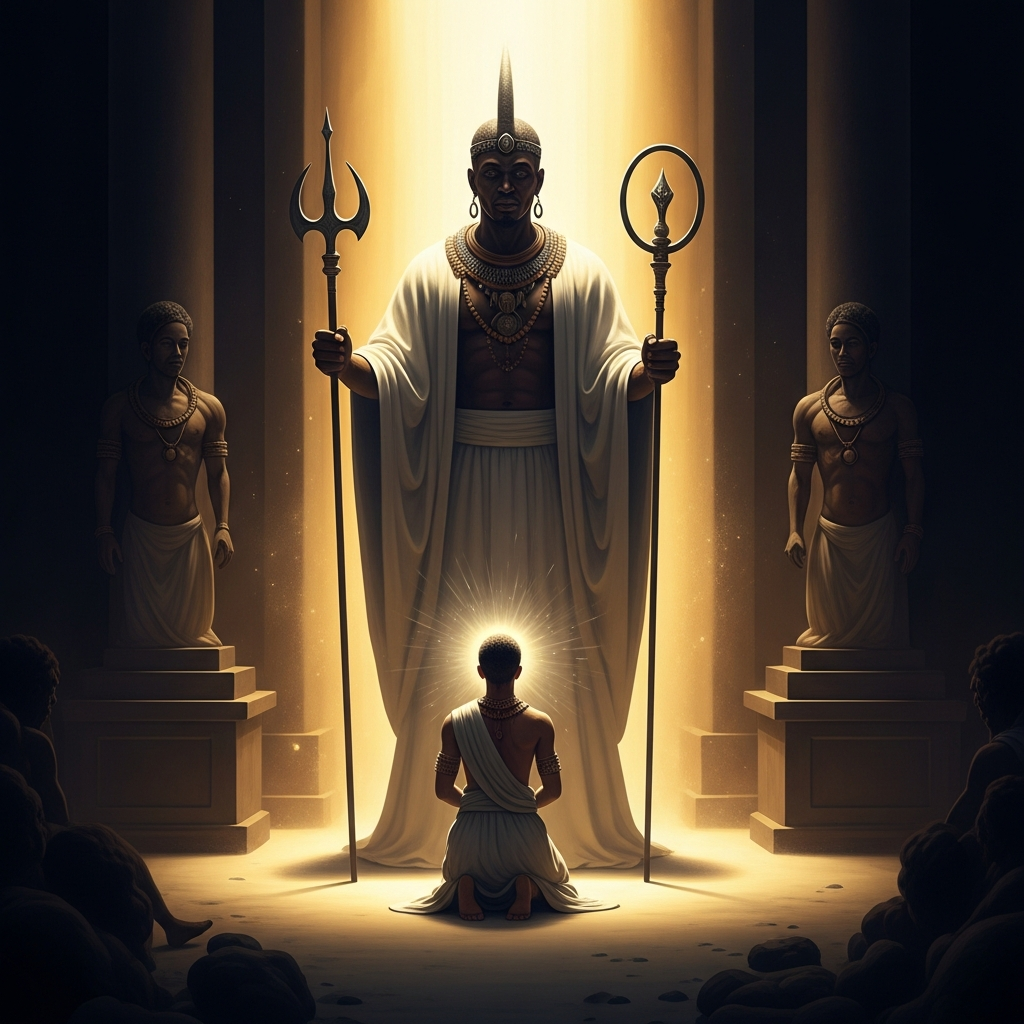
This is the Yoruba metaphysical fact that underlies everything else: the soul, in the space between the world of the orishas and the world of the living, stands before Olodumare, the Supreme God, and chooses its destiny. Not a destiny assigned from above, not a fate written into the stars by a god who decided your life for you — but a choice made by you, the soul in full possession of itself before it entered a body. You kneeled before Olodumare and you stated your life plan. You said: this is what I will do. This is the kind of person I will be. This is whether I will be remembered and how. Olodumare witnessed the choice. Orunmila — the great orisha of wisdom and the master of Ifa divination — was there. He heard.
Then you drank.
The waters of forgetfulness that every soul drinks before birth are not a punishment. They are a gift, in the Yoruba understanding — a strange and difficult gift, but a gift. Without forgetting, you would live your life already knowing its outcome, and the living of it would be hollow performance rather than actual living. The forgetting makes the life real. It makes every choice feel original, every joy feel earned, every difficulty feel new. The problem is that the forgetting is complete. You enter the body with the choice already made and the memory of it already gone, and you spend your life — if you are not careful — trying to be something other than what you chose.
This is why the Ifa oracle exists.
Orunmila’s knowledge is the knowledge of what was chosen. He was present for every soul’s kneeling before Olodumare. He heard every life plan spoken aloud. He cannot tell you everything you chose — the full depth of a soul’s contract with Olodumare is not a thing even Orunmila makes public. But he can open a window. He can let a fragment of it through. The Ifa divination system is the technology of that window-opening: the babalawo, the divination priest, consults the corpus of Odu — the 256 sacred chapters that together map every possible human life-situation — and through the casting of the divining chain or the palm nuts, Orunmila indicates which Odu applies. The Odu is a chapter of ancient stories and poems and proverbs, and within it, for this specific question on this specific day, the relevant passage will be clear to the babalawo who has spent years learning to read.
This is not reading the future. This is reading the past — the deep past, the pre-birth past, the choice that was made before memory.
The young man who comes to the babalawo on this particular morning has not come to read his future. He has come to understand his past. He is in his mid-twenties. He is from a family of some local standing — his grandfather was a well-regarded elder, his father a respectable craftsman. He has worked hard. He has done what people who want to be prosperous do: sacrificed at the right times, respected the elders, maintained his relationships. And nothing has worked. The business failed. The marriage he hoped for did not come. The children he expected have not arrived. He is not destitute — he is fed, he is healthy, his kinship network supports him. But he is not what he believed he was supposed to be. He believed he was supposed to be greater than this.
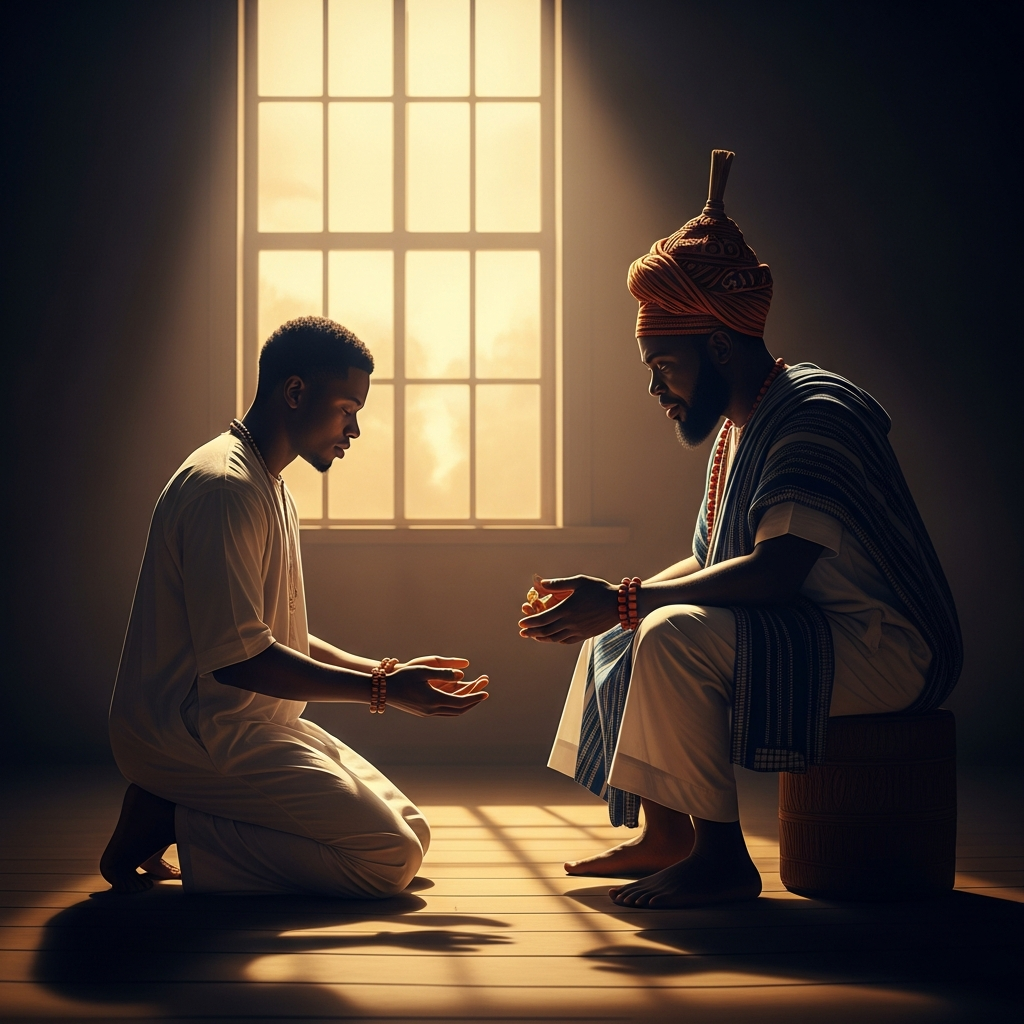
He kneels across from the babalawo and he says: something has gone wrong with my destiny.
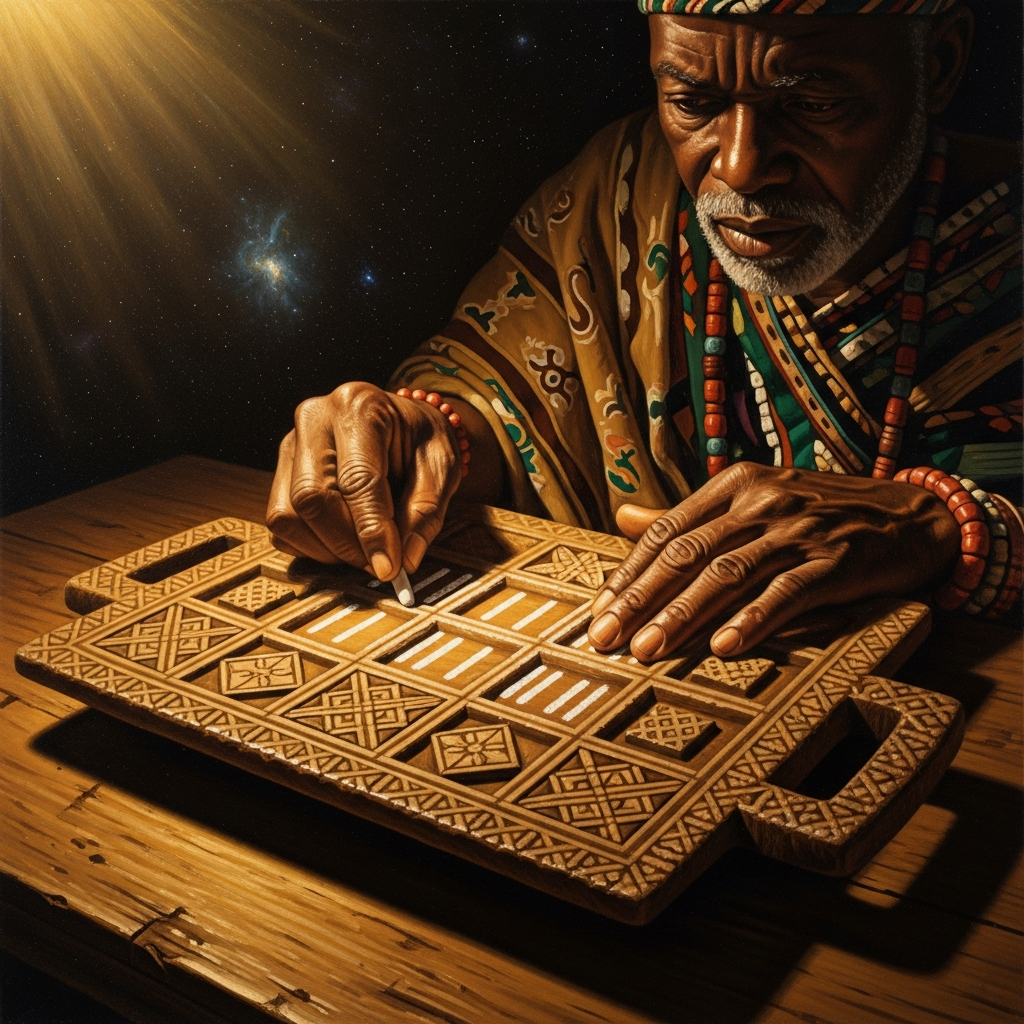
The babalawo does not respond immediately. He takes up his ikin — the sacred palm nuts, sixteen of them — and he begins the casting. He passes the palm nuts from hand to hand, marking each pass in the sacred white powder on the divination tray with strokes that are not made by thought but by the speed and automaticity of long practice: two marks if one nut remains after the sweep, one mark if two remain, all other outcomes off the tray. He does this eight times. The eight marks form the signature of an Odu.
The Odu that appears is Ogbe Meji.
The babalawo is still for a moment. Ogbe Meji is the first and most senior of all Odu — the one that was there when Orunmila first brought Ifa to earth, the one that carries the deepest and most fundamental teachings. In the entire corpus of 256 Odu, Ogbe Meji is the beginning. To cast Ogbe Meji for a man who believes his destiny is broken is either a great confirmation of the seriousness of the question or a great instruction to look more carefully at the ground he is standing on. The babalawo decides it is the second thing.
He says: tell me the shape of your life.
The young man tells him. He describes the failures. He describes what he believed he was going to have — prosperity, status, family, the specific dignity of a man who has built something. He describes it with real pain, not self-pity. He is not complaining. He is genuinely bewildered. He worked. He tried. It is not that he did nothing; it is that what he did produced the wrong results.
The babalawo listens. He listens all the way to the end, to the silence after the last sentence, and then he looks at the divination tray where Ogbe Meji sits in its marks of one and two.
He says: Ogbe Meji says that the greatest destiny is not always the one that looks like greatness from the outside.
He says: Ogbe Meji is the Odu of beginnings. It is the Odu of the person who makes things possible for everyone else. It is the Odu of the elder before elders were elders — the first one, the one who set the ground. People with Ogbe Meji in their destiny often do not see their work in their own lifetimes. Their work is the foundation, and you cannot see the foundation because it is beneath everything standing above it.
He says: the divination shows that your soul, before it was born, stood before Olodumare and chose a life that would make something possible that does not yet exist. The prosperity you expected was not in the plan. The status you imagined was not in the plan. Your kinship network is in the plan. Your health is in the plan. The specific quality of patience that you have developed by working and not seeing results is in the plan. What Orunmila heard your soul choose was not wealth. What he heard was: I will be the ground.
The young man is quiet for a long time.
He says: I did not choose that.
The babalawo says: you did. You chose it before you came here. You were not deceived. You were not given a lesser destiny by accident. You chose this specific difficulty because some part of the soul you were, before you became this body, understood what this difficulty would make.
This is the hardest teaching in all of Ifa.
Not that destiny is fixed — the Ifa system allows for modification, for propitiation, for the shifting of outcomes through sacrifice and effort. Not that human choice is an illusion — the whole point of Ifa divination is to help people make better choices. The hardest teaching is that the original choice was good. That the soul who stood before Olodumare chose wisely, out of full knowledge of what the life would cost, and chose it anyway. That the person sitting across from the babalawo in bewilderment and grief is not a victim of a bad destiny but a practitioner of a difficult one.
To accept this is to undergo a particular transformation that has no word in most Western languages. It is not resignation — resignation is the abandonment of effort, and Ifa never counsels that. It is not contentment — contentment is the feeling of having enough, and Ogbe Meji does not promise enough in the visible sense. It is the recognition that the self who chose is also the self who is living, and that the forgetting was not a failure of information transfer but the precondition of genuine living. You cannot remember choosing this. But you can, if the babalawo reads well and you listen, catch a glimpse of the soul who chose it — the one who was large enough, before it entered a body, to say: I will be what no one will call great, and I will be it anyway, because something in the world requires it.
The young man kneels in front of the divination tray for a long time. Outside the babalawo’s compound the morning is getting on — the market sounds are building, a child is crying somewhere, a rooster that lost track of the hour is crowing late. The young man looks at the marks in the white powder: Ogbe Meji, the first Odu, the ground of everything.
He says: what do I do now?
The babalawo says: you make the sacrifice Orunmila prescribes, and then you go back to your life and live it as if you chose it.
He pauses. He says: because you did.
The great mercy of Ifa is not that it tells you how to change your destiny, but that it tells you how to recognize the one you already chose — and the greater mercy is that in every Odu ever recorded, the soul who chose understood what it was doing, even if the body never will.
Scenes
A soul kneels before Olodumare in the luminous space before birth — not small in the presence of the divine but specific, deliberate, already choosing the contours of its life with an authority that will be forgotten the moment it is enacted
 Generating art…
 The babalawo marks the Ifa divination tray with swift certainty — sixteen marks become an Odu, the sacred chapter falling open like a book that was always there, already written
 Generating art…
 The young man kneels across from the babalawo in the morning light, his hands open on his knees
 Generating art…
 Echoes Across Traditions
Entities
- Orunmila (deity of wisdom, divination)
- Ifa (sacred oracle system)
- Olodumare (the Supreme God)
- Odu Ogbe Meji (most powerful sacred chapter)
- Babalawo (Ifa divination priest)
Sources
- Wande Abimbola, *Ifa: An Exposition of Ifa Literary Corpus* (1976)
- Wande Abimbola, *Ifa Will Mend Our Broken World* (1997)
- William Bascom, *Ifa Divination: Communication Between Gods and Men in West Africa* (1969)
- Rowland Abiodun, *Yoruba Art and Language: Seeking the African in African Art* (2014)
- Jacob Olupona and Terry Rey, eds., *Orisa Devotion as World Religion* (2008)