Chi: The Self You Were Before You Were Born
Mythic time · Igbo oral tradition, present-day southeastern Nigeria · Igboland, southeastern Nigeria — the homeland of the Igbo people
Contents
In Igbo cosmology every person carries a chi — a fragment of the supreme god lodged inside the individual, a personal divine double that agreed to the terms of your life before you entered it. The story of the man who fought his chi and what it cost him.
- When
- Mythic time · Igbo oral tradition, present-day southeastern Nigeria
- Where
- Igboland, southeastern Nigeria — the homeland of the Igbo people
Before you are born, you go before Chukwu.
This is not a metaphor the Igbo take lightly. It is the metaphysical architecture of the world. Chukwu is the high god, the supreme source, the one who is too great to be addressed directly — you speak to him through smaller intermediaries, through the alusi, through the priests of Agbala the Oracle, through the dreams your body sends up from its depths at night. But before you are born, you stand before Chukwu himself. You kneel. You state your own life plan — not the plan that is given to you, but the one you speak aloud yourself. This is what you will do with the time you are given. This is the size of your house. This is whether you will have many children or few. This is whether your name will be remembered.
Chukwu listens.
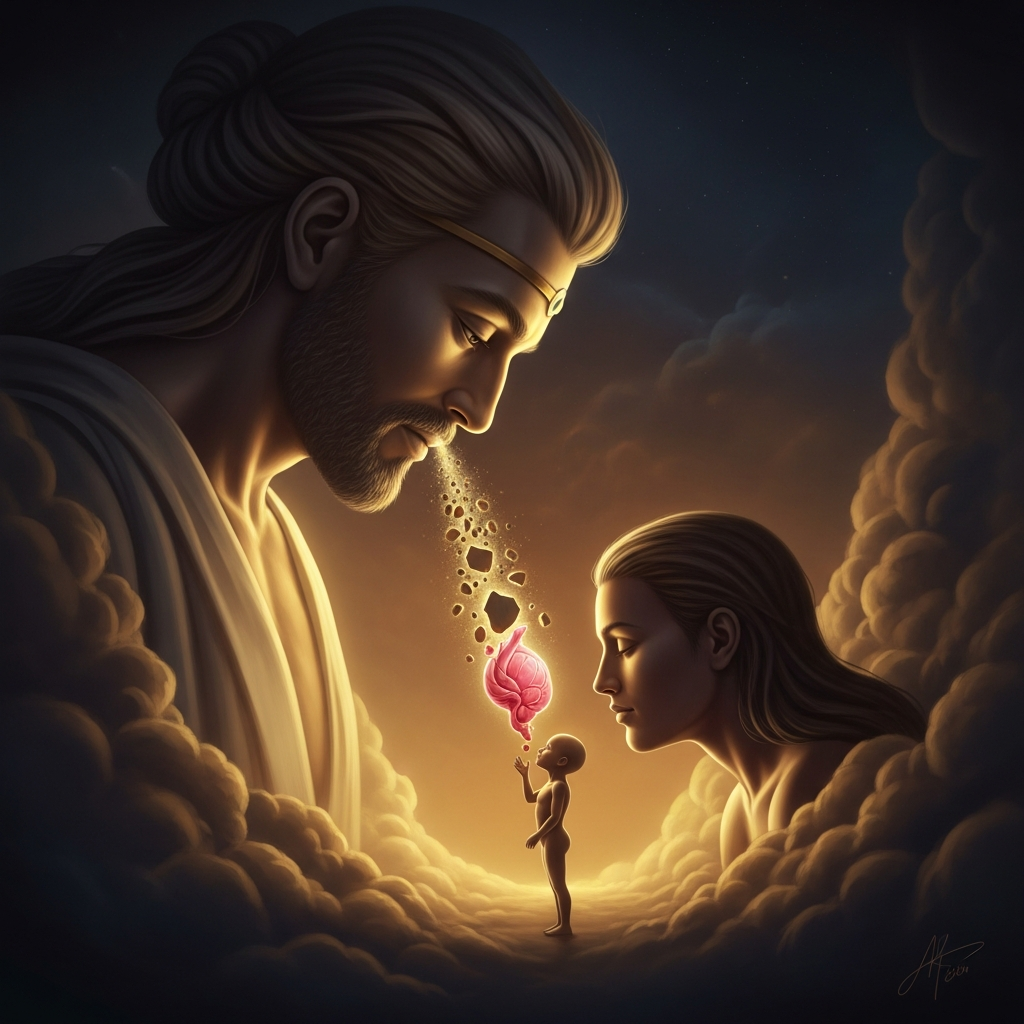
Then Chukwu breathes a fragment of himself into you. This fragment is your chi. It is simultaneously you and not you — your personal spiritual double, your inner divine, the piece of the supreme god that agrees to accompany you through your chosen life. The chi is not a conscience. It is not a guardian angel in the Western sense. It is closer to your own highest version of yourself, the self that stood before Chukwu and spoke the plan clearly, before you drank the waters of forgetfulness and entered a body that immediately began to forget everything it had agreed to.
The chi remembers everything.
The Igbo say: onye kwe, chi ya ekwe. When a person agrees, his chi agrees. The chi cannot carry you past the limit of your own plan; it can only go as far as you were willing to go before you came. But the deeper teaching is darker and stranger. The chi can refuse. If a man reaches for something that is outside the life he chose, his chi does not stretch to cover it. The reach fails. Not because of bad luck or the malice of enemies, but because the inner god, the original self, remembers the plan and holds the line.
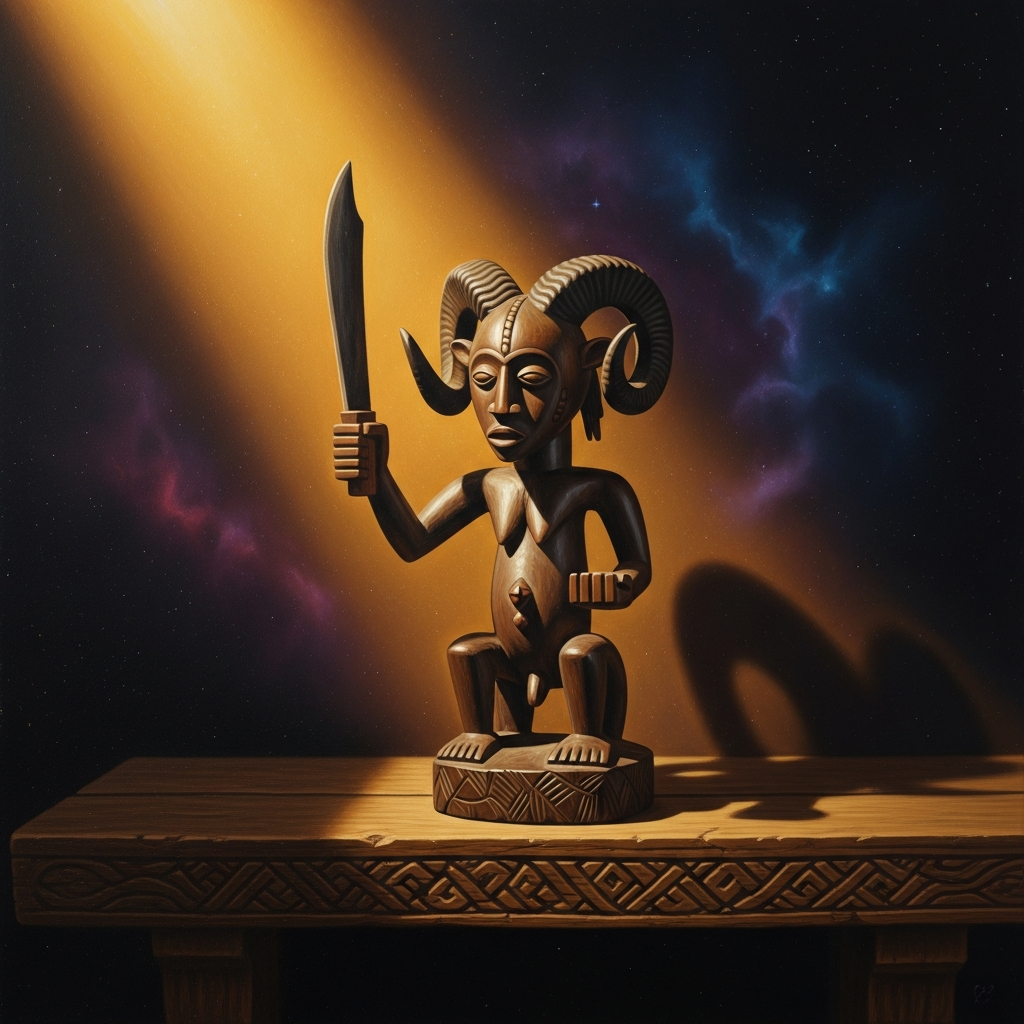
This is not a comfortable theology. It places tremendous weight on a choice you cannot remember making. You chose the size of your life before you entered it. The Igbo know this produces a question that can break a man if he holds it too long: did I choose this? Did I choose this specifically? The difficult answer is yes. And the difficult answer is also: you can negotiate. You can go to Agbala, the oracle at the cave, and consult the chi directly. You can set up an ikenga — the personal altar of will, the carved wooden figure with its two horns and its machete-hand, which represents the right arm of your own effort. The ikenga is where you pray not to an outside god but to your own inner one. To put something before the ikenga is to remind your chi of what you are trying to do.
The ikenga can be destroyed. If a man’s life collapses completely, if he has failed so totally that there is nothing left to repair, he can take his ikenga and smash it. He is smashing the agreement. He is saying: this life is not working; I release myself from the plan. But to smash an ikenga is a terrifying act. You are not just ending a ritual object. You are breaking faith with the self who chose.
Ani watches all of this from below.
Ani is the earth goddess, the ground under every foot, the mother who receives the dead and holds their bodies against the day of judgment. She is older than Chukwu’s cosmology of individual destiny; she is the law of the community, the ofo, the rites of the land. The chi belongs to the individual. Ani belongs to everyone. A man can transgress his chi — can try to live a larger life than he chose, or a smaller one — and the consequences will be between him and his inner god. But if he transgresses against Ani, the earth herself rejects him. The land refuses to grow his yams. His lineage is cut off. The osu — the outcast — is the person Ani has turned away from, not just Chukwu.
In Igbo cosmology there is always this double pressure: the individual chi pulling the person toward their specific, chosen destiny; and Ani holding everyone inside the law that applies to all. The great dramas of Igbo life happen in the space between them. A man whose chi has agreed to a modest life tries to be a great warrior; the tension is internal, a man against his own shadow. A man who is great but breaks the earth-law for greatness — who kills his kinsman, who commits nso ani, the abomination against the earth — finds that his chi cannot protect him from what Ani demands.
The man who falls in this way is a particular figure in Igbo myth. He is not simply a villain and not simply a victim. He is a man of genuine greatness — whose chi did, in fact, agree to greatness — who made the specific, personal error of trying to be great in a way that violated the earth-law that holds the community together. His chi agreed to his strength. His chi never agreed to the kinsman’s blood.
The tragedy is not that he was weak. The tragedy is that he was almost right.
The Igbo word for this figure is not easily translated. He is a man of chi — chi-rich, chi-powered, his inner god in full agreement with his ambition up to the moment of the transgression. His ikenga is oiled and prayed to. His yam harvest has been magnificent. His wrestling victories are genuinely his, earned by the agreement between his will and his chi. He is not lying about his greatness. He is great.
But he has not understood the full shape of his destiny. He has read the chi correctly in its bold strokes — I will be powerful — and missed the fine print: you will be powerful inside the law that holds the earth together. The chi knows the fine print. The chi always knew. When Agbala is consulted on his behalf, the oracle does not say he was wrong to be ambitious. The oracle says he was ambitious in a direction his chi never agreed to.
The eke — the spirit of fate, the force that gives each chi its specific contours — already had the shape of his life in its hands. The shape included the fall. The shape may have included the fall as the only possible end of a life lived at that pitch of intensity, in a world that could not hold both his chi’s ambition and the earth-law intact. When Ani rejects such a man, it is not punishment in the simple sense. It is the conclusion of a shape that was already drawn.
His ikenga stands on the shelf in the empty compound.
No one smashes it. He is not there to do it, and his survivors do not have the right. It remains — carved hardwood, twin-horned, one hand raised and one cupped open — a small god waiting for a man who will not return. Ani has swallowed him. His chi, his own inner divine, has been returned to Chukwu to wait for another assignment, another birth, another life plan. Somewhere in the time before birth, that chi stands again before the high god and kneels and speaks its life plan, and this time it may choose differently — may choose the quieter greatness, the one that fits inside the law without tearing it.
Or it may not. The Igbo do not pretend to know what the chi chooses next time. They only know what it chose this time, and they read the shape of a life to understand what the inner god agreed to. Every great man who falls was a great man. Every great man who stood was also a great man who chose, before he was born, a plan that the earth could hold.
The mystery is that you are both the chooser and the chosen. The chi is yourself. The destiny you are living is one your highest self designed. When you say a man’s chi agrees with him, Chinua Achebe writes, you mean he is at one with his destiny. What he leaves unspoken — what the Igbo understand without being told — is the consequence: when a man wars against his chi, he wars against himself.
There is no tragedy in Igbo metaphysics that is not also a self-portrait — every fall the mirror of a choice made before memory, in the bright room before the body, in the voice that spoke a life into being and then forgot it had spoken.
Scenes
Chukwu breathes a fragment of himself into a new soul at the moment of its formation — two figures, one vast and luminous, one small and new, facing each other at the threshold between the divine and the world of men
 Generating art…
 The ikenga sits on its shelf: carved hardwood, twin-horned, one hand raised with a machete and one cupped open
 Generating art…
 A man strides forward against a sky turning dark, muscles locked, jaw set
 Generating art…
 Echoes Across Traditions
Entities
- Chi (personal spiritual double)
- Chukwu (the Supreme God)
- Ikenga (altar of personal will)
- Agbala (the Oracle)
- Ani (earth goddess)
Sources
- Chinua Achebe, *Arrow of God* (1964) and *Things Fall Apart* (1958) — for chi theology embedded in fiction
- Chinua Achebe, 'Chi in Igbo Cosmology,' in *Morning Yet on Creation Day* (1975)
- Emeka Nwosu, *Igbo Metaphysics: The Paradox of a Theistic Naturalism* (2007)
- Victor Uchendu, *The Igbo of Southeast Nigeria* (1965)
- Sabine Jell-Bahlsen, *The Water Goddess in Igbo Cosmology* (2008)