Chukwu Breathes the Chi
Mythic time — Igbo oral tradition, present-day southeastern Nigeria · Igboland, southeastern Nigeria — the homeland of the Igbo people between the Niger and Cross Rivers
Contents
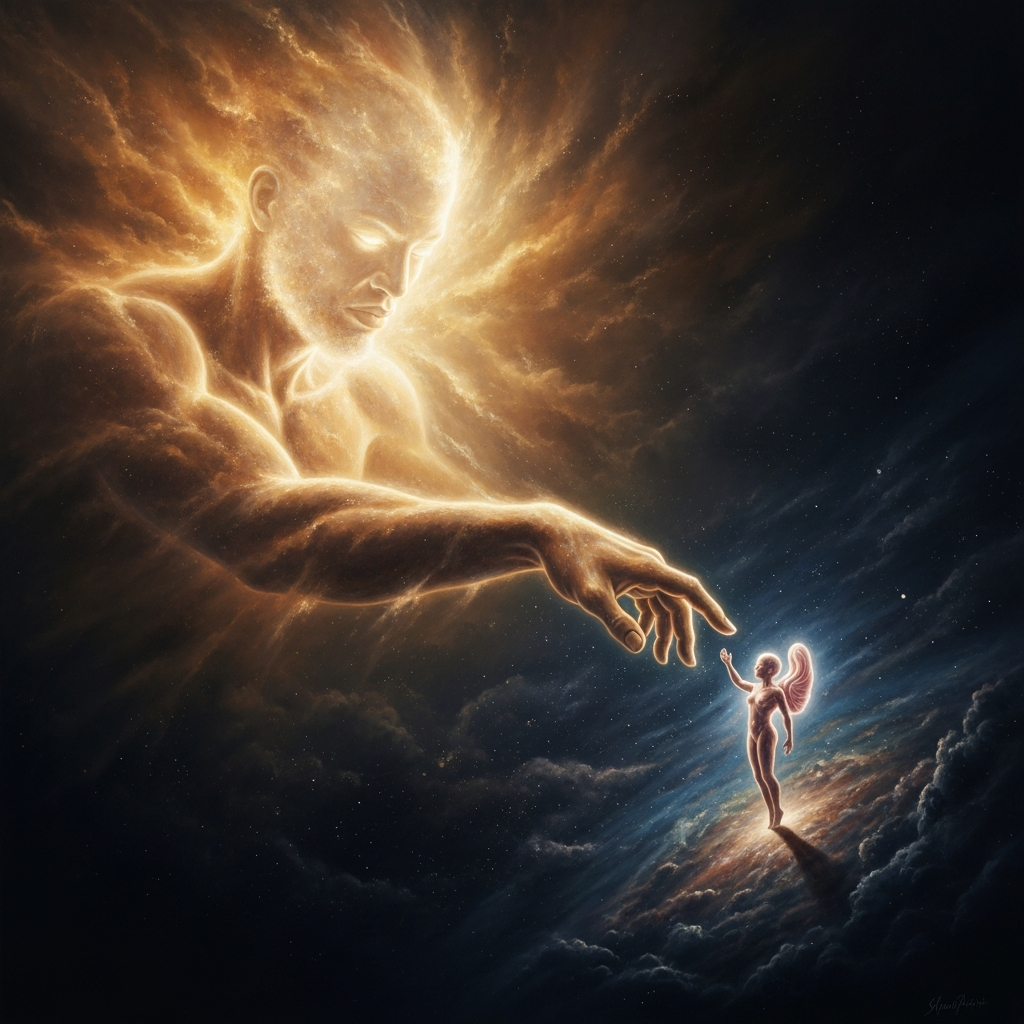
Before you are born, you stand before Chukwu and speak your own life plan. Chukwu breathes a fragment of himself into you — your chi, your personal divine double, who agrees to the terms and will never forget them even after you do. A person with a good chi succeeds even when they try to fail. A person with a bad chi fails even when they try to succeed.
- When
- Mythic time — Igbo oral tradition, present-day southeastern Nigeria
- Where
- Igboland, southeastern Nigeria — the homeland of the Igbo people between the Niger and Cross Rivers
Before you are born, you go before Chukwu.
This is not a metaphor the Igbo treat lightly. It is the architecture of the world. Chukwu is the high god — Chi-Ukwu, the great spirit, the one who is too vast to be approached directly by ordinary living people who instead speak to him through intermediaries, through the alusi, through the priests of Agbala the oracle at the cave in Awka, through the particular dreaming that bodies do at night when the ordinary traffic of consciousness quiets and something older begins to move. But before you are born, you stand before Chukwu himself. You kneel on whatever you were before you had knees. And you speak your life plan.
Not the plan that is given to you. The plan that you choose.
You say: I will be a farmer with three barns and many children. Or: I will be a warrior whose name the elders will repeat. Or: I will be a woman who buries three husbands and outlives them all and is still weaving at ninety. Or something smaller, something modest, something that does not require great victory but only endurance and the ordinary satisfactions of a life lived inside its own dimensions. You speak the life plan. Chukwu listens. And then Chukwu breathes a fragment of himself into you.
This fragment is your chi.
The chi is not a conscience. It is not the Western guardian angel who stands outside you and offers moral advice. It is not a fate imposed from above. The chi is simultaneously you and not-you — your personal spiritual double, your inner divine, the piece of the supreme god who agreed to accompany you through the life you chose. The chi was present when the plan was made. The chi heard what you said. The chi agreed to the terms.
Then you drank the waters of forgetting.
The Igbo do not name this river — it is enough to know that there is a threshold between the divine and the world, and that crossing it costs memory. You arrive in your body already having forgotten everything you agreed to. The body is loud: it is hungry, it is cold, it is surrounded by things that need names, it is learning a language, it is becoming a person. The divine conversation — the kneeling before Chukwu, the plan, the fragment of the high god breathed into you — all of this recedes behind the noise of being alive.
The chi does not forget.
The chi is you before the forgetting. It carries the full transcript of what you said, the complete agreement, the terms. It knows not only what you chose but why — knows the reasoning that seemed sufficient in that bright moment before the body, knows what you were hoping for and what you were willing to endure. The chi is the witness to your own prior self, the self you no longer have access to directly.
This is the Igbo understanding of human nature: every person is two. There is the person who is living the life, making choices moment to moment, suffering and struggling and sometimes winning. And there is the chi — the inner divine, the one who remembers the plan, the one who knows whether what is happening now is on-course or off-course according to the original agreement.
The Igbo say: onye kwe, chi ya ekwe. When a person agrees, his chi agrees.
This phrase contains everything. It means: the chi cannot go farther than you are willing to go. Your chi can only bring you to the edges of your own original agreement — it cannot exceed it, cannot compensate for it, cannot substitute its own greater ambition for the smaller one you chose. If you chose a modest life, a modest life is what your chi can support. If you chose a great one, your chi will carry you toward it — but only toward it, and only by the routes you already agreed to travel.
The converse is also true, and it is darker. A person with a strong chi, who chose a great life before birth, can endure extraordinary setbacks and still arrive. Their chi holds the original agreement and keeps pulling them toward it even when the living person, exhausted and grief-struck, has stopped believing they will ever get there. The chi is patient. The chi knows.
A person with a bad chi — or more precisely, a person who chose a bad plan before birth, a cramped and unlucky plan, one in which the terms were unfavorable — cannot succeed even when they try. This is not laziness. This is not failure of will. This is the original agreement asserting itself against the living person’s effort. The chi does not want them to fail. The chi is them. But the chi agreed to this, and the chi is the part of them that cannot lie.
This is not comfortable theology. The Igbo do not pretend it is comfortable. It places tremendous weight on a choice you cannot remember making. It demands that you take seriously the possibility that the shape of your life — the particular curve of your successes and failures, the specific place where things always go wrong — is the shape of something you designed before you could remember wanting to design anything.
The ikenga sits on a shelf in the corner of the men’s obi — the central reception room of the compound.
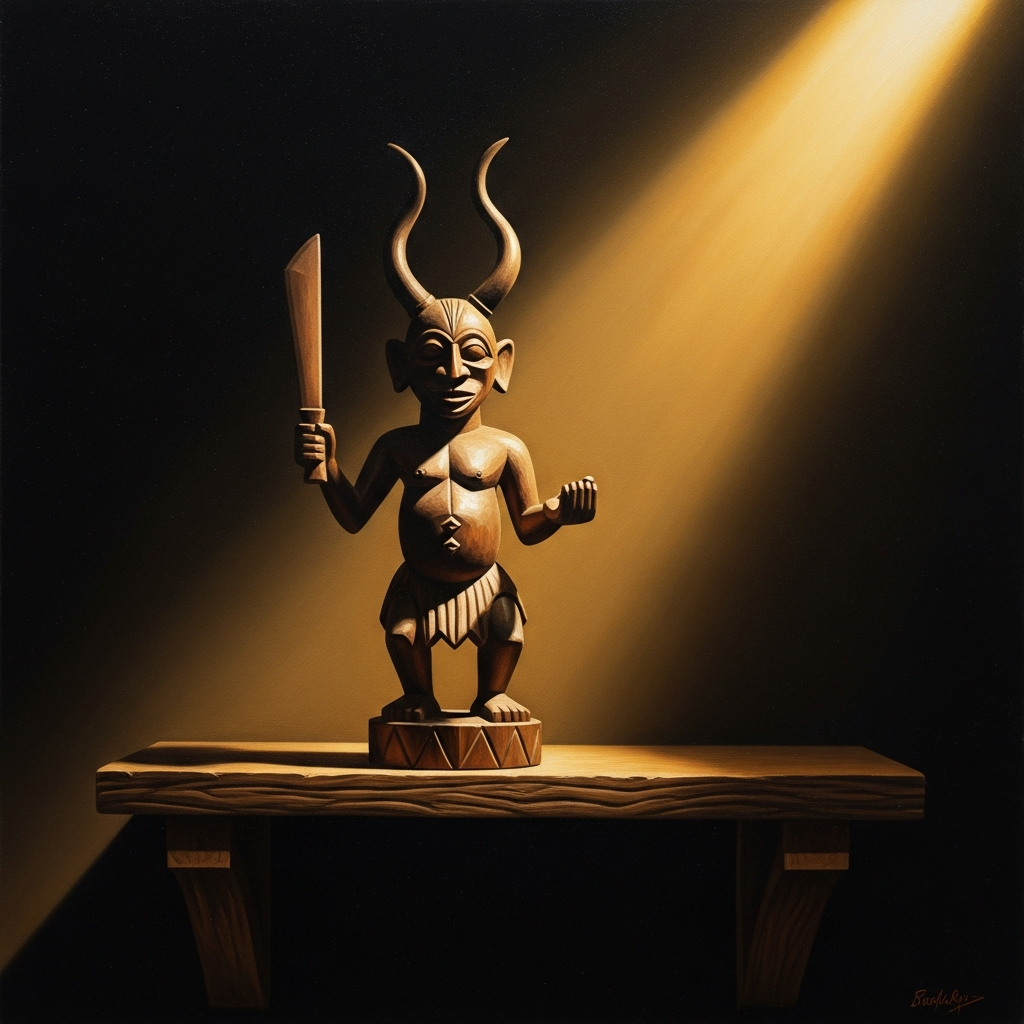
It is a carved hardwood figure, palm-sized or larger depending on the man’s resources, twin-horned at the top, one hand raised holding a machete, the other hand open and cupped. The horns represent the ram — strength, persistence, the power to charge without looking away. The machete hand represents the right arm of a man’s own effort, the force he brings to his life. The open hand receives. Between the two gestures — the striking and the receiving — is the whole life.
The ikenga is not a statue of a god who is outside you. It is the physical representation of your own chi, the altar where a man can address the divine double that is also himself. To pray before the ikenga is not to petition an external power for favors. It is to remind your inner divine of what you are trying to do, to re-state the plan in the present moment, to say: I am still working toward this. Are we still agreed?
The ikenga is oiled with palm oil. It is offered kola nut, the sacred nut that opens every ceremony, that is split and read for good or bad omen. It is spoken to, in the private language of a man talking to the most intimate part of himself. When things go well, the ikenga receives thanks. When things go badly, the ikenga is consulted: what is happening? Are we off course? Is this part of the plan I cannot remember?
And when things go very badly — when a man’s life has collapsed past the point of repair, when the yams have failed and the wives have left and the debts are unpayable and the compound is empty — the ikenga can be destroyed. The man takes it in his hands and breaks it on the ground.
He is not destroying a god. He is destroying his agreement. He is saying: I release myself from this plan. I refuse what I chose. I start over. To smash an ikenga is the most radical act in the Igbo spiritual vocabulary — more radical than any sacrifice, more final than any petition to the oracle. You are not asking the divine to change your fate. You are rejecting the self who made it.
This is terrifying. The Igbo know it is terrifying. To smash the ikenga is also to break faith with the self who stood before Chukwu and spoke clearly and chose this life for reasons that must have seemed sufficient. Breaking faith with that self means there is no self who speaks for you in the divine negotiation anymore. You are starting the negotiation over, without memory, without the transcript.
Ani watches from below.
Ani is the earth goddess, the ala — the ground under every foot, the soil that grows the yams, the mother who receives the dead and holds their bodies. She is older than Chukwu’s cosmology of individual destiny. She is the law of the community: the ofo, the omenala, the ways of doing things that hold the people together. The chi belongs to the individual. Ani belongs to everyone.
A man can stray from his chi’s plan and the consequences are between him and his inner divine. The oracle can help him find his way back. The ikenga can be addressed. There are ritual paths for course-correction, ways of negotiating with the self you were before you were born. The individual relationship with individual destiny has flexibility. It has the flexibility of any negotiation between two parties who both have something to gain from a good outcome.
But if a man transgresses against Ani — if he commits nso ani, the abomination against the earth — there is no ikenga to smash, no oracle to consult. Ani is not a matter of individual agreement. She is the law that holds the earth solid, that makes the crops grow, that allows the dead to lie peacefully in the ground instead of walking angry through the village. To violate her law — to kill a clansman, to commit certain sexual violations, to cut down the sacred trees — is to be rejected by the ground itself. The osu, the outcast, is a person the earth has turned away from. Their chi cannot save them from this. The chi agreed to a life the earth can hold. The chi never agreed to an act that makes the earth refuse you.
Chinua Achebe understood all of this.
He was Igbo. He grew up in a family negotiating between the old religion and the new Christianity, between the world his parents came from and the colonial world that arrived and would not leave. He wrote Things Fall Apart as the story of a man — Okonkwo — whose chi was large and whose life was built on that largeness, and who nonetheless fell. Not because his chi was bad. Not because he lacked strength or will or excellence. But because the specific greatness he chose before he was born required a world that was stable, and the world was not stable, and the chi cannot protect you from history.
The colonial moment — the arrival of the church, the court, the colonial administrator with his notebook and his certainty that he understands what he is looking at — is the moment when the chi of thousands of Igbo people ran into a force they had not agreed to. The life plans made before birth were made in a world that did not include the District Commissioner. The chi carried each person toward the life they had chosen, and the life they had chosen was suddenly not available, and the chi could not compensate for that because the chi was them, and they were standing in a world that had changed faster than any spiritual agreement could account for.
Achebe’s oeuvre is the record of what happens to chi theology in the colonial encounter. It is the story of men and women whose inner divine carries a plan that the external world has invalidated, and of the specific, unrepeatable ways that each person responds to that invalidation — with rage, with adaptation, with collapse, with endurance, with the particular Igbo response that Achebe calls going between the worlds.
The chi watches all of this.
The chi watches because the chi is them. The chi sees the yam barn burning and the compound emptying and the language of the colonizer taking over the schools, and the chi cannot intervene — can only hold the original plan, the one that was spoken before birth, and wait for the living person to find their way back to it, or fail to, or discover that what it means to find your way back has itself changed in a world you did not choose.
There is no tragedy in Igbo metaphysics that is not also a self-portrait — every fall the mirror of a choice made before memory, in the bright room before the body, in the voice that spoke a life into being and then forgot it had spoken. The chi does not forget. This is its gift and its burden: to know, always, the distance between what was chosen and what is happening, and to wait, with the patience of a god, for the living person to close that distance.
Scenes
Chukwu breathes a fragment of himself into a new soul at the threshold between the divine and the world of men — two figures, one vast and luminous, one small and new, the agreement made before the forgetting begins
 Generating art…
 The ikenga on its shelf: carved hardwood, twin-horned, one hand raised with a machete and one cupped open
 Generating art…
 A man strides forward against a darkening sky, muscles locked, jaw set
 Generating art…
 Echoes Across Traditions
Entities
- Chukwu
- Chi
- Ikenga
- Ani
- Agbala
Sources
- Chinua Achebe, *Things Fall Apart* (Heinemann, 1958)
- Chinua Achebe, 'Chi in Igbo Cosmology,' in *Morning Yet on Creation Day* (Doubleday, 1975)
- Chinua Achebe, *Arrow of God* (Heinemann, 1964)
- Victor Uchendu, *The Igbo of Southeast Nigeria* (Holt, Rinehart and Winston, 1965)
- Emeka Nwosu, *Igbo Metaphysics: The Paradox of a Theistic Naturalism* (Morehouse, 2007)