The Maize God Inside the Turtle
Mythic time / Classic Maya period, c. 250-900 CE · Xibalba and the earth beneath the first field, Mesoamerica
Contents
One Hunahpu, the Maize God, is killed by the Lords of Xibalba and his head placed in a calabash tree. He descends into the earth. This is the story of the interval — the dark time between the god's death and his emergence from the cracked turtle shell, the underground season when the corn is neither dead nor born.
- When
- Mythic time / Classic Maya period, c. 250-900 CE
- Where
- Xibalba and the earth beneath the first field, Mesoamerica
There is no fire in the dark.
This is the first thing the Maize God learns when the Lords of Xibalba bring him to the House of Darkness — the first of the six trial-houses, the first of the instruments designed to exhaust the body and unhinge the mind before the real work begins. The Maize God is not the Hero Twins. He does not know to put fireflies on the tips of his cigars or red macaw feathers on his torch. He is the father, not the sons, and the sons have not yet been born, and there is no one in the dark to tell him the trick.
He sits in the Dark House. He uses his cigar. His torch burns down. The dark, which is absolute, becomes the condition rather than the punishment.
This is the distinction the Maya theology insists on, and it is the theology the Classic-period vase painters return to again and again in the images on funerary pottery, the scenes meant to accompany the dead on their own underground journey: darkness is not destruction. It is the interval.
The Maize God’s name in the K’iche’ texts is One Hunahpu. In the Classic-period hieroglyphs he is Hun Nal Ye — First/Young Maize. In the painted vases he appears as an impossibly beautiful young man with an elongated head shaped like an ear of corn — the Maya considered this head-shape the height of aristocratic beauty and bound their infants’ skulls to achieve it — wearing a headdress of corn silk and cacao pods, his skin the pale green of maize just before it yellows into harvest.
He plays ball. This is the first thing the Popol Vuh tells us about him. He and his brother play ball above Xibalba and the noise of the game disturbs the Lords below, and they summon him, and he descends. He does not know enough to send the mosquito ahead. He does not know to name the mannequins. He sits on the hot stone bench without noticing that it glows. He is undone, step by step, by his own innocence.
The Lords of Xibalba kill him in the House of Knives. His skull they place in the fork of a calabash tree at the road-fork, where it will warn travelers: this is what happens when you descend without knowledge. The skull sits in the tree, and a young woman named Blood Moon passes by and holds out her hand, and the skull spits into her palm.
This is how the Hero Twins are conceived. This is what the father’s death was for. The sacrifice is not the end of the story — it is the mechanism by which the better version begins.
But the skull is still in the tree, and somewhere below the tree the body of the Maize God is descending through the strata of Xibalba.
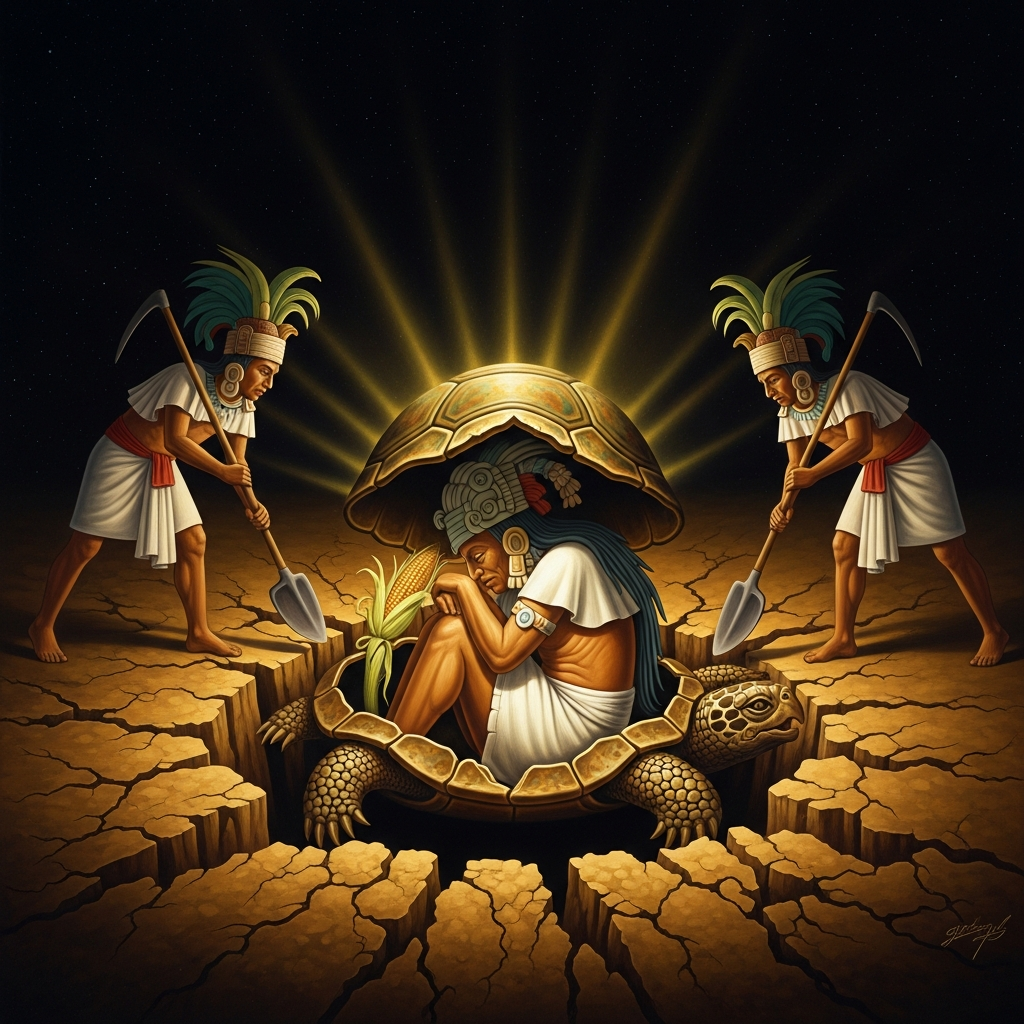
The Classic-period vase paintings show what the Popol Vuh only implies: the underground interval, the dark between death and resurrection, the period when the corn is neither seed nor shoot but something the surface world has no name for. The imagery is consistent across hundreds of painted vessels from the seventh and eighth centuries CE. The Maize God is shown curled inside a cracked turtle shell, surrounded by darkness and water. The shell is the earth. The crack is the moment before emergence. His sons, the Hero Twins — who will not exist until Blood Moon climbs to the upper world and gives birth — stand on either side of the turtle shell, holding hoes, helping from the outside. The painting shows a time that is not linear. It shows the death and the resurrection occupying the same image, the sons helping the father who has not yet conceived them.
This is the theology in a single image: death and resurrection are simultaneous from the perspective of the god inside the shell. The corn does not experience its underground weeks as waiting. The corn is doing something the surface cannot see.
What is the Maize God experiencing in the turtle shell?
The Maya texts do not ask this question directly, because it is not the kind of question agricultural theology asks. Agricultural theology asks: what must be done so that the corn comes up? The answer is: bury it, water it, speak to it, wait. The theology mirrors the practice and the practice mirrors the theology, and together they form a closed system that has no need to ask what the seed feels.
But the presence of the Maize God inside the system changes it. Because the seed is a god means the underground interval is a divine experience, not merely a chemical one. The god who is corn knows something during those weeks in the earth that the surface world cannot access. The farmers who plant the corn and speak to it — in some Maya communities this practice continues today, the planting songs addressed to the seed by name — are speaking to the god. The god is there, inside the shell, inside the dark, listening.
He is not waiting to come back. He is becoming what comes back. These are different things.
The corn that goes into the ground is dry and hard and dead-looking. The corn that comes up is green and wet and alive-looking. They are not the same object. The resurrection is not a return; it is a transformation. The god who descends into the House of Darkness is not the same god who rises from the cracked turtle shell, because the shell is where the change happens, and the change requires the dark.
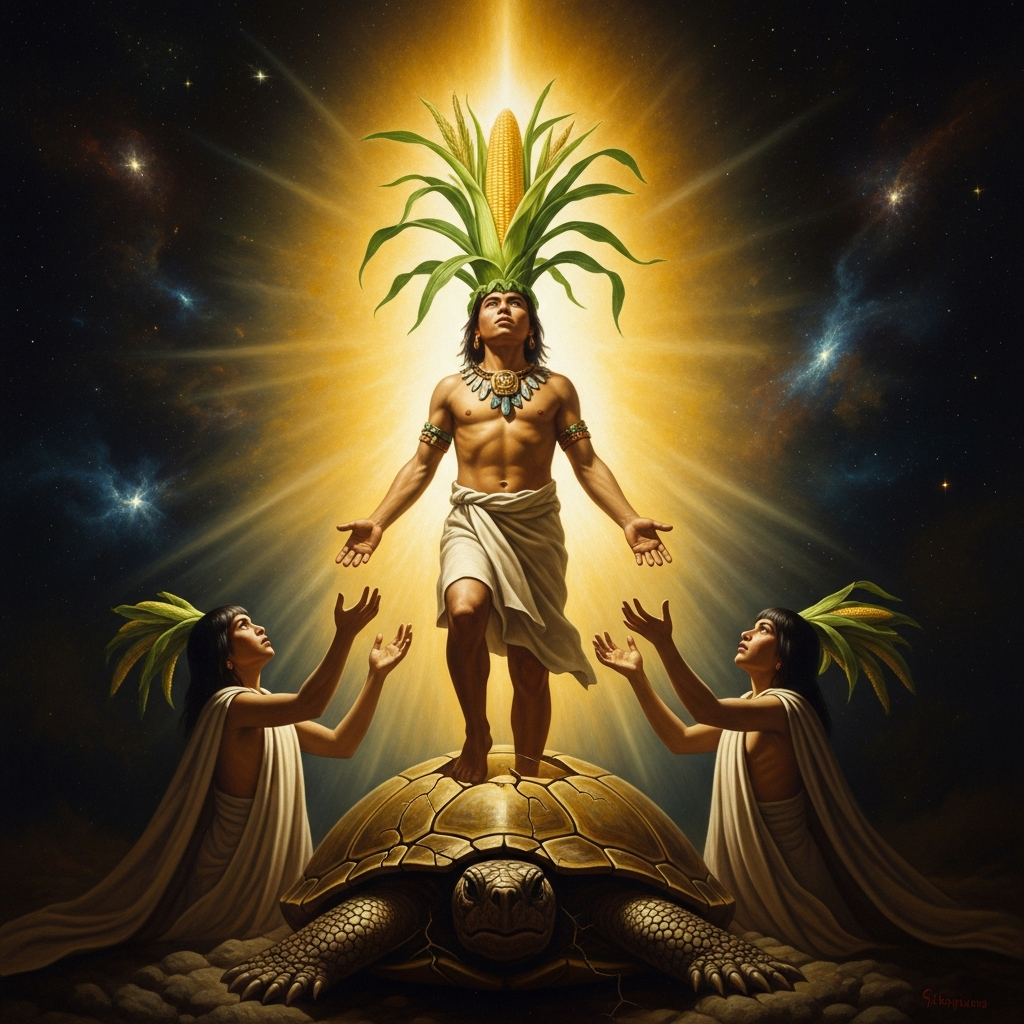
The emergence. Every farmer knows this day. The first green spike of corn pushing through the soil surface is — in Maya theology, stated plainly, without metaphor — the Maize God rising.
The Hero Twins stand on either side with their hoes, loosening the earth, making way. In the paintings they are grinning, which is unusual for divine scenes. It is the expression of people who know how the story ends and are watching the ending happen in real time. They helped create the conditions for this moment — their father’s death was the condition — and now they are here to receive him.
The young corn plant comes up pale and tentative, nothing like the tall-headdressed figure who descended months ago. That is the point. He died old enough to have fathered the twins. He rises young enough to grow again. The resurrection is a rejuvenation. The corn god dies at harvest — full, mature, ready — and rises at planting as a seedling. The cycle does not continue the same life. It restarts it.
This is what the farming year commemorates. Not a historical event. Not a myth that happened once. The planting is the burial, and the burial is Xibalba, and Xibalba is the House of Darkness where the god sits in the dark learning to become green.
The Lord of Palenque, K’inich Janaab’ Pakal, will be buried in a stone sarcophagus in the eighth century CE with an image of the Maize God’s resurrection carved on its lid. The image shows Pakal himself falling backward into the maw of the earth — becoming the corn god in the moment of death, descending to make the same underground journey. The resurrection is already implied. The lid does not show the emergence. It does not need to. Everyone who sees the lid knows what comes next. The shell cracks. The sons stand ready with their hoes.
The Maya farmer who plants corn in May is re-enacting the death of the Maize God. He knows this. His grandfather told him, and his grandfather’s grandfather told his grandfather, in an unbroken line of telling that goes back to before the Classic period, before writing, to the first time someone put seed in the ground and was amazed that anything came up. The amazement is the theology. The theology is the amazement. The green spike is the god rising, and the god rising is the green spike, and in the dark below the surface, in the interval that has no name, something is happening that the surface will not understand until it is already over.
Scenes
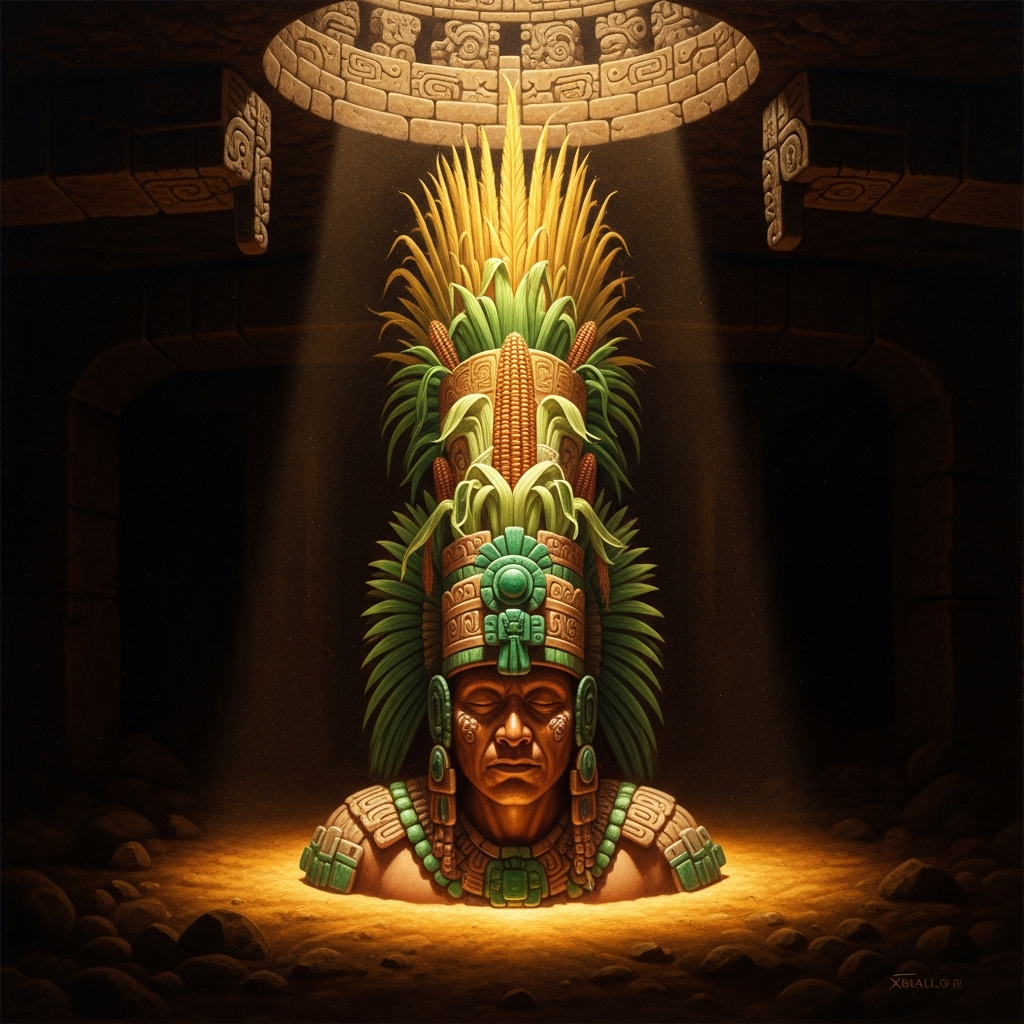
The Maize God descends into the earth below the ball court of Xibalba, his tall headdress of corn silk still intact, entering the dark that is not death but transformation
 Generating art…
 A Classic-period Maya vase painting: the Maize God curled inside the cracked earth, the turtle shell splitting open at the center, two figures leaning in with hoes
 Generating art…
 The Maize God rises from the split turtle shell as a young corn plant, his sons flanking him — the resurrection moment that Maya farmers re-enacted at every planting
 Generating art…
 Echoes Across Traditions
Entities
- One Hunahpu
- Hun Nal Ye
- One Death
- Seven Death
- Hunahpu
- Xbalanque
Sources
- Dennis Tedlock (trans.), *Popol Vuh: The Definitive Edition of the Mayan Book of the Dawn of Life* (1985, rev. 1996)
- Karl Taube, *The Major Gods of Ancient Yucatan* (1992)
- Michael D. Coe, *The Hero Twins: Myth and Image*, in *The Maya Vase Book* vol. 1 (1989)
- Simon Martin, *Ancient Maya Politics: A Political Anthropology of the Classic Period* (2020)
- David Freidel, Linda Schele, and Joy Parker, *Maya Cosmos: Three Thousand Years on the Shaman's Path* (1993)