Tepeu and Gucumatz Speak the World Into Being
Mythic Time · before time · K'iche' Maya oral tradition, written c. 1554–1558 CE · The primordial darkness above the still water, before the earth exists
Contents
In the beginning there is only sky and sea, silence and stillness. The Feathered Serpent and the Heart of Sky meet above the dark water and speak — and what they say becomes what exists. Three failed attempts at humanity follow. The fourth, made from maize, finally remembers its makers.
- When
- Mythic Time · before time · K'iche' Maya oral tradition, written c. 1554–1558 CE
- Where
- The primordial darkness above the still water, before the earth exists
Before the world there is only this: sky, and beneath the sky, the dark water.
No sound. No motion. Nothing rests on the water and nothing rises from it. The sky does not press down on anything because there is nothing beneath it to press against. The water does not move because there is no shore for it to move toward. The Popol Vuh opens in this silence and stays there for a moment — long enough for the reader to feel the specific weight of nothing, the particular darkness that is not the absence of light but the absence of the category of light. There is not yet one person, one animal, bird, fish, crab, tree, rock, hollow, canyon, meadow, or forest. The text is precise about what is missing because precision is the only way to honor the magnitude of what is about to be made.
Then, above the water, two things meet.
Tepeu and Gucumatz come together in the dark.
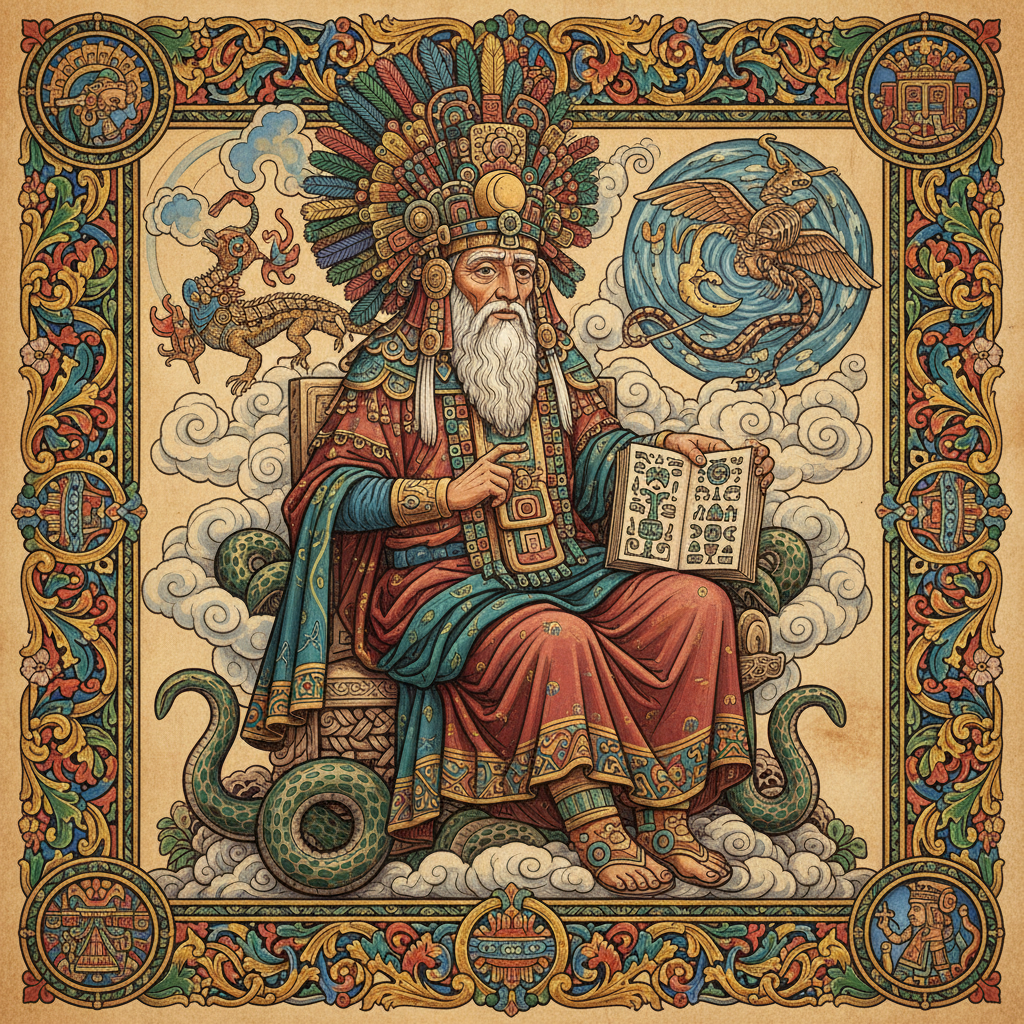
Tepeu is the Heart of Sky — also called Huracan, the one-legged lightning, the first thunder. Gucumatz is the Feathered Serpent, Q’uq’umatz in K’iche’, the great green-feathered snake whose scales flash like light on water, whose motion is the motion of thought moving through a mind. They meet in the darkness above the still surface and they begin to speak. This is the creation: not action but conversation. Not force but the alignment of two minds deciding together what ought to exist. Their words carry. Their consultation carries. The Popol Vuh records it simply: “Let it be so. Let the void be filled.” They speak the earth, and the earth rises from the water like a thought being completed — mountains appearing where before there was only flat sea, valleys cutting between them, the cypress and the pine rising on the slopes before the sentence is finished.
The sky brightens. The animals fill the new earth. The gods listen to them and hear noise, many noises, but nothing that can say a name. Nothing that can speak back.
The first people are made from mud.
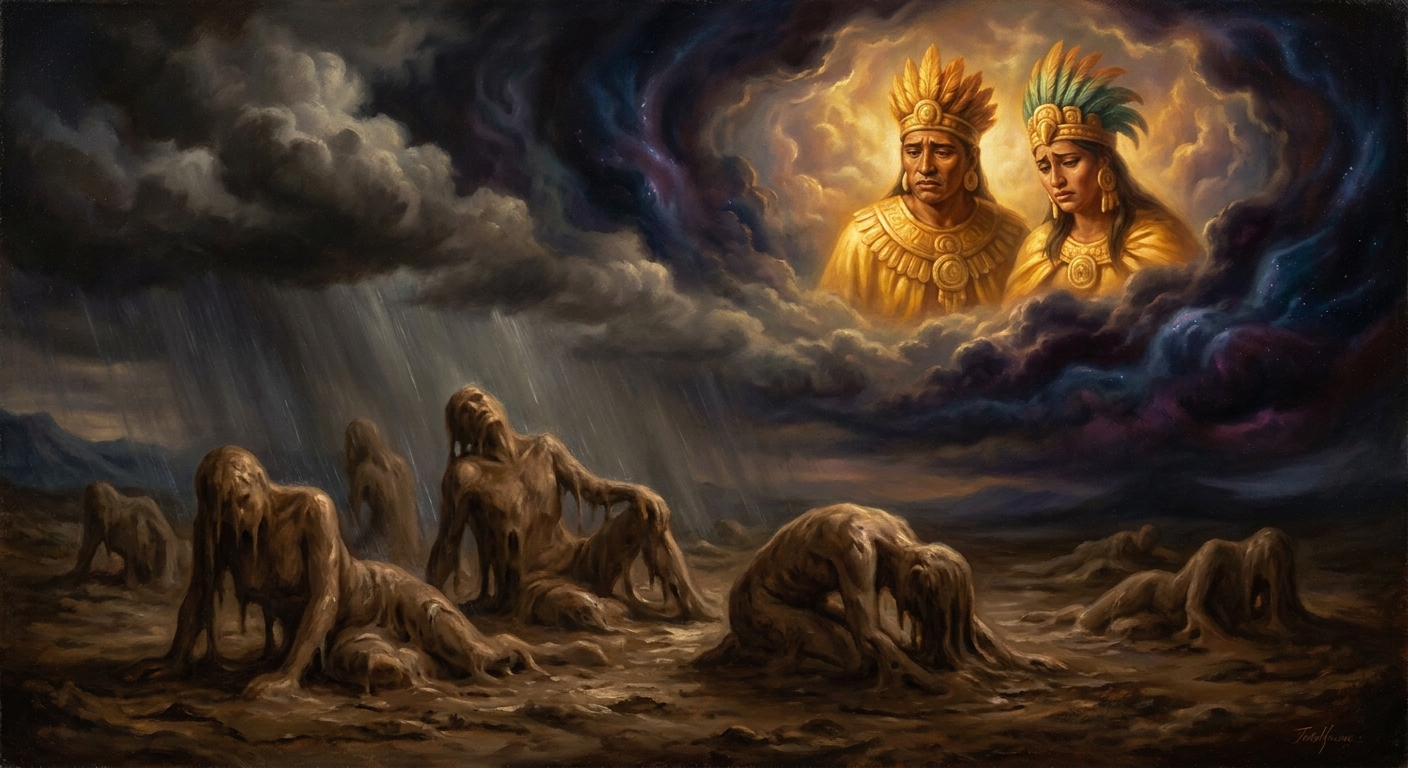
The gods shape them from the wet earth of the new world — figures that hold a form, heads that suggest a face. But the mud is too soft for the weight of consciousness. Their faces cave inward. Their necks cannot hold the head upright. They speak, but the words dissolve like the mud that makes them: each sentence forgotten before it ends, each name evaporating before it can be given. They cannot look at the makers who made them. They cannot turn their faces upward. When the rain comes, they simply soften and run back into the ground, and the gods watch them go and consult again above the water.
The old diviners Xpiacoc and Xmucane — the midwife and the patriarch, the dawn and the day, the two who know the calendar’s secret arithmetic — are called. They cast the days. The verdict: begin again.
The second people are made from wood.
These are better. The wooden people walk and speak and multiply across the earth and fill it with settlements. They have something like faces. They have something like language. But their flesh is without moisture — dry, empty, with no memory of who carved them. They did not remember their Creators, their Makers. The Popol Vuh returns to this indictment three times: they walked, they ate, they reproduced, and they never once looked upward. They never said a name. The gods were invisible to them, which meant the gods, to the wooden people, did not exist. This is the failure — not moral inadequacy but theological blindness. A created being that cannot perceive its maker is a broken instrument.
The Heart of Sky sends a great flood. The dogs and turkeys they ate speak against them. Their pots and griddles and grinding stones rise up and beat them with their own tools. Their dogs bite them. Their houses collapse on them. The survivors flee into the forest and the treetops and become the spider monkeys — the Popol Vuh is clear on this, that the monkeys in the forest are the remnant of the second failed humanity, still walking bent over, still scratching at the bark of trees, still unable to look straight up.
The gods search for the right material.
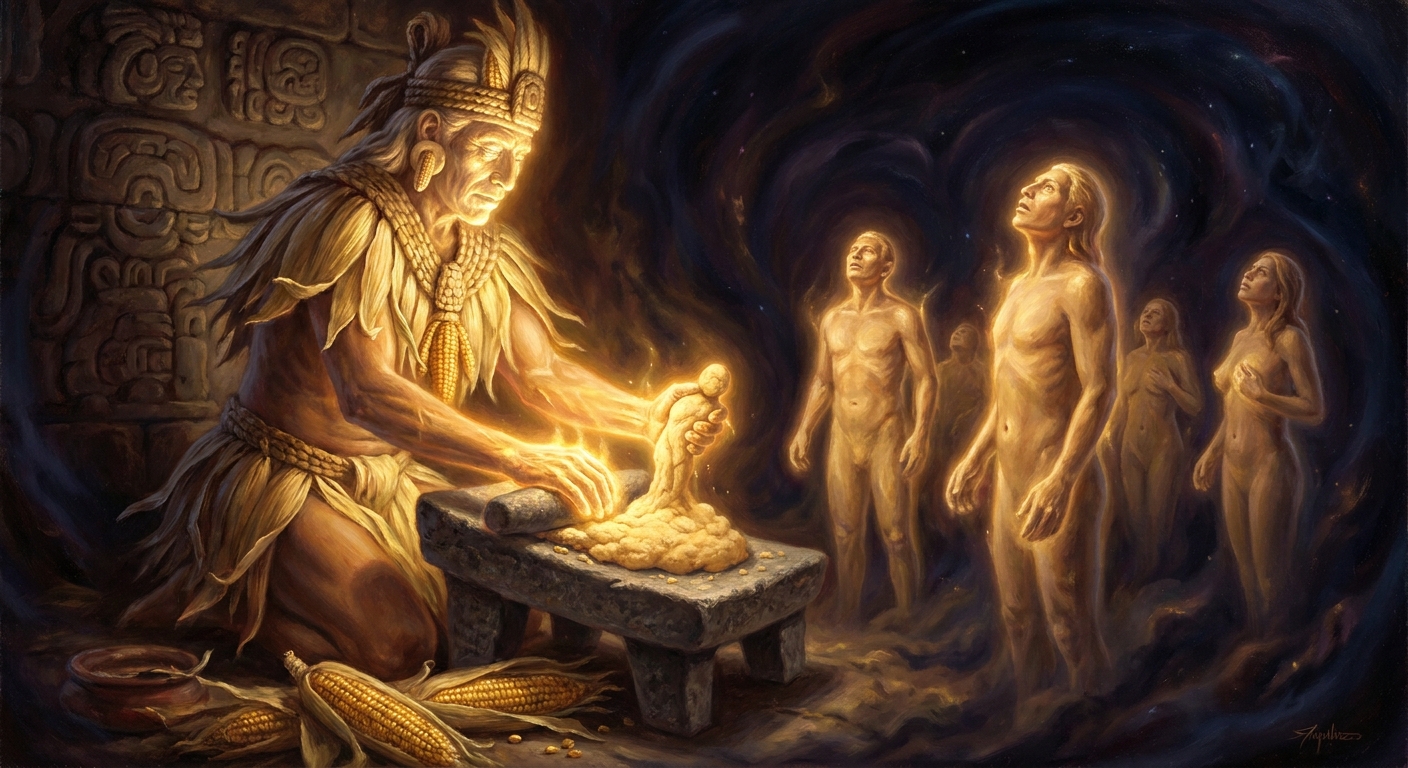
Animals bring maize from the mountain Paxil — the yellow maize and the white maize, the cacao and the pataxte, the sweet things hidden in the folds of the mountain that the fox and coyote and parrot and crow discover by following their noses into the dark. Xmucane grinds the maize nine times. She grinds water into it and shapes the dough and the dough becomes flesh: four men, the first true people, formed from the body of the crop that the people will spend their lives growing and eating and returning to the soil. The circularity is the point. The people are made of maize so that they will understand what it means to plant and harvest and to sustain a world in which the sacred and the edible are the same thing.
The four men open their eyes and see everything. The whole sky, the whole earth, the whole distance to the horizon and past it — they see with perfect clarity, the way gods see, the way no bounded creature should be able to see. The gods look at each other above the new people and feel something adjacent to alarm.
They were too much.
Tepeu and Gucumatz consult again, and what they decide is not cruelty but calibration: these people are as good as the gods themselves, which is not what was intended. What was intended was gratitude, not equality. So the Heart of Sky breathes a cloud across the people’s eyes — not darkness, not blindness, but a gentle mist, the way breath fogs a mirror. The people’s sight shortens. They can see the world near them with precision. They cannot see the whole distance anymore. They look up at the sky and see sky, beautiful and curved, and behind it they sense the makers but cannot see through. This is the human condition in the Popol Vuh: not fallen, not punished, but gently limited, given the capacity for wonder by being denied the capacity for total knowledge.
The four women are made while the men sleep — Xmucane shapes them from the same maize, breathing their names into the dough. The first families wake together in the dark before dawn, burning copal incense, watching the east, waiting for the first light. When the Morning Star rises they weep with gratitude, because they are the first people in the history of creation who can feel gratitude, who know they were made, who remember their makers by name. The gods hear this and the darkness lightens.
The world the Popol Vuh describes is not one where creation was easy or inevitable — it is a world that was almost not made three times, shaped by gods who could fail and revise and fail again, and the people who finally succeeded in being human did so not because they were stronger than wood or harder than mud, but because they were made of something that remembered: the maize, which dies into the earth every season and rises again, which has always known the difference between the soil and the sky.
Scenes
The first people, shaped from mud, dissolve in the rain
 Generating art…
 The wooden people fill the earth — they walk and build and multiply, but their faces are blank and they have no memory of who made them
 Generating art…
 Xmucane grinds the yellow and white maize nine times
Generating art… Echoes Across Traditions
Entities
- Tepeu
- Gucumatz (Q'uq'umatz)
- Huracan (Heart of Sky)
- Xpiacoc
- Xmucane
Sources
- Dennis Tedlock (trans.), *Popol Vuh: The Definitive Edition of the Mayan Book of the Dawn of Life* (1985, rev. 1996)
- Allen J. Christenson (trans.), *Popol Vuh: The Sacred Book of the Maya* (2003)
- Michael D. Coe and Stephen Houston, *The Maya* (9th ed., 2015)
- Munro S. Edmonson (trans.), *The Book of Counsel: The Popol Vuh of the Quiché Maya* (1971)
- David Carrasco, *Religions of Mesoamerica* (2nd ed., 2014)