Tengri and Erlik Divide the World
Before time — the cosmogonic moment before the differentiation of sky and earth · The primordial ocean that preceded the world; and then the first land, which is the whole of the world
Contents
In the beginning there is only water. Tengri orders Erlik to dive to the bottom and bring up the mud of creation. Erlik obeys — and steals a mouthful. What he cannot swallow becomes the mountains. What he cannot control becomes death.
- When
- Before time — the cosmogonic moment before the differentiation of sky and earth
- Where
- The primordial ocean that preceded the world; and then the first land, which is the whole of the world
In the beginning there is only water.
This is not silence — water is never silent. The primordial ocean that precedes the world has its own sound, the deep continuous sound of infinite water moving against itself, a sound so total that it functions as silence because there is nothing else against which it can be measured. Above the water is Tengri, the Eternal Sky. He has always been here. The water has always been here. What has not yet been is everything else.
Erlik is here too.
He is not yet the god of the underworld — that role requires a world, requires an under, requires a surface from which to descend. Right now he is simply the other one, the dark presence that has been coexisting with the sky and the water since before time organized itself around the axis of his future domain. He floats on the surface of the ocean. His expression is attentive. He is waiting for something to do.
Tengri looks down at the water and says: Dive.
Erlik dives.
The descent through the primordial ocean is not like any ordinary dive — there is no light from above that fades as you go deeper, because there was no light from above to begin with. There is only the pressure of the water increasing, and the sense of depth as a quality of attention, the ocean growing more specific as Erlik goes down, more itself, more dense with the potential of everything that has not yet been made.
The bottom, when he reaches it, is mud.
Not ordinary mud — this is the matter before matter, the substrate from which everything that will exist will be drawn. It has a smell that no one will ever smell again once it has been converted into the world, a clean mineral smell like rain-struck stone before stone existed. Erlik scoops it up with both hands, as much as he can carry, and begins the ascent.
He is following Tengri’s instruction. He is also thinking.
What he is thinking is this: he will be the one who brought the material. He descended when asked. He retrieved what was needed from the darkness at the bottom of what was then everything. And when Tengri shapes the world from this mud, the credit will go to the shaper, not the diver. The one who swam through the dark to the bottom will be a footnote.
He is not wrong about this. He knows he is not wrong about this.
The mud is in his hands and his mouth and in the pocket of his cheek. Some of it he will deliver. Some of it he will keep.
Tengri takes the mud from Erlik’s hands.
He spreads it across the surface of the ocean and it becomes land — flat, continuous, even, a surface that extends in all directions without interruption. This is the world as Tengri intends it: sufficient, ordered, fair in its distribution of space. He stands on it and is satisfied with the broad flatness of it.
Then the mud in Erlik’s cheek begins to expand.
It is the nature of the creation material to become what it will be — you cannot hold it inactive in the dark of your mouth without it beginning to do what creation material does. Erlik feels it moving, swelling, pressing against the inside of his face, and he understands immediately that he has miscalculated, that this is not something he can simply retain and use later at his convenience. He tries to swallow. The mud resists. It grows.
Tengri turns and looks at him.
“Spit,” Tengri says.
Erlik spits.
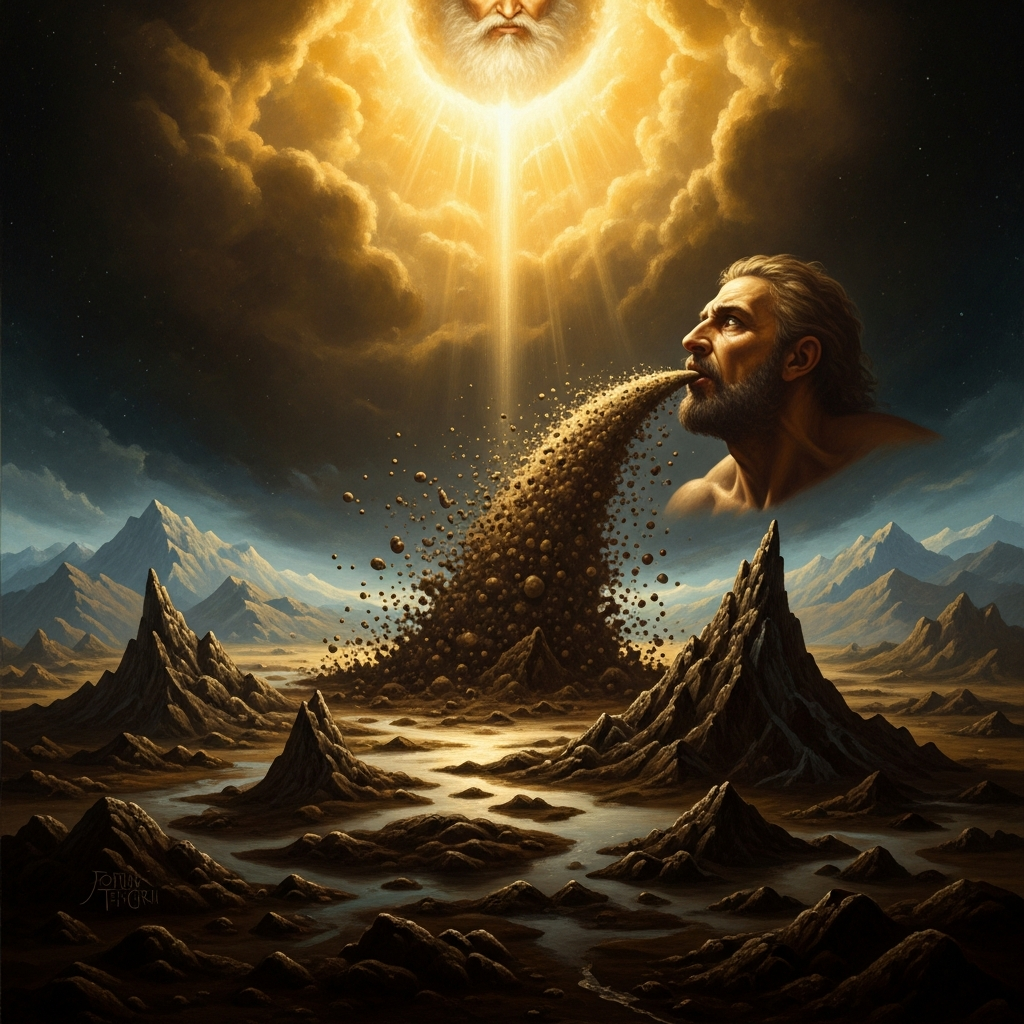
The expelled mud erupts from his mouth and lands across the new flat land and sets immediately — not slowly, not in layers, but all at once, the way a held breath becomes a gasp. Mountains. Swamps. Ravines. The impossible slopes and the waterlogged hollows and the terrain that exists specifically to prevent easy passage. All the parts of the world that refuse to be smooth. Erlik stands there with his hand over his mouth, looking at what just came out of him, and the mountains are enormous and wrong and real, and they will not come down.
“Those are yours,” Tengri says. “The difficult places.”
The creation of humans is Tengri’s work, and Erlik watches.
Tengri shapes the first humans from the new clay — two of them, given the bodies that will become the template for everything that follows. He gives them the internal arrangement that will make thought possible, the structure that will make speech possible. He intends to give them breath and consciousness next, but there is a technical problem: breath and consciousness require a brief absence of Tengri from the scene, a necessary withdrawal into the upper heavens where the fire of life originates. He looks at Erlik.
He says: “Watch them while I’m gone. Don’t touch them.”
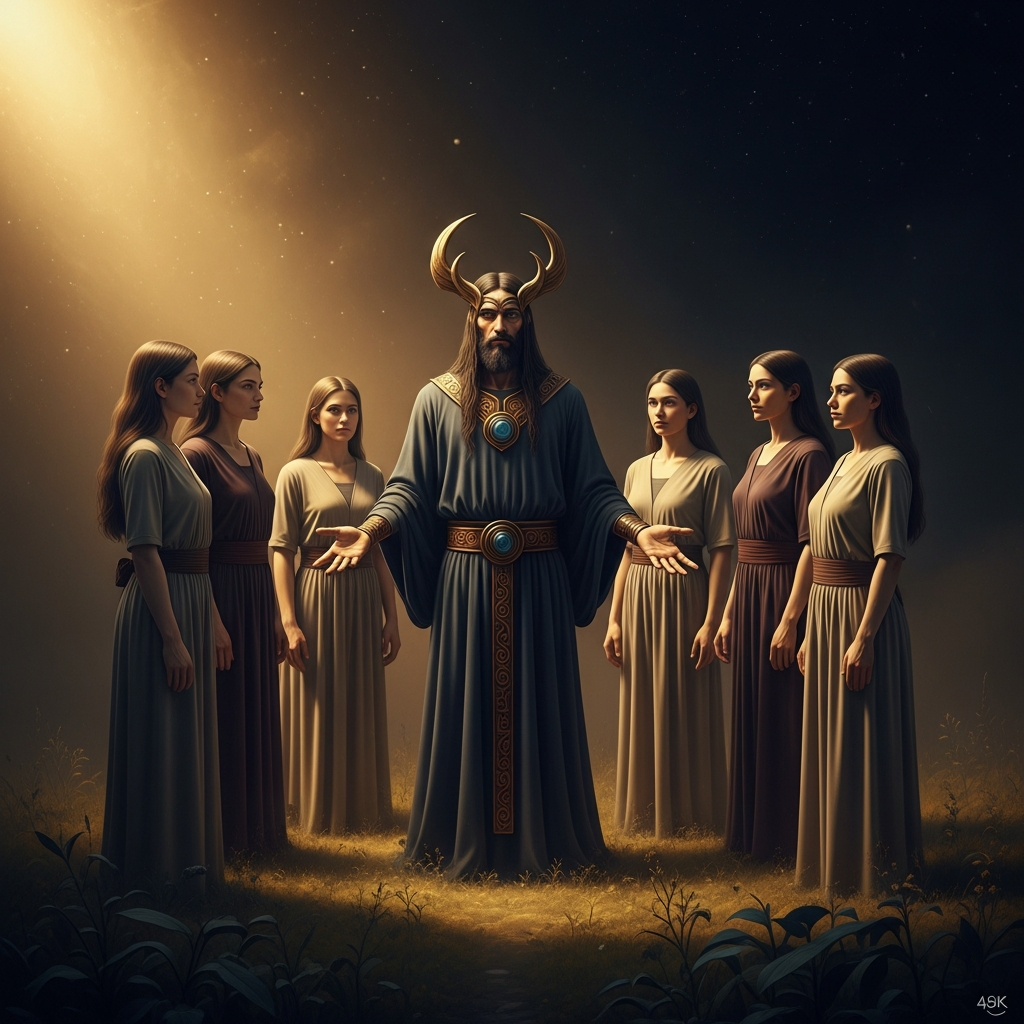
Erlik watches them. He watches them being there, breathing the still air that doesn’t yet carry the fire of life, beautiful and blank and finished except for the final step. He walks around them. He looks at the work. It is, he knows, excellent work — the proportions are right, the architecture is faultless, and the clay has a quality that suggests the effort that went into selecting it.
He is aware that he selected it. He dove for it. He brought it up.
He touches the first human.
He does not know exactly what the touch will do — he is improvising, which is the nature of resentment, it moves before it has a plan. The touch opens something in the clay structure that Tengri did not put there, a small door at the back of the new mind, a room that will be filled when Erlik decides what to fill it with.
He steps back when he hears Tengri returning.
He says nothing about what he touched.
The breath goes in. The humans stand up. They walk.
For some time that cannot be measured in ordinary seasons, they live in the garden that Tengri has made for them on the new flat earth, and the mountains that Erlik accidentally created are distant, and the swamps are distant, and the difficult terrain is elsewhere, and the humans do not go to it because they have not been given a reason to.
Erlik gives them the reason.
He comes to them in the form most likely to produce the conversation he wants — not threatening, not demanding, but curious, interested, holding out something that looks like it might answer the question they didn’t know they had. He tells them that there is something Tengri hasn’t shown them. He tells them about the door in the back of the mind that he opened with his touch. He tells them what is on the other side of it.
This is the teaching of Erlik: that Tengri’s world is not complete. That there is a below as well as an above. That the underworld exists as his domain, as his correction of the flat land’s insufficient depth. That dying is not an ending but a relocation — a passage into Erlik’s realm, which is real, which has its own kings and geography and rules, and which Erlik administers with the seriousness of a ruler who has been given charge of something substantial.
The humans listen. They understand that they are listening to a co-creator.
They understand that the world they are standing on is partly his.
The deal that follows is not written and not spoken aloud.
It is structural. It is built into the nature of how death works in the Tengrist cosmos: Erlik can call the dead to his realm, but he cannot take the living without Tengri’s authorization. And Tengri’s authorization comes at a price — the price of the shaman’s drum-journey. Every time a soul crosses from the living world to Erlik’s domain, there must be a negotiation. The shaman drums, travels down through the roots of the World Tree, enters the nine iron gates of Erlik’s hall, and speaks to the lord of the underworld directly. The shaman can bargain. The shaman can argue. Erlik may refuse. But the negotiation must happen. Tengri requires it, because Erlik’s claim on the matter of creation is not nothing, and even the sky acknowledges the debt owed to the one who dove.
This is why shamans exist.
This is why the drum matters.
This is why the mountains are not flat: because the world is made of what was taken and what was given back, and the distinction has not been resolved since the beginning.
The Mongolian and Turkic creation tradition resists the clean moral architecture of later monotheisms. Erlik is not Satan — he is not the enemy of creation but its accomplice, not the rebel against divine order but its dark necessary partner. The mountains he accidentally made are not punishment. They are the world’s texture, the resistance that makes heroism possible, the difficult terrain that separates the easy life from the achieved one. The death he brought into the world is not a curse. It is the administrative system that Tengri and Erlik agreed on so that the living world would not become so crowded with the accumulated dead that the living could not move through it. Even the shaman’s journey to Erlik’s hall is not a confrontation with evil — it is a business meeting with the other builder. The universe, in this telling, was not made by goodness alone. It was made by the cooperation of everything that exists, including the parts that tried to hide something in their mouths and couldn’t.
Scenes
Erlik descends through the black water of the primordial ocean, his hands trailing dark streamers as he falls toward the bottom where the mud of creation waits
 Generating art…
 The mud Erlik hid in his cheeks expands
 Generating art…
 Erlik circles the new humans as they stand in the garden Tengri shaped for them, still smelling of fresh clay
 Generating art…
 Echoes Across Traditions
Entities
- Tengri
- Erlik
- Etugen
- the first humans
Sources
- Uno Harva, *Die religiösen Vorstellungen der altaischen Völker* (FF Communications, 1938)
- Radloff, Wilhelm, *Aus Sibirien: Lose Blätter aus dem Tagebuche eines reisenden Linguisten* (Leipzig, 1884)
- Antti Aarne and Stith Thompson, *The Types of the Folktale* (FF Communications No. 184, 1961)
- Jean-Paul Roux, *La religion des Turcs et des Mongols* (Payot, 1984)