Temüjin Prays to the Eternal Blue Sky
c. 1177–1178 CE — the years immediately following Börte's abduction by the Merkits · The summit of Burkhan Khaldun, the sacred mountain at the headwaters of the Onon River, in what is now northeastern Mongolia
Contents
Temüjin — not yet Genghis Khan — climbs alone to the summit of Burkhan Khaldun and prostrates himself nine times before Tengri. He has survived slavery and the abduction of his wife. Now he asks the sky whether the mandate belongs to him.
- When
- c. 1177–1178 CE — the years immediately following Börte's abduction by the Merkits
- Where
- The summit of Burkhan Khaldun, the sacred mountain at the headwaters of the Onon River, in what is now northeastern Mongolia
The mountain is already awake when he begins the climb.
Burkhan Khaldun holds the headwaters of the Onon River in a knot of granite and pine that the Borjigin clan has called sacred since before memory. It is the mountain that sheltered Temüjin as a boy when the Tayichi’uts came to kill him. He lay in the dense forest for three days and the hunters did not find him. When he finally came down he prostrated himself and poured a libation, because he understood even then what had happened — not luck, not cleverness, but protection. The mountain chose to keep him.
Now he climbs it alone, before the sun clears the eastern ridge, because what he intends to ask cannot be asked in front of witnesses.
Börte is safe. That is the baseline, the precondition for anything else. He found her among the Merkits in the raid he organized with Toghrul and Jamukha — found her pregnant, and he has decided the child is his, and that decision is also the decision of a man who understands that the future he is building cannot be undermined from within before it has begun. She is safe and the Merkits are broken and there are followers now, real ones, men who chose him rather than men who were born into his ulus. He has done things these past years that would not have seemed possible to the boy who survived in the forest. He has also survived slavery. He carries the mark of the wooden collar in the way he holds his neck.
But something larger is being asked of him, and he needs to know if he has the right to answer it.
The Tengrist theology is precise on this point, and Temüjin has grown up inside it.
Tengri — the Eternal Blue Sky — is not an abstraction. It is not a metaphor for fate or the indifferent cosmos. It is a presence, vast and specific and attentive, and it has an interest in human affairs that it expresses through the granting of köke möngke — the blue eternal power, the mandate that descends on a specific individual and authorizes him to act as Tengri’s representative on earth. This mandate is real. It can be felt. It announces itself in victories that should not have been victories, in escapes that should not have been possible, in the particular quality of a man’s luck when the sky has decided to back him.
But the mandate can also be withdrawn. This is the part that matters.
The current representative — whoever holds the mandate over the steppe at this moment — holds it until Tengri decides otherwise. Which means that for Temüjin to receive the mandate, someone else must lose it. Which means that for him to pray for it openly is to pray for a realignment of cosmic authority. This is not a modest prayer.
He reaches the summit as the light comes.
He faces east.
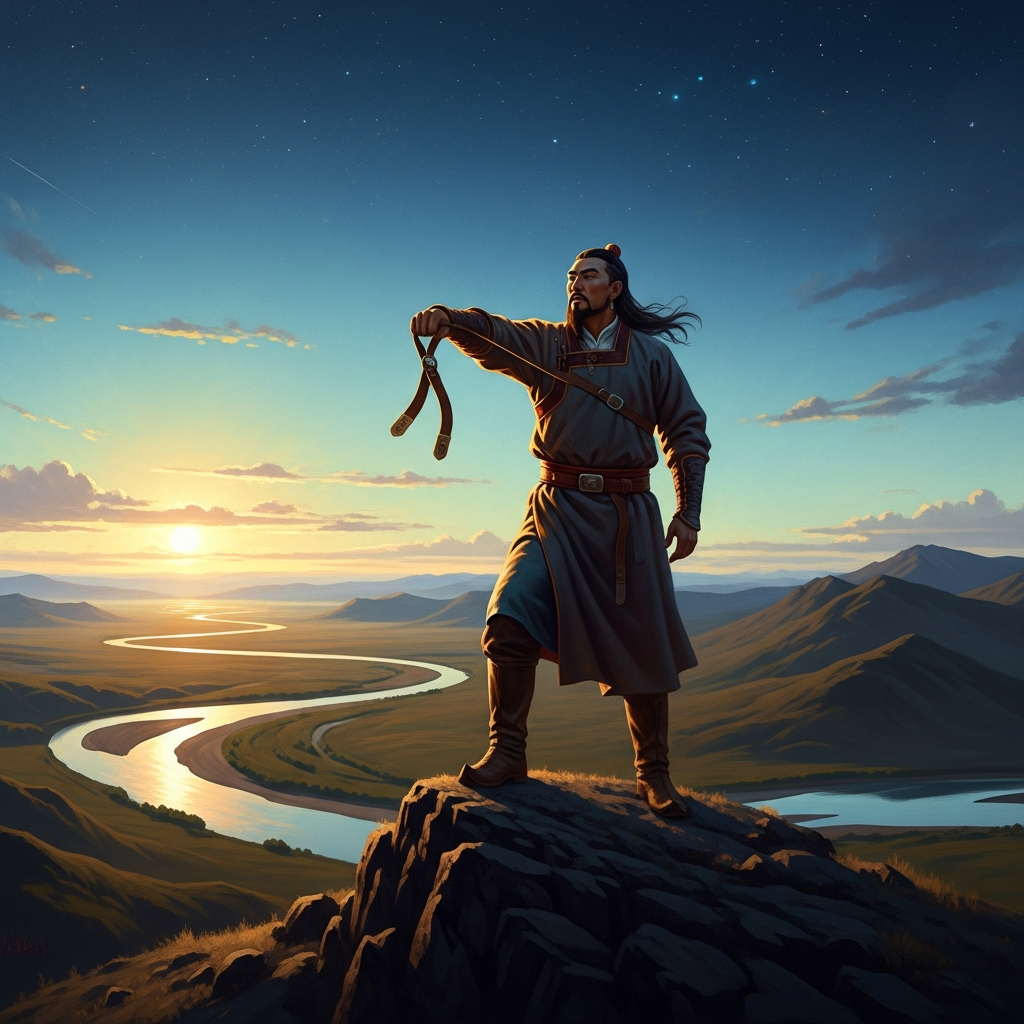
This is the prescribed orientation — east, toward the rising sun, toward the source of light and warmth and the direction from which the divine power descends. He removes his hat and hangs it on his neck. He throws his belt over his shoulder — both gestures of ritual humility, the submission of a man who approaches with nothing, no status, no armor, only himself. He holds the bowl of airag in both hands.
The summit is cold. Wind moves across the granite without interrupting the silence underneath it.
He dips his finger into the airag and sprinkles it into the air — once toward the sky, once toward the earth — and then he goes down.
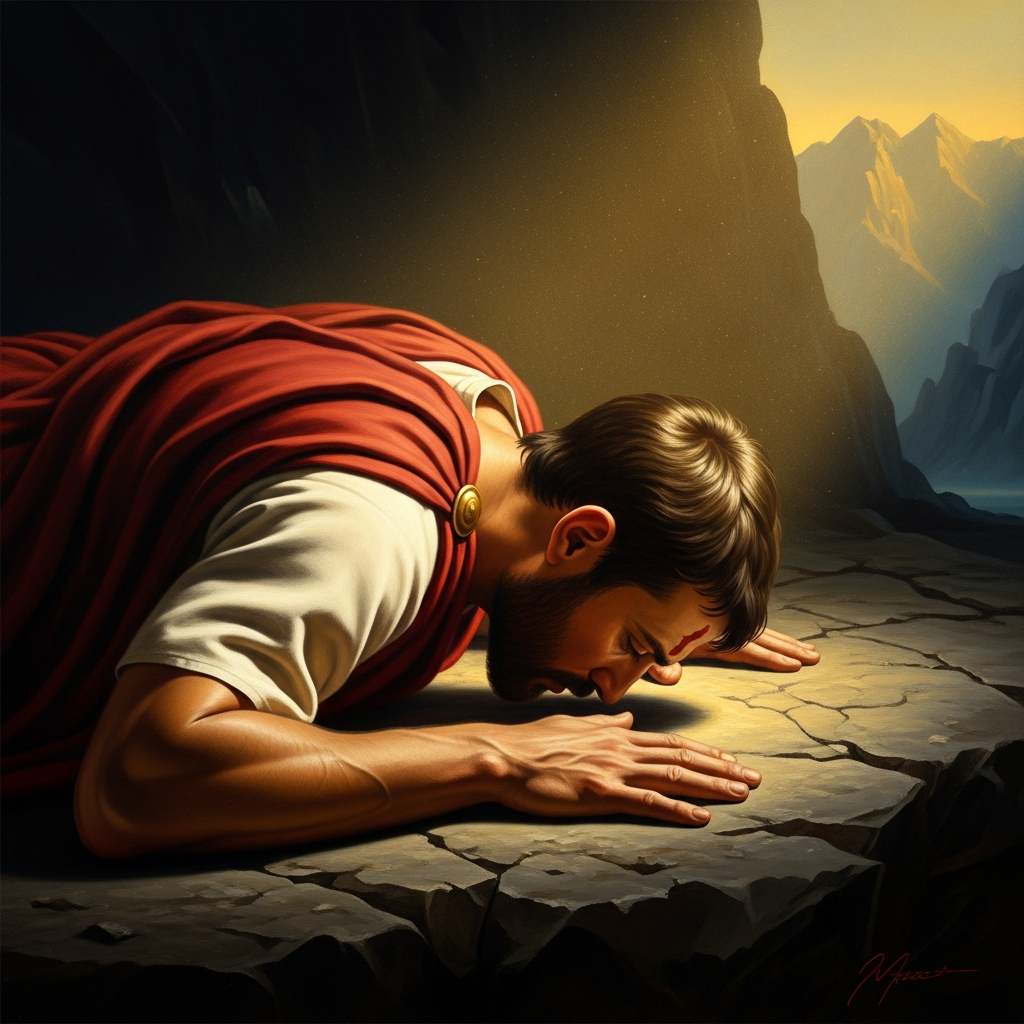
Face to the stone. Forehead touching the cold ground. Arms spread, hands flat, the entire length of him prone before the sky. He holds the position and speaks the words inside it, not aloud but through his whole body, the prostration itself being the primary language of this prayer. Then he rises.
And goes down again.
And rises.
He does this nine times. Nine is the sacred number — nine times nine is the highest offering, but nine alone is sufficient for a prayer this large. His forehead marks the stone. His knees find their position on the rock without his choosing it, because he has done this before on smaller occasions, at smaller altitudes, asking for smaller things. This time his knees find the rock and his body knows how much weight this prayer carries.
The ninth prostration is the longest.
He stays down in it. The cold comes through his deel at the knees and the chest. He feels the mountain under his palms, the earth under the mountain, the root system of the world running down through the stone into whatever is below stone. Etugen — the Earth Mother — is here too. This prayer is to the pair of them, the sky and the ground that answers it, the blue above and the dark below, the two parents of everything.
He says: I have survived. I want to know if the survival means something.
He says: If this is your will, make it clear to me. If it is not, let me know that too and I will stop.
He says: I am not asking to be comfortable. I am asking to be used.
He rises from the ninth prostration.
He dips his finger into the airag and sprinkles it nine times into the air, east and then in a circle, the liquid catching the early light before it falls. He pours the last of it onto the mountain stone. He stands with his hat off and his belt over his shoulder and the wind moving through his hair, and he waits.
The sky does not speak in words. This is understood. Tengri’s communication is structural — it operates through the pattern of events that follow a prayer rather than through a voice that answers it. What Temüjin is doing by standing here is opening the channel, declaring his intention, placing his request formally into the record of whatever record the sky keeps. The answer will come through what happens next.
He has enough theology to know this. He has enough experience to believe it.
He thinks of the collar. The years when a man who would later claim mandate from heaven was led around on a rope by the Tayichi’uts, sleeping in the open, doing labor that oxen could do. The theology holds that this was not an accident. The theology holds that the period of humiliation was preparation — that Tengri does not give the mandate to men who have not been refined by suffering, because unrefined men break under the weight of what the mandate requires.
He is still alive. That is the primary evidence.
He stays on the summit until the sun has fully risen and the valley below is bright.
From up here he can see the Onon curving through the steppe, the birch forests on the lower slopes, the smoke of his camp rising from the plain. He can see how small a camp it is. He can see how much steppe there is in every direction, and how many other camps are out there, and how many men who also believe themselves to have been chosen.
The difference — and he knows this, and it is the prayer’s foundation — is that most of them have not climbed the sacred mountain and asked openly. Most of them operate by assumption: they are who they are, and the sky confirms it by not interrupting them. Temüjin has done something different. He has made the request specific, formal, and audible. He has made it a matter of record. He has put himself on the line in a way that the sky can answer by making his future easier or harder, and he will read the answer in the difficulty.
He puts his hat back on. He settles his belt. He begins the descent.
The Secret History records what he said when he came down from Burkhan Khaldun: that he had made offerings to the mountain with the shirt off his back and with his horse given as a gift. That he had prayed with his heart and held nothing back. That he owed the mountain a debt for protecting him, and he intended to pay it.
He does not record what the sky answered.
He doesn’t need to. The answer became the next forty years.
What the Tengrist tradition understands — and what the later biography of Genghis Khan makes difficult to see because of the scale of what followed — is that the prayer on Burkhan Khaldun is not a prayer for power. It is a prayer for permission. The distinction matters enormously. A prayer for power assumes the ability to wield it exists in the man and needs only to be magnified. A prayer for permission assumes that the authority comes from outside the man entirely, that it is a loan rather than a possession, and that the one who loans it can recall it at any moment. Temüjin prays as a man who knows he is not the source. He is only the candidate. The sky chooses — or does not. He has stated his case as clearly as he knows how. The mountain witnessed it. Etugen felt his weight against her. Now he waits, as everyone who has ever genuinely prayed for anything has always had to wait, for the answer to arrive through the texture of what happens next.
Scenes
Temüjin stands alone on the summit of Burkhan Khaldun, his belt thrown over his shoulder, facing the east
 Generating art…
 He prostrates himself to the east, face pressed to the cold ground, hands spread flat
 Generating art…
 He dips his finger nine times into the bowl of airag and sprinkles the fermented mare's milk into the air as offering
 Generating art…
 Echoes Across Traditions
Entities
- Tengri
- Etugen
- Temüjin
- Börte
Sources
- Anonymous, *The Secret History of the Mongols* (c. 1240, trans. Igor de Rachewiltz, Brill, 2004)
- Paul Ratchnevsky, *Genghis Khan: His Life and Legacy* (Blackwell, 1991)
- Timothy May, *The Mongol Empire: A Historical Encyclopedia* (ABC-CLIO, 2017)
- Urgunge Onon, trans., *The Secret History of the Mongols: The Life and Times of Chinggis Khan* (Routledge, 2001)