The Shaman Recovers the Child's Soul
Buryat Mongolian tradition, Lake Baikal region — oral and ritual tradition documented from the 17th century onward · A Buryat Mongolian ger near Lake Baikal; and simultaneously Erlik's subterranean realm, nine levels below
Contents
A Buryat Mongolian child has been sick too long. The family summons the shaman at dusk. He drums himself into the spirit world, descends to Erlik's hall, and negotiates with the demon who has taken what does not belong to it.
- When
- Buryat Mongolian tradition, Lake Baikal region — oral and ritual tradition documented from the 17th century onward
- Where
- A Buryat Mongolian ger near Lake Baikal; and simultaneously Erlik's subterranean realm, nine levels below
The child has been sick for eleven days.
The family has done everything in the ordinary order: the mother’s remedies first, then the older woman down the valley who knows the plant medicine, then the prayers to the domestic ongons, the spirits of the ancestors who live in the felt bundles hanging from the ger’s honored wall. None of it has worked. The child lies on the sleeping platform with the particular remoteness of someone who is present in the body but not fully in the world — the eyes open and looking at something that is not in the room, the responses delayed, the hunger absent. Eleven days of this.
The grandmother calls it by name, finally, because someone has to.
“Something has her,” she says.
The father goes for the shaman.
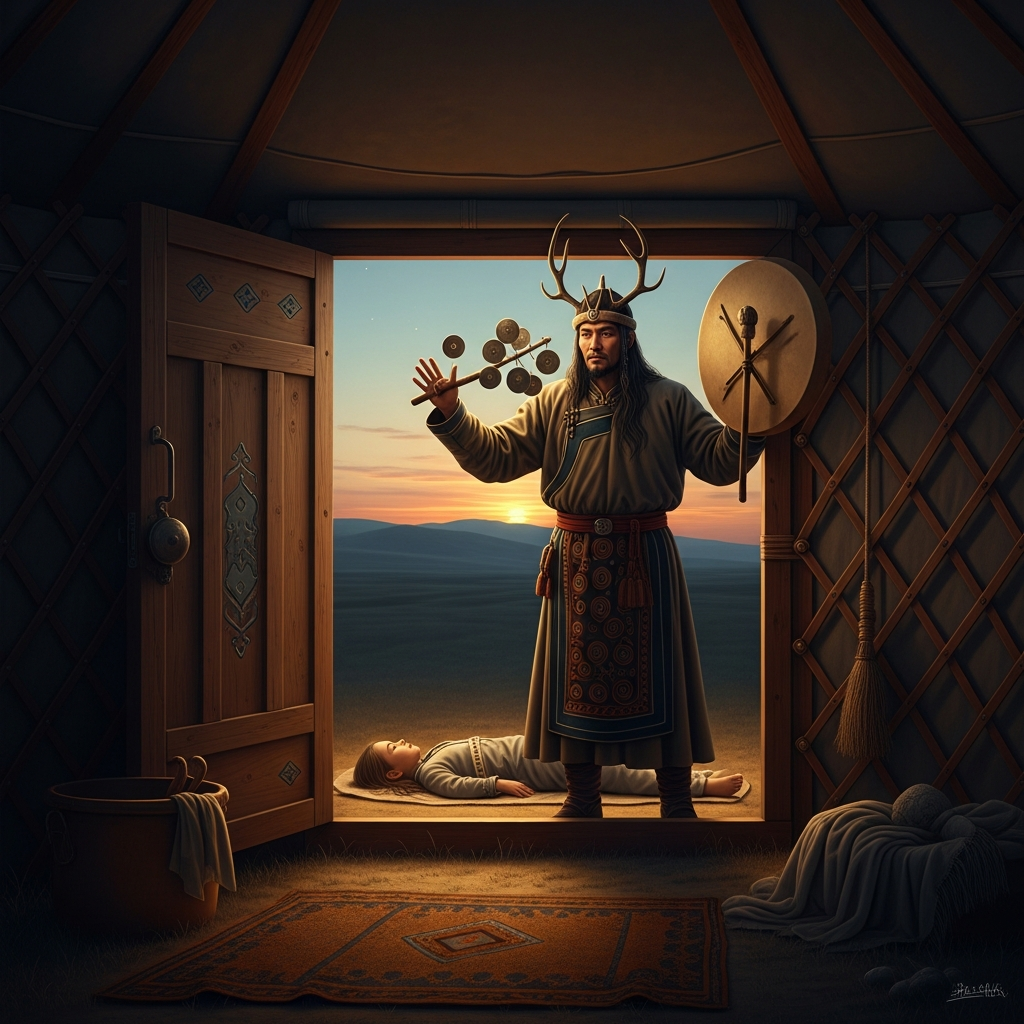
He arrives at dusk, when the light is going amber across the steppe and the first stars are visible at the zenith. He is not a young man, and the iron crown of antlers on his head — the branching iron that represents the World Tree, that marks him as the person in this community who can travel between the levels of the universe — bobs as he walks with the slight forward lean of a man who has carried heavy things for a long time.
He does not ask what is wrong with the child. He can see it.
He stands in the doorway of the ger for a moment, drum held in both hands, and looks at the child on the sleeping platform, and his eyes do the thing they do when he is reading the space rather than the surface of things — a slight unfocusing, a turn inward, like a man listening for a sound just below the threshold of ordinary hearing.
“Three days,” he says.
The family does not understand. He means the soul-fragment has been held for three days already, wherever it has been taken. The longer it is held the harder the recovery becomes. Three days is not too long. But they should not have waited this long to call him.
He steps inside.
He puts on the dalia over his traveling clothes.
The dalia is not ceremonial decoration — it is working equipment. The iron discs sewn across the chest and back represent the bones that his initiation added to his spirit-body, the shamanic bones that let him move between worlds without dissolving. The mirror discs on the back reflect the harmful spirits he passes through on the journey, deflecting what cannot be negotiated past. The fringes on the sleeves are the bird-feathers of his spirit-flight. All of it together is a body-suit for the spirit world, assembled over years of practice and adjusted for every journey.
He settles the iron antler crown on his head and takes the drum.
The drum is the oldest thing in the ger, older than the ger itself, older than the shaman’s own tenure in this body. The frame is birch — the tree of the nine heavens, the tree whose white bark carries the light of the upper world down into the middle. The drumhead is a stretched hide inscribed with figures that the shaman painted himself during his first years of practice: the World Tree at center, the nine heavens stacked above it, Erlik’s nine-gated hall below, and along the rim the names of his ongons in a script that is not quite any written language but that the spirits can read.
He begins to beat.
The rhythm is specific to this journey.
There is a rhythm for the upper world ascent and a rhythm for the lower world descent, and tonight he uses the descent rhythm, the beat that sounds like a stone falling through still water — deliberate, measured, getting slower as it goes deeper. The family sits along the walls of the ger in the positions the shaman has assigned them: the grandmother at the north, the parents flanking the child’s sleeping platform, the older siblings near the door. No one may leave the ger while the journey is in progress.
The ger’s smoke-hole is open above the fire. This matters.
The World Tree stands precisely there — in the smoke-hole, in the column of rising heat and smoke, the axis that connects all levels of the universe. To go up, the shaman’s spirit rises through the smoke-hole and enters the trunk of the tree and climbs. To go down, the spirit passes through the fire itself, which is not destructive because the shaman’s spirit-body is constructed for exactly this transit, and descends through the roots.
Tonight he goes down.
He beats the drum and sings the journey song — not words exactly, or not only words, but the vibrational pattern that the ongon recognizes as the summons, the sound that tells the helping spirit: I am coming, I need you, meet me at the gate. The fire in the center of the ger pops and settles. The child’s eyes track something across the ceiling.
The shaman’s body keeps beating the drum.
The shaman himself goes down through the fire.
The nine trees of the nine heavens mirror downward into the nine levels of Erlik’s realm.
The upper world is organized by light — each heaven brighter, more refined, more difficult to reach without the right kind of spiritual constitution. Erlik’s realm is organized by depth: each level darker and more governed, more administrative, more insistent on its own rules. The shaman passes through levels populated by the dead who are waiting for reincarnation, by the minor functionaries of the underworld bureaucracy, by the demons who hold specific domains and who will not let anyone through without checking credentials.
His ongon is with him — the ancestor shaman from three generations back, whose presence he feels as a warmth at his left shoulder, a steering pressure when the passage branches. Without the ongon he could not find his way. The underworld is not a physical space with reliable geography; it is a space organized around the intention of its ruler, and Erlik arranges it to make unauthorized access difficult.
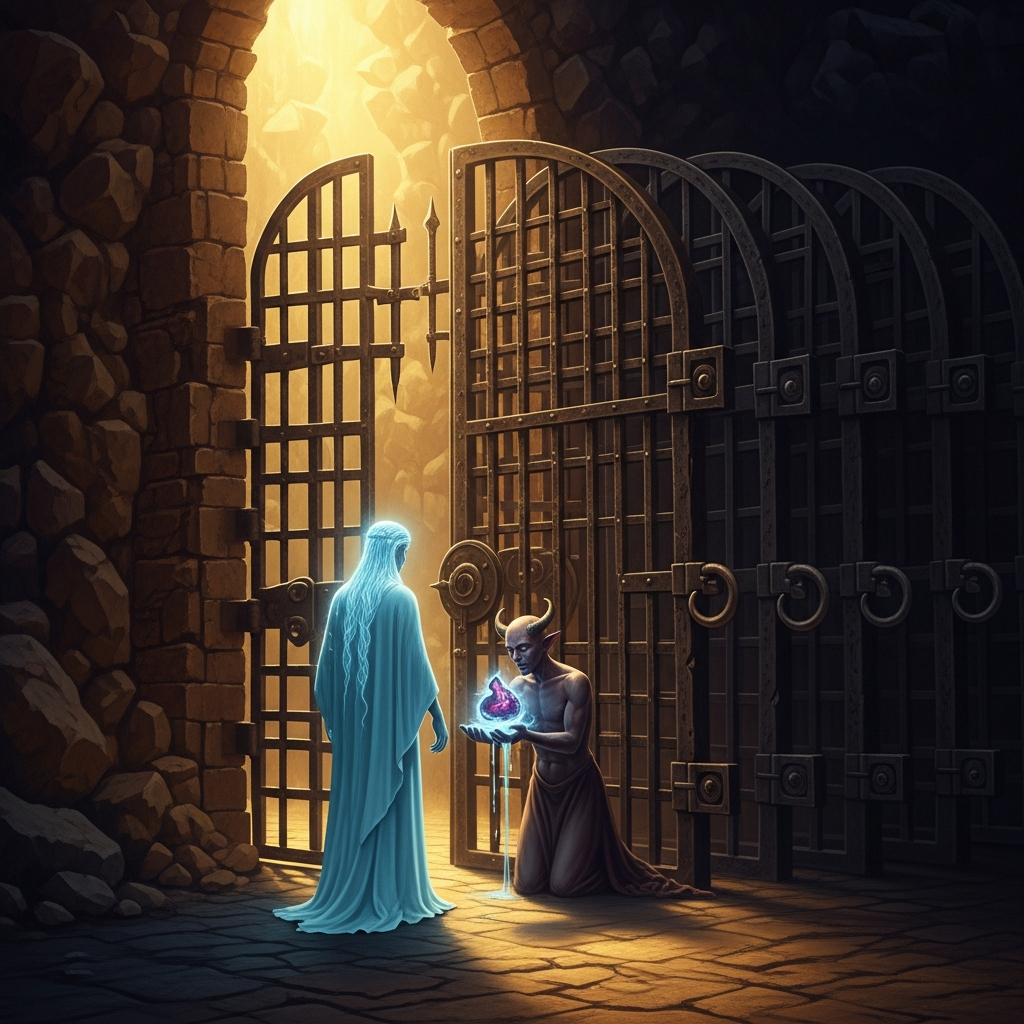
At the ninth gate — iron, black, so cold that the air around it smokes — the minor demon is waiting.
It is not large. This is always the surprise: the demons that hold stolen soul-fragments are not the great powers of the underworld, not the ancient entities with authority and mass. They are small functionaries, the underworld equivalent of a clerk who has appropriated something from the inventory. This one is holding the child’s soul-fragment cupped between its hands, and the soul-fragment is glowing faintly, a small coal of life that has not gone out despite eleven days in the cold of Erlik’s realm.
The shaman addresses the demon formally. There is a protocol.
The negotiation is not violent, though violence is available as a last resort.
The shaman states his standing: he is a legitimate intermediary, traveling under the authorization of Tengri, accompanied by an ongon who can verify his credentials. He states the terms of the return: the family has brought offerings — vodka, butter, the silk scarf that the mother has been holding since before the ceremony began. He states the case: this soul-fragment was taken improperly, the child’s soul was not forfeit, the illness does not represent a legitimate claim by Erlik’s realm on this particular life.
The demon argues. The demon always argues. Its claim is that the soul-fragment came to it — wandered into Erlik’s territory during a moment of vulnerability, a fever-dream in which the child’s soul traveled further than it should have and got lost, and in Erlik’s realm, lost things are the property of whoever finds them.
The shaman counters: the soul-fragment is a child, not property. Erlik’s own rules on the matter of children’s souls are specific, and the shaman knows them, and the demon knows that the shaman knows them.
The demon looks at the glowing fragment in its hands. It looks at the shaman. It calculates.
It hands the fragment over.
The ascent is faster than the descent.
The shaman carries the soul-fragment carefully, the way you carry a small flame in wind, and his ongon clears the path ahead of him, and the nine gates open in reverse order, and the nine levels rise past him, and he surfaces through the fire and back into his body in the ger with a sound that is not quite a gasp but is the body’s recognition of its inhabitant returning.
He opens his eyes.
The child, on the sleeping platform, opens hers.
She looks around the ger with the expression of someone who has been somewhere and has returned and is deciding whether the familiar room is as she left it. She looks at her mother. She says, in the voice of someone who has been absent for eleven days and is only now entirely back: “I’m hungry.”
The grandmother makes a sound. The mother presses her face into her hands.
The shaman removes the iron crown and sits down heavily on the low stool near the door.
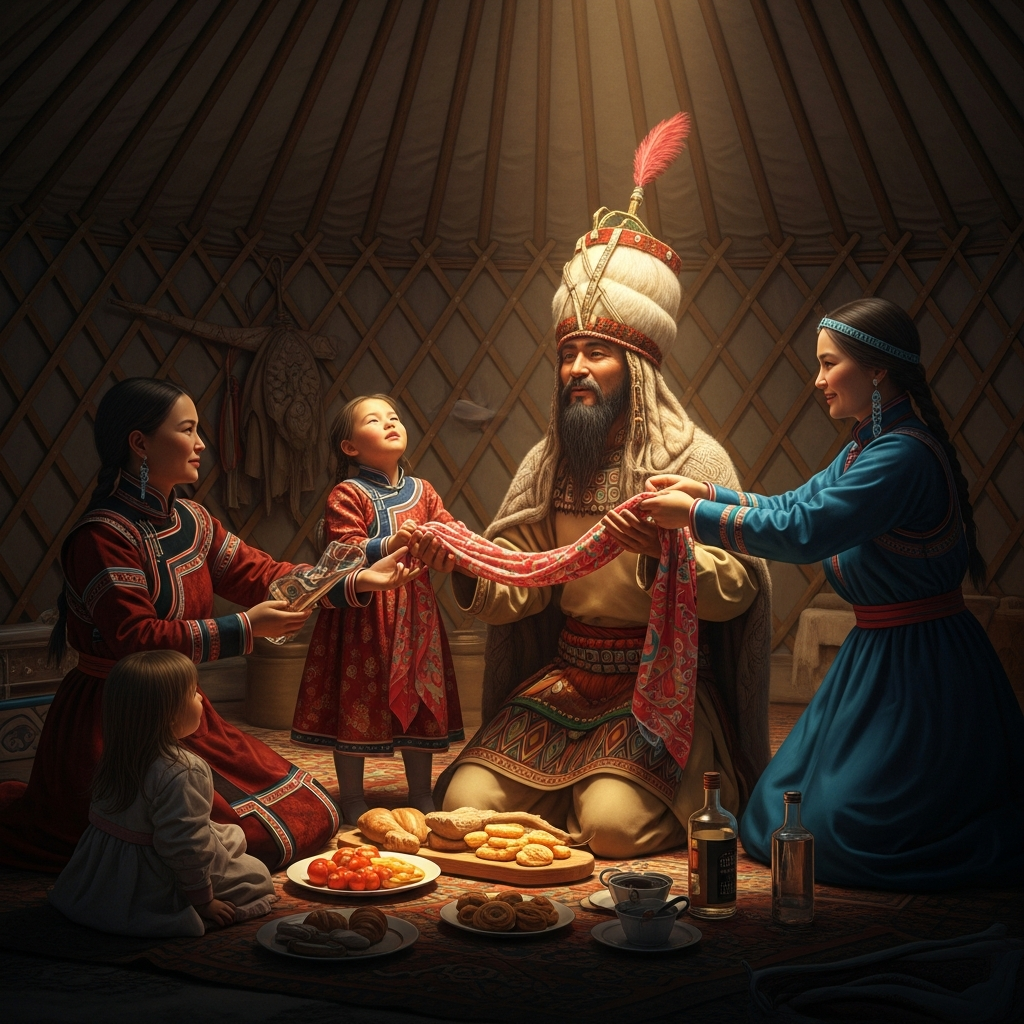
The family moves around him — vodka poured, butter pressed onto the waiting plate, the silk scarf laid across his hands. The payment is not payment in the commercial sense. It is acknowledgment: the recognition that the shaman has spent something real on this journey, has used his spirit-body in the service of the community’s need, and that the community owes a debt that cannot be fully settled but must be formally acknowledged in each transaction.
He drinks the vodka slowly. He wraps the silk scarf around his wrists.
He will feel the descent for days afterward — the cold of Erlik’s realm stays in the bones for a while, a deep chill that is not temperature but memory, the body’s record of where it has been. He has learned to live with it. He has learned that the cost is not extractable from the work, and the work is the thing he was remade for during the illness that preceded his initiation.
He looks at the child eating, and the satisfaction he feels is not personal. It is structural. The world has been reordered slightly toward the shape it should be. The soul-fragment is where it belongs. The demon has returned what was not its property. The gates of Erlik’s hall have closed.
For now.
The Buryat shamanic system does not locate the source of illness in the patient. The child did nothing wrong. The soul-fragment did not wander into Erlik’s realm because the child was bad or the family was impious. It wandered because children’s souls are sometimes imperfectly anchored, because the spirit world and the living world occupy the same space at different depths, and because minor demons have the same acquisitive instincts as any functionary who has discovered that the rules favor possession. The theology is almost bureaucratic in its logic: there is a correct jurisdiction for every soul, and incorrect jurisdictions can be challenged by someone with the appropriate credentials. The shaman is that person. The drum is the passport. The ongon is the lawyer. And Erlik, for all his authority over the dead, is bound by the rules of a cosmos that he helped create and cannot entirely unmake.
Scenes
The shaman stands in the ger doorway at dusk, the iron antler crown on his head, the drum held out before him like a shield
 Generating art…
 The nine iron gates of Erlik's underground hall, each one heavier and darker than the last
 Generating art…
 The child opens her eyes in the ger and asks for food
 Generating art…
 Echoes Across Traditions
Entities
- the böö
- Erlik
- the ongon
- the Nine Trees
Sources
- Roberte Hamayon, *La chasse à l'âme: Esquisse d'une théorie du chamanisme sibérien* (Société d'ethnologie, 1990)
- Caroline Humphrey, *Shamans and Elders: Experience, Knowledge, and Power among the Daur Mongols* (Oxford University Press, 1996)
- Mihaly Hoppal, *Shamans and Traditions* (Akadémiai Kiadó, Budapest, 2007)
- Urgunge Onon, *My Childhood in Mongolia* (Oxford University Press, 1972)