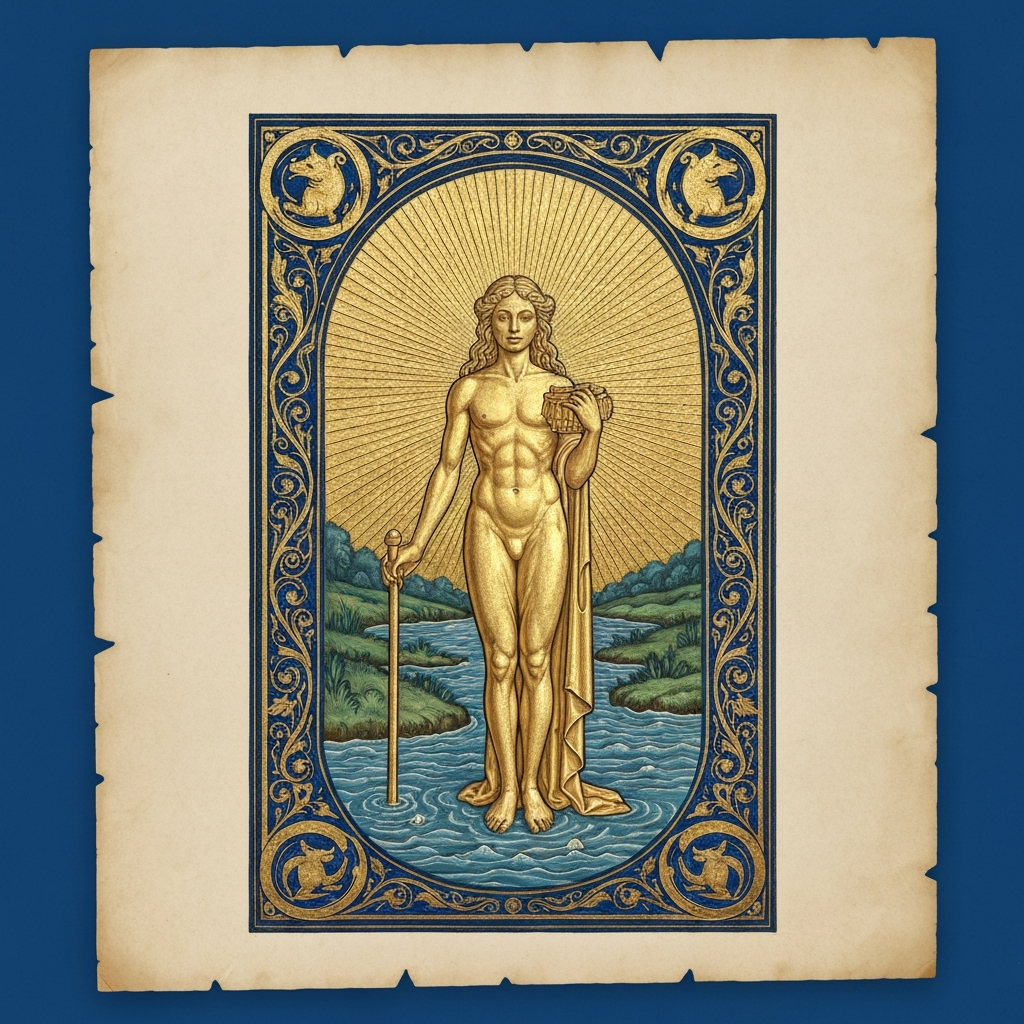
Yemoja and the Middle Passage
~1500–1800 CE · the Atlantic slave trade · The Niger Delta — the Atlantic Ocean — Cuba, Brazil, Haiti, Louisiana
Contents
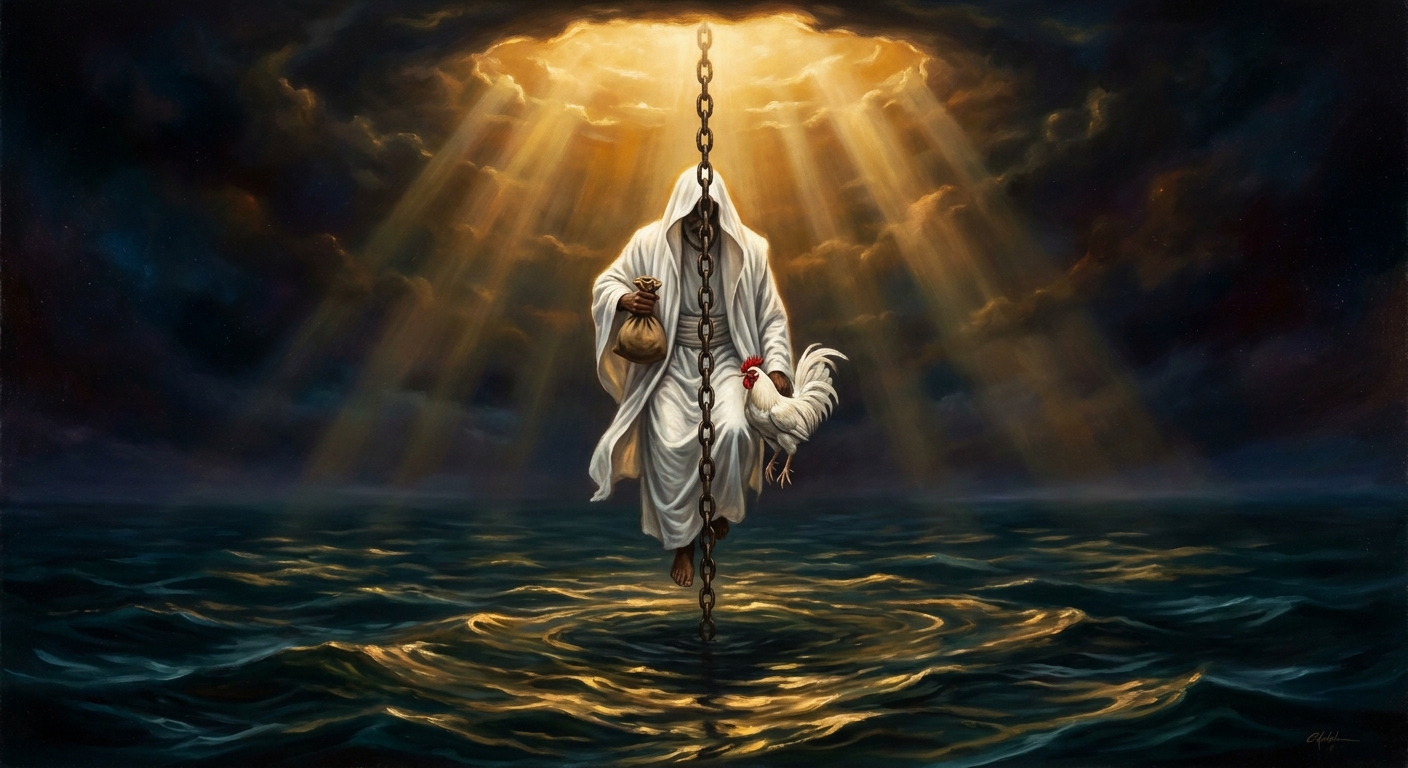
Yemoja, mother of all Orishas and guardian of the ocean, watches the first slave ship load its human cargo at the Niger Delta. She must choose whether to follow the chained women across the water — and in crossing with them, she arrives in a new world.
- When
- ~1500–1800 CE · the Atlantic slave trade
- Where
- The Niger Delta — the Atlantic Ocean — Cuba, Brazil, Haiti, Louisiana
She is older than the ships.
She has been the ocean since before there were boats to cross it, since before there were people standing on the shore looking out at it and wondering what was on the other side. She is the salt water that fills and fills and fills without asking to be filled, the mother of all rivers because all rivers eventually return to her, the source of Oshun because Oshun is the sweet water that comes from her and will return to her. She is Yemọja — the name means mother whose children are like fish, which is to say innumerable, which is to say she does not count her children because counting implies a finite number and she has never had a finite number.
She knows every coast of the continent. She knows the Niger Delta the way she knows all deltas — as the place where the river makes its last effort before surrendering to her, where the fresh water and the salt water argue briefly and the salt always wins, and the silt settles, and the birds come to work the shallows, and the mangroves reach their roots into both worlds simultaneously, which is a thing only mangroves and gods can do with any ease.
She is watching when the first ship anchors.
She watches it for a long time.
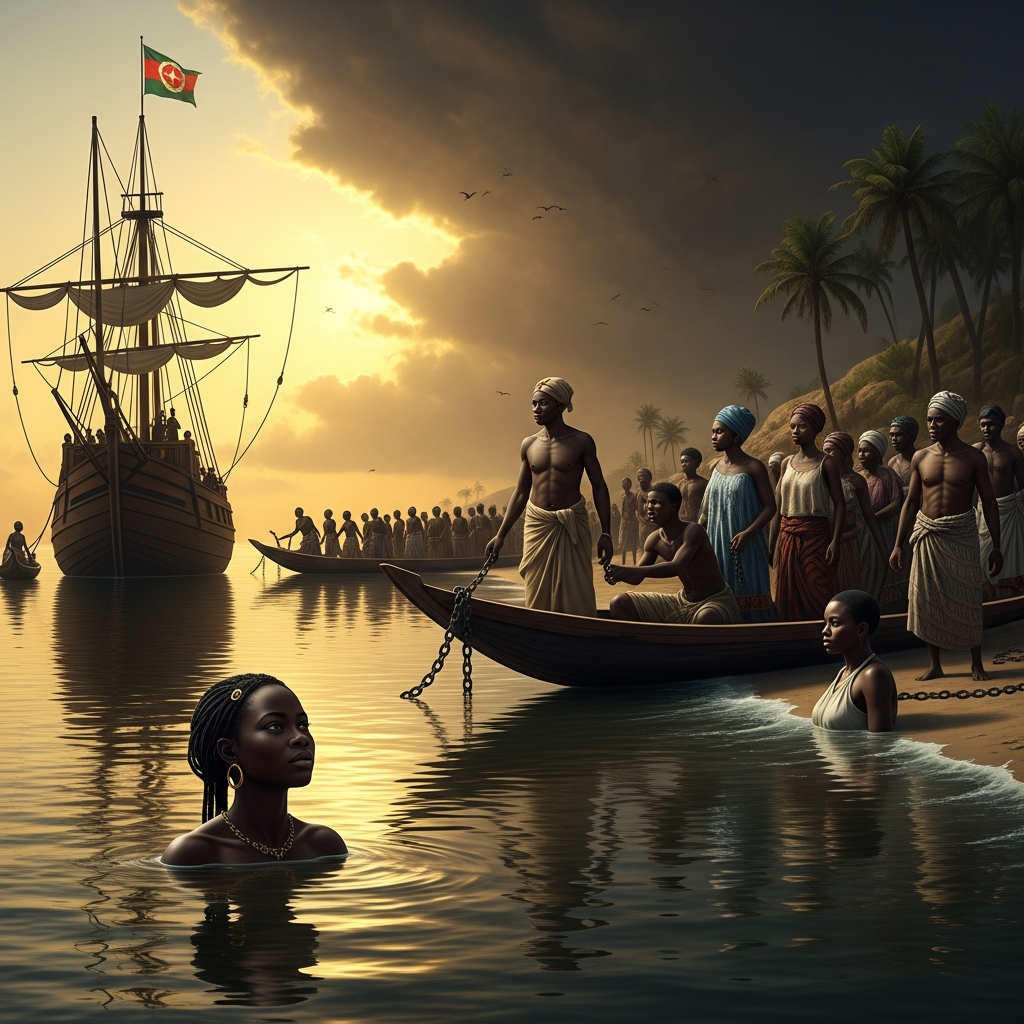
The ship is Portuguese — the cross on the sail, the officers at the rail with their particular category of businesslike inattention, the way they look at the shoreline and see inventory where she sees her coast. She has seen many boats. She has never seen this kind of boat. The boats she has known before came to the water and left it and the water was the same afterward. She understands, watching the lines of chained people moved toward the longboats at the shore, that the water will not be the same afterward. That something is being loaded onto this ship that will change the relationship between the ocean and the land on both sides of it.
The enslaved are loaded.
She watches the longboats cross to the ship. She watches them climb, or be pushed up, the rope ladder. She watches the hatches close. She watches the ship’s anchor rise. She watches the sails fill with wind — her wind, the trade winds, the specific planetary movement of air above the Atlantic that she has felt against her surface for longer than human memory — and she watches the ship turn west.
She makes a choice.
The choice is not about whether she can stop it.
She knows she can stop it in the way that gods know things about their own power: clearly, without illusion, including the full knowledge of what stopping it would cost and what stopping it would not address, which is the human capacity for this particular organization of violence and commerce and category error. She could sink the ship. She has sunk ships. She has sunk ships the way storms do, without testimony, without record, without the loss meaning anything more than the loss. She could sink this ship.
She does not sink the ship.
She does not sink it because the people in the hold are her children and the Atlantic is her body and she will not make her body a tomb for her children, will not permit the Middle Passage to be the ocean’s final statement about the people it carries. The dead who drown in the Atlantic she holds. She holds them, she has always held them, the way the ocean holds everything it takes — not as a collection but as a continuing presence, the dissolved mineral of all the bodies the ocean has ever received, salt becoming part of the solution, the solution becoming the ocean. But she does not choose drowning for these. Not these.
She follows the ship.
She is the water the ship moves through.
She is under the hull, she is the current that the ship rides or fights depending on the day, she is the spray at the bow, she is the deep cold water two thousand feet below that the ship’s shadow falls through as the sun passes overhead. She is everywhere the ocean is, which means she is with the ship the whole way across, and the whole way across means six weeks or eight weeks depending on the winds, which is long enough for a great deal of dying but also long enough for the living to find ways of being living, which is what people do.
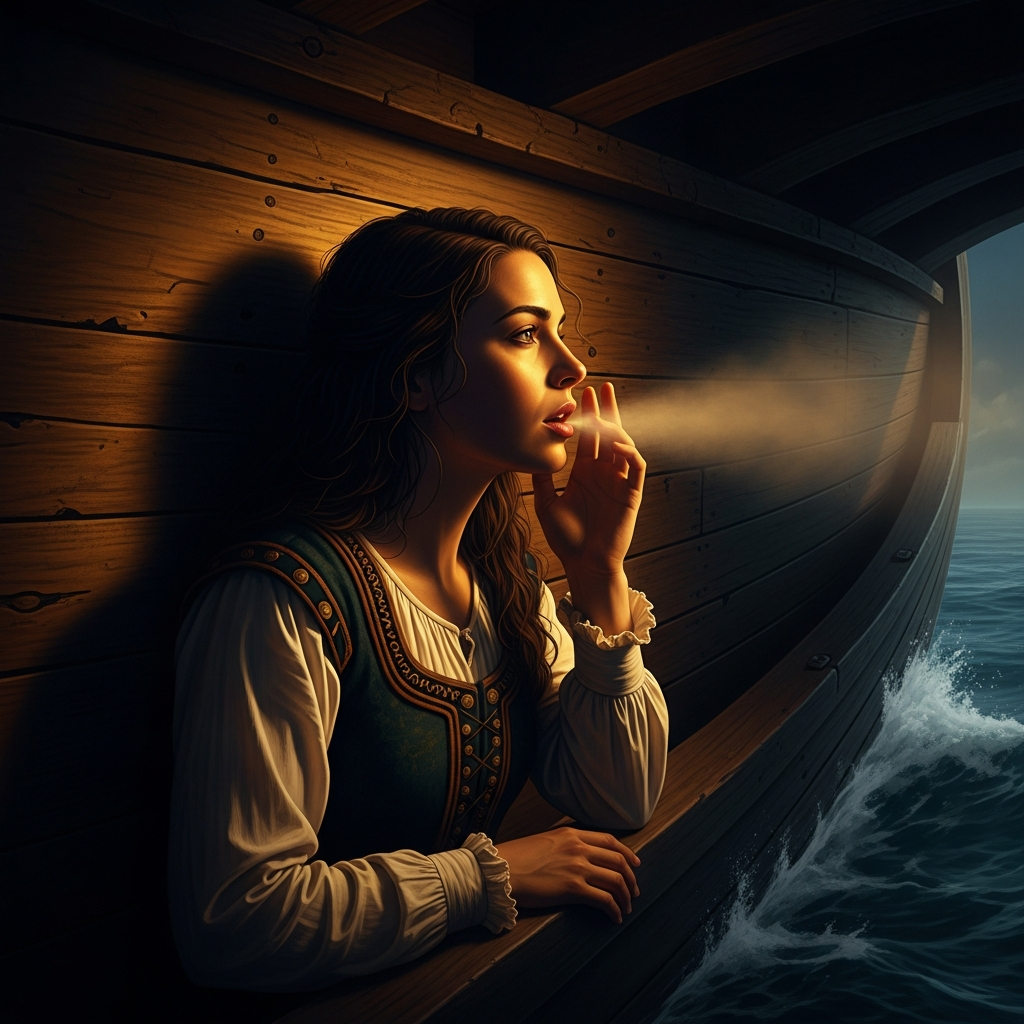
In the hold, the women pray.
They pray in Yoruba, in Igbo, in Fon, in Wolof, in the mixed languages that form in confined spaces when people who share a catastrophe but not a tongue find their way toward common ground. They pray to the water. They feel the water through the hull — the movement of the ship, the sound of the ocean against the wood, the particular slap of the wave against a wooden side that translates into the body of anyone lying against the hull and can be felt as clearly as a heartbeat. They press their lips to the wood and speak names. Yemọja. The mother of fish. The ocean.
She hears every word.
She arrives in the Caribbean before she understands that arrival is what she is doing.
She is still the Atlantic. She is the water off Cuba that turns turquoise in the shallows, the water off Hispaniola that is deep blue until suddenly it is not, the Gulf of Mexico, the brown water at the mouth of the Mississippi where a river larger than the Niger insists on itself. She is all of it. She has always been all of it. The Atlantic was hers before the Portuguese crossed it. The Caribbean was hers. The Gulf was hers. The enslaved who are brought to these places are not brought somewhere outside her reach — they are brought deeper into it.
They bring her with them, which is the same as saying they arrive with the knowledge of her.
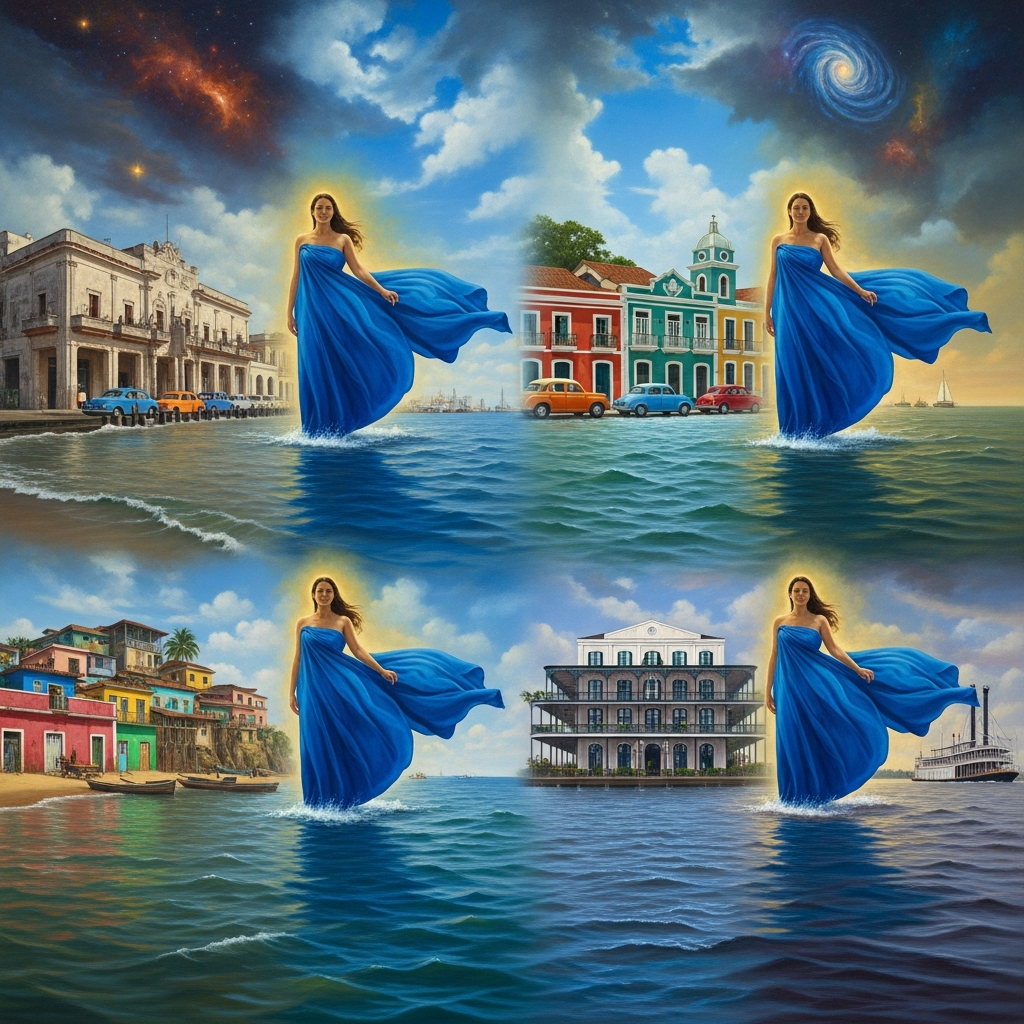
In Havana, in the first generation, the women reconstitute what they remember. They do not have the sacred groves, the initiated priests, the carved opon Ifa, the drumming societies. They have the memory of these things and the ocean outside the city, which is Yemayá’s ocean, the same body of water, still salted with the minerals of the same deep currents. They hold ceremony at the shore. They bring offerings. They speak her name in the new language, the Spanish-inflected Yoruba that is already becoming Lucumí, and she answers. She answers because she is the ocean and the ocean is here, because she crossed with them, because the Middle Passage was her passage too.
She is Iemanjá on the coast of Bahia.
She is La Sirène in the harbor at Port-au-Prince, mermaid-formed, silver and blue, holding a mirror and a comb because beauty and self-knowledge are what survive the crossing, the insistence on being seen truly and seeing yourself truly in conditions designed to deny both. She is the Stella Maris, Star of the Sea, in the confused theology of the colonists who bring Catholicism as a weapon and discover that their Mary has been occupied, that the woman in blue at the water’s edge is recognizable to the enslaved for reasons the colonizers cannot parse and cannot prevent.
She is all of these things because she crossed. Because she made the choice at the Niger Delta to follow rather than sink, to go into the hold in the only way a god can enter a ship’s hold — as the water outside it, as the element that surrounds it, as the thing that receives everything the hold produces. She has never left the water. She is the water. She went where the water went.
The water went everywhere.
She did not choose the crossing. She chose not to abandon it. These are different things. The first would have required her to be something other than what she is. The second required her to be exactly what she is, which is the ocean — present at the worst thing that happened in her body, refusing to look away, holding the drowned and accompanying the living and arriving, salt-heavy, in every harbor where her children came ashore and looked for her in the water and found her there, recognizable, waiting, as if she had been on the other side this whole time, as if the Atlantic is not a crossing at all but her body, and her body is home, and home moved with them.
Scenes
At the mouth of the Niger Delta, a Portuguese slaving vessel rides at anchor
 Generating art…
 Below decks, in the darkness of the hold, a woman presses her lips against the wood of the hull — the ocean inches away — and whispers a name
 Generating art…
 On four shores simultaneously: Havana, Salvador, Port-au-Prince, New Orleans
 Generating art…
 Echoes Across Traditions
Entities


Sources
- Robert Farris Thompson, *Flash of the Spirit* (1983)
- Luís Nicolau Parés, *The Formation of Candomblé: Vodun History and Ritual in Brazil* (2013)
- Karen McCarthy Brown, *Mama Lola: A Vodou Priestess in Brooklyn* (1991)
- Lydia Cabrera, *El Monte* (1954)