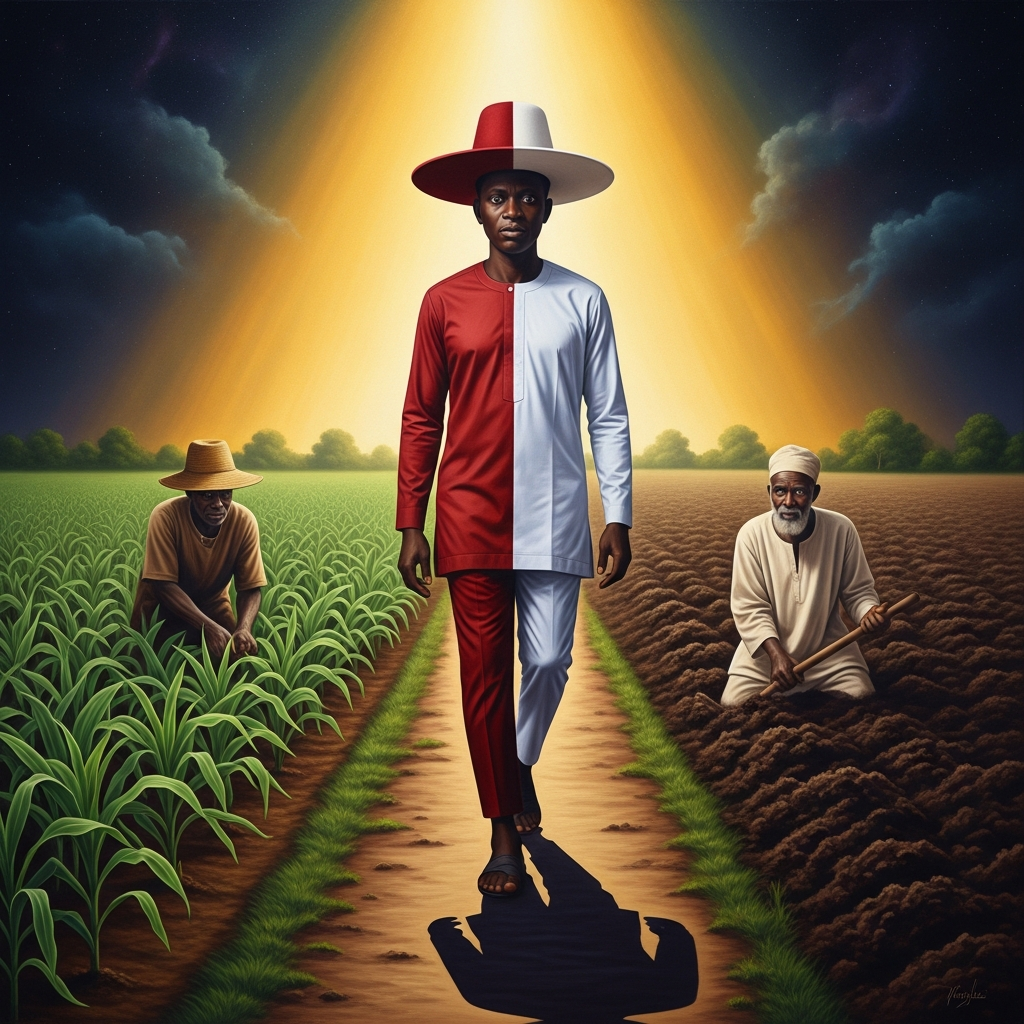
Ifa Divination Comes to Earth
The time before the first consultation — and every consultation since · Yorubaland — the sacred grove, the divining board, the space between what is known and what can be said
Contents
Orunmila, the Orisha of wisdom who witnessed each soul choose its destiny before birth, teaches the first human diviner to read the sacred chain. The student's first client is a dying man. What the Odu says, and whether the student can bear to say it, is the whole of the story.
- When
- The time before the first consultation — and every consultation since
- Where
- Yorubaland — the sacred grove, the divining board, the space between what is known and what can be said
Before the first consultation there is a long apprenticeship.
Orunmila does not rush his teaching. He is the Orisha who was present at the beginning of every soul’s existence — who stood at the threshold where souls choose their fate before they enter the body, and heard each one speak its destiny, and holds all that knowledge in the way a great river holds all the water that has ever flowed through it — which is to say, without strain, without the effort of remembering, simply because that is what he is. He teaches the student the way rivers teach: by showing the same movement in different conditions, by demonstrating how water finds its way around an obstacle or through it, by patient repetition that looks like patience but is actually the pedagogy of something that does not conceive of impatience.
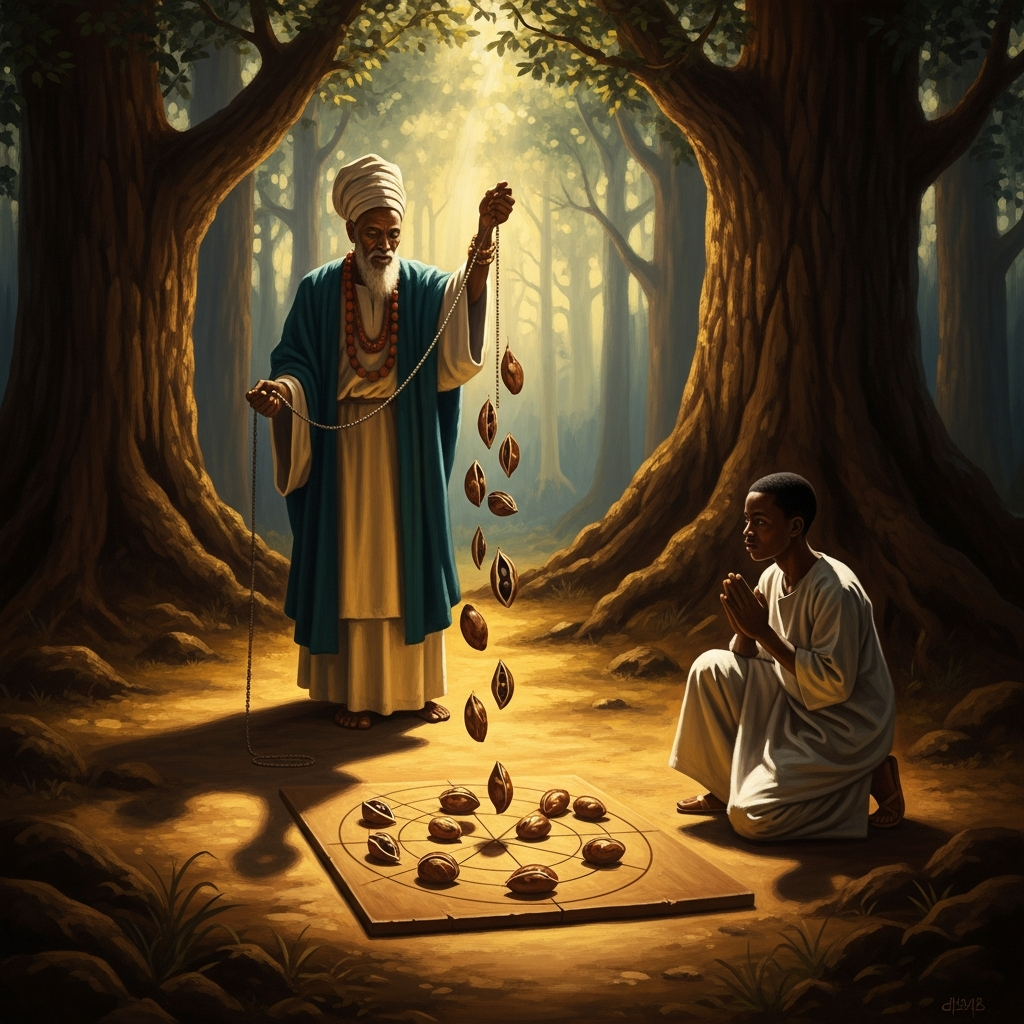
The sacred grove is quiet at this hour. The student is young enough to be awed and old enough to be serious, which is the right combination. He watches Orunmila’s hands above the opele, the divining chain.
The chain has sixteen seed pods connected by cord — the opele of the Odu, the chain of questions and answers. Each pod is a binary gate: this face or that face, up or down, marked or unmarked. Sixteen pods in two columns of eight mean two Odu meeting — the first named Odu and the second its complement, a pairing that locates you in the vast library of Ifa with the precision of a coordinate. The chain lands on the board and Orunmila reads the pattern without hesitation, the way a reader reads, because he is not calculating — he is recognizing, which is faster.
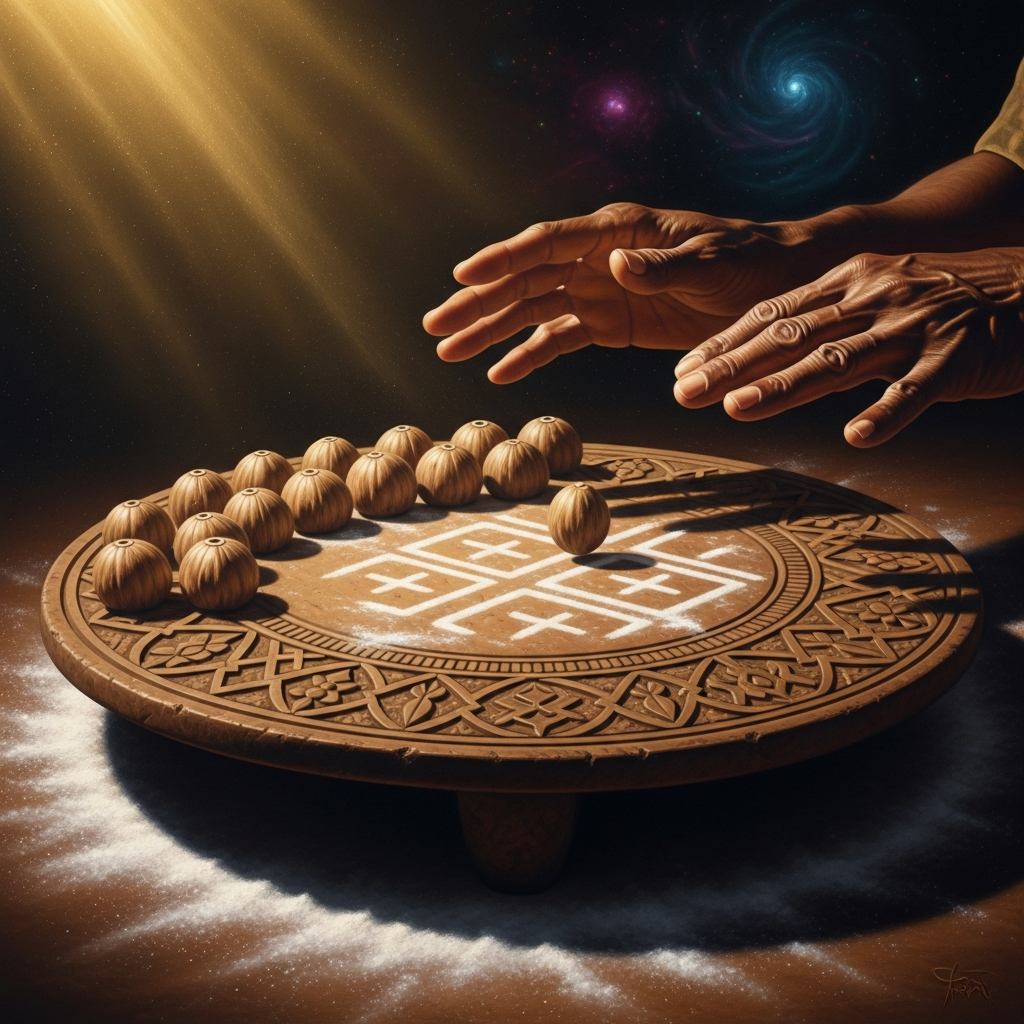
He shows the student how to hold the chain. He shows the weight of it, the particular neutrality that the grip must maintain — too tight and you influence the fall, too loose and you lose the message in transit. He shows how to dust the opon Ifa, the divining board, with white powder — the white that is Obatala’s color, the white of openness, the white that can receive any mark. He shows the marks that correspond to the sixteen Odu, the sixteen principal verses, and he explains what principal means in this context: not most important, not first in any hierarchy of significance, but foundational, the sixteen deep patterns from which all other patterns are derived, the sixteen books in which all human situations are contained.
The student learns them one by one. This takes years. This is supposed to take years.
Each Odu is not a text but a living pattern.
The student understands this slowly, the way you understand anything that cannot be understood quickly. An Odu is not a set of instructions. It is a history of every being who has ever faced the situation it describes — the accumulated experience of all the people and animals and spirits who have consulted Ifa about this configuration of circumstances, all the solutions tried, all the consequences observed, all the stories accreted around the pattern over time. When the chain falls into an Odu, it is not delivering a verdict. It is saying: here is everyone who has ever been where you are. Here is what they did. Here is what happened. The pattern is not a prescription but a context so rich that the person inside it can see their own situation more clearly.
Orunmila teaches this. He teaches it by reciting the Odu verses in the quiet grove, his voice taking on the particular cadence of recited Ifa — steady, not musical exactly but rhythmic, each verse a paragraph in a conversation that has been happening since before the student was born. The student listens and repeats, listens and repeats. He makes marks in the powder with his finger. He learns the marks. He learns the sequences. He learns what each sequence opens into — which stories live there, which beings have inhabited this pattern, what they chose and what they paid.
He learns it until it is not learned but present.
The first client comes to him while his teacher is away.
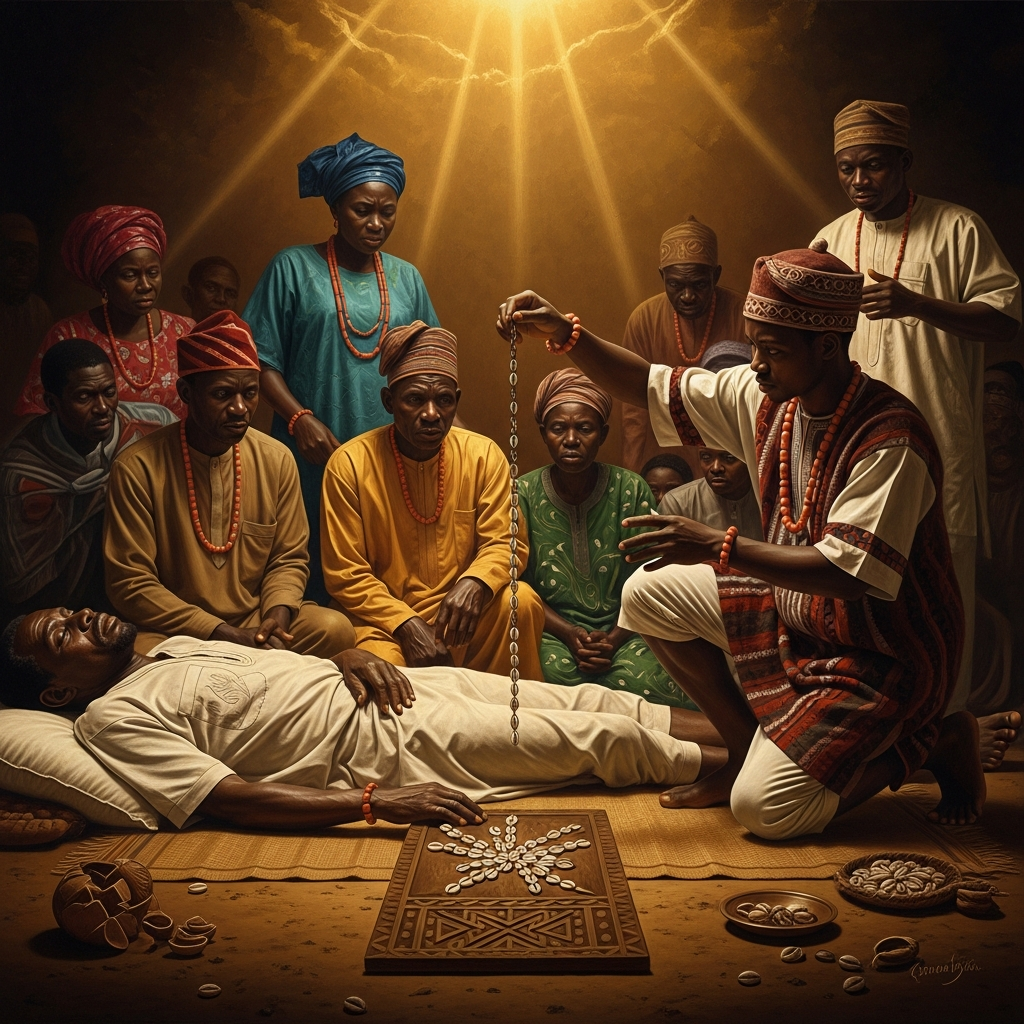
The man is dying — not quickly, not in crisis, but in the slow deliberate way that the body eventually decides on when it has come to some conclusion about what it is willing to continue doing. He is old, or middle-aged and made old by what has happened to him. He arrives at the edge of the sacred grove supported by two of his sons, and the sons are frightened in the way that people are frightened when the person who has always been reliable is becoming unreliable, when the person who has always known what to do no longer knows, when the gravity that organized their lives is visibly weakening.
The student sets out the board. He dusts it with white powder. He holds the ikin, the sacred palm nuts — sixteen of them, hard and round, transferred between the hands in the particular way that generates the Odu marks. He steadies his breathing. He has done this in practice hundreds of times. He has never done it with a client who is actually dying.
He casts.
The Odu appears in the powder.
He recognizes it immediately. He has memorized all sixteen. He has spent months with this one in particular because it is one of the harder ones — not harder to identify, which is a matter of pattern and practice, but harder to say. It is an Odu of transition. It is an Odu of conclusion. It contains within it the stories of souls who came to the boundary and crossed it and what they found there, and the stories of the families who remained, and what they were asked to do to ease both passages — the passage of the dying and the passage of those who must continue after.
It does not say you will survive. It does not say you will recover. It says: you are in the time of completion, and completion requires specific actions, specific prayers, specific offerings, and the honesty of all the people involved to recognize what is happening and respond to it correctly. It says the dying man has unfinished business — a reconciliation unmade, a word unspoken, a debt of honor uncollected that needs to be cleared before the passage. It says the sons need to hear something from their father that they have not yet heard.
The student knows what the Odu says. He holds it in his mind like a vessel full of water, trying not to spill it.
The dying man looks at him.
The sons look at him.
He is aware of every piece of his training simultaneously — the weight of the opele, the marks in the white powder, the years in the grove, Orunmila’s voice reciting verses in the morning cool, the particular phrase his teacher used once about the diviner’s responsibility: you are not the message, but the message cannot arrive without you. Do not mistake one for the other. Do not protect yourself by blurring them.
He takes a breath.
He says what the Odu says.
He says it in the particular syntax of Ifa — not bluntly, not as a verdict, but as a navigation: here is where you are, here is the shape of the territory you are in, here are the actions that correspond to your location, here is what those actions require. He speaks the verse for this configuration. He speaks the part about the reconciliation and he watches the dying man’s face shift in recognition, because the man knows who he needs to speak to, and has known for years, and the knowledge that he was seen by something beyond his own privacy is not humiliating — it is relieving. The weight of an unconfessed thing is heavier than the confession.
He speaks the part about the sons. One of them weeps. The other does not weep but reaches for his father’s hand.
The student sits with the board after the family has gone.
The opon Ifa still holds the marks in the powder — the Odu that appeared, the configuration that addressed itself to a dying man’s specific situation with the accuracy of something that has been waiting for him to arrive and ask. He looks at the marks and understands what Orunmila understood from the beginning: the chain knows because all of this has happened before. Every dying man’s situation has been a dying man’s situation. Every family’s grief has been a family’s grief. The Odu contain all of it, the compressed inheritance of every consultation ever conducted, every question ever brought to the board and answered and acted upon and resolved.
He is not the one who knew. He is the one who was able to say it.
This is what the training was for.
The chain falls, and the marks appear, and the diviner reads them — not because he is smarter than the client, not because he is closer to the gods, but because he has spent years learning to be transparent enough that what the chain says passes through him without distortion. The courage required is not the courage of certainty. It is the courage of a man who knows he might be wrong, who knows the stakes if he is wrong, who has nothing to offer the person in front of him except his full attention and his willingness to say the difficult thing when the marks require it. This is the oldest technology. It has never been replaced.
Scenes
Orunmila demonstrates the opele chain in the sacred grove — sixteen seed pods falling onto the divining board, each a question and answer, the pattern assembling itself in the morning light as the student watches
 Generating art…
 The opon Ifa: a carved wooden board dusted with white powder, the sixteen ikin palm nuts arrayed beside it, the diviner's hands above them before the first cast
 Generating art…
 The dying man reclines on a mat, his family behind him, the student diviner kneeling with the chain above the board
 Generating art…
 Echoes Across Traditions
Entities
- Orunmila
- Eshu
- Olodumare
Sources
- Wande Abimbola, *Ifá: An Exposition of Ifá Literary Corpus* (1976)
- William Bascom, *Ifa Divination: Communication Between Gods and Men in West Africa* (1969)
- Rowland Abiodun, *Yoruba Art and Language* (2014)
- Kola Abimbola, *Yoruba Culture: A Philosophical Account* (2005)