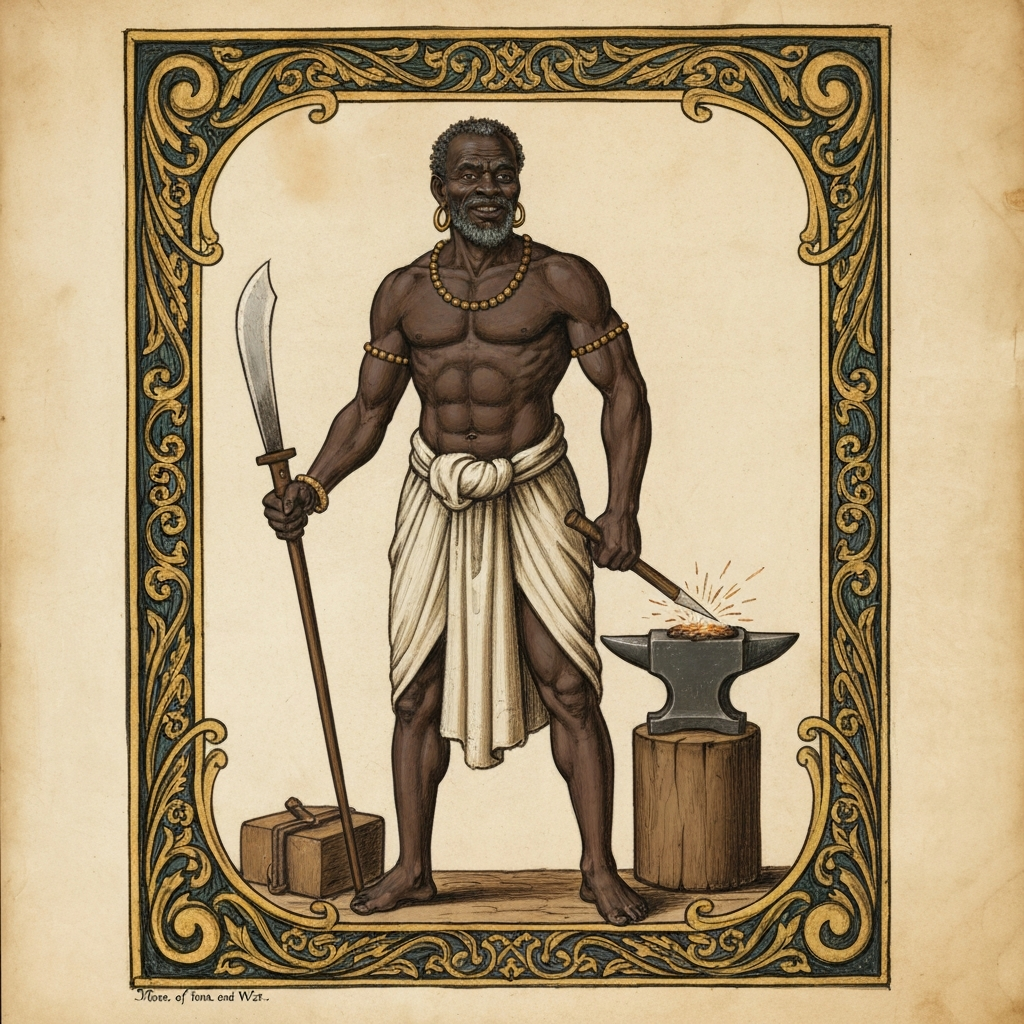
Eshu at the Crossroads
Archetypal time · oral tradition, recorded ~19th–20th century CE · The crossroads between two farms — everywhere and always, since every road has a crossing
Contents
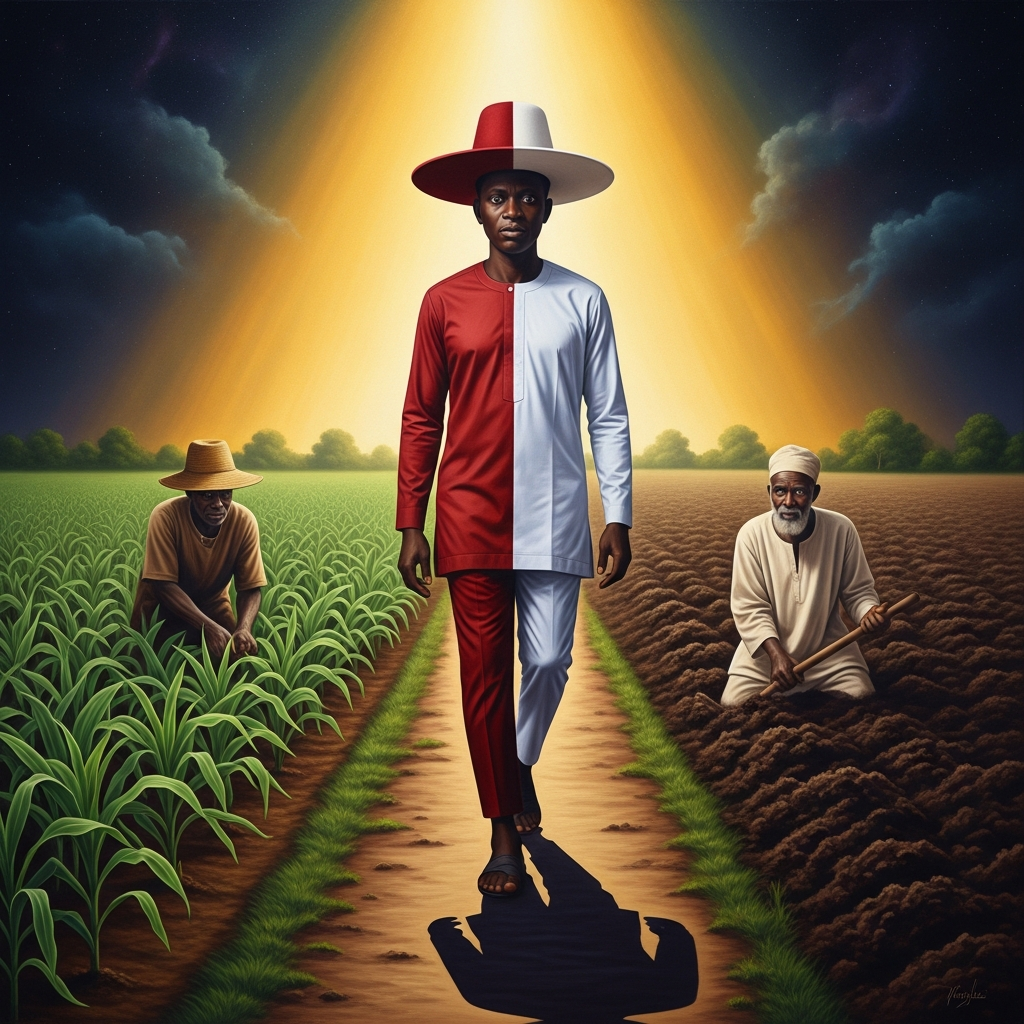
Two lifelong friends farm side by side. Eshu walks between their fields in a hat that is red on one side and white on the other. They see different colors. They come to blows.
- When
- Archetypal time · oral tradition, recorded ~19th–20th century CE
- Where
- The crossroads between two farms — everywhere and always, since every road has a crossing
The two farmers have worked side by side for thirty years.
Their fields share a boundary that has never needed a fence because neither man has ever wanted what the other has. They plant at the same time. They harvest at the same time. They drink together at the end of the season, sitting on the boundary line itself, and they talk the way people talk who have known each other long enough that most of the conversation is understood before it is spoken. They are, by the standards of any tradition that values it, friends in the deep sense: not convenient company but necessary ones, people who carry a portion of each other’s life in their keeping.
This is the situation Eshu finds interesting.
Eshu arrives in the morning, while both men are in their fields.
He appears from the south and walks the narrow path between the two farms, the path that runs along the shared boundary. He walks slowly, the way he always walks — unhurried, interested in everything, leaning on his long staff, wearing his hat. The hat is the kind of wide-brimmed hat a traveler wears in the savanna, and it is divided cleanly down the center: one side deep red, the color of laterite earth, and one side pure white, the color of egret feathers. He walks the path exactly in the middle, and the farmer on the left sees the white side, and the farmer on the right sees the red side, and Eshu walks the whole length of the boundary and turns onto the road north and disappears.
The farmers meet at the boundary line at midday. They greet each other. Someone mentions the traveler who passed this morning. The white hat, says the farmer on the right. The red hat, says the farmer on the left. They look at each other.
The argument begins as arguments always begin — with certainty.
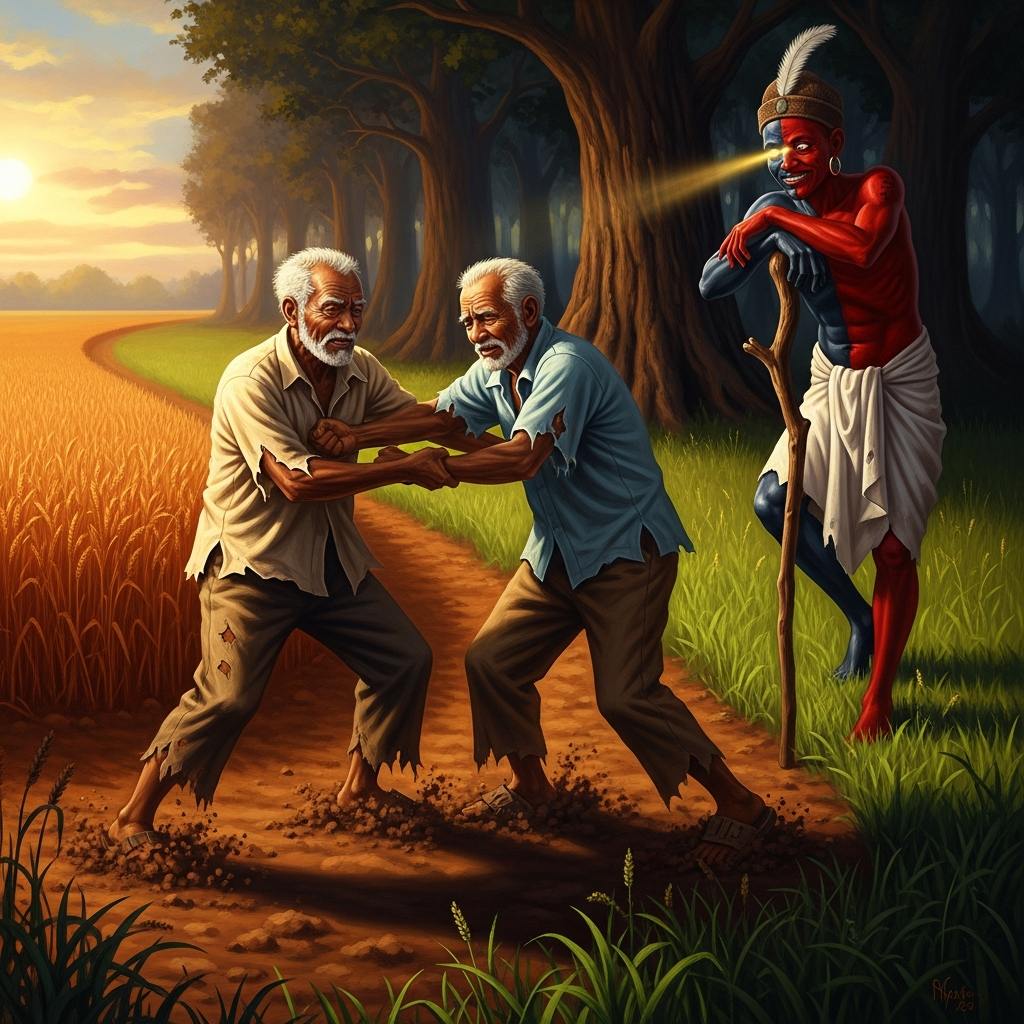
Each man knows what he saw. Each man was standing in good light, awake, at work, in full possession of his faculties. The traveler walked directly in front of both of them. There is no question of poor visibility or distraction. The farmer on the right saw white. The farmer on the left saw red. Both of these things are true. The argument does not have room for both of them to be true, so they begin to question each other’s eyesight, then each other’s honesty, then each other’s character, then thirty years of small grievances that have never been spoken because there was never before a reason to speak them. By the time the sun is past its height they are shouting. By the time the shadows lengthen they have their hands on each other.
Eshu sits in the shade of a tree at the edge of the bush and watches with the attentiveness of someone who is learning something important about the people he is responsible for.
He lets them fight.
He lets them fight long enough that the fight becomes the thing itself — not an argument about a hat but an argument about who these men are to each other, whether friendship is real or just proximity, whether understanding is ever possible between two people who stand in different places looking at the same moving thing. He lets it run until both men are tired and sitting apart in the dirt and the friendship is somewhere between broken and suspended, neither one knowing which.
Then he walks back down the road from the north.
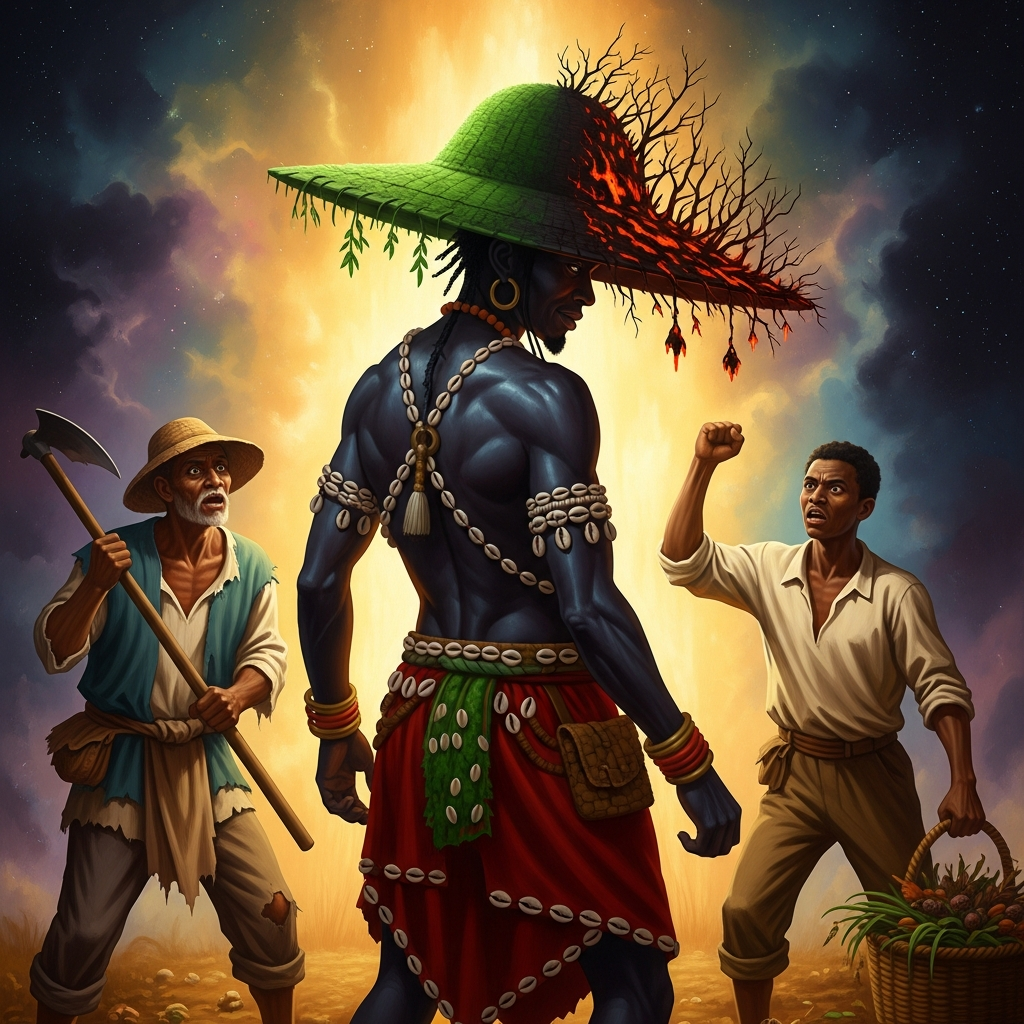
He walks between the two farms again, on the same path, at the same pace. He stops where the two farmers can both see him. He holds still. He tilts the hat forward, brim down, so that both sides face outward — red toward the right, white toward the left, exactly reversed from the morning — and he rotates it slowly so both men see both colors. He does not explain. He does not apologize. He laughs: the laugh of something that has just demonstrated a principle at the cost of someone else’s comfort and finds the cost exactly appropriate to the lesson.
He speaks.
“You are both right,” Eshu says, “and you were both right this morning. You were not fighting about my hat. You were fighting because you forgot that no two people stand in the same place.” He leans on his staff. “This is the lesson: before you decide a man is lying, find out where he was standing.”
He looks at both of them for a long moment — the particular look of Eshu, which sees not what you are but what you will be after this — and then he turns back onto the road south and walks away. The farmers sit in the dirt for a while longer. Then one of them stands. Then the other. The silence between them is different from the silence before the fight: that silence was the absence of conflict; this silence is the presence of something learned in the hardest way, which means it will stay.
No message travels without Eshu.
He stands at every crossroads, every doorway, every beginning of every ritual. You invoke him first — before Shango, before Obatala, before Olodumare himself — because nothing reaches the other orisha except through him. He is not the greatest orisha in power; he is the most necessary one in function. He is the principle that all communication passes through a medium, and every medium has its own nature, and the message that arrives is always partly the messenger. The Yoruba understood this before there was a word for it. They built a theology around it. They put a trickster at the center of divine communication not as an embarrassment but as an honest description of how meaning moves.
The two farmers repair their fence.
But it is not quite the same fence, and Eshu would say that is exactly right: the fence that knows it is a fence is more honest than the one that thought it was unnecessary.
Eshu is not cruel. He is the universe’s most efficient teacher — he finds the gap between two people’s realities and walks straight through it, so they finally have to look at the gap instead of pretending it isn’t there.
Scenes
Eshu walks the narrow path between the two farms, his hat a perfect split — deep red on the left, pure white on the right
Generating art… The two farmers wrestle in the dirt at the boundary of their fields, their friendship of thirty years dissolved in a single argument about color
 Generating art…
 Eshu turns to face them both, tilting the hat forward so both sides are visible at once
 Generating art…
 Echoes Across Traditions
Entities
- Eshu
- Elegba
- Olodumare
Sources
- Wande Abimbola, *Ifá: An Exposition of Ifá Literary Corpus* (1976)
- Lydia Cabrera, *El Monte* (1954)
- Robert Farris Thompson, *Flash of the Spirit* (1983)
- Gary Edwards and John Mason, *Black Gods: Orisa Studies in the New World* (1985)