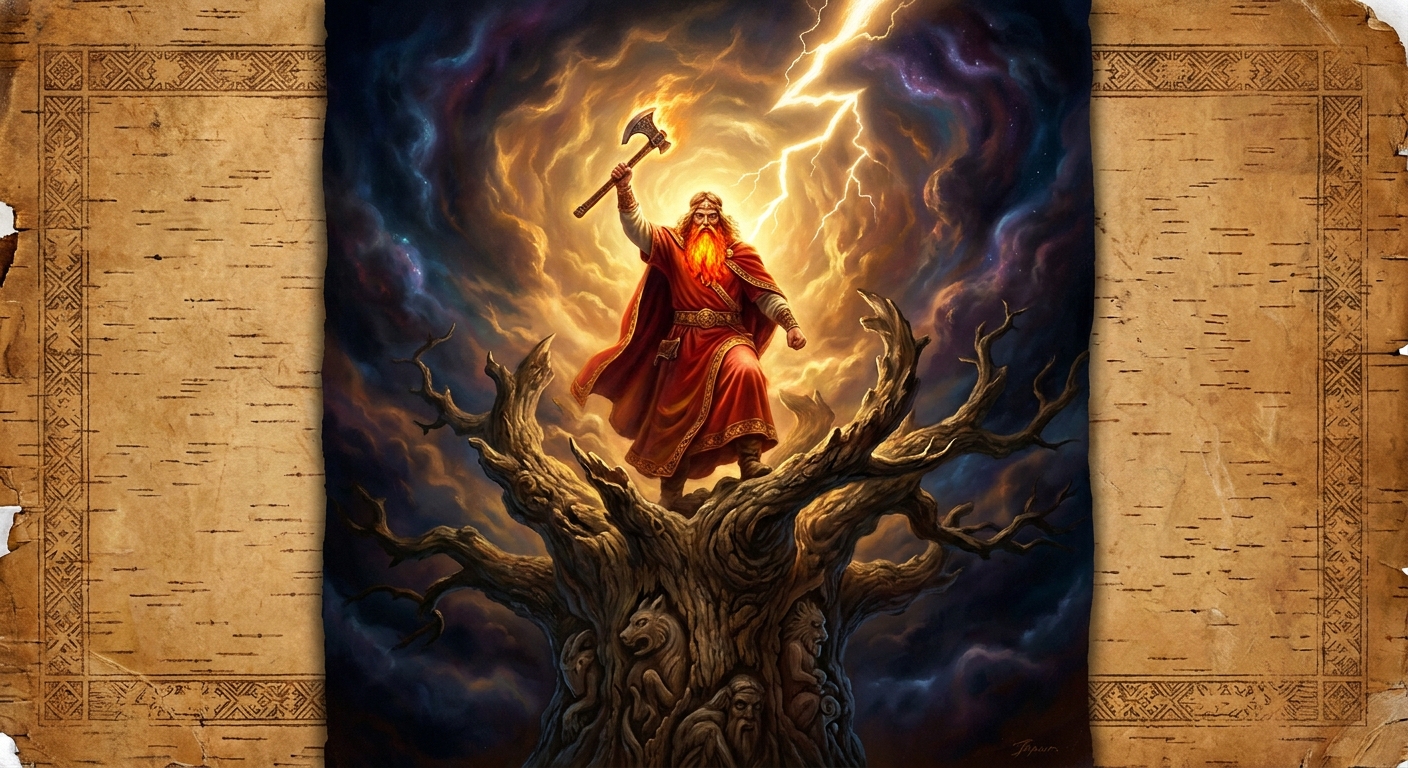
Baba Yaga Tests the Hero
Mythic time — Slavic oral tradition, recorded in 19th-century collections · The deep forest at the border of the living world and the dead — Russia / Eastern Slavic tradition
Contents
At the edge of the living world and the dead, in a hut that stands on chicken legs and turns with the wind, Baba Yaga gives Vasilisa the Beautiful three impossible tasks and a skull lantern with burning eyes. What the witch cannot understand is the doll in the girl's pocket — love made material, a dead mother's warmth against the cold of the forest.
- When
- Mythic time — Slavic oral tradition, recorded in 19th-century collections
- Where
- The deep forest at the border of the living world and the dead — Russia / Eastern Slavic tradition
The forest does not end. That is the first thing Vasilisa learns.
She has walked since her stepmother sent her out for fire — go to our neighbor, she said, we have no light — and the neighbor is Baba Yaga, and everyone knows what that means, and everyone also knows that Vasilisa’s stepmother meant for her not to come back. The girl is beautiful and her stepmother’s daughters are not, and this is the oldest story inside the story. But Vasilisa has something in her apron pocket: a small wooden doll with bead eyes, carved by her mother’s hands, pressed into hers in the last hours before her mother died. Feed it when you are in need, her mother whispered. It will help you.
She feeds it now, from the crust she has kept back. The doll’s eyes brighten. The path forward becomes visible.
The forest is not going anywhere. Neither is the hut.
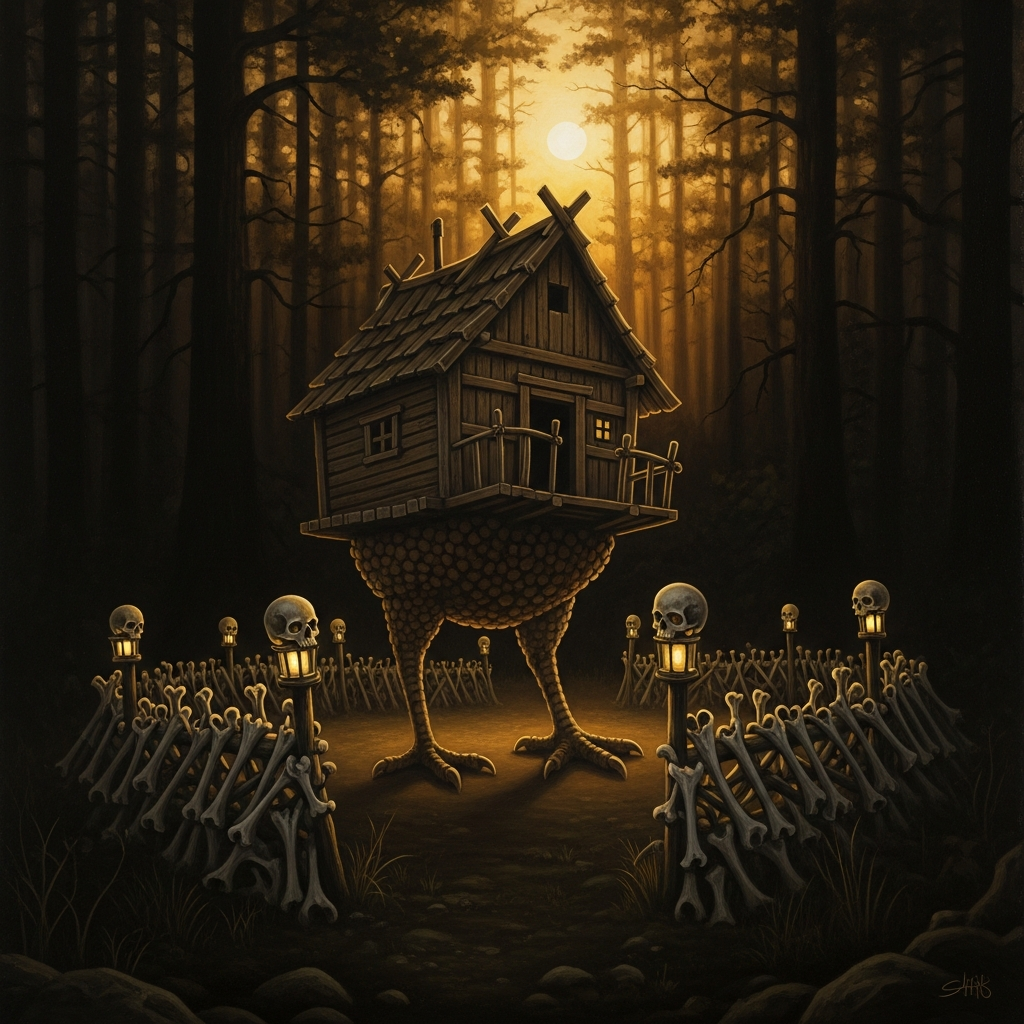
It stands on chicken legs at the border between the living world and the dead, and it is turning — slowly, rootlessly — the way a weather vane turns in a storm that has no single direction. The fence around it is bone. The gate-posts are topped with skulls, and the skulls still have their fire, and the fire in each socket is not the fire of life. Vasilisa has stopped walking. Her feet have the sense her heart has not quite managed: this is the place beyond which children do not return.
Then the hut stops turning. The door faces her.
Baba Yaga comes out.
She is not what fear made her in the dark. She is worse: a real thing rather than an imagined one. She is old with the oldness of the forest itself — not aged, but primary, the way a root system older than any individual tree is primary. Her nose hooks down, her chin hooks up. She rides a mortar, steers with a pestle, sweeps her track with a broom. She smells of something that is not death exactly but is adjacent to death, the way a charnel field in late autumn smells not of rot but of the earth that is finishing the work of rot.
I smell Russian flesh, she says. Have you come on business, or has fate brought you?
On business, says Vasilisa, because she has the wit to know that fate in this context means she dies and business means she might not. I need fire.
Then earn it.
The tasks are given at dusk. By dawn she must: card and spin all the wool in the barn, sort a pile of grain-sized millet from a pile of poppy-seed (they are mixed together; together they fill three barrels), and prepare supper enough for a hungry house. Baba Yaga does not say what happens if the tasks are incomplete. She does not need to. The skulls on the fence have explained it already.
The witch climbs into her hut. The door shuts. Three riders go out — white on a white horse at dawn, red on a red horse at noon, black on a black horse at dusk — they are Baba Yaga’s Day and Sun and Night, her servants and her hours, and when they return the work must be done.
Vasilisa puts her hand in her apron pocket.
The doll is warm. She feeds it three seeds from the poppy pile, the smallest offering she can spare. The doll’s bead eyes catch the skull-fire.
Sleep, says the doll. I will work.
She sleeps.
In the morning every task is finished. The grain is sorted with the precision of something that has an instinct for categories the way water has an instinct for low ground. The wool hangs in skeins that could be sold in a city. The supper is warm in a pot on the fire. Baba Yaga’s riders have come and gone — the white, the red, the black — and the night is ending.
Baba Yaga eats for a long time, and she does not offer any to Vasilisa, because to offer food in Baba Yaga’s house is to make the guest into something other than a guest, and Baba Yaga has not decided yet what Vasilisa is. She examines the work with the eye of someone who has been set impossible tasks herself, once, long before the forest, before the hut, before the bone fence — someone who knows what impossible looks like and what it looks like when it has been accomplished through means outside the natural.
You did not do this yourself, she says.
I had help, says Vasilisa.
From whom?
From my mother’s blessing.
The witch goes still. She is old enough to know what that phrase means. She is old enough to know that there are forces she cannot touch — not because she lacks power, but because certain kinds of love leave a mark on a living person that the dead cannot enter and the ancient-mortal cannot bear. She recoils. Not in fear exactly. In something that might be called recognition of a border.
Get out of my house, says Baba Yaga. I do not take the blessed ones.
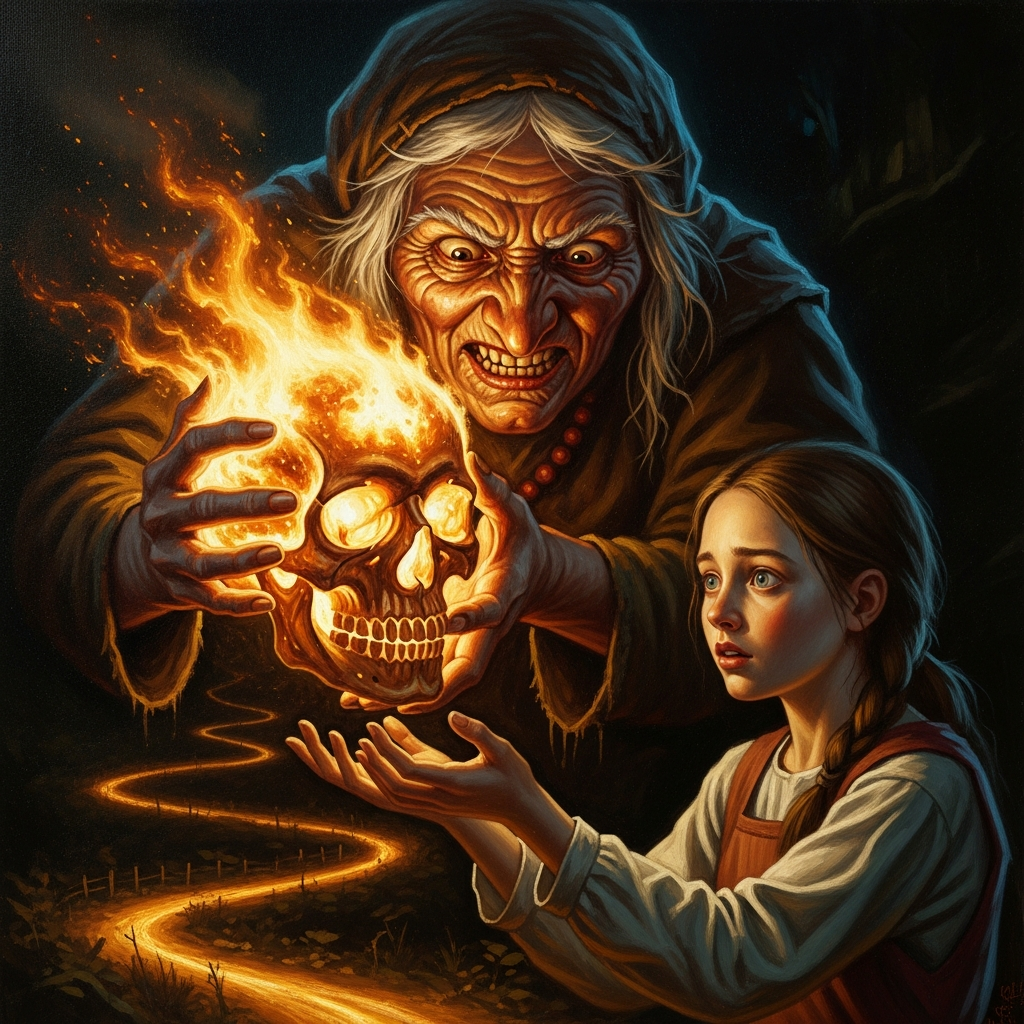
Then she takes one of the skulls from the fence, the one whose eye-fire burns hottest and most steadily, and she presses it into Vasilisa’s hands. The heat of it should burn. It does not. Take your fire, she says. And do not look back.
The skull guides her home by its own light. The eyes of it track the path without error through a forest that is no longer trying to lose her, the way a forest stops being hostile the moment a trial has been passed. Vasilisa does not look back. She knows the rule. She walks the whole night.
In the morning she reaches her stepmother’s house.
The stepmother and her daughters are there, and they are cold, for no fire has lit in the house since Vasilisa left — every flame gone out, every ember, even the coals raked from the dead fire at the bottom of the hearth. They have been three days without light or warmth, and they have learned something about what the forest gives and what it withholds.
They reach for the skull.
The skull’s eyes find them, and the fire in those eyes is not the fire that cooks food or drives away the dark. It is the fire that sees. By morning the stepmother and her stepsisters are ash. The skull has burned through them with the patience of something that has all the time of the dead and no obligation to hurry.
Vasilisa buries the skull in the yard, because it is powerful and she has had enough of power for now. She goes to the city. She weaves cloth so beautiful that the Tsar himself will eventually see it and want to meet the weaver, and from there the story moves into other territories: marriage, palace, ordinary happiness that a girl who once walked to the edge of death and back has perhaps earned.
The doll goes with her. It always does. It is in her pocket at her wedding and in the pocket of her gown when her children are born, and when she is an old woman and her grandchildren ask what that wooden thing is, she opens her hand and shows them: two bead eyes, carved by dead hands, still warm.
This is what the story is actually about. Not the witch. Not the impossible tasks. Not even the skull lantern, burning its way through the wicked with such patient precision.
Baba Yaga is not evil. She is the test. She sits at the border because every border must be kept by something that does not die, and she tests every traveler not out of cruelty but because the road beyond her hut requires a quality she can smell and cannot fake: the presence of genuine love, inherited and carried. You can learn to card wool. You can learn to sort seeds. You cannot manufacture a dead mother’s warmth in an apron pocket at the edge of the world’s last forest.
You either have it or you don’t.
Scenes
The hut on chicken legs at the forest's edge — spinning slowly, bone fence gleaming, skull lanterns fixed at every post, the last light of the living world fading behind the trees
 Generating art…
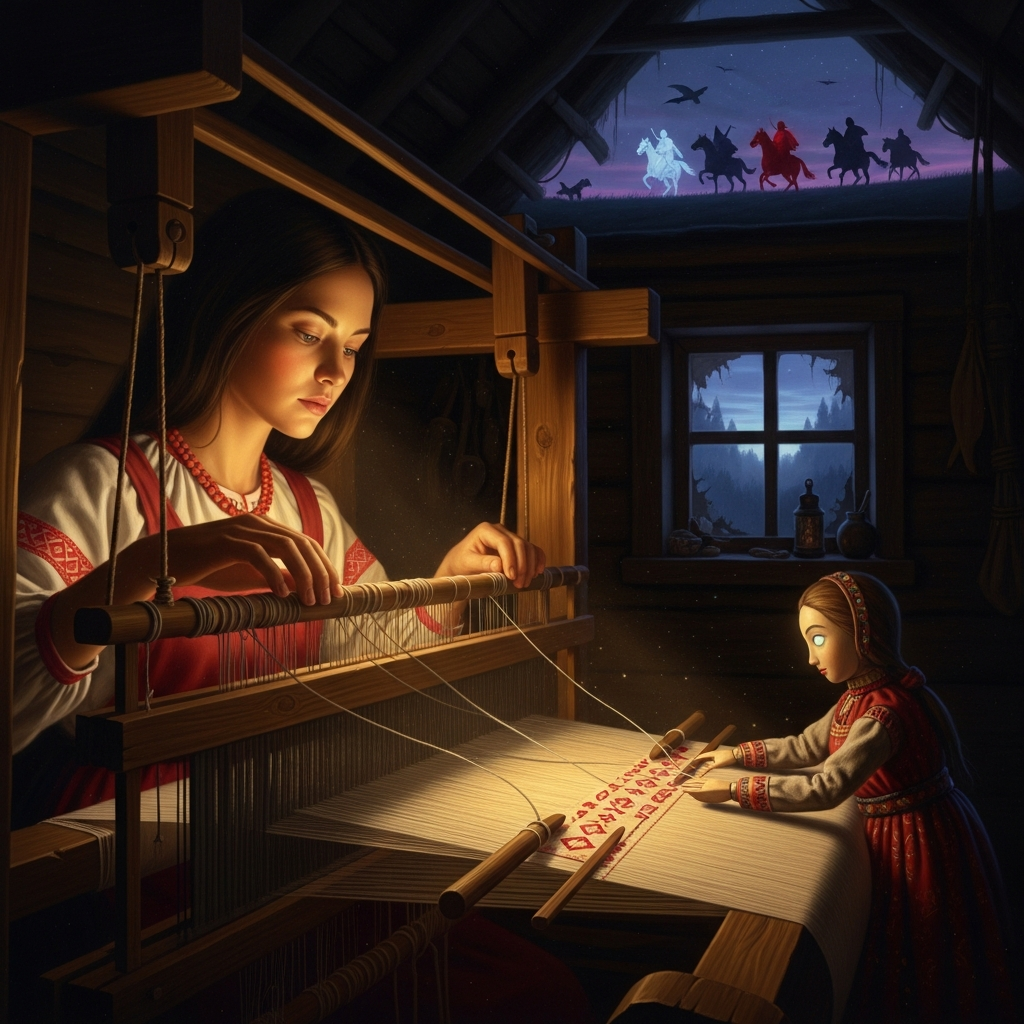
 Vasilisa at the loom in the dark before dawn, the enchanted doll working beside her, the impossible tasks completing themselves while Baba Yaga's riders circle the hut
 Generating art…
 Baba Yaga pressing the burning skull into Vasilisa's hands — the witch's face caught between fury and something older, the eyes of the skull already fixed on the road home
 Generating art…
 Echoes Across Traditions
Entities
- Baba Yaga
- Vasilisa the Beautiful
- the enchanted doll
- the skull lantern
Sources
- Alexander Afanasyev, *Russian Fairy Tales* (1855-1863, trans. Norbert Guterman, 1945)
- Vladimir Propp, *Morphology of the Folktale* (1928, trans. 1958)
- Vladimir Propp, *The Historical Roots of the Wonder Tale* (1946)
- Andreas Johns, *Baba Yaga: The Ambiguous Mother and Witch of the Russian Folktale* (2004)
- Elizabeth Warner, *Russian Myths* (2002)