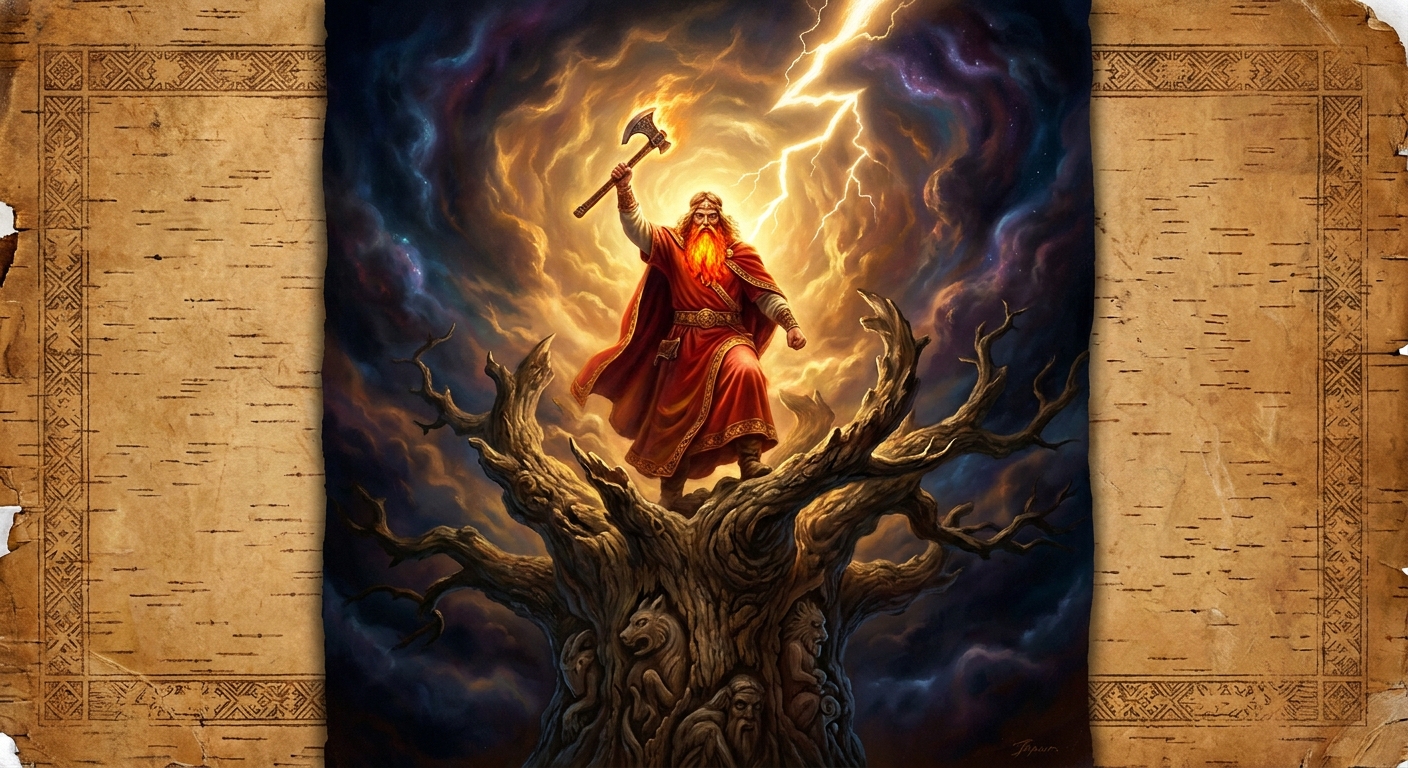
Koschei the Deathless: The Needle at the End of Everything
Mythic time — Slavic oral tradition, widely recorded from the 18th century onward from much older oral sources · The kingdom of the undying — past the sea, past the islands, at the edge of the mappable world
Contents
Koschei the Deathless cannot be killed because his death is not in him — it is in a needle, inside an egg, inside a duck, inside a hare, inside a chest buried under an oak on an island at the edge of the sea. A prince, three magical animals, and a question older than mortality: what happens to a world where death is defeated?
- When
- Mythic time — Slavic oral tradition, widely recorded from the 18th century onward from much older oral sources
- Where
- The kingdom of the undying — past the sea, past the islands, at the edge of the mappable world
Here is what Koschei the Deathless is.
He is old. Not in the way that kings are old or mountains are old — old in the way that the sea is old, which is to say in a way that has stopped meaning anything to the thing itself. He has been alive since before the first Slav named him, which means he was already ancient in the time of myth, which means the story cannot tell you when it begins because it was always already under way. His kingdom is somewhere past the sea, past the islands, past the place where the horizon has given up. It is a grey country. The sky there is always the sky of an hour before dawn — neither night nor morning, the color of old metal, fixed permanently at the point where darkness has not yet decided to end.
His subjects do not die. This is not a blessing. A body that cannot die in a grey country under a metal sky is a body that has stopped wanting anything except the moment it did not know would be its last. Koschei’s kingdom is full of people waiting. They have forgotten what they are waiting for.
He rides out sometimes. He takes a wife, or a beloved, or a queen from some kingdom that made the mistake of being beautiful enough to be worth raiding. He brings her back through the sky on his black horse, which outruns any wind, and he puts her in a tower in the grey country, and he says: Stay. You will not age. You will not die. You will stay here with me, which is the same thing.
This is why a prince is currently saddling a horse.
His name is not given. In some tellings he is Ivan; in others he is the youngest of three brothers, which amounts to the same thing. He has a dead father, a captured beloved, and the specific quality of stubbornness that the Slavic tradition considers heroic: not brilliance, not beauty, not supernatural strength, but the refusal to admit that a thing cannot be done until the thing has been tried all the way to the end.
He rides east.
He rides until his horse is gone and his boots are worn and the map he was given by the wise woman at the crossroads is used up. He comes to a forest so old that the trees have forgotten they are trees. In the forest he finds a bear the size of a barn — a bear that has been sleeping since before his grandfather was born — and he raises his bow to shoot it for food.
Do not kill me, says the bear, with the resigned dignity of a thing that has made this bargain many times. Spare me and I will be useful to you in a moment you cannot imagine yet.
He lowers the bow. He rides on.
He finds a pike in a river, stranded in a pool where the river has abandoned it, silvery and ancient and nearly dead from the shallowness of the water. He cups his hands and carries the fish back to the river.
In a moment you cannot imagine, says the pike, and sinks.
He finds a heron caught in the reeds, one leg tangled in the kind of knot that makes itself tighter. He frees it.
In a moment, says the heron, and flies.
He keeps riding. He always knew it would cost something to save a god’s animals in a fairy forest. He has made three debts he does not know how to pay except by arriving at the island.
The island is real. It sits in the sea past the horizon, and reaching it requires either a boat that can sail impossible distances or the knowledge that the border between the living world and the place where Koschei keeps his treasures is not a physical distance but a willingness — a readiness to go the extra step that sensible men stop at. The prince reaches the island because he did not stop when the land did.
The oak is at the center. It is very large and very old and it is the kind of tree that has a past: sacrifices at its base, names cut into its bark, the roots visible aboveground like the ribs of something that has decided not to hide what it is. Under the roots there is an iron chest with seven locks.
He cannot open it. He cannot lift it. He stands before it for a long time and then the ground shakes and the bear is there, because the bear has come through the forest-distance at the speed of a debt being paid, and the bear tears the chest open the way you open a hinge with your hands when your hands are strong enough.
Inside the chest there is a hare.
The hare runs. It has been coiled in the chest for centuries and it runs with the explosive speed of something that has been waiting and has forgotten how to be anything but fast. It runs for the edge of the island, for the sea, for the horizon — for the edge of the story, where stories go when they try not to be caught.
The heron arrives.
It takes the hare from the air at the cliff’s edge — a precise, unhurried violence, the heron’s patience against the hare’s fear, and patience wins as it always does — and brings it back to the prince’s feet.
Inside the hare there is a duck.
It explodes upward. It goes for the sky with the vertical desperation of a thing that has spent its life inside a hare inside a chest and knows, at some level of its animal mind, that this is its one chance. The pike comes from the sea-spray somehow — from the water around the island’s base, having swum the impossible distance through salt and time — and catches the duck against the air over the water.
Inside the duck there is an egg.
The egg falls.
It falls toward the dark water below the island’s edge, spinning, falling with the terrible patience of inevitability — and the prince catches it. He catches it with the reflexes of a man who has ridden until his boots wore through and carried a pike in cupped hands and freed a heron in a reed-bed, a man who has been practicing, for the whole length of this story, the art of saving a thing at the last possible moment.
Inside the egg there is a needle.
The needle is the length of a finger. It is ordinary iron, the kind of iron a village blacksmith makes, and it has been inside an egg inside a duck inside a hare inside a chest under an oak on an island for as long as Koschei has been deathless, which is as long as memory goes. It is Koschei’s death, externalized — taken out of his body the way a man might take a jewel from his pocket to keep it safe, except that what he kept safe was his death, which means what he removed from himself was the capacity to end.
The prince turns it in his hands and feels it. It does not look like the end of the undying. It looks like a needle.
He breaks it.
He snaps it across his knee, a single motion, and there is a sound from the direction of the horizon that is not quite a sound — more the absence of a sound that has been continuous for so long that its ending registers as noise. In the grey kingdom past the sea, Koschei the Deathless is in the middle of something — sitting on his throne, or riding, or standing at the tower window where his beloved refuses to stop looking toward the horizon — and then he is not in the middle of anything. He is simply finished. The armies of the undying stand still. The grey sky, for one moment, turns a color that has no name in the language of the dead because the dead have never seen it before.
It is the color of morning.
This is the cosmological question the story raises and does not answer: what happens to the kingdom of the undying when death returns? The beloved comes home. The prince comes home. They marry, as princes and beloveds do.
But the grey country is still there, somewhere past the sea, and Koschei’s subjects are still there — people who have been unable to die for centuries, who have forgotten the faces of their living families, who have lost track of the year and then the decade and then the era. They can die now. They can finally die. Whether that is rescue or execution depends on what you believe about the mercy of endings.
The Slavic tradition does not decide. It leaves the grey country off the map, past the horizon, accessible only to those foolish or brave enough to ride east until the land stops. Maybe someone is sitting under the oak on the island right now, waiting to see if the chest will fill again. Maybe Koschei will find a new way to hide his death. Death-avoidance is a persistent urge, and the world is full of oaks.
The needle is broken. This time.
Scenes
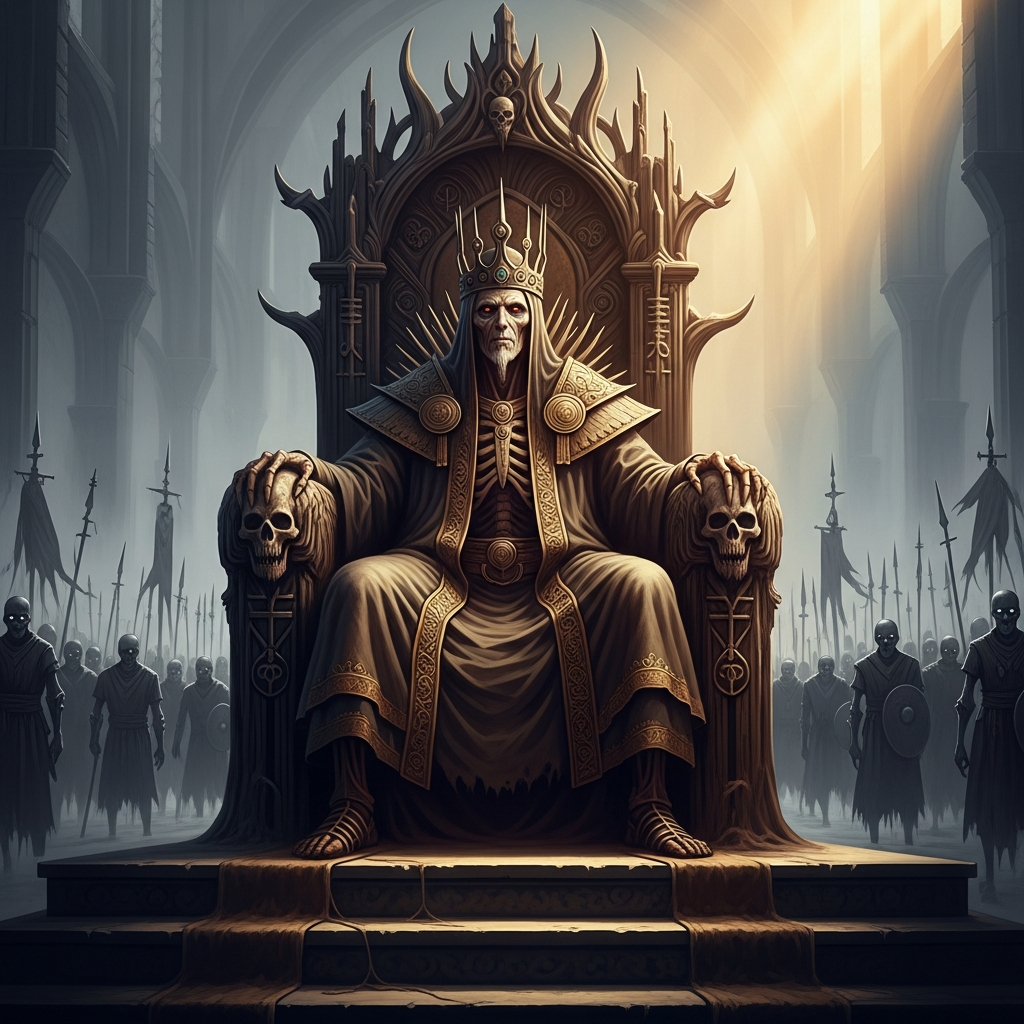
Koschei on his throne in the kingdom of the undying — gaunt, ancient, his eyes the colour of old bone, armies of the never-dead ranked behind him in the grey light of a world without weather
 Generating art…
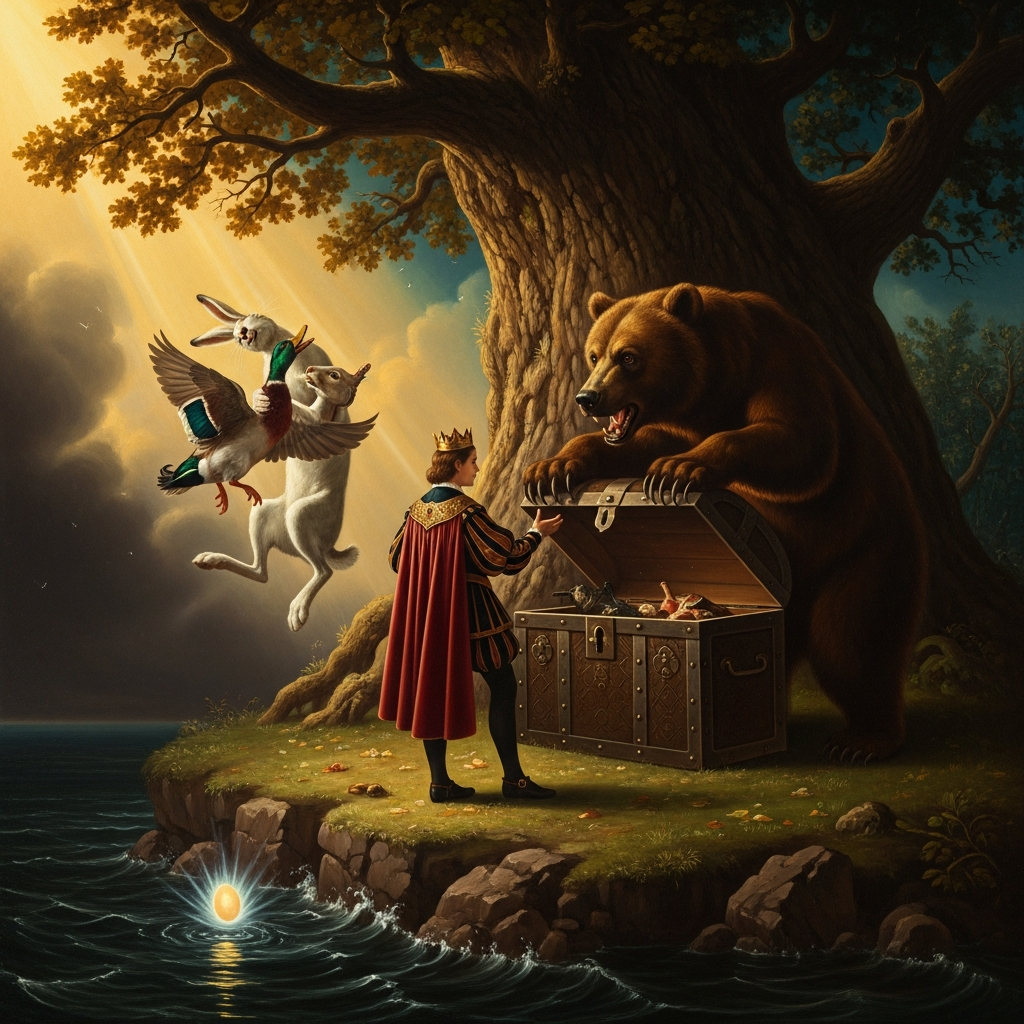
 The prince at the iron chest beneath the great oak — the bear holding the chest open, the duck breaking from the hare's grip, the egg falling toward the dark water below the island's edge
 Generating art…
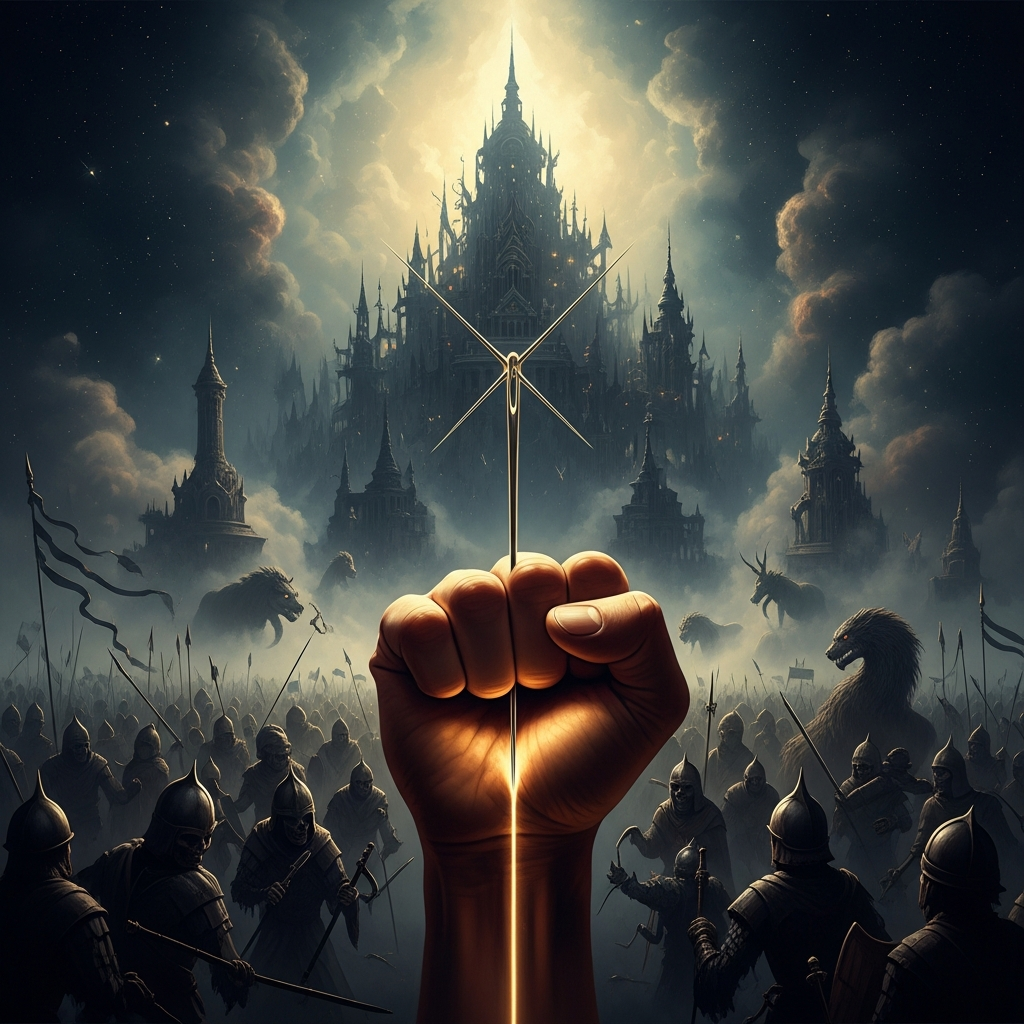
 The needle snapping — a thin line of light across a closed fist, and in the distance Koschei's kingdom dissolving like smoke, the undying armies stilled at last
 Generating art…
 Echoes Across Traditions
Entities
- Koschei the Deathless
- the prince
- the bear
- the pike
- the heron
- the iron chest
- the needle
Sources
- Alexander Afanasyev, *Russian Fairy Tales* (1855-1863, trans. Norbert Guterman, 1945)
- Vladimir Propp, *The Historical Roots of the Wonder Tale* (1946)
- Mike Dixon-Kennedy, *Encyclopedia of Russian and Slavic Myth and Legend* (1998)
- James George Frazer, *The Golden Bough* (1890) — chapter on the external soul
- W.R.S. Ralston, *The Songs of the Russian People* (1872)