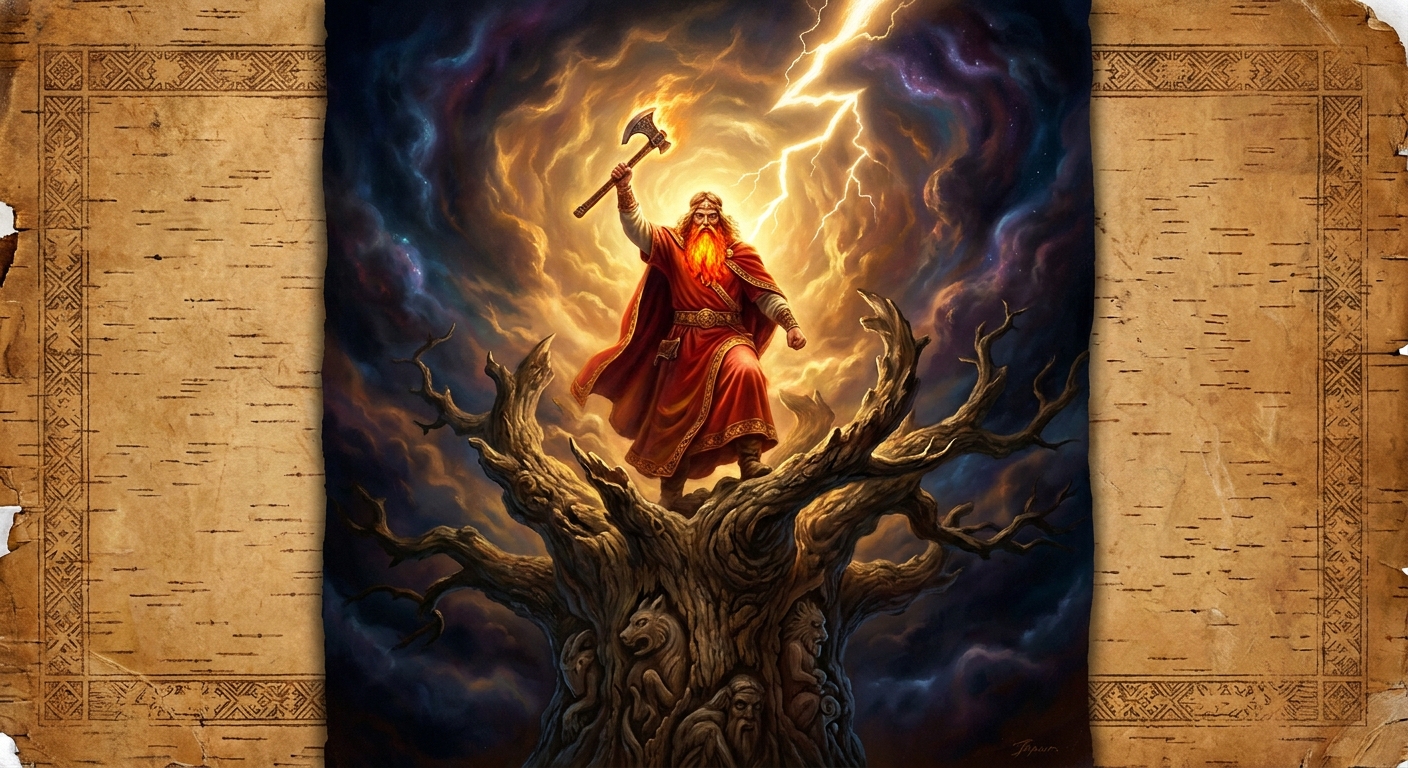
Perun and Veles: The Storm Forever
Pre-Christian Slavic religion · reconstructed from folklore, ~6th century BCE through ~10th century CE · The cosmic axis — Perun's oak at the crown of the world, Veles's swamp-roots beneath; the sky and the wet earth
Contents
Every summer thunderstorm is the same chase — the sky-god hunting the serpent through the branches of the world tree, the cattle stolen, the fire taken, the lightning falling on a house that should not have stood there.
- When
- Pre-Christian Slavic religion · reconstructed from folklore, ~6th century BCE through ~10th century CE
- Where
- The cosmic axis — Perun's oak at the crown of the world, Veles's swamp-roots beneath; the sky and the wet earth
Perun keeps the high places.
He lives at the crown of the World Oak — the cosmic tree the Slavs called the dub, whose branches divide the sky into compass points. He carries a stone axe with a bronze edge, and where the axe falls there is a smoking gash in the wood of the world. His beard is the colour of a forge that has been burning all night. He is married to Mokoš, the moist earth, the one who weaves the threads of fates while she walks the furrows.
Veles keeps the low places.
He coils in the wet roots of the same tree. He is a serpent the size of a river, or a bear the size of a hill, or a man with horns and the eyes of a swamp — the Slavs were not strict about which. He owns the dead, the cattle, the underground rivers, the songs of the gusli, the wealth that hides. He breathes mist.
They have been at war since before the first Slav uttered their names.
It begins, this time, with a theft.
Veles climbs.
He climbs the World Oak from below, slow as roots growing, slow as a marsh swallowing a cart, and reaches the high pasture where Perun’s herds graze. He takes the cattle. He takes Mokoš’s spinning. Some versions say he takes Perun’s wife herself; others say he takes only the dew, the sky’s milk, which is the same theft told smaller. He takes the fire from Perun’s hearth. He drives it all back down through the trunk into his own dripping kingdom, and he closes the swamp behind him.
The world goes dry.
The wells fail. The grain stops in its sheath. The cattle of mortals lie down in the fields and do not get up. The Slavs look at the sky and the sky has no clouds in it. The earth-mother has gone silent. The fire on the household altar gutters.
Perun comes down from the crown of the tree.
He hunts Veles through the world.
The serpent runs. He hides in a tree — Perun splits the tree with lightning. He hides in a stone — Perun cracks the stone. He hides in a cow — Perun strikes the cow. He hides in a man — and this is why, the old peasants said, lightning sometimes falls on a person who seems to have done nothing wrong. He was hiding something. He had Veles in him.
The chase is the storm.
That is the secret of every Slavic summer thunderstorm — it is not weather, it is theology in motion. The sound of thunder rolling across the steppe is the wheels of Perun’s chariot. The branched bolt is the axe descending. The rain is Mokoš weeping, or Mokoš laughing, or the dew finally coming home. The break in the cloud where the sun returns is the moment Veles has been driven back underground and the chase has paused for breath.
The Slavs went outside during storms. They did not hide from them. They stood in the doorway and watched the gods work.
Perun corners him at last in the swamp.
The water boils where the lightning enters it. The reeds burn flat. Veles, surrounded, does the only thing his nature permits — he gives back the theft. The cattle come out of the water lowing, the fire reignites on a thousand mortal hearths in a single instant, the rain begins to fall in a way that is not the rain of the chase but the rain of return, slow and warm and full. Mokoš opens her hands and the threads she had been holding tight loosen. The wells fill.
Veles is not killed. That is the point. He is driven back, beaten down, returned to his place — and his place is necessary. The dead need a king. The cattle need a winter shelter. The songs need somewhere to come from. Perun cannot rule the underworld; he would burn it dry. Veles cannot rule the sky; he would drown it.
The duel ends, every summer, with both gods alive and the world watered.
Then it begins again.
This is the third secret. The Perun–Veles myth is not a one-time creation event, like Marduk killing Tiamat or Indra killing Vritra in the Vedas. It is cyclical. Veles will steal again next year. Perun will hunt him again next year. The Slavs did not believe the storm-god had won the war once and for all in the past. They believed he was winning it right now, in the sky above their heads, and that his victory was the rain currently soaking their wheat.
It is the most agricultural theology any Indo-European people produced. Other branches put the dragon-killing in mythic prehistory; the Slavs put it on next Tuesday.
When Vladimir of Kiev raised his idol-cluster on the hill outside the city in 980 CE — Perun at the centre with a silver head and a gold mustache, surrounded by the lesser gods — Veles was not there. Veles was down at the marketplace, by the river, where the merchants swore their oaths on him because he kept the cattle and the contracts. The two gods could not share a hill. They could share a city only if one was on the height and the other in the wet.
Eight years later Vladimir threw all the idols into the Dnieper and was baptized. Perun’s idol floated downstream. Peasants on the banks reportedly cried out to it as it passed. Vydybay, bozhe! Vydybay! — Climb out, god! Climb out!
He did not climb out.
But Veles did. The serpent in the wet roots is harder to kill than the thunderer on the crown, and the underground gods always survive Christianization better than the sky ones do. Veles became Saint Blasius — Vlas, Volos — the patron of cattle, sworn on by Russian peasants until the twentieth century. Perun became Saint Elijah, riding his chariot across the sky in storms.
The duel kept happening. The names changed. The weather did not.
Folklorists in the nineteenth century, recording charms and harvest songs from old women in Belarus and Macedonia and Croatia, kept finding the same fragment surfacing: a god on a tree, a serpent in the water, a chase, a stolen herd, a returning rain. They thought they were collecting peasant superstition. They were collecting one of the oldest pieces of religion still being said out loud anywhere on earth.
Scenes
Perun on the crown of the World Oak, axe raised, beard the colour of a forge-fire — the moment before the thunderbolt falls
Generating art… Veles in the wet roots — half-serpent, half-bear, eyes the colour of swamp-water, the stolen cattle hidden behind him in the dark
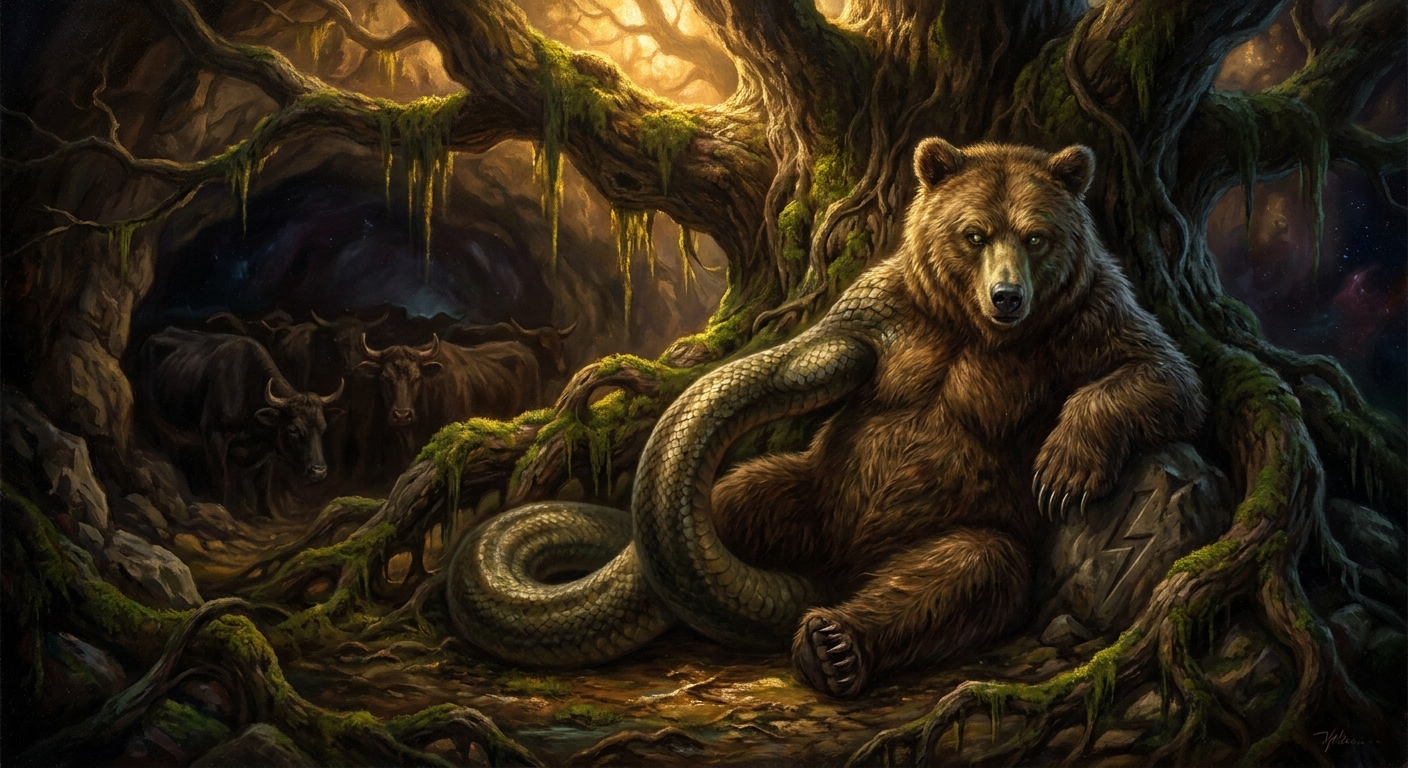 Generating art…
 The summer storm itself — the chase across the sky, lightning splitting an oak, rain breaking the drought
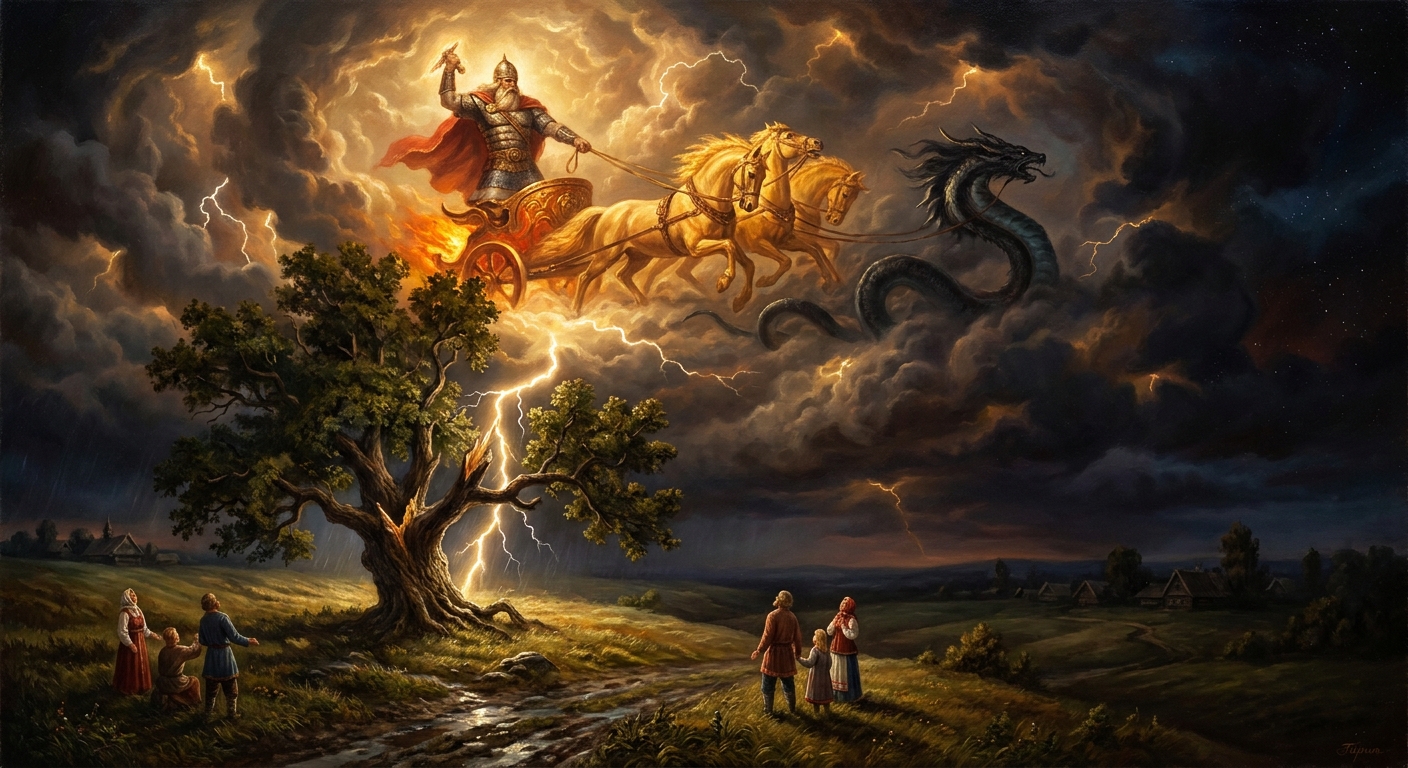 Generating art…
 Echoes Across Traditions
Entities
- Perun
- Veles
- Mokoš
- the World Oak
- Dodola
Sources
- Roman Jakobson, 'The Slavic God Veles and his Indo-European Cognates' (1969)
- Vyacheslav Ivanov & Vladimir Toporov, *Slavic Antiquities* (1974)
- Mike Dixon-Kennedy, *Encyclopedia of Russian and Slavic Myth and Legend* (1998)
- Marija Gimbutas, *The Slavs* (1971)
- *Primary Chronicle* (Povest' vremennykh let, ~1113 CE) — Vladimir's idol-list at Kiev, 980 CE