
The Peacemaker and the Great Law
Estimated 1100–1450 CE (scholars vary); understood in Haudenosaunee tradition as foundational time before European contact · The territory of the Haudenosaunee — present-day New York State, from the Mohawk Valley to the Genesee River
Contents
Deganawida is born to a virgin mother among the Huron and crosses a lake in a stone canoe to prove divine commission. He finds Hiawatha shattered by grief and teaches him the condolence ceremony. Together they confront Atotarho — the Onondaga sorcerer whose hair is living snakes — comb the evil from his mind, and found the Haudenosaunee Confederacy of Five Nations.
- When
- Estimated 1100–1450 CE (scholars vary); understood in Haudenosaunee tradition as foundational time before European contact
- Where
- The territory of the Haudenosaunee — present-day New York State, from the Mohawk Valley to the Genesee River
He is born to a virgin mother among the Huron, and the midwife who receives him knows immediately that something has come into the world that was not in the world before.
His grandmother tries to drown him three times. Three times the infant appears in the morning sitting by the fire, unharmed, watching the door. The grandmother accepts what this means and raises him, and he grows up strange — too quiet, too knowing, a boy who looks at the world with eyes that are already somewhere else. He does not speak much, when he finally speaks, his words carry a weight that makes the air feel different.
When he is grown, he tells his mother and grandmother: “I must go. There is a work given to me. I go to plant the Tree of Peace.”
He builds a canoe from white stone. This is the first proof. No stone canoe floats. His floats.
He crosses the great lake alone.
On the far shore, a woman named Jigonsaseh lives at the crossing of war trails and feeds all warriors, friend and enemy alike. She is the first person he meets in the territory of the Five Nations. He tells her: “A new way is coming. An end to war. A great peace.”
She listens. She becomes the first convert. In the tradition that follows, she becomes the Mother of Nations — the head of the clan mothers who will appoint all leaders of the confederacy, the principle of feminine wisdom at the foundation of the Great Law. Without her first yes, nothing else happens.
He continues east, into the country where blood calls for blood in cycles no one alive can remember beginning.
He finds Hiawatha alone in the forest.
What happened to Hiawatha is this: his daughters are dead. One by one, they were taken from him — through sickness, through violence, through the working of the sorcerer Atotarho, who rules the Onondaga through terror and whose mind is so corrupt that evil literally grows from his skull in the form of writhing snakes. Hiawatha went to the council three times to speak for peace, and three times Atotarho used his power to drive him away, and each time a daughter died, and now there are no more daughters and Hiawatha’s grief has become something beyond grief.
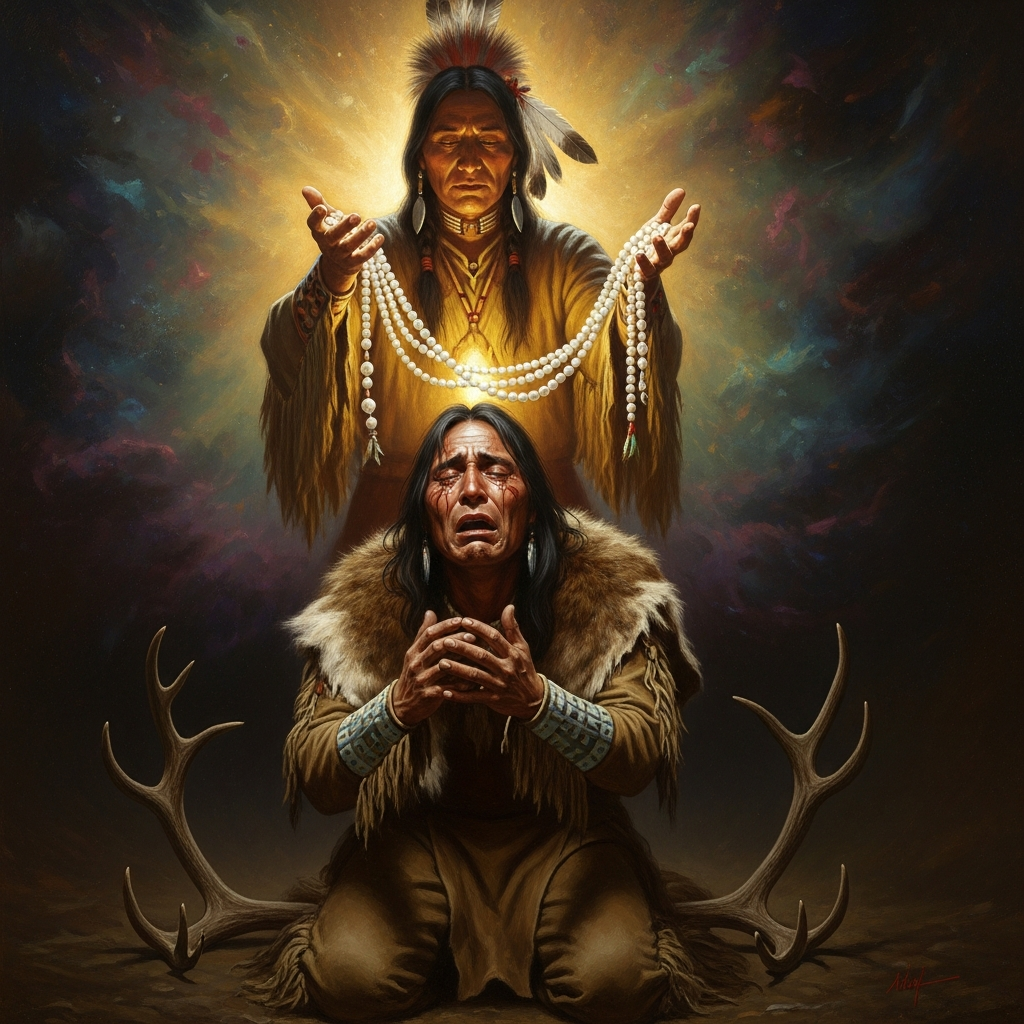
He wanders. He does not eat. He is present in his body and not present. He has assembled strings of shell beads — white and purple wampum — and he holds them and cannot use them because he cannot complete the thought. He is a man whose mind has broken along the fault line of loss.
Deganawida sits with him.
He does not speak immediately. He waits. He waits a long time, the way a person who understands grief waits — not trying to fix it or shorten it, but sitting inside it alongside the person who is suffering, acknowledging that no words yet exist that are equal to the weight.
Then he takes the strings of wampum from Hiawatha’s hands.
“I wipe the tears from your eyes,” he says, touching the wampum to Hiawatha’s face, “so that you may see clearly.”
“I remove the obstruction from your ears so that you may hear clearly.”
“I remove the grief from your throat so that you may speak clearly.”
This is the condolence ceremony — the first performance of it in the world. Deganawida invents it in real time from the recognition that no political peace is possible among people who cannot mourn their dead without being consumed by the hunger for revenge. The ceremony does not deny the loss. It does not ask anyone to forget. It does the specific work of clearing the passages of perception — eyes, ears, throat — so that a grieving person can function again in the world. So that the dead can be properly mourned and then, properly, released.
Hiawatha lifts his head.
Something has moved. He looks at the Peacemaker with eyes that are present again.
“Who are you?”
“I carry a message from the Master of Life. The message is peace. And you — you will help me bring it.”
Together they go to Atotarho.
They have gone first to the Mohawk and the Oneida and the Cayuga and the Seneca — nation by nation, council by council, singing the Great Law to the leaders the way you sing sacred things, so the mind takes them in whole rather than piece by piece. Nation after nation has said yes. The vision is the same in all of them: a great tree, a white pine, its roots running in the four directions, its top piercing the sky, and an eagle perched at its crown watching for threats to the peace. Under the tree, the leaders of all nations will bury their weapons of war.
But the tree cannot be planted without Atotarho. The Onondaga, because they sit in the center of the five nations’ territory, must hold the central fire of the confederacy. And Atotarho — twisted, terrible, his thoughts so bent toward domination and destruction that they have taken physical form as snakes — will not hear the message.
Every time they approach, the air around him is wrong.
Deganawida goes anyway.
He stands before Atotarho and sings.
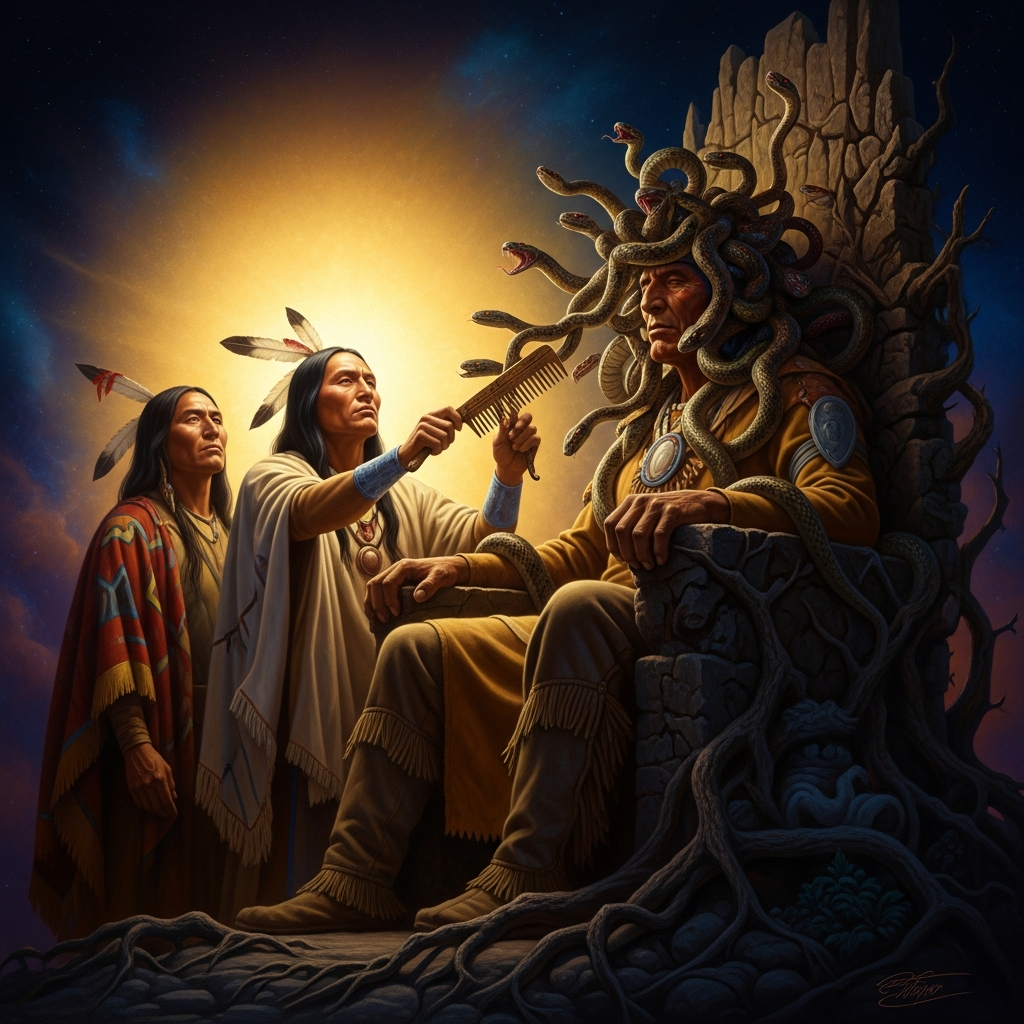
He sings the Great Law straight at the sorcerer’s twisted body — the law of the good mind, Kariwiio, the principle that good governance flows from cleared, undistorted thought. He sings while Hiawatha stands beside him holding strings of white wampum, the same wampum that cleared Hiawatha’s own grief, now prepared for a harder task.
The snakes in Atotarho’s hair begin to slow.
The sorcerer’s body, which has been contorted — some accounts say his hands were like claws, his feet twisted backward — begins to straighten. Not because Deganawida attacks the evil in him, but because he does the opposite: he sings what Atotarho was always meant to be. He names the good mind that exists in every person before it is distorted, and the naming draws it out.
Hiawatha draws the comb of peace through Atotarho’s hair.
The snakes go still. They fall. They are not snakes anymore; they are only hair.
Atotarho looks up. His eyes are clear for the first time in his life.
“You have straightened me,” he says.
“Yes,” says Deganawida. “And now you will be the firekeeper. You will call the councils. You will chair the Great Peace. You were not destroyed, because you were never only what you had become.”
The Tree of the Great Peace was planted at Onondaga.
The five nations buried their weapons beneath its roots — the Seneca (Keepers of the Western Door), the Cayuga, the Onondaga (Keepers of the Fire), the Oneida, and the Mohawk (Keepers of the Eastern Door). Later, the Tuscarora joined as a sixth nation. The Great Law established a bicameral council of fifty chiefs, appointed by clan mothers who could remove them for cause, operating by consensus rather than majority rule. It established freedom of religion, the rights of women as political agents, and the principle that leaders must think seven generations ahead before making decisions.
The Haudenosaunee Confederacy has met in continuous council since the tree was planted. It meets still.
What the Peacemaker built was not a treaty. Treaties can be broken. He built a way of being in right relationship — with each other, with the land, with the future. He built it from a grieving man’s wampum strings and a sorcerer’s straightened body. He built it on the principle that no peace is real that does not first honestly perform the work of mourning.
That, say the Haudenosaunee, is why it has lasted.
Scenes
Deganawida steps into a white stone canoe and it does not sink
Generating art… Hiawatha kneels in grief so deep it has become madness
 Generating art…
 Deganawida and Hiawatha stand before Atotarho, whose hair writhes with living serpents
 Generating art…
 Echoes Across Traditions
Entities
- Deganawida (the Peacemaker)
- Hiawatha
- Atotarho
- Jigonsaseh (Mother of Nations)
- the Five Nations
Sources
- Paul A. W. Wallace, *The White Roots of Peace* (1946)
- Arthur C. Parker, *The Constitution of the Five Nations* (1916)
- Bruce Johansen, *Forgotten Founders: How the American Indian Helped Shape Democracy* (1982)
- John Mohawk, *Utopian Legacies: A History of Conquest and Oppression in the Western World* (2000)
- Haudenosaunee Confederacy official oral tradition as recorded by Onondaga faith-keepers