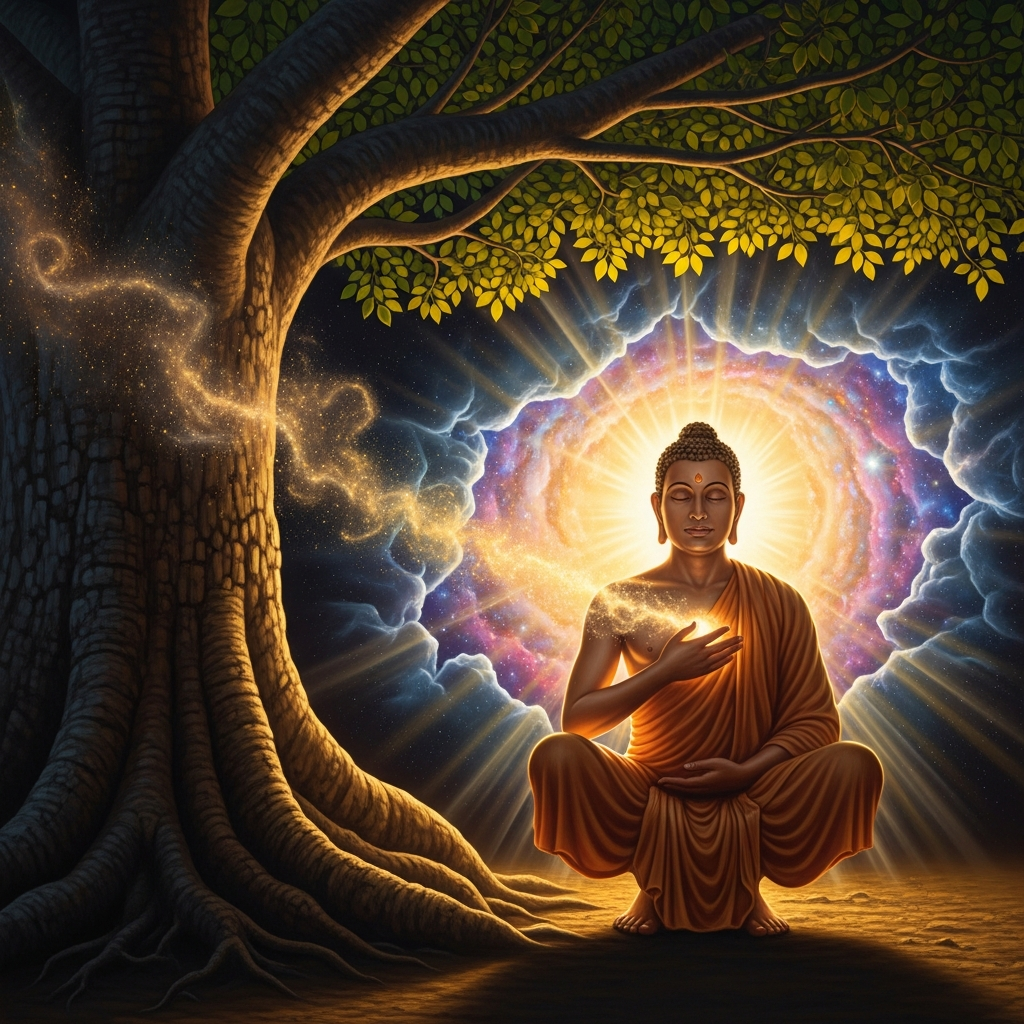
The Princess on the Threshold
c. 600 BCE · the kingdom of Vatsa, north India · Kausambi, capital of Vatsa, on the Yamuna river — during the wandering ascetic period of Mahavira
Contents
A princess sold into slavery, beaten and starved, has been keeping a six-month fast under conditions Mahavira himself has set without telling anyone. On the seventh day, with shaved head and iron chains and a bowl of plain boiled lentils on a clay potsherd, she stands on a threshold — half-inside, half-outside, exactly as the unspoken vow requires — and offers him the meal that no one else has been able to.
- When
- c. 600 BCE · the kingdom of Vatsa, north India
- Where
- Kausambi, capital of Vatsa, on the Yamuna river — during the wandering ascetic period of Mahavira
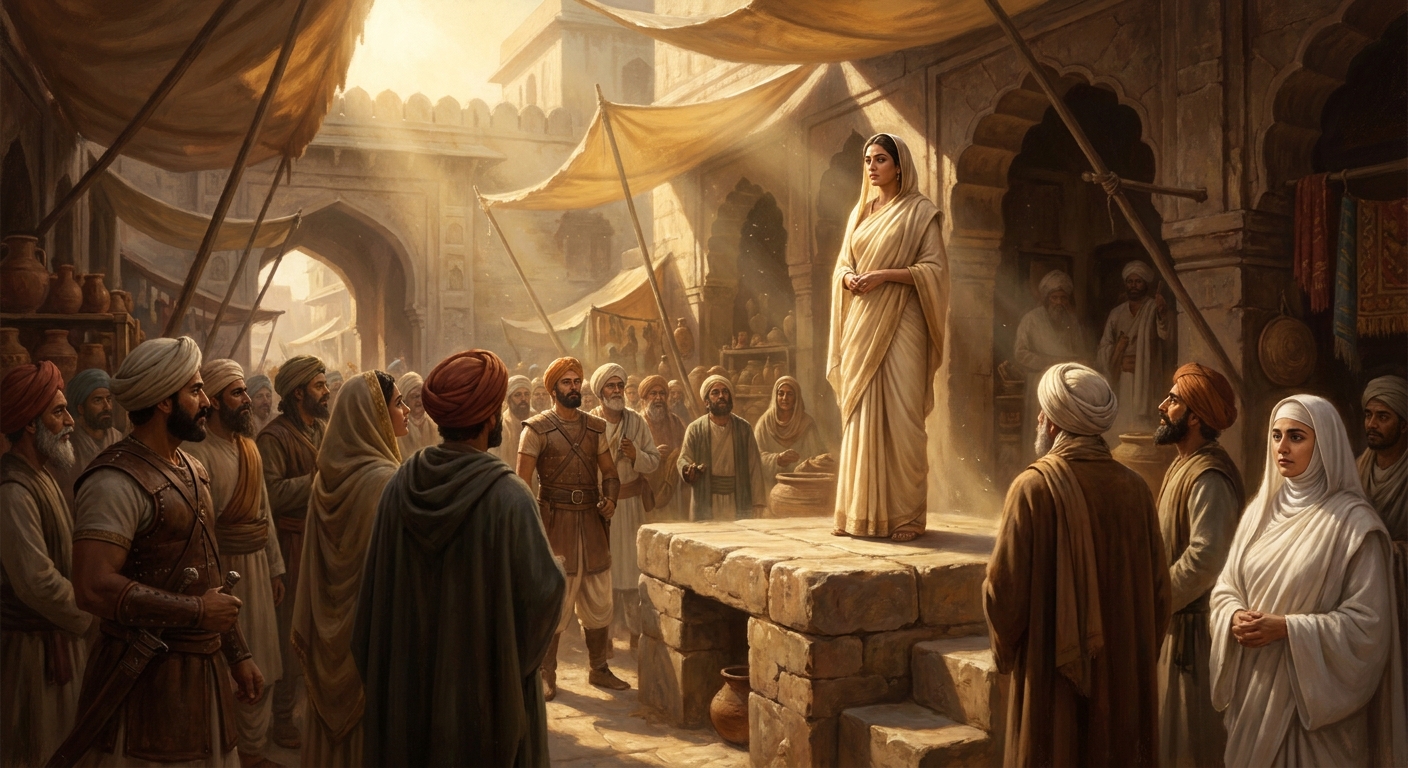
Champa, the kingdom of Anga. The siege has just ended.
King Shatanika of Vatsa has taken the city. The royal household has been broken. King Dadhivahana is dead. His widow Queen Dharini, refusing the harem, has killed herself with a knife she kept in her sleeve. Their daughter, Princess Vasumati — sixteen, beautiful, calm in a way that disturbs the soldier who has captured her — is taken to the slave market at Kausambi and put up for sale.
A wealthy merchant, Dhanavaha, sees her standing on the platform. He is forty, childless, kind. He pays the price without bargaining. He brings her home and tells his wife Mūla: This is our daughter now. We have been given a daughter.
He renames her Chandana — sandalwood — for the composure of her face. The household calls her Chandanbala.
For a year, this works. She helps in the kitchen. She reads to Dhanavaha in the evenings. She does not speak of the war.
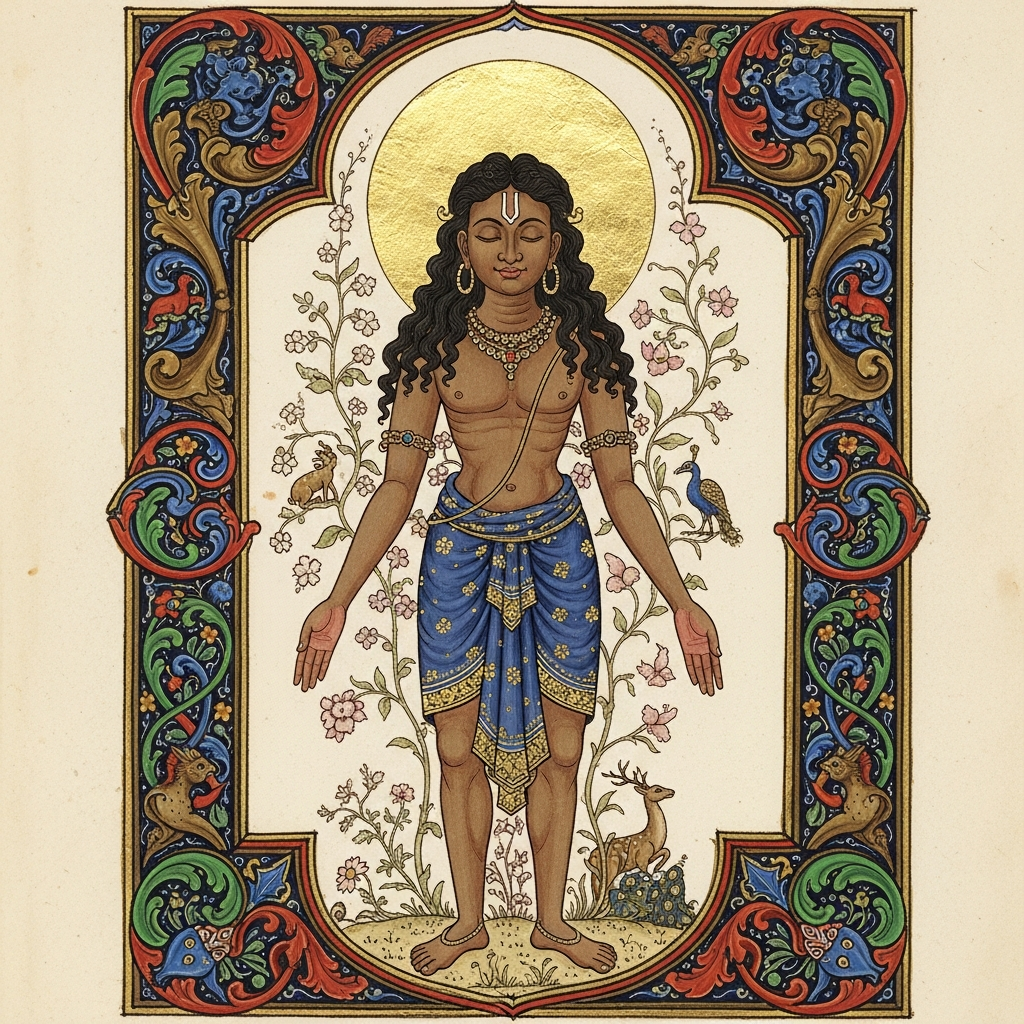
Then one summer afternoon, Dhanavaha returns from the market dusty and tired. Chandana, seeing no servant nearby, kneels and washes his feet herself. While she works, a strand of her hair slips from its tie and falls across the basin. She tucks it back. Dhanavaha, with a father’s affection, helps her with it.
Mūla is watching from the doorway.
The next morning, while Dhanavaha is away on a business trip to Ujjain, Mūla calls the barber.
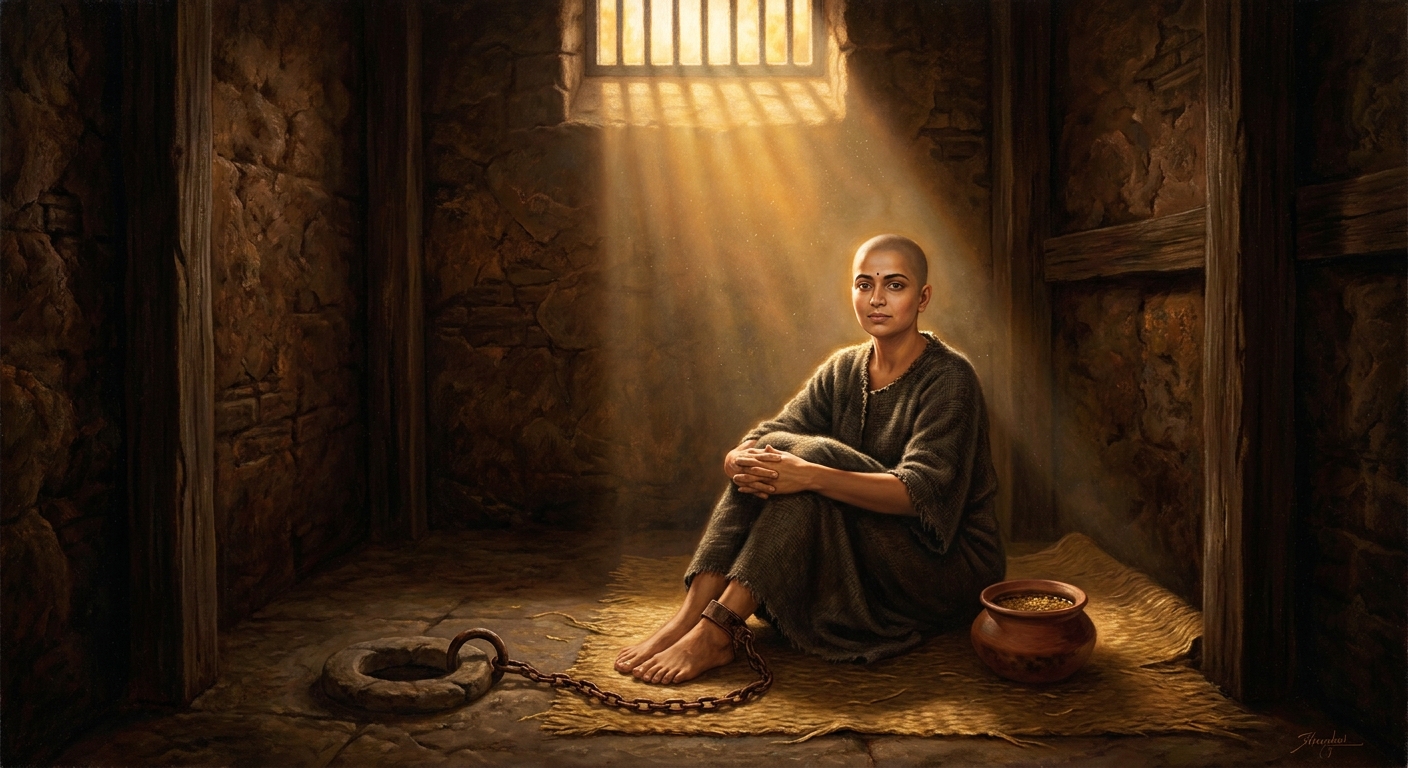
She has Chandana’s head shaved bare. She has the iron chains brought from the storehouse and locked around the girl’s ankles. She has her dragged into the cellar — the underground room where rice was stored before the new granary was built — and the door bolted from outside. She tells the household: No one is to feed her. No one is to give her water. Anyone who opens this door will be beaten.
Mūla then leaves on a pilgrimage to her natal village, three days away, so that no one can ask her to relent.
Chandana sits in the dark in the chains. She does not weep. She does not call out. She has been a queen’s daughter; she has been a slave; she is now this. The Jain ethic has not yet been taught to her — Mahavira is wandering somewhere between Vaishali and Kausambi at this very moment — but something in her, the chronicles say, had already begun the practice without yet knowing its name.
She does not eat. She does not drink. The servants whisper at the door. She tells them, gently, not to risk Mūla’s anger for her sake.
The first day passes. Then the second. Then the third.
Dhanavaha returns from Ujjain on the fourth day.
The household is silent in a way that means something is wrong. He looks for Chandana. He cannot find her. He asks. The old housekeeper, weeping, points at the floor of the storeroom. He breaks the bolt with a hammer himself.
She is alive. She is a shaved head, two iron chains, and a pair of unmoved eyes in the dark.
He carries her out. He looks for food. The kitchen has been locked by Mūla; the servants have been forbidden to enter. The only thing he can find anywhere in the house is, in a clay pot in the corner of the storeroom, a handful of kulattha — coarse black horse-gram lentils, the food given to plough oxen, never to people. He boils them in plain water on a small fire. He pours them into a broken clay potsherd because Mūla has taken even the wooden bowls. He sets it before her.
He says: Eat, my daughter. I will go for the blacksmith and have these chains struck off. He runs.
Chandana looks at the potsherd. She is hungrier than she has ever been. She has not eaten in months — though no one in the household has counted, what is happening here is not merely four days of starvation but the climax of a much longer fast that her own body has been performing without comment.
She does not eat.
She has, that morning, made a vow.
She has made it silently, in the dark, with no witness — abhigraha, the unspoken resolution that Jain practice considers the highest form of austerity because no one but the practitioner can verify it. She has resolved: I will not eat unless an ascetic appears at the threshold, unless he is keeping the conditions I have named in my heart, unless I can offer him this food on a clay sherd, with my head shaven, in chains, with my body half-inside and half-outside the doorway, and unless he will accept it.
She does not know that on the same morning, six miles away, Mahavira — wandering in his thirteenth year of asceticism — has himself adopted the silent vow that he will not eat that day unless he encounters a princess with a shaven head, in chains, weeping, offering boiled horse-gram on a broken potsherd, standing on a threshold.
Both vows are unspoken. Neither knows the other exists.
It is the sixth month of Chandana’s fast.
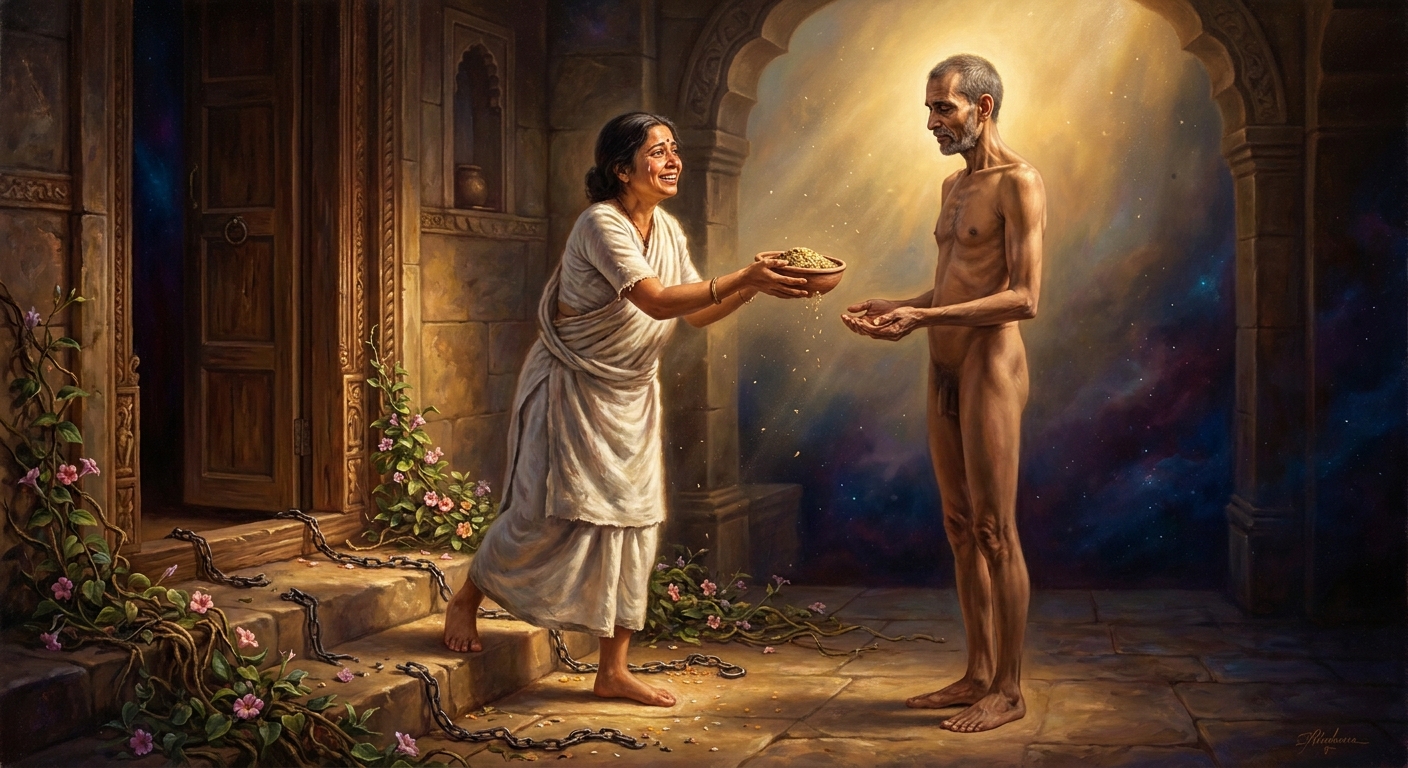
She sets the potsherd on the doorstep. She arranges herself: one foot inside the room, one foot in the courtyard. The chains hold her in place. The shaved scalp catches the noon light. She does not eat.
Mahavira walks down the lane.
He passes the door. He has been refused at every house in Kausambi for five and a half months. The conditions of his vow have not been met by a single offering in any kingdom. His face, the Acaranga says, is the face of a man who has stopped expecting anything.
He passes Chandana’s threshold. He walks three paces beyond. Then he stops.
He turns around.
He retraces the three paces. He stands in front of her. The shaved head matches the vow. The chains match. The potsherd matches. The threshold matches. The food — boiled horse-gram, the food of oxen — matches. He waits.
There is one condition unfulfilled.
She has not yet wept.
He turns to walk away.
Chandana sees him turning. She has not understood, exactly, what is happening, but she understands that something is happening, and that she has missed it. The injustice of having waited six months and met the test in every detail and still being passed over breaks something in her that the chains and the shaved head and the cellar did not. Tears come.
He turns back. He receives the food.
The lentils are gone in a single offering.
The earth, the Kalpa Sutra says, responds. A rain of jewels and gold and divine flowers falls on the courtyard. Drums sound from no source. The chains on her ankles fall away. Her hair grows back to her waist in the time it takes to draw a breath. The royal princess and the cellar slave and the ascetic with the unspoken vow are, for an instant, the same person being seen by the same gaze.
Mūla returns from her pilgrimage that evening to find the courtyard full of marigolds, the iron chains in a melted heap by the door, her husband weeping, and her household kneeling.
The next morning Chandana — no longer slave, no longer princess — walks to where Mahavira sits beneath a tree on the riverbank. She asks for ordination. He gives it. Her hair is shaved a second time, this time as a vow rather than a punishment. She is given the white robes of a sadhvi, the bowl of a mendicant, the five great vows of nonviolence, truth, non-stealing, celibacy, and non-possession.
She is the first nun of the order.
The order grows.
Chandanbala will lead it for the rest of her life. By the time of Mahavira’s parinirvana twenty-eight years later, the sangha will count fourteen thousand monks and thirty-six thousand nuns — the female order under Chandanbala outnumbering the male order more than two to one, an imbalance the Jain tradition has carried, with no surviving full explanation, for twenty-five centuries.
Her fast — six months on horse-gram and water, ended by an offering on a threshold — becomes the prototype of chha-masi tap, the six-month austerity reenacted by Jain women on every continent the diaspora has reached. The conditions of the abhigraha — the unspoken vow that the world either meets or does not — become the central technology of Jain practice. You do not announce. You do not advertise. You set the conditions in your own heart and let the world find them.
If the world finds them, you have eaten.
If it does not, you have practiced.
The threshold is the precise image. Chandanbala stands neither inside nor outside; the food is on a sherd that is neither pot nor plate; the food itself is neither human nor inedible; the giver is neither slave nor princess; the receiver is neither householder nor god. Every Jain category the story touches is bisected.
The Acaranga Sutra preserves the bare outline. The Kalpa Sutra embellishes. Hemacandra’s twelfth-century elaboration adds the rain of jewels. Modern scholars argue about which layers are original and which are accretion. The bone of the story — the unspoken vow met by a stranger’s unspoken vow, the shaved head, the chains, the lentils, the threshold — has been the same in every recension.
The Jain claim is that the universe is not random. It is full of unspoken vows, intersecting at thresholds, recognized only at the moment of weeping. Chandanbala stands at the first one.
Scenes
Champa, after the war
 Generating art…
 Mūla, the merchant's jealous wife, shaves Chandana's head and chains her in the cellar with no food and no water
 Generating art…
 Day 175 of the fast
 Generating art…
 Echoes Across Traditions
Entities
- Chandanbala (Vasumati)
- Mahavira (the 24th Tirthankara)
- Mūla, the merchant's wife
- Dhanavaha, the Kausambi merchant
- King Shatanika of Kausambi
Sources
- *Acaranga Sutra* (oldest layer c. 4th-3rd c. BCE), Book II, *Bhavana* lecture
- *Kalpa Sutra* of Bhadrabahu (c. 2nd c. BCE), the lives of the Tirthankaras
- Hermann Jacobi (trans.), *Jaina Sutras*, *Sacred Books of the East* vols. 22 and 45 (Oxford, 1884-1895)
- Padmanabh S. Jaini, *The Jaina Path of Purification* (University of California, 1979), ch. 1
- Paul Dundas, *The Jains*, 2nd ed. (Routledge, 2002), ch. 2
- *Trishashti Shalaka Purusha Charitra* of Hemacandra (12th c.) — narrative elaborations