Amaterasu Withdraws from the World
Mythic Time — the age before the sun had learned it could not simply stop · Ama-no-Iwato — the heavenly rock cave
Contents
After Susanoo's violent rampage devastates the heavenly paddies and kills a weaving maiden, the sun goddess locks herself inside the Ama-no-Iwato cave. The world goes dark. Eight million kami gather outside the boulder and Ame-no-Uzume performs a bawdy, ecstatic dance that makes all the gods laugh. The comedy — not grief, not force — saves the world.
- When
- Mythic Time — the age before the sun had learned it could not simply stop
- Where
- Ama-no-Iwato — the heavenly rock cave
The weaving maiden is the one who makes it real.
Susanoo has been making noise in heaven for months before it goes this far. He wept so long for their dead mother Izanami — so loudly, for so many consecutive days — that the mountains shook and the rivers dried and the sea convulsed with the excess of his grief. Amaterasu kept working. She planted the paddies of the High Plain of Heaven herself, in the spring fields, marking the rows with the particular care of a creator who understands that the world does not sustain itself. She ran the sacred weaving hall. She organized the rituals. She did what the ruler of heaven does, which is everything, constantly, without acknowledgment.
Then Susanoo came to say goodbye.
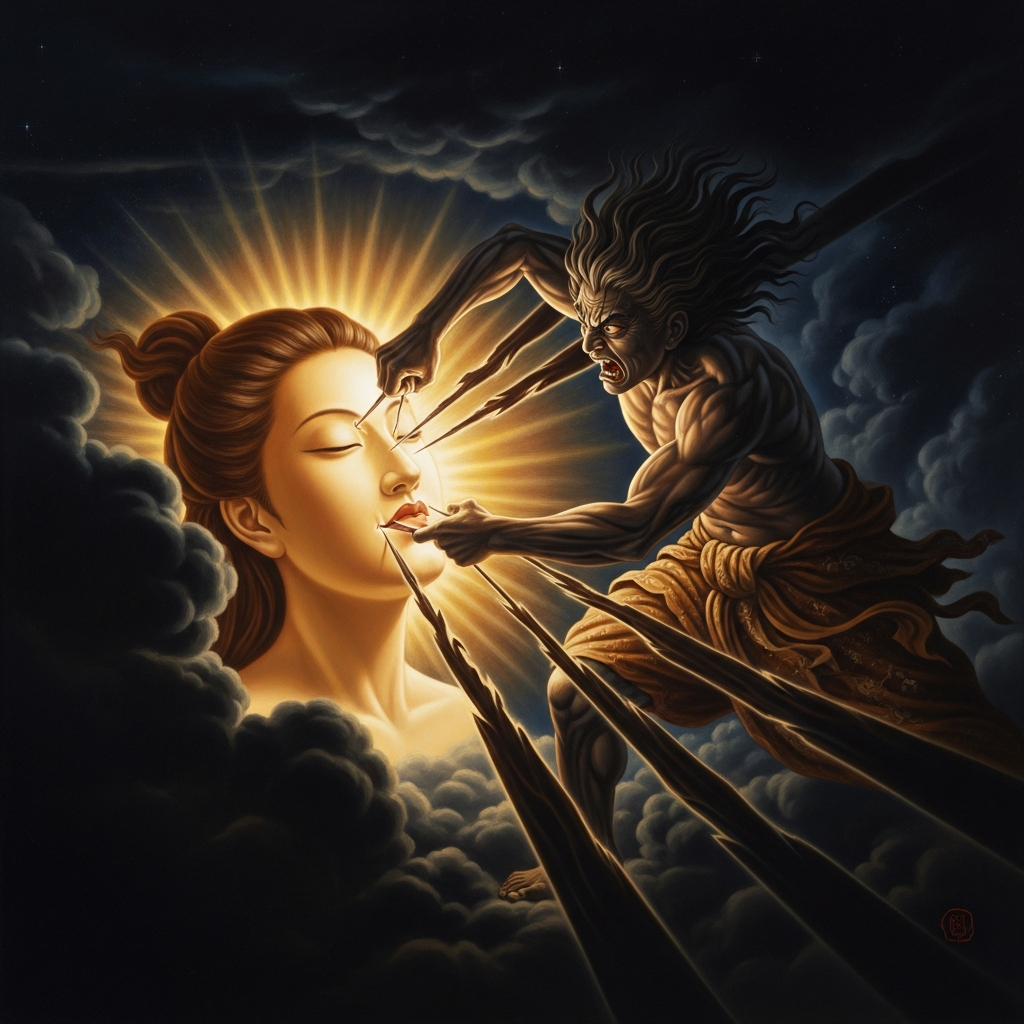
He was being expelled — the storm god’s grief had become too loud for heaven to contain — and he came to his sister’s hall to make his farewell, and in the making of his farewell he dismantled everything she had built. He tore out the ridges between her paddy fields and buried the irrigation ditches under mud. He defiled the hall where the sacred garments were woven by throwing a flayed horse through the roof. The weaving maiden — her name is not in the record, which is its own comment — died in the chaos. A weaving shuttle driven through flesh, or the shock and fall, or something the Nihon Shoki is too careful to specify. A woman who was doing her work in a sacred hall died because a god could not grieve quietly.
Amaterasu was armed and ready when Susanoo arrived; she had heard him coming. She watched what happened. She had been watching what happened for months.
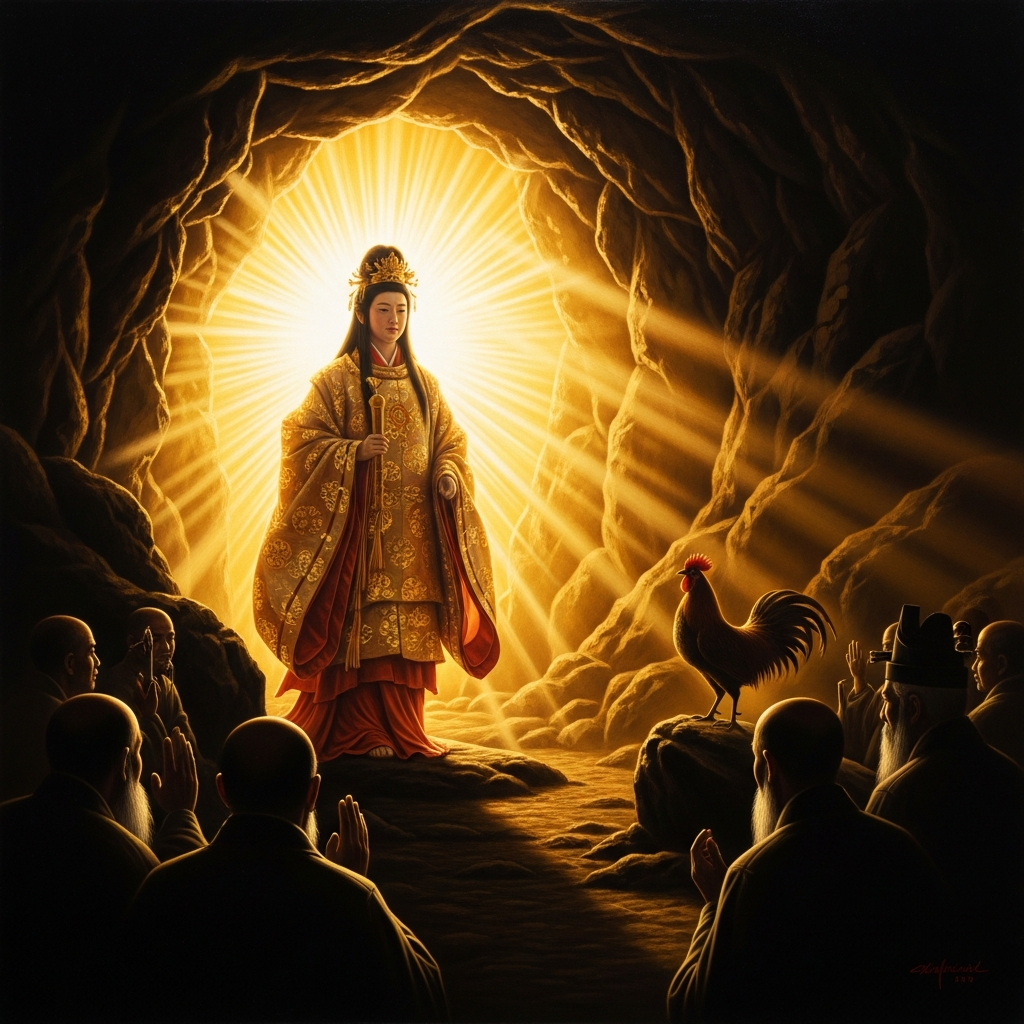
She found the cave. She went in. The boulder rolled into place behind her.
The world does not adjust gradually to the absence of the sun. It stops.
Paddies that were mid-growth go still. Herons freeze in the shallows. The particular gold of morning light over water — that specific quality of light that Japan will later call komorebi when it falls through trees, that quality that painters and poets and scroll-makers will chase for two thousand years — disappears without leaving a memory of itself. Stars appear in the middle of the day. The moon is confused. Evil spirits, which had been skulking at the edges of things, walk openly through the streets of heaven and through the rice fields of earth and through the minds of creatures that were not designed to withstand unbroken dark.
Amaterasu is not sorry.
This is the important thing to hold: she is not having a breakdown. She is not overwhelmed. She is a creator goddess who has been sustaining the world while her brother destroyed what she made, and she has made a rational assessment and decided that the world, at this particular moment, can manage without her. The grief and the anger have hardened into something colder and more deliberate. She has pulled the boulder shut and sat down in the black and she is waiting to see if anyone is going to do anything about the weaving maiden.
Eight million kami gather on the plain of heaven outside the rock.
Yaoyorozu no Kami — literally eight million gods, though the Japanese mean something closer to all the gods there are, every spirit of every river and mountain and doorpost and old tree, crowded onto the plain in the dark, arguing. They argue the way committees argue when the problem is both urgent and impossible: loudly, without consensus, circling back to the same failed proposals.
Omoikane is not a god of great power. He is a god of great cleverness, which in a crisis is more useful. He calls them to order. He lists what they will need: a mirror of specific size and quality, the long-singing birds to crow at the right moment, a jewel, sacred grasses, bonfires lit along the plain, and Uzume.
The list goes quiet when he gets to Uzume.
She is already there.
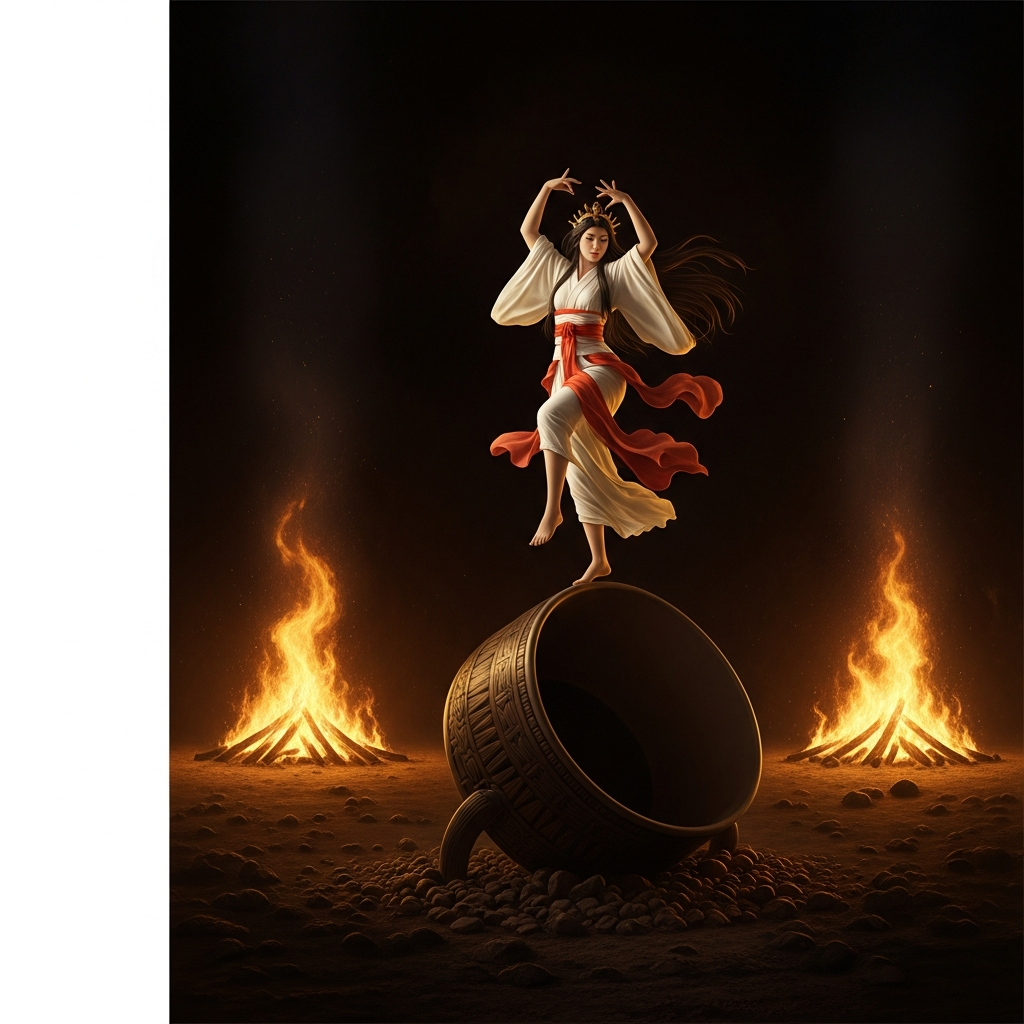
Ame-no-Uzume is the goddess of dawn and festivity and the particular kind of joy that breaks through grief when nothing else has worked — the laughter at a funeral, the joke made in extremity, the sudden inappropriate lightness that is the first sign that a person is going to survive. She overturns a wooden tub in front of the boulder. She climbs on top of it. She holds the sacred grasses and the torch of the tachi-hana tree and she begins.
The Kojiki says that she became divinely possessed and that her clothing became disordered. The Nihon Shoki is slightly more specific and slightly more euphemistic about what disordered means. The medieval commentators are more specific still, in the way that medieval commentators often are when court decorum forces the original text into compression. What Uzume does on the overturned tub in front of the cave of Ama-no-Iwato is the first recorded performance of something the Japanese will later call sarugaku, the monkey music, the bawdy theatrical tradition that will become Noh and then Kyogen — comedy, buffoonery, the body making itself ridiculous in front of an audience.
She stomps on the tub until it thunders. She pulls at her robes. She makes faces. She improvises. She is working without a script in total darkness in front of eight million bewildered deities and she does not stop.
The gods begin to laugh.
Not all at once. First one, then a cluster, then a wave. The laughter is not polite. It is the uncontrolled kind, the kind that takes over a body before the body has decided whether it wants to laugh, the kind that eight million gods laughing in concert turns into a physical event. The plain of heaven shakes. The sound rolls outward in every direction like the pressure wave of something detonating, and it hits the boulder of Ama-no-Iwato and passes through it.
Inside the cave, Amaterasu hears it.
She has been sitting in the dark waiting for something to happen. She had not been specific about what that something should be. She had not imagined eight million gods laughing in the dark outside her cave. She can hear the laughter and she cannot hear a reason for it — the world is dying, the rice is not growing, the evil spirits are walking in the open — and the laughter is coming from the direction of the boulder, from the direction of everyone who should, by rights, be as grim as she is.
She moves toward the noise.
She is curious. This is the deepest fact about Amaterasu, the one the myth is really about: she is a goddess of light, and light is always curious. Light always finds the crack. Light is constitutionally incapable of sitting still in the dark when there is a crack available to investigate. She moves to the boulder. She does not know this is what she is doing. She thinks she is listening.
The boulder shifts. A crack appears.
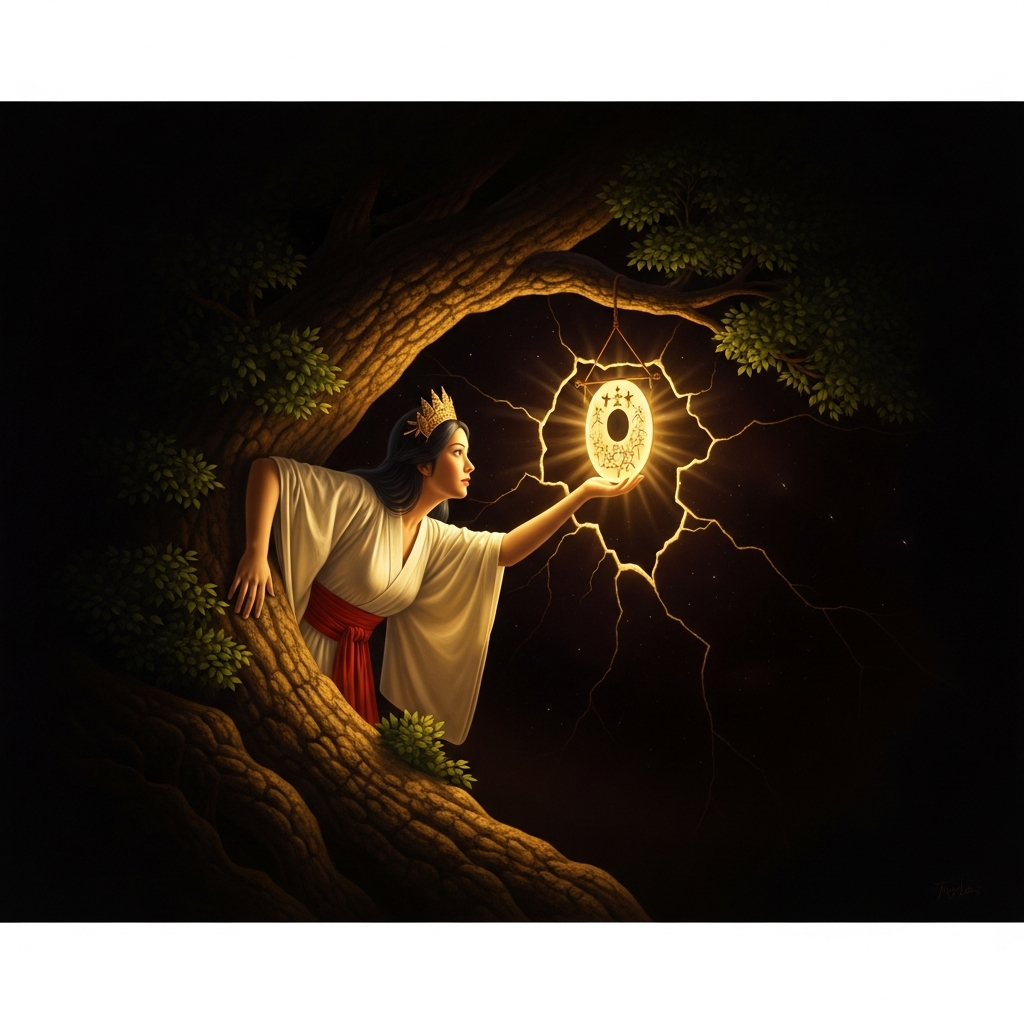
Her own light leaks out around the edges of the stone — the same light the world has been missing, now pouring through a gap no wider than a hand. The long-singing birds begin to crow all at once. The bonfires flare. And there, in the line of light from the crack, something gleams.
Omoikane has hung the Yata no Kagami from a sacred sakaki tree directly in front of the entrance. The mirror is large and precisely made, polished to hold light the way a lake holds the moon. As the crack widens, as Amaterasu leans out to see what there is to see, the mirror catches her light and throws it back at her.
She stops.
There is another sun.
She thought she was the sun — the only one, the thing that light meant. But the mirror shows her a radiance as bright as she is, looking back with the same expression she must be wearing, which is the expression of someone encountering the entirely unexpected. She leans out further. The strong god Ame-no-Tajikarao, who has been waiting in the shadows beside the boulder, takes her hand and pulls. The jeweled rope of Futodama is drawn across the entrance behind her — you cannot go back in; the rope says you have already come out; the gods are sorry about the rope but it is necessary.
The sun floods back into the world.
Susanoo is found and punished. His beard is cut, his fingernails extracted, and he is expelled from heaven — this time permanently, which is what permanent means when the expulsion involves fingernails. He descends to Izumo. The weaving maiden is not restored to life. The paddies grow again. The evil spirits retire to the margins.
The mirror goes to Ise, where it is kept today in perpetual darkness inside the inner sanctum of the Grand Shrine — wrapped in cloth, unseen, not displayed, not unsheathed, existing as the thing that once held the light of the sun when the sun needed to see itself from the outside.
What the mirror showed Amaterasu is still argued over. Some commentators say it showed her nothing but her own reflection, and the surprise was simply one of angle. Some say the kami arranged the mirror so the light would appear to be a separate divine presence — a deception so well executed that even a goddess of the sun could not see through it. Motoori Norinaga, the eighteenth-century scholar who spent his life in the Kojiki, did not think it was a deception. He thought the mirror showed her exactly what it was supposed to show: the world’s need for her, reflected back at her in the form of her own brightness.
The story is usually told as a rescue — the gods rescue the sun from her own anger. But the Kojiki is more careful than that. No one compelled Amaterasu. No one overpowered her. No one argued theology with her or made promises about her brother’s behavior or offered reparations for the weaving maiden.
What worked was a dance. What worked was a goddess making herself ridiculous on an overturned tub in total darkness while eight million deities laughed until the plain of heaven shook.
Grief could not do it. Force could not do it. Argument could not do it. Solemnity had been tried, implicitly, for the entire duration of the dark, and solemnity had not worked.
What worked was Uzume — the dawn goddess, the festivity goddess, the one who knows that the body laughing is the body insisting on its own continuity. You cannot mourn forever in the presence of laughter. Even a sun goddess cannot stay in a cave when everyone outside is having a better time than she is.
The comedy saved the world. This is the Shinto answer to the problem of divine withdrawal: not prayer, not sacrifice, not the correct ritual form. The correct ritual form was Uzume on a tub, doing something the Nihon Shoki still cannot quite bring itself to describe directly, in the dark, for an audience of eight million.
Curiosity is stronger than grief. Joy is louder than the dark. The sun came out.
Scenes
Susanoo tears the ridges from Amaterasu's sacred paddies, fills the irrigation ditches with mud, and defiles the weaving hall
 Generating art…
 Ame-no-Uzume dances atop an overturned tub in the darkness outside the Ama-no-Iwato cave
 Generating art…
 The crack of light widens
 Generating art…
 Echoes Across Traditions
Entities


Sources
- Donald L. Philippi (trans.), *Kojiki* (University of Tokyo Press, 1968)
- W.G. Aston (trans.), *Nihongi: Chronicles of Japan from the Earliest Times to A.D. 697* (Tuttle, 1972)
- Carmen Blacker, *The Catalpa Bow: A Study of Shamanistic Practices in Japan* (Allen and Unwin, 1975)
- Joseph Kitagawa, *Religion in Japanese History* (Columbia University Press, 1966)
- Motoori Norinaga, *Kojikiden* (Commentary on the Kojiki, 1764–1798)