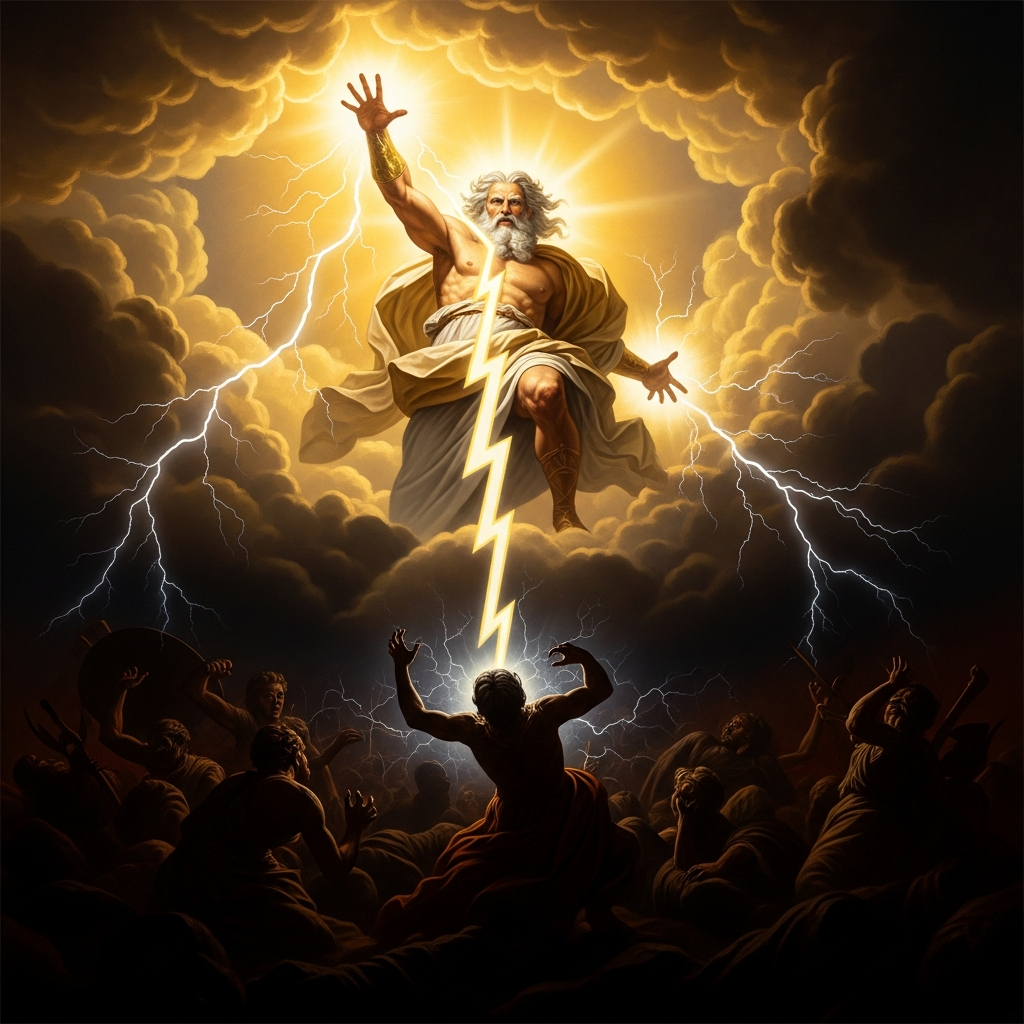
Zeus's Twofold Revenge
Mythic Time · the inheritance described in Hesiod, ~700 BCE · Mecone, Olympus, the Caucasus, the house of Epimetheus
Contents
Prometheus tricks Zeus twice — first at the sacrifice at Mecone, then by smuggling fire down the mountain in a hollow stalk of fennel. Zeus answers with two punishments at once: the Titan to a rock in the Caucasus, and the first woman, Pandora, sent to humanity with a sealed jar. The fire and the jar arrive together. Hesiod is explicit: this is one act of vengeance, not two.
- When
- Mythic Time · the inheritance described in Hesiod, ~700 BCE
- Where
- Mecone, Olympus, the Caucasus, the house of Epimetheus
It begins with a meal at Mecone.
The gods and mortals are still close enough to share a table. There is a dispute about how the meat should be divided at sacrifice — which portions go to heaven, which stay below — and Prometheus is appointed to settle it. He kills an ox. He divides it into two heaps.
The first heap is the bones, but he wraps them in glistening fat — a parcel that looks rich, looks heavy, looks like a feast. The second heap is the actual meat, but he disguises it with the ox’s stomach, which is ugly. He invites Zeus to choose.
Zeus chooses the fat-wrapped bones.
He sees through the trick — Hesiod is careful about this; the king of the gods is not deceived, only outraged at being tested — and from that day forward, mortals burn bones and fat for the gods at sacrifice and keep the meat for themselves. The trick is permanent. The grievance is also permanent.
Zeus takes fire from humanity in retaliation.
He removes it carefully.
Not all at once. He withdraws it from every hearth in Greece, the way a tide withdraws — present in the morning, gone by evening. The cooking-fires die. The forges go cold. The lamps stop being lamps. Mortals huddle in the dark and the dark is colder than it has been. The cold is the mid-step of Zeus’s first move. The cold is also a question: what will Prometheus do now.
Prometheus does what Forethought always does.
He climbs Olympus by an unknown path. He passes the wheel of Helios’s chariot — the wheel still hot from the day’s run — and he carries with him a stalk of narthex, the giant fennel that grows in the dry hills, hollow at the core. He lights the fennel from the chariot’s wheel. The pith inside the stalk catches fire. The outside of the stalk does not — that is the cunning of fennel, and the cunning of Prometheus, who chose the plant because it would carry an ember down the mountain like a candle inside a lantern.
He walks down with the stalk in his hand.
He returns the fire to humanity. He is careful about the distribution: every household, every village, every island. Within a single night, the cooking-fires are back. The forges glow. Greece has its fire again, brought down from heaven inside a weed.
Zeus, on Olympus, looks down. He sees the lights coming back, scatter by scatter, across the dark earth. He understands that he has been outmaneuvered a second time. He does not rage. He calculates.
The calculation is the heart of the myth.
A lesser god would chain Prometheus and consider the matter closed. Zeus is not a lesser god. He understands that the punishment of a giver, however severe, does not undo the gift. The fire is loose in the world. Mortals are warm. They are forging. They are stepping out from under the original cold the way a man steps out from under a winter cloak when the spring comes. Punishing Prometheus does not put the cold back.
Zeus needs a second punishment that travels along the gift.
He summons Hephaestus.
The god of the forge — using the same fire Prometheus stole, which is the first irony Zeus enjoys — takes deep clay from a riverbed and shapes a woman. Each Olympian contributes. Athena dresses her. Aphrodite glazes her with desire. Hermes folds deceit into her speech. The Charites and the Horai add adornment. Every gift is a refinement; every refinement is a hook. They name her Pandora — all-gifted, all-given — and Zeus puts a sealed jar into her hands.
She is the second move.
He sends her down the mountain.
Prometheus has warned his brother.
Epimetheus — Afterthought — is the slow twin, the one who can only see what has just happened. Prometheus has told him, more than once, in clear language that an ordinary man could not have made clearer: do not accept any gift from Zeus. Whatever it is, refuse it. Send it back. Pretend you are not at home.
Epimetheus nods. Epimetheus, by his nature, will fail.
Pandora arrives at the door. The light catches her hair in the way the Charites planned. She looks at Epimetheus the way Aphrodite arranged for her to look. He opens the door.
He accepts the gift.
This is the moment the punishment lands. Not when the jar is opened — that comes later — but in the doorway, in the failure of Afterthought to do what Forethought told him to do. The jar is now inside the house. Whatever happens to it next is incidental to the fact that the trap is already sprung.
Pandora lives in the house with the sealed jar.
On the same morning, Hephaestus arrives in the Caucasus.
He carries chains of adamant — the unbreakable metal, denser than bone — and he binds Prometheus to the rock face that Zeus has selected. Prometheus does not resist. He has known this would be the shape of his punishment since before he climbed Olympus. He chose the fennel anyway. Forethought includes its own consequences and proceeds anyway; that is what makes it Forethought rather than mere prudence.
The eagle arrives at noon.
Wings like storm clouds. Talons like sword-blades. It opens his side and tears the liver out — the organ the Greeks believed was the seat of feeling, the warm engine of the body — and it eats. By sunset Prometheus is empty. By sunrise the liver has regrown. By noon the eagle returns. The cycle is the cycle, day after day, with no terminus written into the sentence.
In the house of Epimetheus, the jar sits in the corner.
Pandora does not open it on the first day.
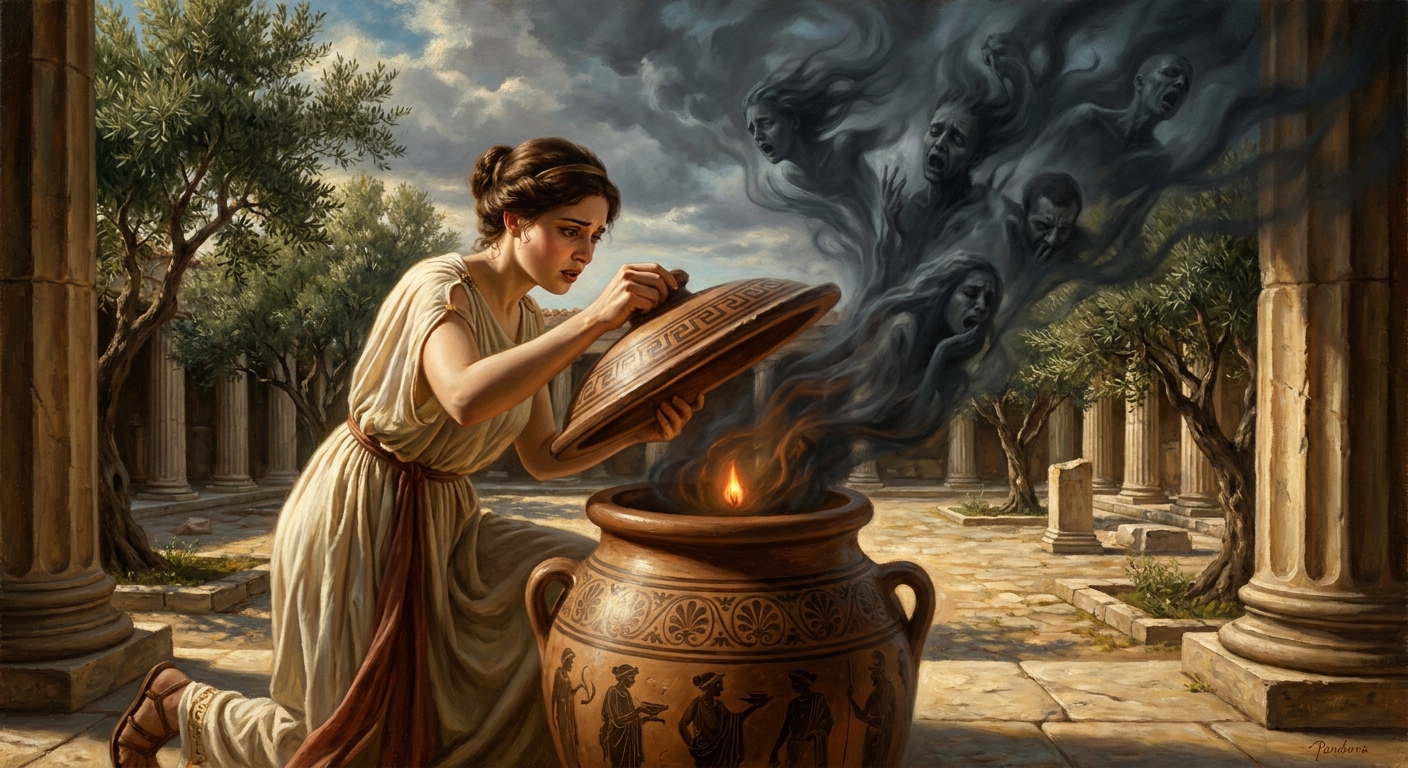
This is the part of the story Hesiod does not linger on, but which the architecture of the myth requires. She lives with the sealed jar for an unspecified time. She passes it. She cooks near it. She knows it has been given to her by gods, and she knows the instruction was do not open, and she also knows that whatever is inside the jar is the reason she is in this house at all. The pull of an unanswered question — the same pull that brought Prometheus up Olympus — works on her too.
She opens it.
They come out in the order Zeus packed them. Sickness first, the way smoke fills a room. Then war, then hunger, then jealousy, then every grief that has a name and every grief that does not. They pour into Greece in a single afternoon. The fire is still burning in every hearth in the country, and now the evils are also there, traveling alongside the warmth, indistinguishable from it.
She seals the jar before Hope escapes.
This is the second irony Zeus enjoys: the one comfort he placed in the jar is also locked inside it. Whether Hope is a mercy retained or a cruelty withheld is a question that will be argued for two thousand seven hundred years. Zeus does not clarify. He set the trap and walked away.
The two punishments run on the same clock.
In the Caucasus, the eagle eats. In Greece, the evils spread. Prometheus’s liver regrows; the human population grows alongside it; each new generation receives both the inheritance of the fire and the inheritance of the jar. The two gifts arrive together because they were sent together, and there is no human life from this point forward in which they can be separated.
Hesiod is explicit about the linkage. He tells the Prometheus story in the Theogony and the Pandora story in the Works and Days, and he tells them as one mind unfolding one revenge. The fire-thief on the rock and the woman with the jar are two halves of the same divine reply. To take the fire was to invite the eagle. To accept Pandora was to accept the eagle’s reach into every house in Greece.
Prometheus, on the rock, does not regret it.
This is the part of his character that Aeschylus, four centuries later, will turn into a tragedy. He could end the punishment by recanting — by saying the fire was not worth it, by promising to be useful to Zeus, by giving up the secret of who will dethrone the king of the gods. He does not. He hangs there with the bird in his side and the cold wind moving across the Caucasus and he keeps his mouth shut.
Zeus waits for him to break. Pandora’s jar empties into Greece. The earth fills up with the kinds of suffering it had not previously contained. The fire still burns. The forges still hum. Children still warm their hands at the hearth.
Both punishments continue. Neither one ends.
Hesiod’s audience would have heard these as a single narrative, broken across two poems for compositional reasons but unified in meaning. The Theogony narrates the cosmic crime; the Works and Days delivers the consequence to ordinary life. The two are halves of one warning: do not trick Zeus, and if you must, understand that the price will be paid by everyone you were trying to help.
The naming is part of the cunning. Pro-metheus is “Forethought.” Epi-metheus is “Afterthought.” Pan-dora is “All-Gifts.” Pan-doros is also a possible reading: “All-Giving,” which is what she is, in the catastrophic sense. The brothers’ names predict the failure mode of the brothers’ minds. The woman’s name predicts the failure mode of the gift. The Greek language is doing theology by the time it has finished naming the cast.
Aeschylus and Plato, working centuries later, soften the misogyny by emphasizing Prometheus’s heroism and downplaying Pandora’s culpability. Hesiod did not soften anything. For him, the doubled punishment was just: gods do not forgive theft, and any human who imagined the gift came without a cost was not paying attention to the gods on offer.
The fire was real. The jar was real. They came together. They are still coming together. Every act of human ingenuity in the world after Hesiod has carried both halves of the inheritance — the warmth and the wound, the forge and the grief, the bright thing the Titan stole and the dark thing the woman released. Zeus’s revenge is the structure of civilization itself.
Echoes Across Traditions
Entities
- Prometheus
- Zeus
- Pandora
- Hephaestus
- Epimetheus
Sources
- Hesiod, *Theogony* 521-616 (c. 700 BCE)
- Hesiod, *Works and Days* 42-105 (c. 700 BCE)
- Aeschylus, *Prometheus Bound* (c. 430 BCE)
- Plato, *Protagoras* 320c-322d
- M. L. West (ed.), *Hesiod: Theogony, Works and Days* (1988)
- Jean-Pierre Vernant, *Myth and Society in Ancient Greece* (1980)