Blodeuwedd Made of Flowers
Mythic Welsh time, recorded in the Mabinogion c. 12th-13th century CE · Gwynedd, northwest Wales — the court of Math and the forests of Ardudwy
Contents
Lleu Llaw Gyffes cannot marry a human woman because of his mother's curse, so his uncle Math and foster-father Gwydion conjure him a wife from the blossoms of oak, broom, and meadowsweet. Blodeuwedd falls in love with Gronw Pebr and plots Lleu's death. Gwydion turns her into an owl. The story of a woman created for someone else's convenience who refuses that story.
- When
- Mythic Welsh time, recorded in the Mabinogion c. 12th-13th century CE
- Where
- Gwynedd, northwest Wales — the court of Math and the forests of Ardudwy
Math fab Mathonwy keeps a law that requires him to rest his feet in the lap of a virgin at all times, except during war.
This is not the strangest thing about the Fourth Branch. It is, however, where the logic begins. Math’s foot-holder is his niece Goewin, and his nephew Gilfaethwy wants Goewin, and Gwydion — Math’s other nephew, the great magician — fabricates a war to get Math away from court long enough for the assault to occur. The war is with Pryderi of Dyfed and it is over pigs — magical pigs, pigs that came from the Otherworld — and when Math returns and learns what happened to Goewin, he punishes his nephews by turning them into breeding pairs of animals for three years: a pair of deer, then a pair of pigs, then a pair of wolves, male and female alternating, each year one of them nursing the other’s offspring.
The point of all this is that transformation in the Fourth Branch is punishment. To be remade is to be unmade. This is the frame in which Blodeuwedd’s story occurs, and you have to hold it to understand what it means when Gwydion makes her and what it means when he unmakes her.
Lleu Llaw Gyffes is Math’s great-nephew, Gwydion’s sister-son. He is under three curses from his mother Arianrhod — who bears him in circumstances she finds humiliating and turns her humiliation into prohibition. He will have no name unless she gives it. He will have no weapons unless she gives them. He will have no wife from any race that is now on the earth.
Gwydion tricks her out of the first two, as magicians trick: by disguise, by her own reflexive action, by making her name him and arm him without meaning to. The third curse is harder because a woman who does not exist cannot be produced by deceiving a living one. Math and Gwydion make her instead.
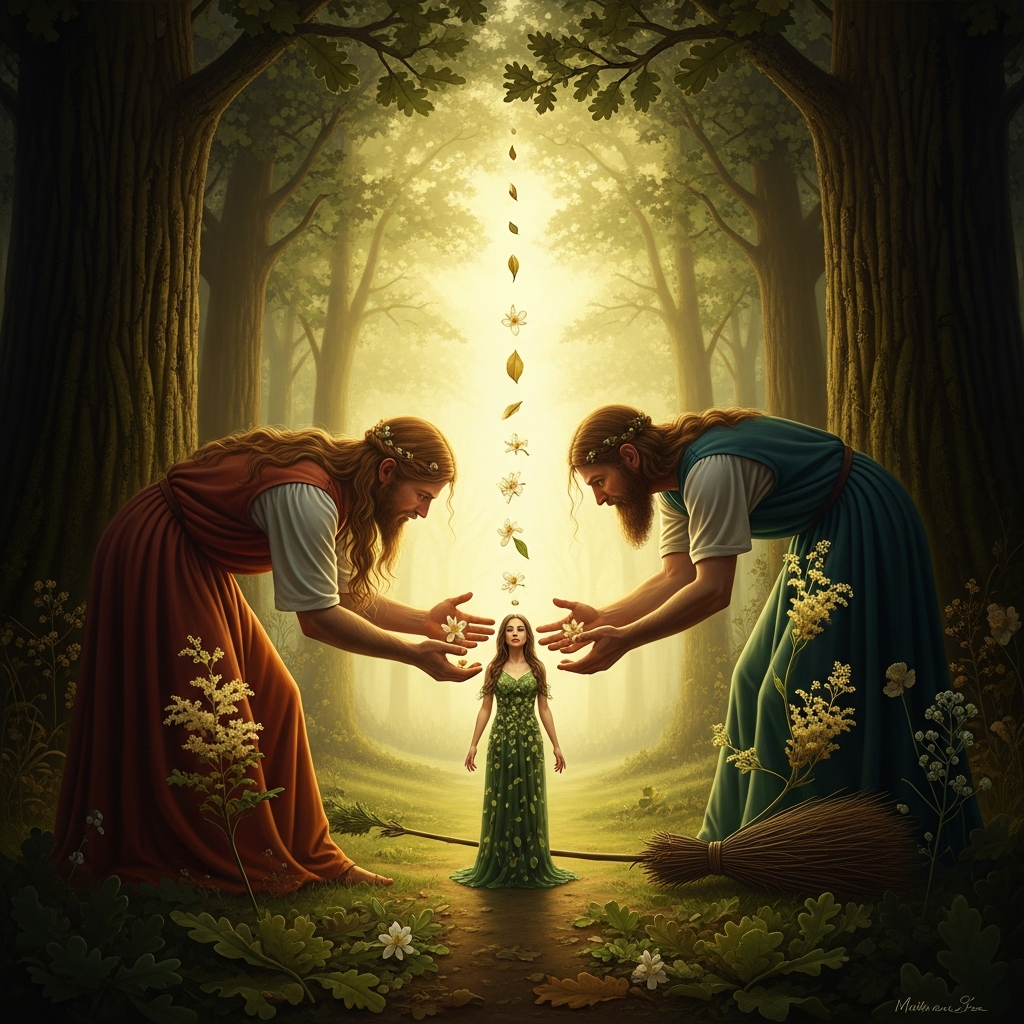
They take the flowers of oak, the flowers of broom, and the flowers of meadowsweet, and through the art that Math has — the mathematics of the world’s deep grammar — they conjure these into a woman. She opens her eyes at the edge of the oak wood, and the first thing she sees is two old men standing over her with the residue of magic still on their hands, looking pleased.
They name her Blodeuwedd: flower-face. They give her to Lleu.
She is, by all evidence in the text, entirely herself.
This is what the Fourth Branch does not quite acknowledge directly but cannot conceal through indirection: Blodeuwedd has been made to order but she is not made to order. She has preferences. She has a response to the world that is her own. She has, in the form of Gronw Pebr, what we would recognise as desire.
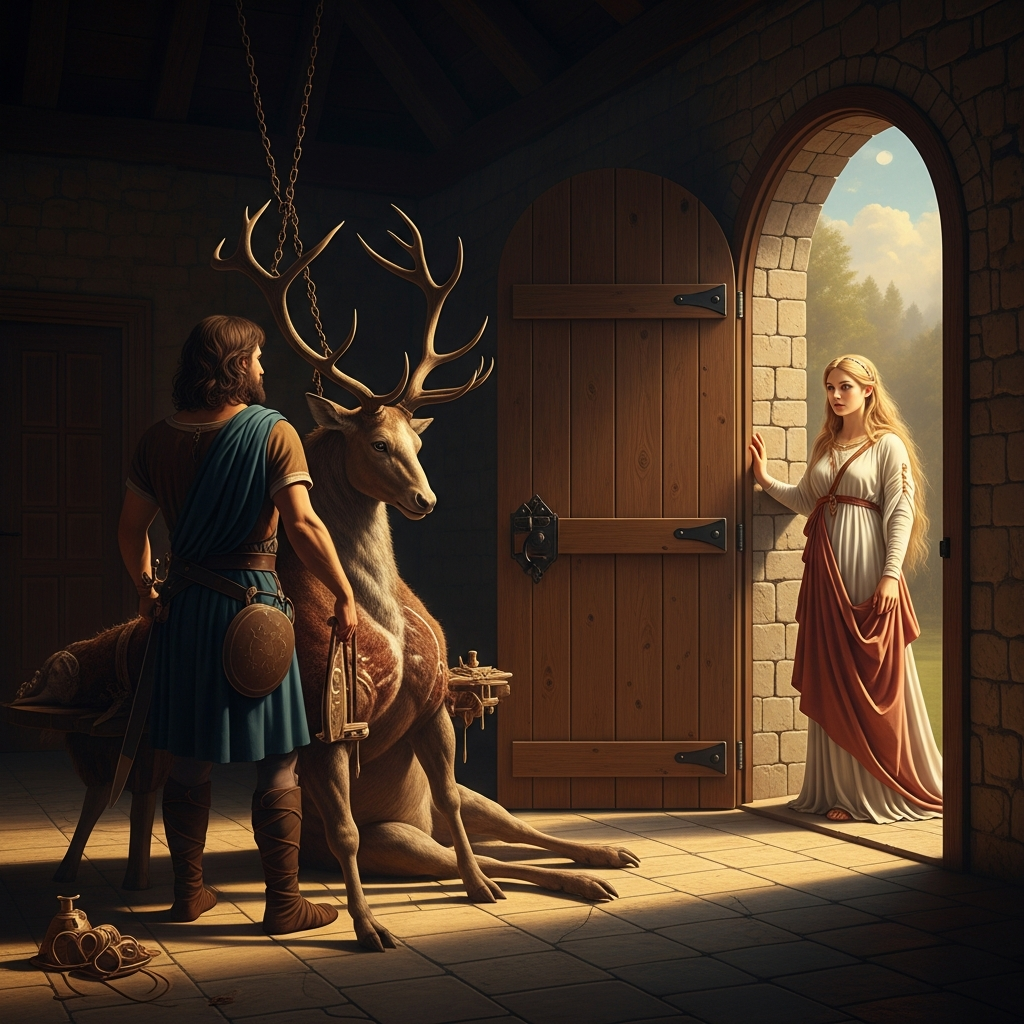
Gronw Pebr is a lord from Penllyn who arrives at the hall of Mur Castell one evening when Lleu is away at Math’s court. He is flushed from a day’s hunting, dragging the carcass of a stag, and he needs lodging for the night. Blodeuwedd offers it because hospitality is the law, and at dinner they talk, and by morning they are lovers, and by the third morning they are planning how to remove Lleu from the equation.
The Fourth Branch is careful here. It gives Blodeuwedd no villain’s speech, no justifying monologue, no moment where she explains what she wants and why she has decided this is how to get it. She simply acts, as someone acts who has weighed her situation and arrived at a conclusion. She extracts from Lleu, through patient and affectionate conversation, the peculiar conditions of his death: he can only be killed at dusk, and only on a riverbank, and only by a spear that takes a year to make, and only when he is standing with one foot on a goat’s back and one on the edge of a bath. These conditions seem designed for impossibility and Lleu recites them as if they are proof of his invulnerability rather than a map.
Blodeuwedd provides the map to Gronw. Gronw makes the spear. Blodeuwedd arranges the bath.
Lleu is struck. He does not die — he transforms, as things do in this text, into an eagle, and flies into an oak tree, and hangs there in diminished form while Gronw takes the hall and the land and Blodeuwedd. Gwydion finds him by the singing of a sow who has been feeding on the maggots falling from the rotting eagle in the upper branches. He coaxes the eagle down and transforms it back into Lleu, who then recovers and goes to war on Gronw.
Gronw falls. The accounting of the Fourth Branch is complete for the men. Gwydion turns to Blodeuwedd.
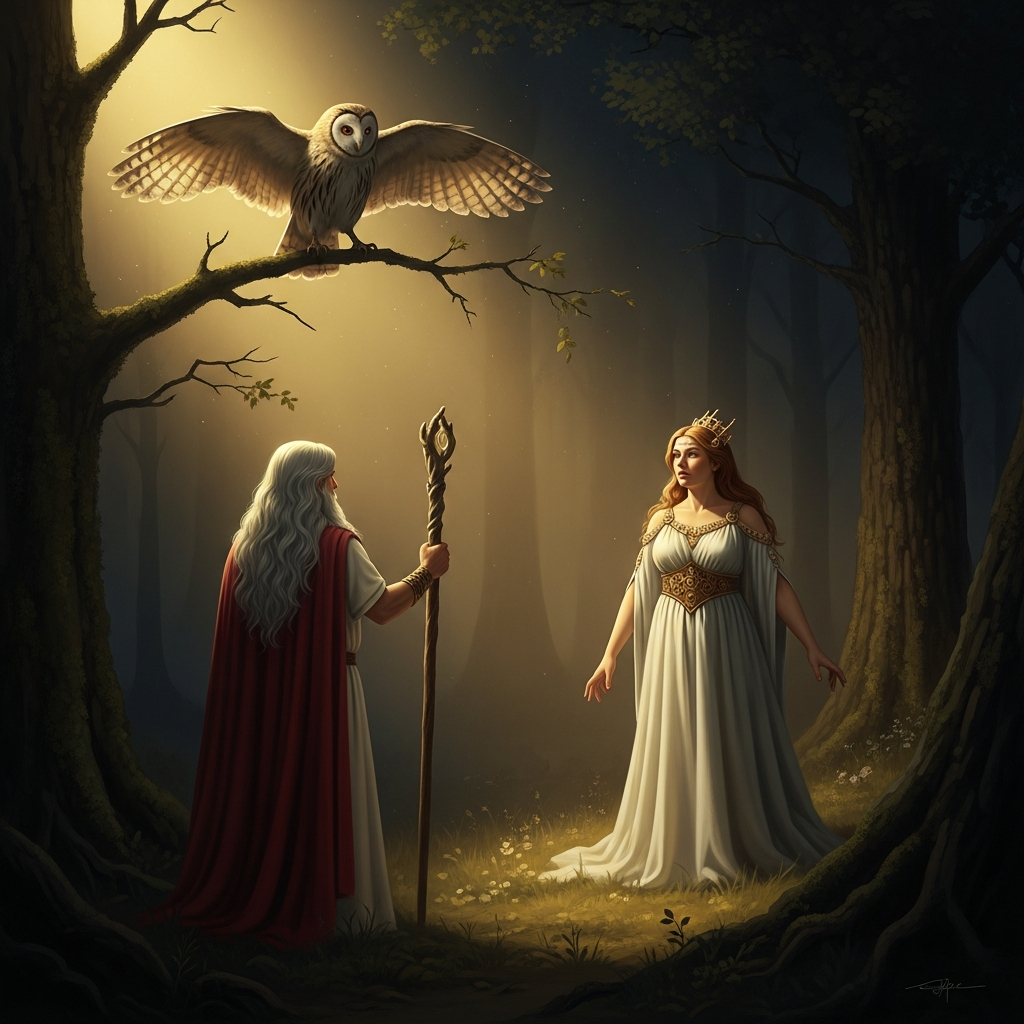
He tells her he will not kill her. He says this as if it is mercy. He says he will do something worse: he will make her into a bird that must live in shame and fear, that other birds will mob and harry, that cannot show its face by daylight. He makes her an owl.
The owl in Welsh is tylluan. Blodeuwedd the flower-face becomes Blodeuwedd the owl-face, which is also a face of flowers — broad, flat, pale, with the same quality of geometric precision as the meadowsweet she was made from. She turns away from the light. She will never look at another woman’s face, Gwydion says, for the shame of what she did.
The text presents this as justice. Most readers of the Fourth Branch since the nineteenth century have found it increasingly difficult to agree.
The difficulty is this: Blodeuwedd was made to be Lleu’s wife. She did not choose this. She was conjured from flowers by two men for the purpose of solving another man’s problem, which was that his mother had cursed him out of bitterness and he could not otherwise marry. She was given no education in what she was, no account of the situation she had been placed in, no mechanism for changing it through any means the text acknowledges as legitimate. She found a man she wanted and she wanted him. She removed the obstacle. She used the only information she had, which Lleu gave her.
Gwydion, who made her, punishes her for behaving like a person rather than an object. He calls this shame.
The owl is the bird of the night, of the margin, of the creature that sees in the dark what the daylight watchers cannot see. Blodeuwedd did not invent her story. She was given a story by people who had decided what she was for, and she refused that story, and her refusal cost two men their preferred futures and cost her the daylight.
She turns her face away. She does not disappear.
The Fourth Branch of the Mabinogi is one of eleven stories in the collection, and it is the one most concerned with what it costs to make something. Math makes Blodeuwedd; Gwydion makes her; Lleu is unmade by her; Gwydion remakes Lleu and then remakes Blodeuwedd again. Everything in it is transformation, and transformation in this text is always a form of punishment, even when it is called a gift.
The owl persists in Welsh folk tradition as the bird of bad omen — the cry of the owl near a house is a death portent. This is the long echo of Blodeuwedd: the woman made of flowers who became the night bird, whose cry is warning and whose face is always turning away from whoever is looking.
She was given no name until they needed one. She was given no choice until she made one. The choice she made was the wrong one by the accounting of the men who made her. She is still the owl. The flowers she came from bloom every May and fill the oak-edge air with the smell of something that is almost honey and is not quite right — meadowsweet, which smells like healing and is used for pain, which is the plant that keeps the flower-face alive in the world long after the woman was turned to feathers and the night.
Scenes
Math and Gwydion bending over the ground at the edge of the oak wood, hands moving through oak blossom and broom and meadowsweet
 Generating art…
 Gronw Pebr arriving at the hall at Mur Castell with the carcass of a stag, flushed from the hunt, and Blodeuwedd standing in the doorway watching him with the expression Math and Gwydion did not account for when they made her
 Generating art…
 Gwydion standing in the clearing with his staff
 Generating art…
 Echoes Across Traditions
Entities
- Blodeuwedd
- Lleu Llaw Gyffes
- Gwydion
- Math fab Mathonwy
- Gronw Pebr
Sources
- Patrick K. Ford (trans.), *The Mabinogi and Other Medieval Welsh Tales* (1977)
- Jeffrey Gantz (trans.), *The Mabinogion* (Penguin, 1976)
- Proinsias Mac Cana, *Celtic Mythology* (1970)
- Miranda Green, *Celtic Myths* (British Museum Press, 1993)
- Sioned Davies (trans.), *The Mabinogion* (Oxford World's Classics, 2007)