The Seeds That Bound Her
Mythic Time · *Homeric Hymn to Demeter* (7th c. BCE) · The meadow of Enna in Sicily, then the halls of Hades, then the Rharian plain at Eleusis
Contents
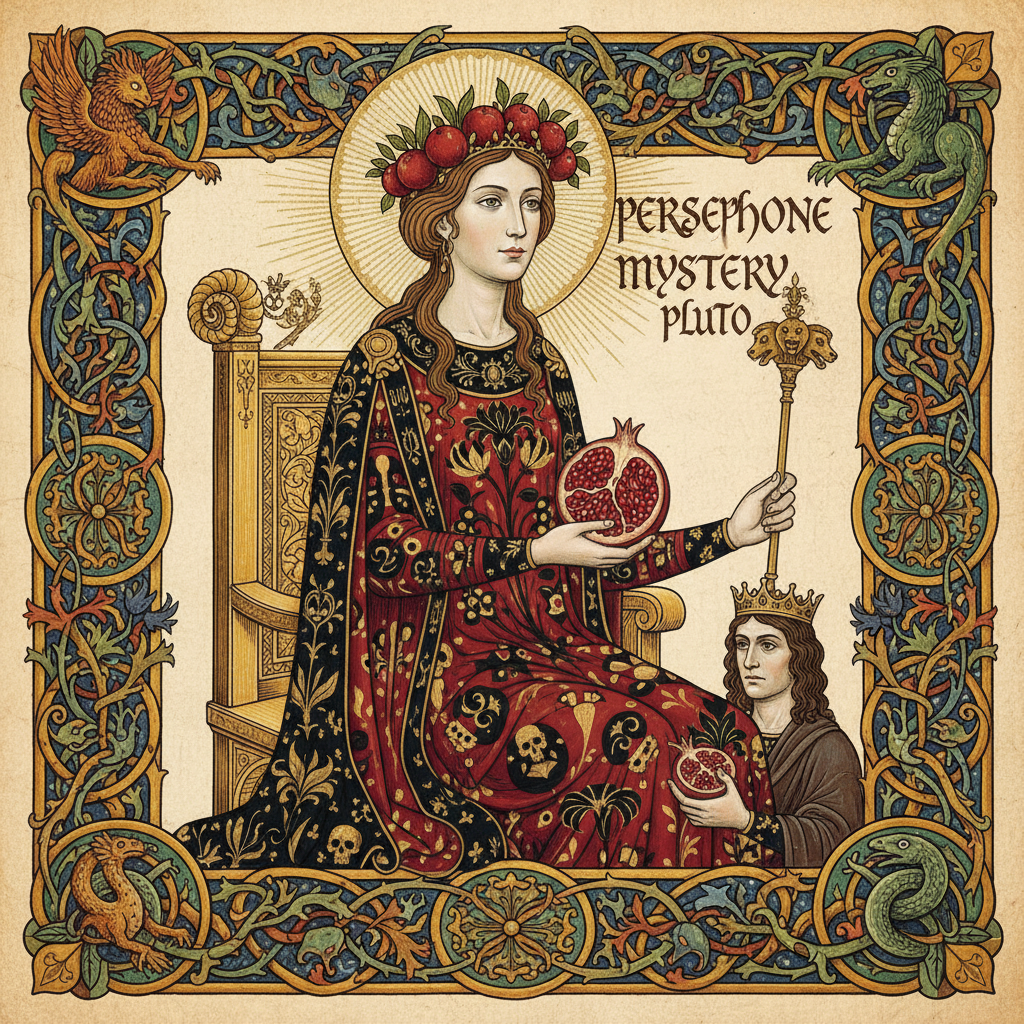
Persephone is in the meadow of Enna picking flowers when the earth opens. Hades offers her a kingdom. She eats six pomegranate seeds. When she returns to the upper world, she is no longer the girl who was taken. She is the Queen of the Underworld visiting her mother. The pomegranate changed her — and whether she knew it would is the question the myth refuses to answer.
- When
- Mythic Time · *Homeric Hymn to Demeter* (7th c. BCE)
- Where
- The meadow of Enna in Sicily, then the halls of Hades, then the Rharian plain at Eleusis
The meadow of Enna is famous in Sicily for its flowers.
Every source that locates the abduction places it here — the high plain in the center of the island, ringed by mountains, the air cooler than the coast, the flowers dense and various and, in the particular season when the narcissus blooms, almost overwhelming. Persephone is with companions. The Homeric Hymn names them: Athena, Artemis, and the daughters of Ocean, the Oceanids, who have come to this meadow on this particular day as they come to many meadows on many days, gathering flowers with the ease of beings who have nothing to fear in the daylit world.
She sees the narcissus.
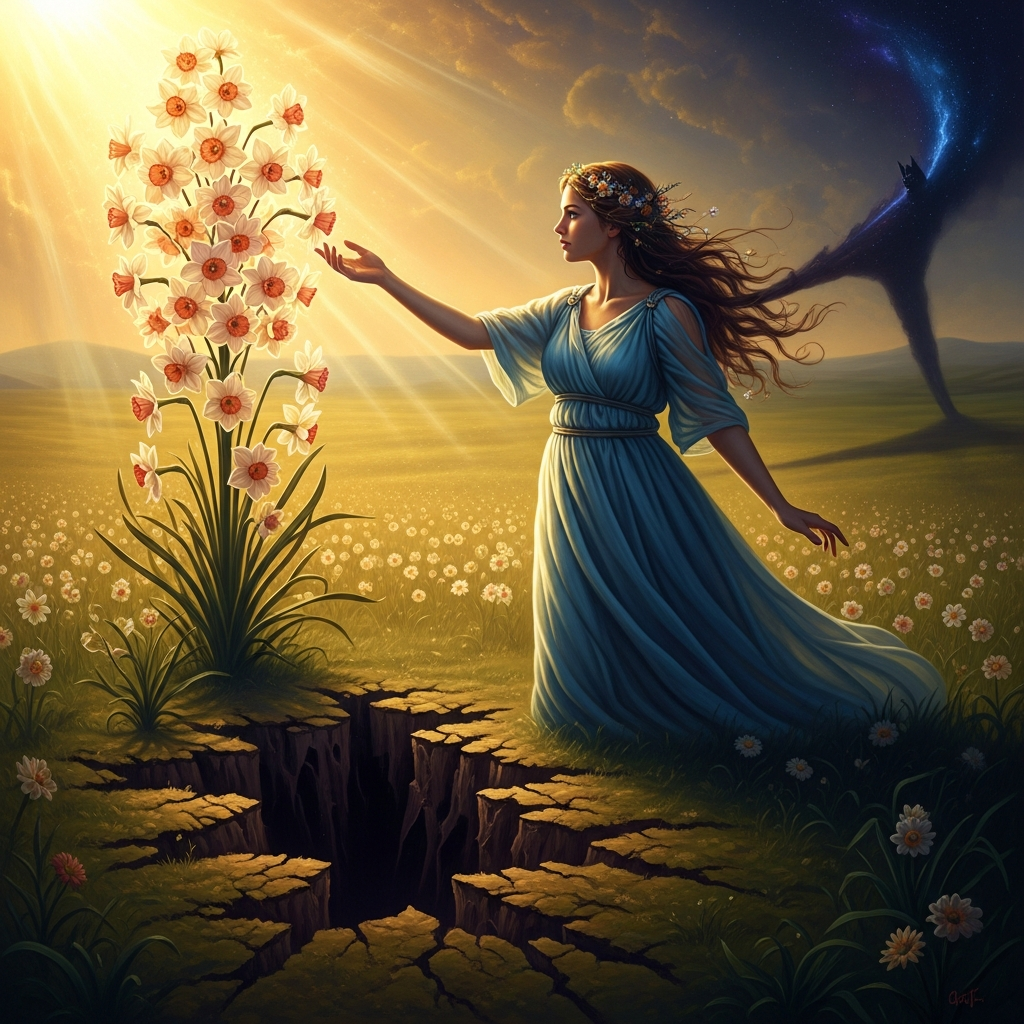
The Hymn is precise: this particular narcissus was created by Zeus at the request of Hades, who wanted — and was given permission — to take Persephone as his bride. The flower was made as a lure: a hundred blooms from a single root, the scent designed to stop the breath, the beauty calibrated to produce exactly the reaching gesture that will put her within reach of what is coming. The meadow has been prepared. The flower has been prepared. Her father has arranged this.
She reaches.
The earth opens without warning.
This is the feature every account emphasizes: not a trembling, not a groan, not a slow crack along a seam — the earth simply opens, fully, immediately, the way a trap opens when the spring releases. The chariot is already there, below the surface, as if Hades has been waiting with the horses for exactly the duration of the flower’s blooming. He takes her the way a man reaches for something he intends to have: decisively, without ambiguity, with the assurance of a god who has been told yes by the only authority that matters and has been waiting for the right flower.
She screams.
The Hymn says she calls on her father Zeus with a high, sharp cry. Zeus does not come. He is not in a place where he can come; he is in a temple, the Hymn says, receiving the prayers of mortals. He does not come because he cannot come — not because of any limit on his power but because he is the one who said yes to Hades, and he knew the moment the yes was given what it would mean for her, and he chose anyway.
The earth seals over the chariot. Persephone’s companions — Athena, Artemis, the Oceanids — see the flower without the girl, the empty space in the air where she was, and scatter. The mountains hear the cry. The sea hears the cry. Only Hecate in her cave and Helios in his chariot are close enough to know what happened.
Neither of them speaks immediately.
Hades is not a monster.
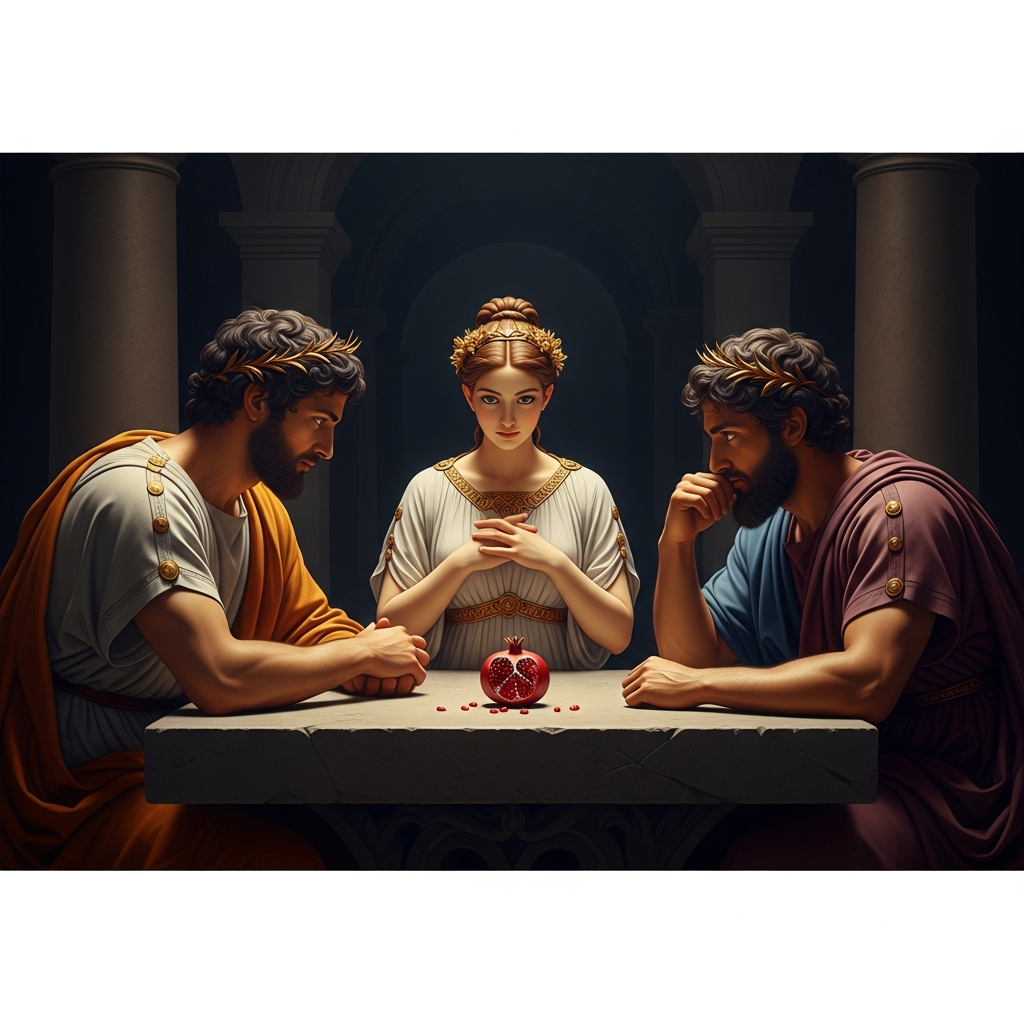
This is the aspect of the myth that every reduction of it to a simple abduction narrative misses. The Homeric Hymn gives Hades almost no dialogue, but the dialogue he is given is careful. When Hermes comes to retrieve Persephone on Zeus’s instructions, Hades does not resist. He tells Persephone herself: go back to your mother. He adds — and the Hymn gives this to him without irony — that she should know she will be queen here, of all the dead who have ever lived. That this is not nothing. That Hades, which receives all things, is a kingdom with a queen.
He gives her the pomegranate seeds before she mounts the chariot.
The Homeric Hymn leaves the mechanics ambiguous — she is given them, she eats them, the Hymn does not specify whether she eats them in ignorance of their significance or in knowledge of it. Ovid, writing six centuries later, has her eat them accidentally — a small, casual mouthful while wandering the underworld gardens, the act of hunger not of choice. But Ovid is writing for a Roman audience that prefers its heroines passive, and the Homeric Hymn is not a Roman poem.
In the Hymn, the seeds are given and eaten in a moment that the text does not slow down to examine. The reader is left with the question: did she know?
The rule of the underworld is ancient and absolute: what is eaten here belongs here.
The rule applies equally to gods and mortals; it is not a punishment but a structure, the logic by which the underworld maintains its boundary with the upper world. The food of the dead is the food of the place where the dead are kept, and to eat it is to be of that place, to take it into yourself in the most literal way available, to make its substance part of your substance. Six seeds. Six months.
If she did not know this, she was a girl taking fruit in a garden, the gesture of someone comfortable enough in her surroundings to eat, and the consequence was a trap she walked into without understanding the mechanism.
If she knew — if she understood what the seeds would do and ate them anyway — then the six months below are not a sentence imposed on her. They are a choice she made. The girl who was taken from the meadow without consent becomes, in the moment of the seeds, someone who decided something. The queen of the underworld is not only what Hades made her. She is what she made herself, with six seeds, in the moment between the chariot and the light.
The tradition does not resolve this. The scholars argue. The poets vary. Claudian, writing in the fourth century CE, gives Persephone a moment of deliberate eating — she knows, she eats, she secures her kingdom — and this Persephone is someone to reckon with. The Homeric Hymn’s Persephone is more ambiguous, more like a person in the middle of a situation whose full shape she cannot see, which is more like the experience of being human than Claudian’s deliberate queen.
Both are true simultaneously, in the way that myths are true: the girl who did not know and the queen who chose are the same person, because the girl becomes the queen through the eating, regardless of the intention.
She rises into autumn light.
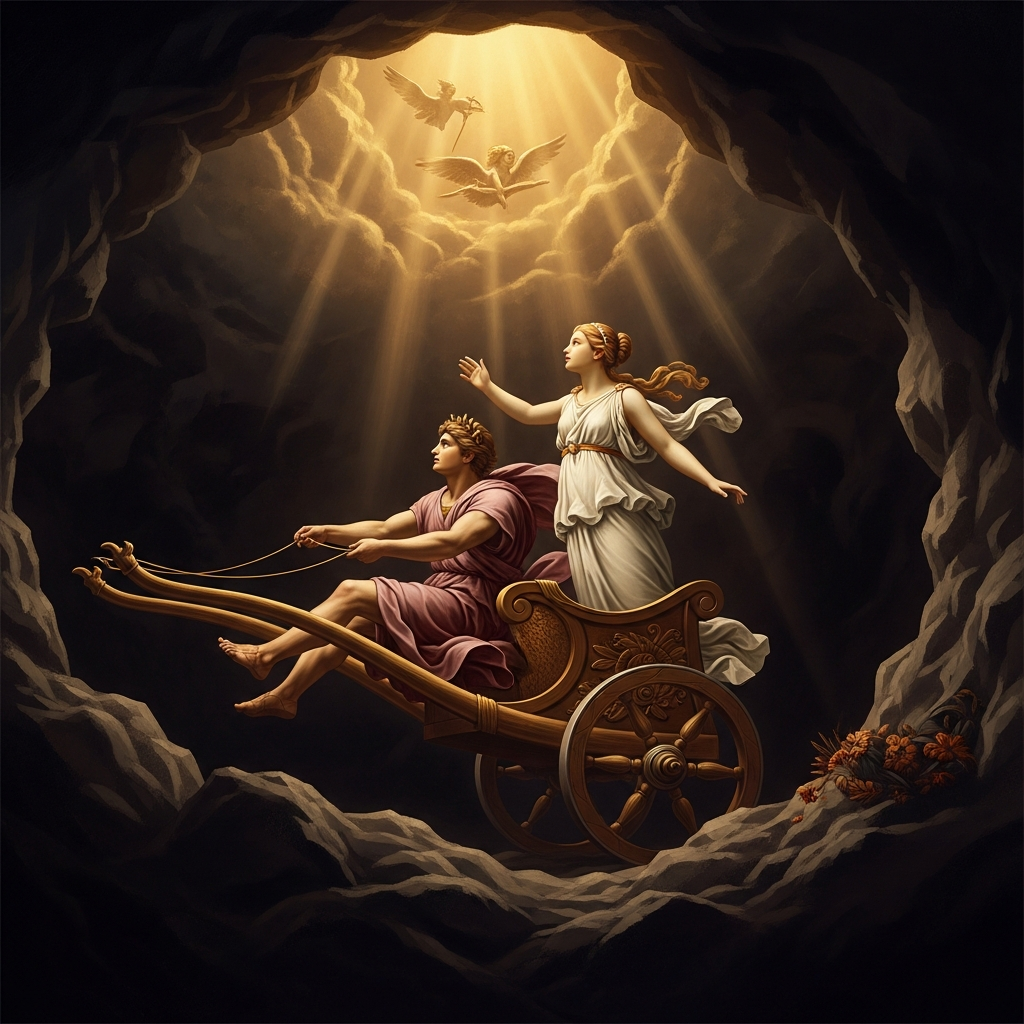
The chariot comes up through the gate and Persephone is standing in it when the Sicilian sun hits her, and Demeter runs — the Hymn gives the mother this run without elegance, without the dignity of a goddess, just the speed of someone who has been searching for nine months and has finally found the direction to run.
They hold each other on the Rharian plain.
Then Demeter asks: did you eat anything there?
Persephone tells the story of the seeds. The Hymn gives her a long narrative, careful and complete, that reaches the seeds after circling through everything else: the abduction, the journey, the hall of the dead, the moment Hermes arrived with Zeus’s message. Six seeds. She ate six pomegranate seeds that Hades gave her.
The number matters. There are twelve months and she will spend six below and six above. The math is exact. Six seeds is the right number for the arrangement the cosmos needs.
Zeus sends Rhea to negotiate with Demeter, and Demeter accepts the compromise because Demeter must accept it — the seeds are already eaten, the rule is already established, the only choice remaining is between six months with her daughter and zero months with her daughter. She chooses six.
When Persephone comes back in spring, she is not the same person who was taken.
This is what the myth means by the pomegranate. Not simply that she is bound to the underworld — being bound to a place does not change who you are. What changes her is that the underworld is inside her now, in the most literal sense: she ate it. Six seeds. Six pieces of a fruit whose color is the color of blood, whose interior is a jeweled architecture of red chambers, whose juice stains permanently whatever it touches.
She comes back to her mother. She comes back to the Rharian plain, to Eleusis, to the upper world that smells of grass and salt air. She comes back, and the narcissi come with her — the same flowers, the trap-flowers, because the trap worked in two directions and the flower that opened the earth for Hades also opens the earth for spring.
But she is Queen of the Underworld visiting the upper world. She is not a girl visiting her mother. She is a being who has been where the dead go and knows what that place is and carries it in her body. The Eleusinian initiates who were shown what was shown in the Telesterion — the thing no initiate ever described — were shown something about this: that descent is not destruction, that the underworld inside you does not kill you, that the queen who carries the kingdom of the dead in her blood is also the goddess of the spring.
She goes back every autumn, and she goes as a queen.
This is the detail the myths tend to underemphasize: she goes back. Not reluctantly, not screaming, not chained to the chariot by Hades’s force. She goes back because the seeds she ate are part of her now, and the place where the seeds are from has a claim on her, and the claim is not only Hades’s — it is also hers. She is queen there. The dead are hers. Hecate, who heard the original scream, becomes Persephone’s companion in the underworld, her attendant, the triple-aspected goddess who belongs to crossroads and thresholds and who moves, as Persephone moves, between the worlds.
The Hymn ends with Persephone and Demeter leaving Eleusis together, returning to Olympus, giving the gift of the mysteries to the Eleusinian princes before they go. The mysteries are the gift that the descent made possible. You cannot give initiates the knowledge of death-and-return if no one has been through death-and-return. Persephone is the one who has been through it. The mysteries are hers to give precisely because the seeds made the underworld hers.
The pomegranate appears in almost every religious tradition that touches the Mediterranean. In Jewish tradition, the pomegranate’s seeds — said to number 613, one for each commandment in the Torah — make it a symbol of righteousness and of the full life. It hangs on the hem of the High Priest’s robe in Exodus. It sits atop the pillars of Solomon’s Temple. In Islamic art, the pomegranate appears in paradise gardens. In Christian iconography, the Virgin holds the open fruit, the seeds visible, as a symbol of the Church — the many contained within the one.
Persephone’s pomegranate is older than all of these uses, and it is the same image: the many chambers, the red seeds, the something that looks like blood and tastes like winter, the fruit that is the inside of something that looks solid from outside.
What she ate in the dark became part of her. This is the thing the myth says about transformation that no other kind of story says as precisely: it is not enough to have been in the dark. You have to eat something there. The experience must become nutritive — must enter the body, must be metabolized, must change the composition of what you are made of — before the descent produces the queen rather than only the prisoner.
Six seeds. The rest is spring.
Scenes
Persephone reaching for the narcissus in the meadow of Enna — the hundred-bloomed trap-flower, the earth cracking behind her, the moment before the chariot comes — hyper-realistic mythological painting, warm Sicilian light, the shadow already falling
 Generating art…
 Persephone in the hall of the dead: not prisoner but queen, the lord of the underworld across the table from her, the pomegranate between them on the stone — the moment before the six seeds, the choice that makes winter
 Generating art…
 Hermes driving the chariot upward from the underworld, Persephone standing in it, face turned toward the light coming from above — the return that is not a return to the same place, the girl ascending who will be the queen descending every autumn
 Generating art…
 Echoes Across Traditions
Entities
- Persephone
- Hades
- Demeter
- Hermes
- Hecate
- Helios

Sources
- *Homeric Hymn to Demeter* (7th c. BCE, trans. Gregory Nagy)
- Ovid, *Metamorphoses* V.341-571 (8 CE)
- Apollodorus, *Library* 1.5.1-3
- Carl Kerényi, *Eleusis: Archetypal Image of Mother and Daughter* (Princeton, 1967)
- Helene Foley, *The Homeric Hymn to Demeter* (Princeton, 1994)
- Claudia Rapp, *Holy Bishops in Late Antiquity* (California, 2005)