The Sacred Way
c. 1500 BCE–392 CE · Eleusis, Greece · Eleusis, fourteen miles west of Athens, on the coast of Attica
Contents
Every autumn for nearly two thousand years, tens of thousands of Greeks walked the fourteen miles from Athens to Eleusis to be initiated into the Mysteries of Demeter. What happened inside the Telesterion was never written down. Those who survived it lost their fear of death. Cicero called it the greatest gift Athens ever gave humanity.
- When
- c. 1500 BCE–392 CE · Eleusis, Greece
- Where
- Eleusis, fourteen miles west of Athens, on the coast of Attica
The preparation begins nine days before the walk.
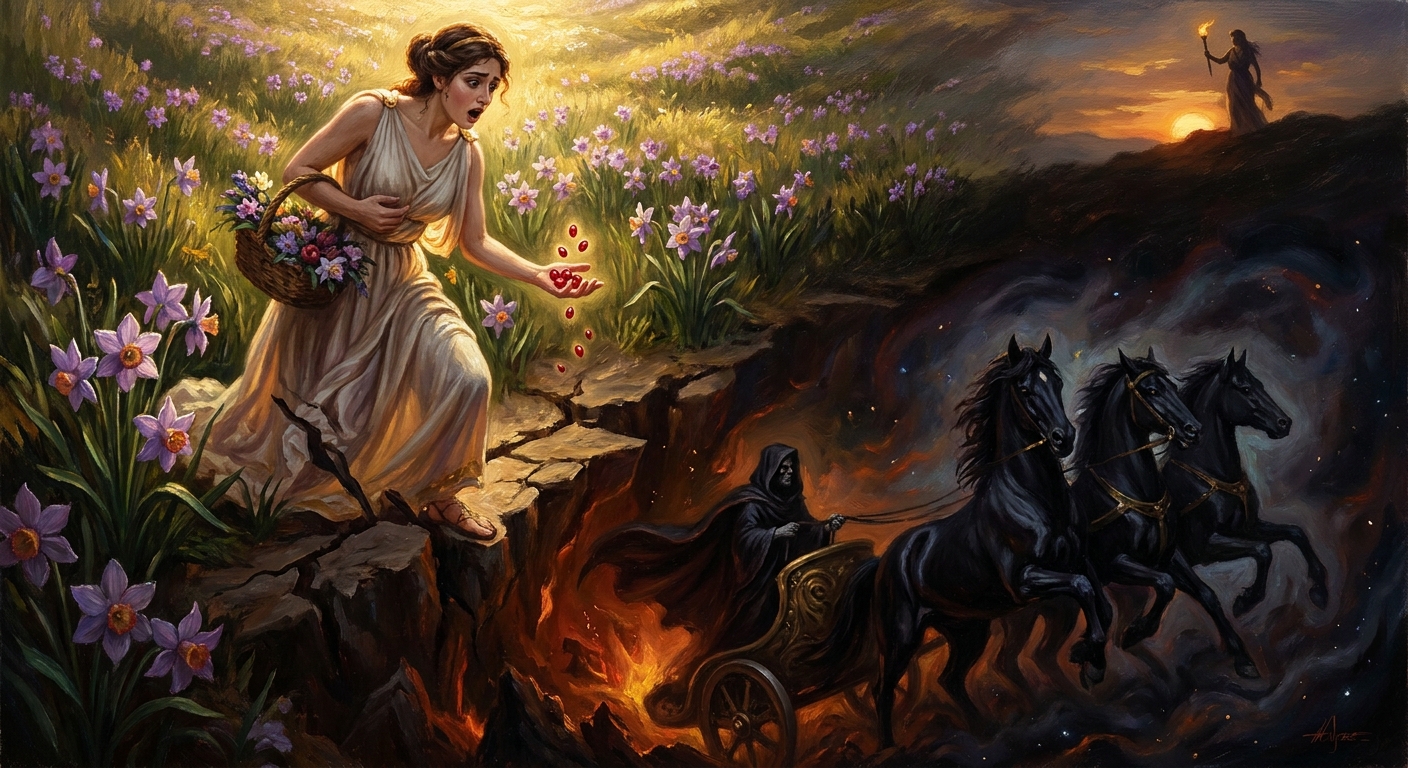
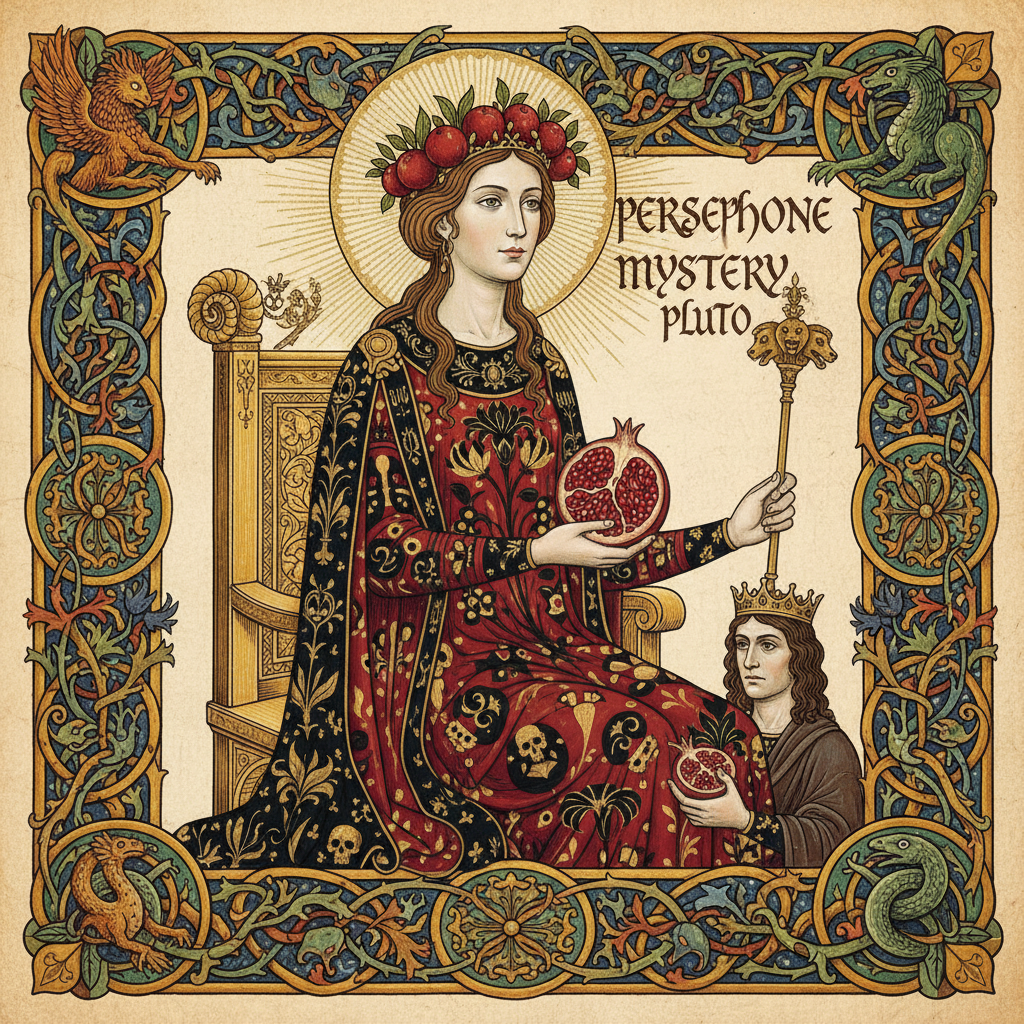
The initiates — mystai, from myein, to close the eyes — must purify themselves. They abstain from certain foods: pomegranates, which belong to the underworld; fish caught in the rivers that empty near the sanctuary; red-fleshed meat and eggs. They fast. They visit the sanctuary at Athens where the sacred objects are housed and offer gifts they cannot see, because the objects are covered in purple cloth and no one may look at what is inside the basket until the right hour.
On the fifth day, the proclamation goes out in the Agora: the initiates must go to the sea.
They walk in procession to the beach at Phaleron and walk into the cold Aegean — all of them, men and women and freed slaves, Athenians and foreigners, the only initiation in the ancient world that crosses the boundary of citizenship — and the water closes over their heads. Each initiate carries a small pig. The pig is washed. The pig is sacrificed. The pig takes into it, by the ritual logic of substitution, what the initiate is carrying into the mysteries.
On the nineteenth of Boedromion, the procession begins.
The road out of Athens runs through the Kerameikos, the potter’s quarter, where the dead are buried along the Sacred Way they will walk no more. The initiates pass the grave stelae and the funeral monuments and the great lion-headed columns that mark the boundary of the city, and they leave the city behind, and ahead of them is the flat road to Eleusis, fourteen miles, the bay of Phaleron on their right, the salt marshes on their left, the sun going down at their backs.
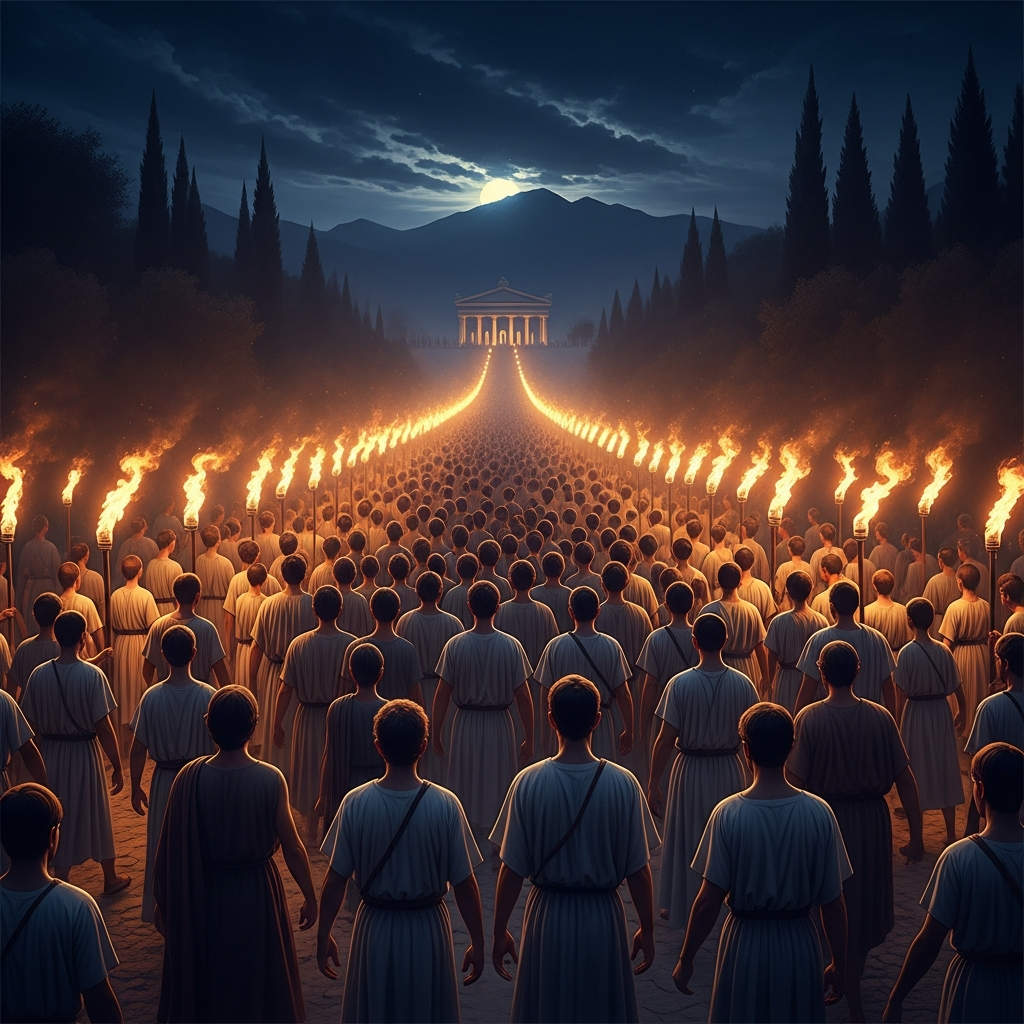
They have been carrying torches since the Eleusinion at the foot of the Acropolis. By the time they reach the Rheitoi, the two sacred lakes at the edge of the salt flats, the sky is dark and the torches are all there is.
The cry begins somewhere in the middle of the procession and spreads forward and backward until the whole column is shouting it:
Iacchos! Iacchos!
The name is a mystery in itself. Iacchos is a deity of the procession, the divine escort who leads the initiates from city to underworld-and-back. He may be Dionysus in a local Eleusinian aspect. He may be a separate deity. He may be the sound the procession makes when it becomes large enough to have its own voice, when ten thousand people walking together and crying a single name becomes something that neither they nor any individual among them could have made alone.
At the bridge over the Cephissus, masked figures lean down from the parapet and shout obscenities at the marchers. The gephyrismoi, the bridge-jests. The procession laughs and shouts back. This, too, is required. Demeter, in her deepest grief, was made to laugh by an old woman’s coarse joke. The laughter broke the grief enough for the goddess to accept a cup of something. The bridge-jests are not frivolity. They are the ritual repetition of the moment when the world remembered how to be fed.
They arrive at Eleusis by torchlight, after midnight, their throats raw with crying the name.
Eleusis is smaller than it should be, for what happens here.
The sanctuary occupies a shelf of land between the sea and the rocky hillside, enclosed by walls, centered on the Telesterion: a square hall fifty meters on a side, forty-two stone columns, a roof with a louvered opening to the sky, step-seats rising from the floor on all four interior walls. It can hold three thousand standing. There is no altar in the middle. There is no space for a priest to speak from, no raised pulpit for teaching. The hall is not built for an audience. It is built for witnesses — for people who have come to see something, not hear it.
At one corner of the hall, built against the hill, is the Anaktoron: a small stone structure, a shrine within the shrine, where only the hierophant may enter, and from which he will emerge at the climactic moment with his arms raised, carrying what cannot be named.
The mystai undergo one more night of ritual before the rite itself. They carry torches and search in the dark along the shore, calling for Persephone the way Demeter called, walking back and forth in the dark the way a mother walks when her child is taken and the searching has become mechanical and the world has not answered for nine days and there is nothing to do but keep walking.
They grieve ritually. They search ritually. Then they enter the Telesterion.
The hall goes dark.
Not the comfortable dark of a shuttered room. The dark of three thousand people on a stone floor in a building with no windows, the oil lamps extinguished, the columns invisible, the ceiling and the walls and the neighbors gone — not gone into shadow but genuinely gone, the whole architectured world dissolved into a black that has no texture, no direction, no middle distance.
Into this dark, the kykeon.
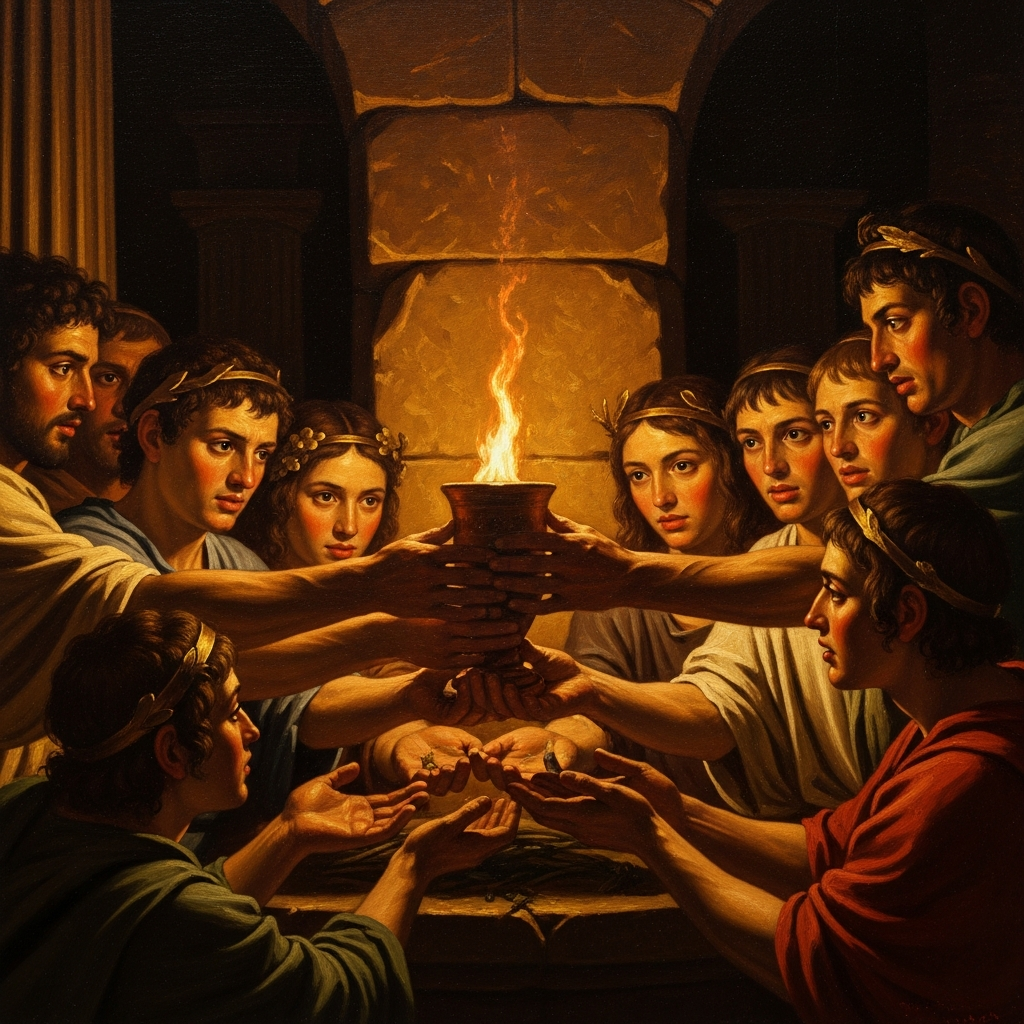
The cup goes around hand to hand, cool clay passed from one unseeing grip to another, the barley drink cold against the lips, the taste of pennyroyal bitter and medicinal. This is Demeter’s own drink — the Homeric Hymn records it precisely: when the goddess arrived at Eleusis and was brought into Metanira’s house, she refused wine, she refused water, she asked only for barley meal stirred with water and pennyroyal. A poor drink, a road-drink, a drink for the exhausted and the bereaved.
The barley, in all probability, is not ordinary barley.
The soil around Eleusis is damp. The grain is stored in underground chambers. The fungus Claviceps purpurea — ergot — grows on damp-stored grain and produces alkaloids chemically related to LSD. R. Gordon Wasson, the mycologist, and Albert Hofmann, the chemist who synthesized LSD, argued this case in 1978. The ancient sources cannot confirm it. The ancient sources cannot rule it out. What they describe of the next several hours is not what happens to people who have drunk barley water.
A drum begins.
The mystai stand in darkness, fasting, the kykeon in their blood, the drum inside their sternums before it is in the air. Time moves differently. Each breath is a distinct event. The cold of the stone floor through sandal leather. The warmth of thousands of bodies pressed close, the smell of salt and incense and human fear going quietly, very slowly, quiet.
The Neoplatonists who later systematized what happened at Eleusis described three stages: legomena, things said; dromena, things done; and deiknymena, things shown. The first two stages are preparatory. The third is the rite itself.
No one recorded what was said or done in the dark. We have fragments: the initiates handled sacred objects from a chest and from a basket. They recited a formula — the synthema, the password — which Clement of Alexandria, hostile and probably working from hearsay, quotes as: I fasted; I drank the kykeon; I took from the chest; having worked, I placed in the basket, and from the basket into the chest. What was taken from the chest? What was worked? Clement does not know. His source does not know. The initiate who knew took it to the grave.
The torches ignite all at once.
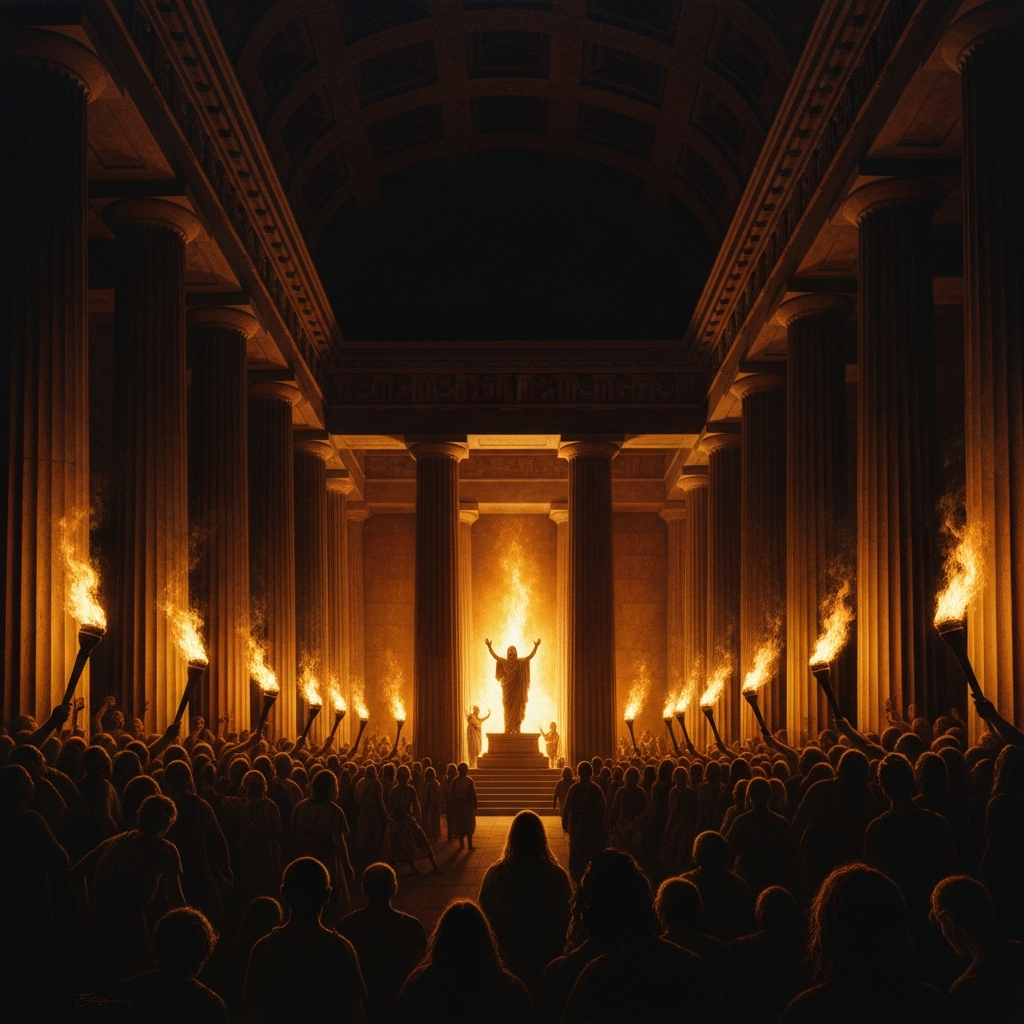
This is the fact all witnesses agree on — not the gradual brightening of dawn, not one torch and then another, but the simultaneous combustion of a thousand flames pulled from sand pits in the walls, a thousand initiates holding fire overhead at once, the hall detonating from total dark into total light in a single instant, the forty-two columns erupting from nothing into orange fire, the ceiling beams visible for the first time, the crowd seeing itself for the first time, three thousand faces blinking in the sudden brightness —
And in the same instant, the hierophant appears.
He is old. He has trained his voice for forty years to fill this hall. He stands on the platform of the Anaktoron in robes of saffron and white and he cries out a formula that no initiate ever recorded, a phrase that Hippolytus — a Christian bishop writing from hostile hearsay three centuries later — claims was: Holy Brimo has borne the holy child Brimos. He may have had it right. He may have fabricated it. He was not there. The men who were there died silent.
The hierophant turns to the inner door of the Anaktoron. He goes in. He comes out.
He raises something above his head.
There is no historical account of what he holds.
Hippolytus claims it was a single, cut ear of wheat, raised in absolute silence. If this is true — if the climax of the most attended religious initiation in the ancient world, the revelation that Plato built half his philosophy around and Cicero called the greatest gift Athens gave humanity, was an old man in saffron robes raising a grain stalk in a firelit hall — then the only possible conclusion is that the thing shown was not the information but the seeing, and the seeing was only available to those who had walked fourteen miles in the dark and fasted and drunk the kykeon and stood in total blackness with a drum in their sternum for however long it was.
There is no shortcut to what was seen in the Telesterion. The preparation was not the admission fee. The preparation was the instrument. The initiate who had walked the Sacred Way and searched the dark shore and drunk the kykeon and stood in the total dark and been split open by the sudden fire was a different instrument than the person who had done none of those things. What the hierophant raised in the firelight would have passed through that instrument differently than it passes through the reading eye.
This is what Aristotle meant. He was the most systematic thinker the Greek world produced. He classified the parts of a squid and outlined the constitution of a hundred city-states and wrote the first systematic works on logic and ethics and biology and poetics. At Eleusis, confronted with the question of what was taught there, he could get no further than: the initiates do not learn anything. They suffer something, and are put into a certain condition.
A certain condition. That is all.
The secret held for two thousand years.
Not because the Athenians were unimaginative about punishment — the death penalty for revealing the rites was serious, and the trial of Aeschylus and the prosecution of Alcibiades proved it would be enforced. But the silence was not primarily fear. The silence was the consequence of the experience itself. You cannot describe a color to someone who has never seen. You cannot explain the kykeon-and-dark to someone who has not stood in it. The mystai who returned to Athens and resumed their grain trading and their symposia and their jury service carried something that had no vocabulary, and so they said what every initiate said when the subject came up: it cannot be told.
Plato was initiated. He wrote the Phaedo and the Republic and the Symposium in the grammar of the initiation without once describing the initiation itself. The allegory of the cave — the prisoners facing the wall, the one who turns and sees the fire and cannot describe the light to those who have only seen shadows — is Eleusinian. The soul rising through levels of understanding toward the Form of the Good is Eleusinian. The argument that death is not destruction but a passage is Eleusinian. Plato found the philosophical vocabulary for an experience that the mystic grammar of Eleusis held but could not articulate in propositional form.
Cicero was initiated in 79 BCE. He wrote to Atticus that Athens had produced many things worthy of admiration and export, but nothing more excellent or divine than those Mysteries which tamed our lives and humanized them, and which initiated us into the recognition of their beginnings and gave us a reason not only to live with joy but to die with better hope.
Marcus Aurelius was initiated. When Sarmatian raiders burned the sanctuary in 170 CE, he rebuilt it — rebuilt it himself, with imperial funds, returning from the Danube frontier to walk the Sacred Way and oversee the restoration of a building whose content he would never discuss.
In 392 CE, the emperor Theodosius closed the pagan sanctuaries.
Three years later, Alaric’s Visigoths burned Eleusis. The last hierophant — a man named Nestorius, the end of a line that traced itself, generation by generation, to the priests of the goddess herself — escaped the fire but never performed the rite again. The succession ended with him. The formula the hierophant cried when he emerged from the Anaktoron went with Nestorius into the silence.
The wheat is not lifted again. The kykeon is not passed. The Telesterion stands empty, its forty-two column sockets cut into a stone floor by the sea, its sacred objects looted or burned or buried so thoroughly that no excavation has produced them. Mylonas dug at Eleusis for decades. What he found was the architecture: the halls, the platforms, the wall-foundations, the socket-holes. Not the objects. Not the contents.
Not the secret.
What the mysteries gave was not doctrine. The ancient world had plenty of doctrine — the philosophers argued about it in the gymnasia and the market stalls and the symposia with the technical precision of people who had spent their lives doing nothing else. What Eleusis gave was something prior to argument: a direct experience of the territory that argument maps.
The territory was death. Not the idea of death — the felt apprehension of it, the body’s knowledge that it will not persist, the ground-floor terror that lives below every other anxiety and that most people most of the time are extraordinarily busy not examining. The mysteries took the initiate into that territory, in the dark, with the kykeon and the drum and the exhaustion and the sudden fire, and showed them something. And what they showed them produced in the people who saw it the persistent, rationally unjustifiable, apparently unshakeable conviction that the thing they were most afraid of was not the thing they thought it was.
Cicero calls this a gift. Twenty-four centuries later, in a world where the Telesterion has been a ruin for sixteen hundred years, we are still, obliquely, living on it. Every mystical tradition that uses ritual darkness and ecstatic music and communal physical experience to produce a transformation that cannot be transferred by lecture is working the Eleusinian formula. Every theology that insists the soul is not destroyed by death is making the Eleusinian claim. Every philosopher who argues that what matters is not the argument but the capacity to receive it is remembering, without knowing it, Aristotle’s sentence: they do not learn anything. They suffer something.
They are put into a certain condition.
We do not have the condition. We have only the shape of the hall where it was given, and the silence of everyone who received it, and Cicero’s gladness, and the strange fact that an emperor fighting Germans on the Danube made time to rebuild a grain sanctuary fourteen miles outside a city he would never govern.
The wheat is still somewhere in the dark, waiting to be lifted.
Scenes
Tens of thousands of initiates walking the Sacred Way from Athens to Eleusis at night, torches flaring in the September wind, the cry of Iacchos rising from every throat — the longest pilgrimage in the ancient Greek world, performed without interruption for nearly twenty centuries
 Generating art…
 The Telesterion at Eleusis erupts with torchlight after total darkness: three thousand people gasping as a thousand flames rise simultaneously, the columns leaping from black into fire, the hierophant emerging from the Anaktoron with arms raised
 Generating art…
 The kykeon passed cup to cup in the dark before the revelation: barley, water, and pennyroyal — the same drink the goddess accepted from Metanira's hands when she was too lost in grief to eat
 Generating art…
 Echoes Across Traditions
Entities
- Demeter
- Persephone
- the Hierophant
- Iacchos
- the Dadouchos

Sources
- *Homeric Hymn to Demeter* (7th c. BCE, trans. Gregory Nagy)
- George E. Mylonas, *Eleusis and the Eleusinian Mysteries* (Princeton, 1961)
- Carl Kerényi, *Eleusis: Archetypal Image of Mother and Daughter* (Princeton, 1967)
- Walter Burkert, *Ancient Mystery Cults* (Harvard, 1987)
- R. Gordon Wasson, Albert Hofmann, and Carl A.P. Ruck, *The Road to Eleusis* (Harcourt, 1978)
- Cicero, *De Legibus* II.14.36 (c. 52 BCE)