The Weighing of the Heart
Composed ~1500 BCE · New Kingdom · The Hall of Two Truths · the Underworld
Contents
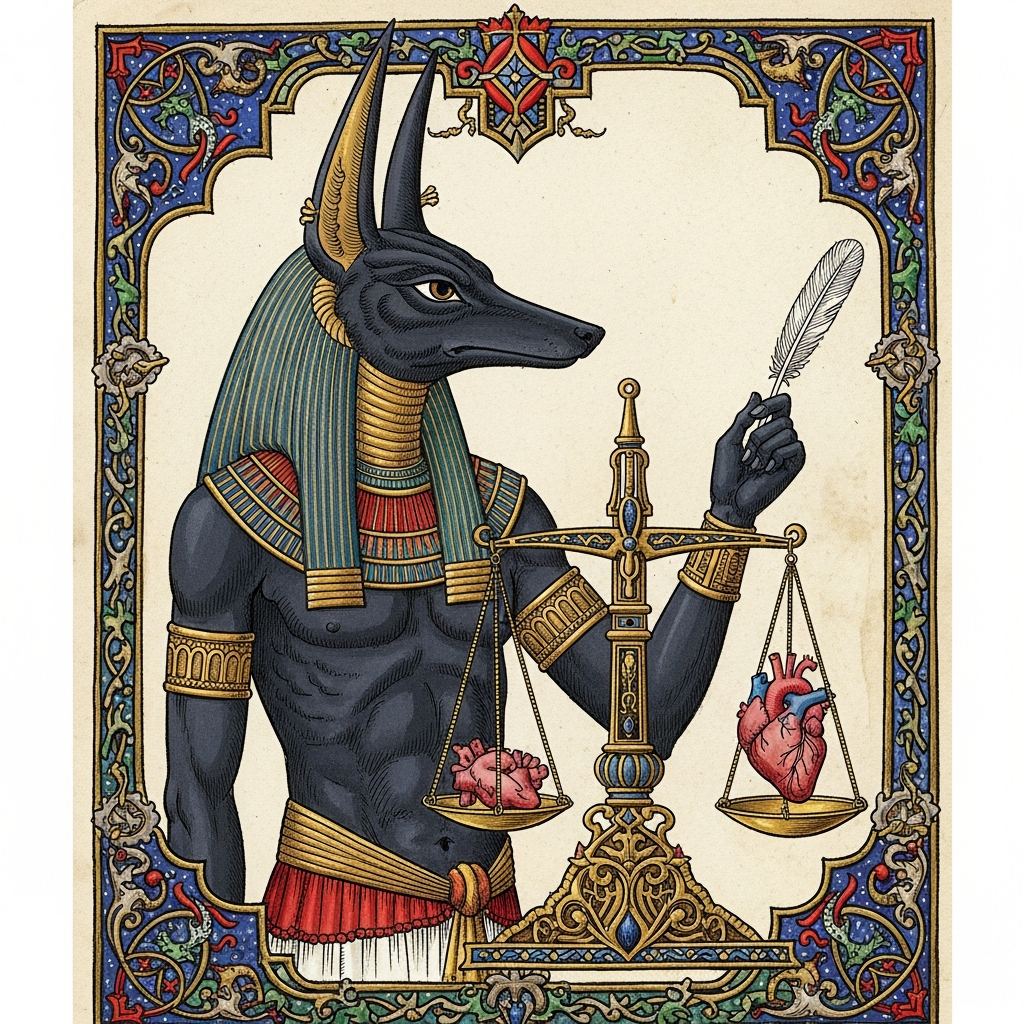
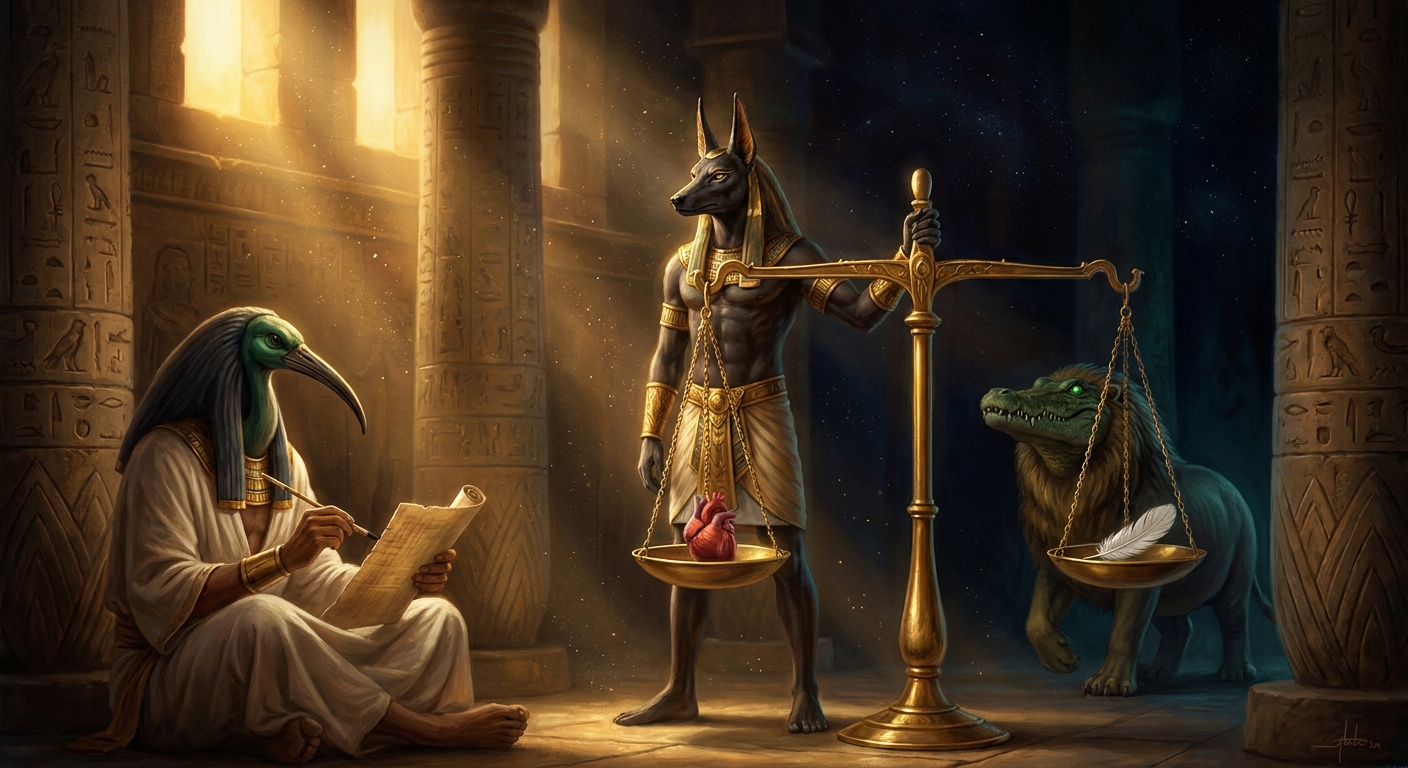
In the Hall of Two Truths, Anubis sets the dead man's heart on a scale against the feather of Maat. Forty-two gods press their accusations. Thoth waits with his reed. Ammit waits below. The scale decides everything.
- When
- Composed ~1500 BCE · New Kingdom
- Where
- The Hall of Two Truths · the Underworld
The jackal-headed god takes your hand at the threshold.
You do not remember dying. You remember a room, lamplight going thin, a sound like the Nile at low tide — and then Anubis, who is already here, who has always been at this threshold, who will be here for every soul that comes after you until the stars burn out. His grip is not unkind. He is the embalmer, the guide, the one who knows the road because he mapped it when he prepared the first body, when he wrapped Osiris himself in linen and sealed him for the journey. He knows what you are afraid of. He does not tell you whether you should be.
The Hall of Two Truths opens ahead.
You have imagined this room. Every Egyptian imagines it — the scribes paint it on the papyrus they bury with you, so the pictures are waiting for you, so the words on the scroll become your script. You know the forty-two names. You have practiced the declarations. I have not stolen. I have not lied. I have not murdered. I have not caused weeping. I have not been violent. I have not polluted the water. Forty-two denials, one for each judge, each keyed to a specific sin, each spoken into the face of a god who has been judging the dead since before your civilization could write.
But knowing the script does not mean the words come easily.
The hall is vast. Columns recede into darkness at both ends. Torches burn in brackets that appear to float, and the light they cast is the color of the sun at the moment before it sets — amber, ancient, final. At the far end, on a great throne of black granite, Osiris watches. His skin is green, the green of new grain, of the Nile’s flood-gift to the delta. He holds a crook and a flail crossed over his chest. He does not speak yet. He waits the way a verdict waits, already written, not yet read aloud.
Between you and Osiris: the scale.
The scale is simple. You have seen balances in the market — two pans, a central beam, a brass needle that reads the truth of weights without opinion or mercy. This one is the same, except that one pan holds nothing. The other holds a single feather: white, faultless, the feather of Maat, goddess of truth, justice, cosmic order. She stands nearby, her feather also on her headdress, duplicated, as if to say: what you see is what I am. There is no other standard.
Anubis releases your hand.
He reaches — and you understand, in the way you understand things in this place without being told — that he is reaching into you. Not violently. With the practiced certainty of a man who has done this ten thousand times and will do it ten thousand more. He draws out your heart. Not the muscle; the record. Everything you felt, chose, refused to choose, turned away from, ran toward, held when you should have released, released when you should have held. The weight of every moment you were fully awake and every moment you chose not to be.
He sets it on the scale.
The needle moves.
In the market, in the delta towns, you have seen dishonest merchants load weights into their palms, press thumbs against the pan. There is no thumb here. The needle moves where the truth takes it, and you cannot look away from where it settles.
The forty-two assessors press forward. They are gods, each named for a different city, a different sin, a different failure of ma’at. They do not shout. They speak in turn, each one’s accusation precise as a surgeon’s cut. Did you enrich yourself at another’s expense? Did you speak what you knew to be false? Did you eat without having shared? Did you close your ears to the one who came to you in need?
You answer. The words of denial rise in you, and you say them, and the gods listen, and the needle shows what the words are worth.
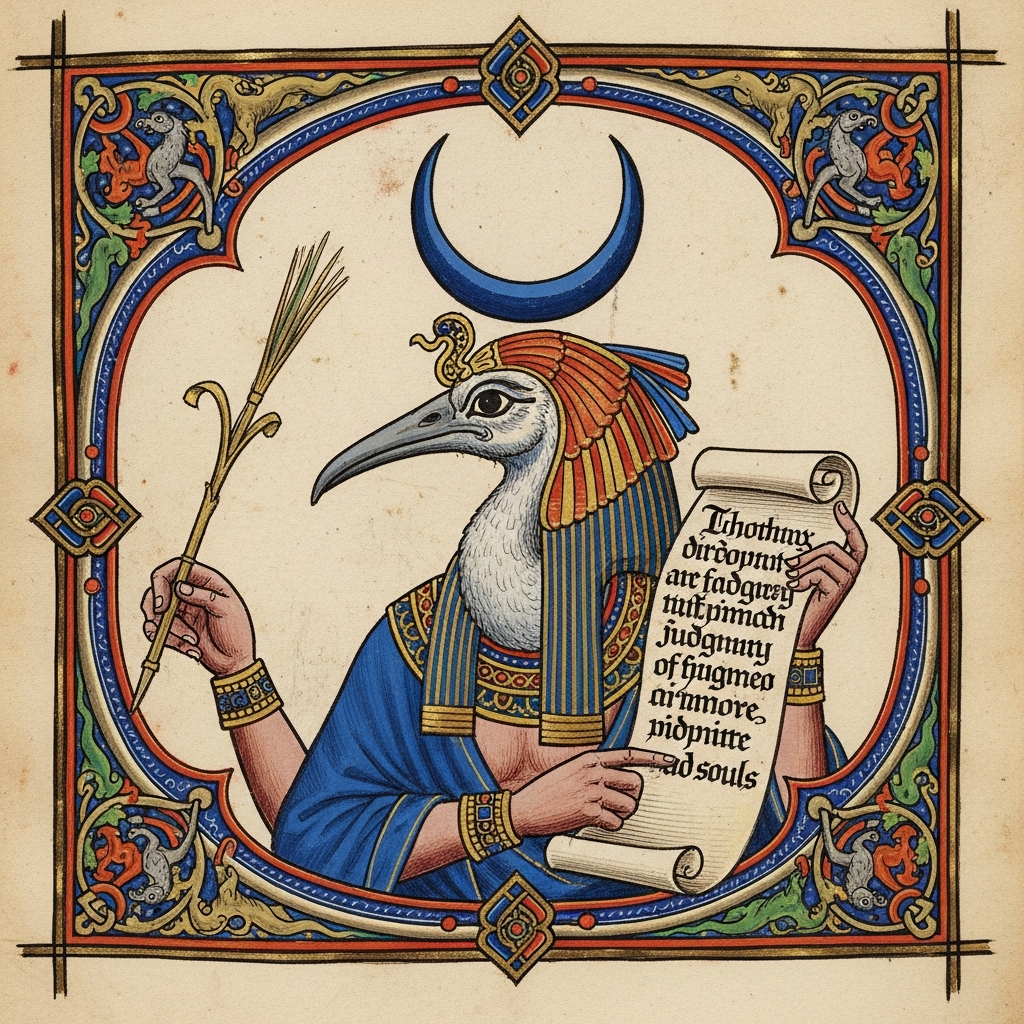
Thoth watches from his post at the edge of the scale, ibis-headed, stylus in hand, papyrus unrolled across his knee. He is the scribe of the gods, the keeper of the divine record, the god who invented writing because he understood that truth requires a witness and a ledger. He does not hurry. He misses nothing. Every tremor of the needle, every shift in the balance as the assessors speak and you reply, goes onto the papyrus in script so precise it is itself a form of judgment.
He has recorded every soul that has passed through this hall. He will record every soul that comes after. The papyrus does not run out. Thoth does not tire. The record exists whether or not you want it to.
Below the scale, Ammit waits.
She is the Devourer, and she is exactly what the name promises. Lion’s mane, hippopotamus haunches, crocodile head — the three most lethal animals in Egypt folded into one creature, crouched at the foot of the scale, waiting with the patient, boneless readiness of a thing that has never not been hungry. She does not pace. She does not threaten. She simply exists at the end of the process, the way consequence exists at the end of a choice.
If your heart is heavier than the feather — heavier with resentment, with cruelty, with the accumulated weight of every moment you refused to live in ma’at — she eats it. Not as punishment. As dissolution. There is no afterlife for the soul whose heart Ammit consumes. There is no punishment in the Field of Reeds, no torment in a dark place, no second death in fire. There is simply nothing. The person who lived becomes the person who never was. Existence, withdrawn.
The Egyptians understood something the later traditions obscured: the worst thing that can happen to you is not suffering. It is erasure.
The needle settles.
Thoth marks the verdict. His reed crosses the papyrus once, twice, and the sound it makes is the quietest sound in the hall. Anubis reads the scale. Osiris on his throne inclines the crook a fraction.
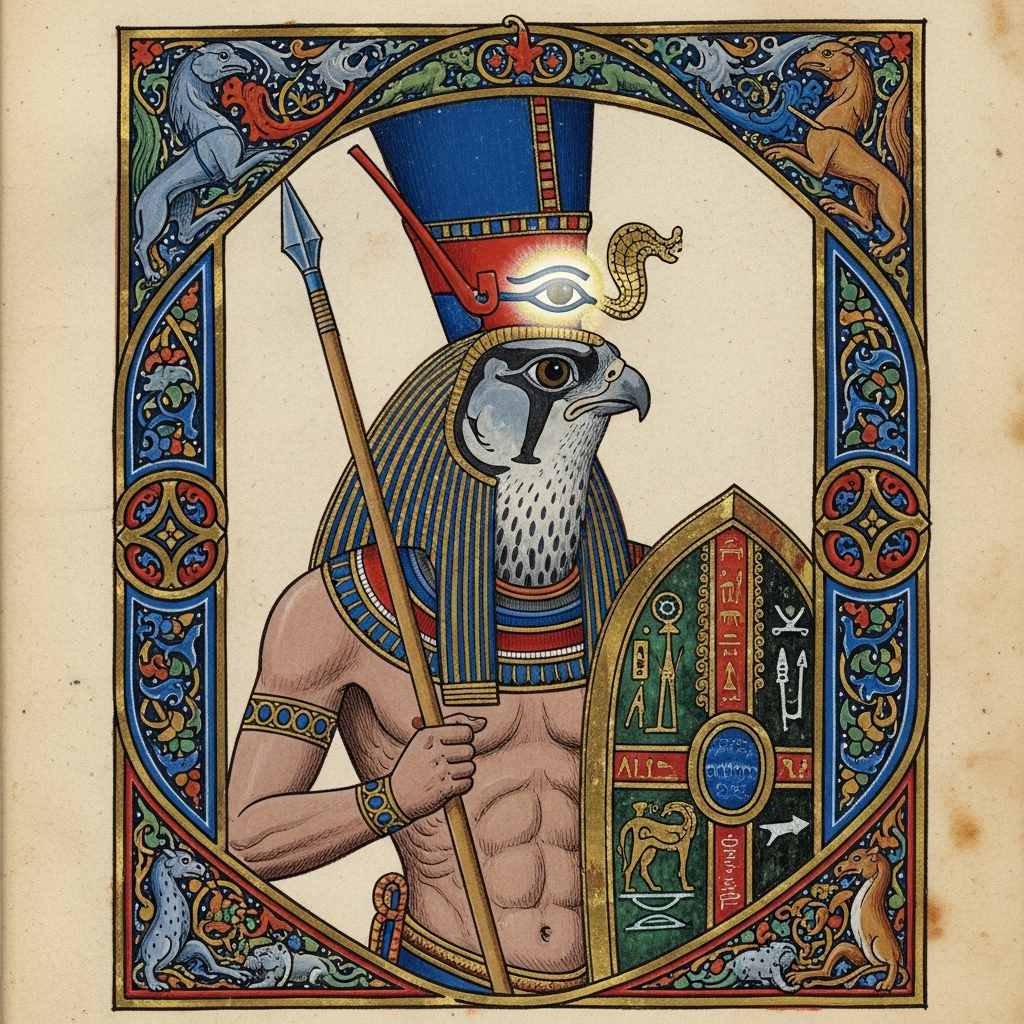
If the heart is lighter than the feather — if it has been worn down to the weight of a life lived in truth, in generosity, in the daily and undramatic practice of ma’at — then Horus steps forward, takes the hand that Anubis releases, and leads the soul onward. Past the forty-two judges. Past Thoth’s papyrus. Past Ammit, who does not rise. Through the far door of the hall and into the Field of Reeds: Aaru, the Egyptian heaven, where the wheat grows tall and the Nile never floods wrong and the dead live the life they lived at their best, but without the interruptions.
The field is real. The dead who reach it are not shadows. They work and rest and eat and know one another, and the boats of Ra still cross the sky overhead, and the stars still turn, and the world continues.
Three thousand years before John the Apostle sat in exile on Patmos and wrote of books opened and souls judged and a second death, an Egyptian scribe in Thebes painted this scene on papyrus by lamplight and tucked it into a coffin so the dead man would have the script in hand.
The judgment scene is not a metaphor. In the Egyptian understanding, it is literally true — as literally true as the Nile’s flood or the sun’s rising. What changes across the millennia is the name of the god on the throne, the name of the recorder, the architecture of the consequences. The structure does not change.
A scale. A feather. A heart that contains everything.
The Weighing of the Heart appears in the Papyrus of Ani (British Museum, ~1275 BCE) in full color — Anubis at the balance, Thoth with his ibis head and his reed, Ammit crouched and waiting, Ani and his wife watching from the side. It is among the best-preserved images in the ancient world. You can look at it today and understand exactly what is at stake.
Maat is not a goddess who intervenes. She does not argue for you or against you. She is the standard — the feather, the measure, the claim that the universe has a moral structure and that structure is real. Every tradition that came after her borrowed the feather, renamed it, and called it their own.
The Egyptians would not have minded. They understood that truth, properly understood, belongs to everyone.
Echoes Across Traditions
Entities


Sources
- *Book of the Dead* (Papyrus of Ani, ~1275 BCE)
- *Coffin Texts* (Middle Kingdom, ~2055-1650 BCE)
- *Pyramid Texts* (Old Kingdom, ~2400-2300 BCE)
- Erik Hornung, *Conceptions of God in Ancient Egypt* (1982)
- E.A. Wallis Budge (trans.), *The Book of the Dead* (1895)