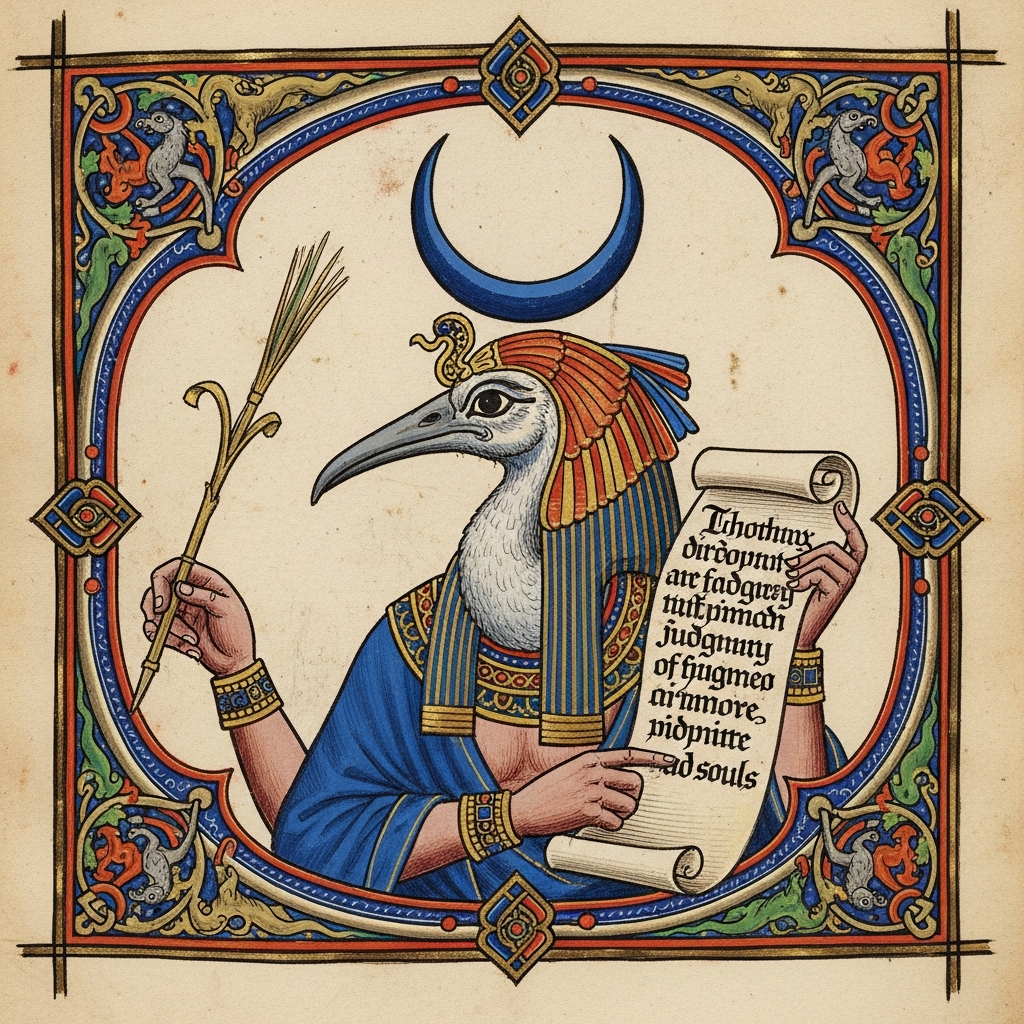
Thoth and the Five Days He Won from the Moon
Before the ordering of time — the mythological age of divine kingship · The sky — the celestial court of Ra, the Moon's domain
Contents
Nut the sky goddess and Geb the earth god want children, but Ra has forbidden Nut from giving birth on any day of the year. Thoth — god of wisdom, writing, and divine cleverness — goes to the Moon and proposes a wager at senet. He wins, game by game, 1/72 of the Moon's light: enough to build five extra days that fall outside Ra's calendar. Nut gives birth on each of those days. The five children are Osiris, Horus the Elder, Set, Isis, and Nephthys. The world as Egyptians knew it begins.
- When
- Before the ordering of time — the mythological age of divine kingship
- Where
- The sky — the celestial court of Ra, the Moon's domain
The problem, to begin with, is Ra.
Ra has forbidden Nut — the sky, the great arching goddess whose body forms the ceiling of the world from horizon to horizon — from giving birth on any day of the year. This is a specific and peculiar curse, and it requires a moment of contemplation before its weight becomes clear. There are three hundred and sixty days in the Egyptian calendar. Ra has forbidden birth on all of them. He has not forbidden pregnancy; Nut is pregnant, has been pregnant, with the children of Geb the earth god, her husband who lies beneath her arching body in the embrace they are never quite allowed to complete because Shu the air god holds them apart. But the children cannot come into the world because the world, as Ra has defined it, has no room for them.
Why Ra did this depends on which account you read. Some say he had a prophecy that Nut’s children would displace him; some say it was jealousy; some say it was the ordinary tyranny of a god who had arranged time to suit himself and did not want the arrangement disrupted. The effect is the same regardless of the cause: three hundred and sixty days, all prohibited, Nut enormous and waiting and her husband the earth pressing his case from below in the way the earth always presses up against the sky.
Into this problem steps Thoth.
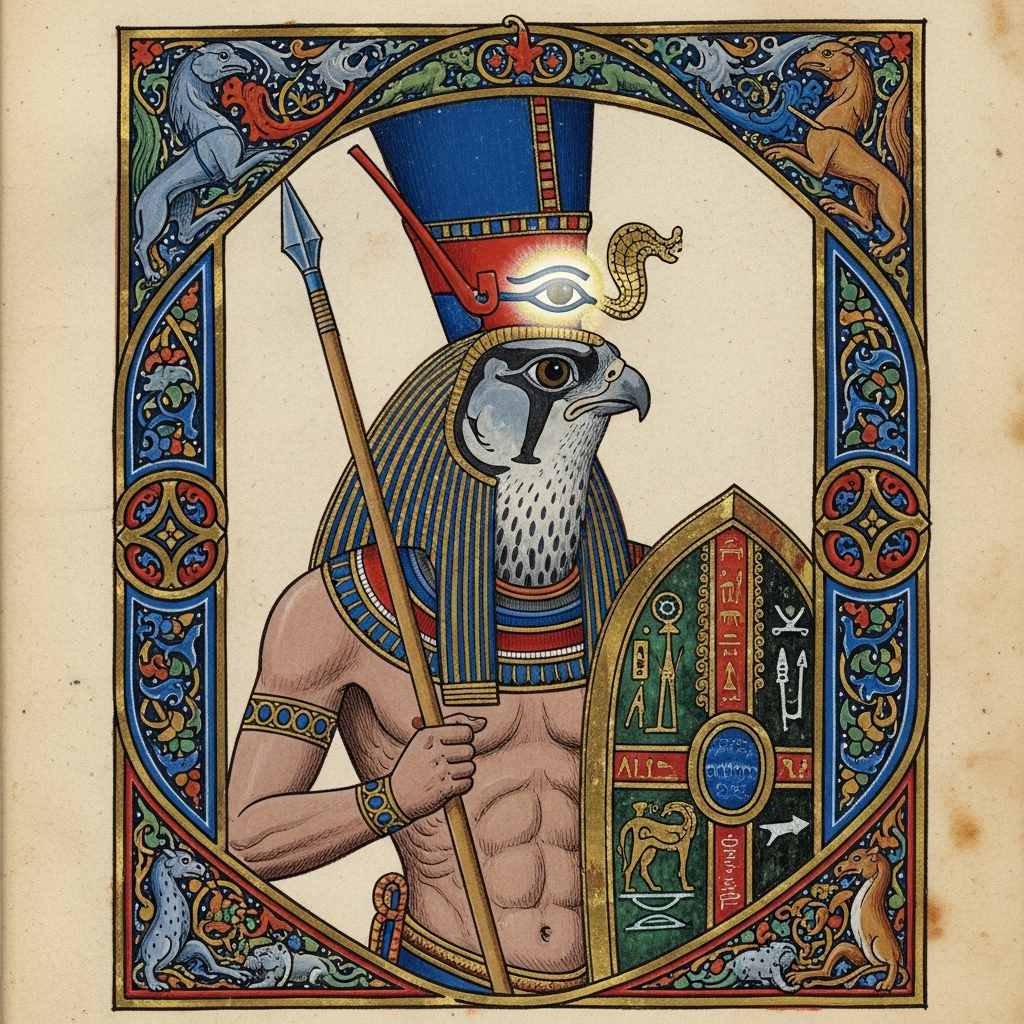
Thoth is the god of writing, of measurement, of the moon’s light, of wisdom that is practical rather than merely contemplative. His head is an ibis — the bird that stands in the shallows counting fish, patient and absolutely precise, that strikes when the calculation is complete and not before. He is the divine scribe, the one who records what happens in the Hall of Two Truths, the one Ra sends when something needs to be figured out rather than merely decreed. He is, in the Egyptian theological vocabulary, the mind of Ra separated from Ra and given independent operation — the same relationship that Sekhmet has as Ra’s Eye, but applied to intelligence rather than force.
He goes to the Moon.
The Moon at this point in Egyptian cosmology is a god — Khonsu, or sometimes identified as Thoth himself in his lunar aspect — and the Moon possesses light that it measures out in a cycle, waxing and waning over thirty days. Thoth proposes a game of senet.
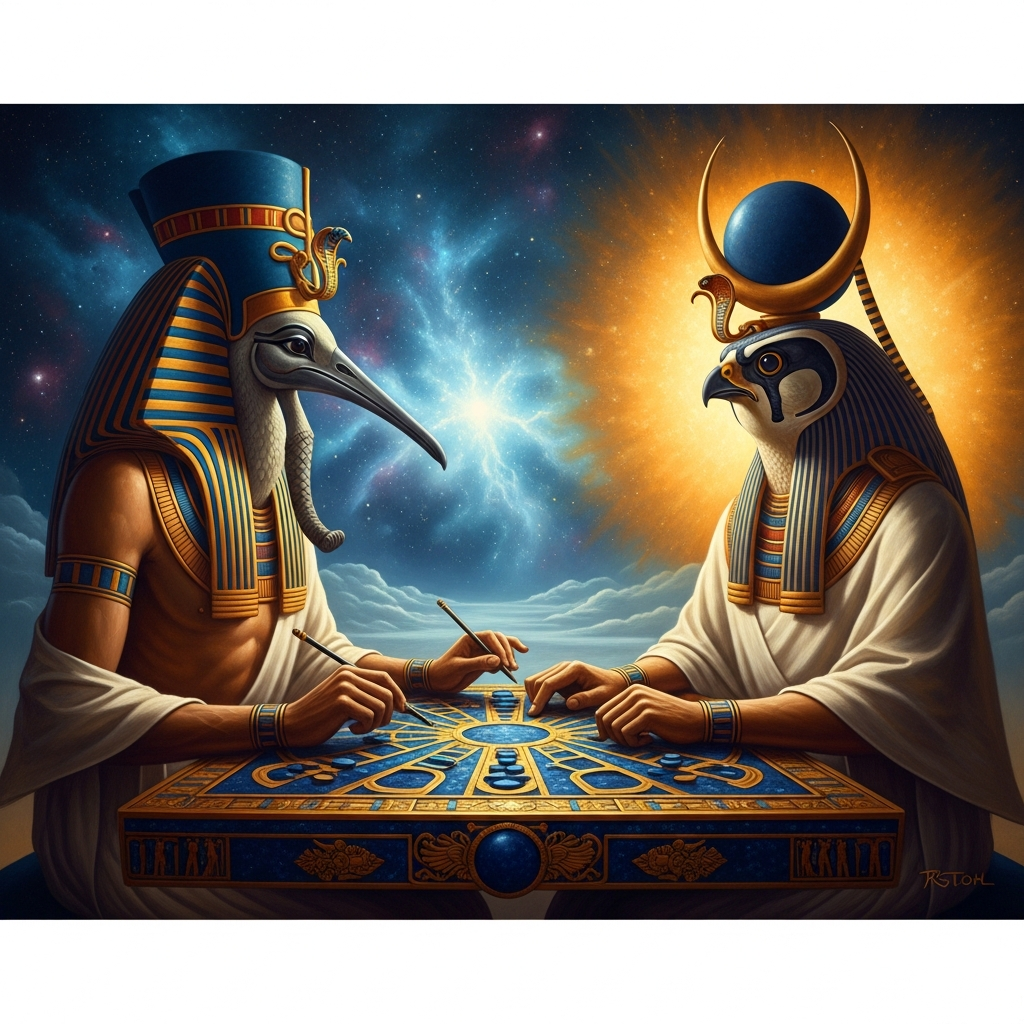
Senet is the board game that Egyptians played from the predynastic period forward, a race game with throwing sticks used as dice, twenty squares, a series of squares that are lucky and squares that are very bad. It is also the game played in the afterlife and depicted in tomb paintings. It is a game with cosmic stakes built into its ordinary form, a game that Egyptians understood as enacting the soul’s journey through the duat. Thoth proposes it, and the Moon agrees, because the Moon has always agreed to games, and because Thoth has not said what he wants to play for.
They play.
The texts do not record the individual games — whether Thoth won the first and the Moon the second, whether the senet pieces moved slowly or quickly through their lucky and unlucky squares, how many evenings they sat across the board from each other under a sky that was somewhat lighter or darker depending on how the wager stood. What the texts record is the outcome: Thoth won enough games across enough sessions to accumulate 1/72 of the Moon’s total light.
One seventy-second. This is a precise fraction. It is not a story fraction — not a half or a quarter, the round numbers that myths tend to favor. It is a fraction that someone calculated, because 1/72 of 360 days is exactly five days.
Five days of light wrested from the Moon through games of senet. Five days that the Moon now has to go without, which is why the lunar month is twenty-nine and a half days rather than thirty — the Moon is always missing those five days that Thoth won, always slightly shorter than it would otherwise be. The debt is encoded in the sky.
With five days of light won from the Moon, Thoth goes to Nut.
He has, he explains, found a solution to the problem of Ra’s prohibition. Ra said she could not give birth on any day of the year. Thoth has created five days that are not days of the year — they are the epagomenal days, the days outside the calendar, the days that fall between the end of one year and the beginning of the next, the days that exist in the gap. They are not Ra’s days. His prohibition does not cover them.
This is either a loophole or a different kind of power — the power of precision, of reading the exact words of a decree and finding the space the words do not cover. Thoth is the god of writing, and a god of writing knows that all decrees have edges, and that the edges are where things become possible.
Nut gives birth once on each of the five days.
On the first epagomenal day: Osiris. He enters the world with a voice that carries across the newly-born sky, a voice so large that the god Pamyles hears it coming from the temple of Zeus (the Greeks later said) and understands that the lord of all things has arrived. Osiris is grave, dark-skinned, the color of the silt that makes the fields fertile after the flood. He is already complete in some way that the others are not — already the king he will become, already the judge he will become after he is murdered.
On the second day: Horus the Elder, Haroeris, the great falcon, who is already watching the horizons.
On the third day: Set. He is born sideways, tearing out of his mother’s side rather than waiting for the proper moment, red and golden and already impatient with the ordinary sequence of things. He enters the world in a hurry and will spend the rest of his very long mythological career moving too fast, wanting too much, refusing the constraints that the other gods accept as the price of participation.
On the fourth day: Isis, who slides into the world knowing things — knowing the secret name of Ra that she will spend centuries extracting from him, knowing the words of power that will reassemble her murdered husband from fourteen scattered pieces, knowing already that she is the one around whom everything else will eventually organize itself.
On the fifth day: Nephthys, the youngest, the one whose name means Lady of the House, who is Set’s wife and Isis’s shadow and Osiris’s mourner and the guardian of the threshold between the living and the dead. She is the complement, the other horizon.
Five births. Five children. Five days that Thoth made from a fraction of the Moon’s light by sitting across a senet board and playing until he had what he needed.
Ra discovers what has happened. The texts do not record his reaction with precision, which may be its own kind of precision. He cannot unmake the five days — Thoth has built them into the structure of time, and you cannot unbuild the structure of time without unbuilding everything that has happened inside it. He cannot unborn the five children. He can only accept that the divine family is now larger than he intended, that the story of the world now has characters he did not authorize, and that the loophole in his own decree was there from the moment he pronounced the words.
This is the paradox at the center of the Thoth myth: the god of writing shows the god of all things what happens when language is precise enough to create reality but not quite precise enough to close every possibility. Ra made time. Thoth found the seam in it and threaded five days through the needle’s eye.
Everything that follows — Osiris’s murder, the resurrection, the judgment of the dead, the divine kingship of Egypt, the entire theological architecture of one of history’s longest-running religions — everything that follows begins here, in a game of senet played under a slightly-diminishing moon.
The ancient Egyptian calendar maintained the five epagomenal days as a distinct period each year — the days outside the reckoning, the days of transition, the days when the usual rules were suspended and the world was briefly between one state and another. Egyptians treated them with a mixture of festivity and caution: they were dangerous days, unlucky for ordinary business, the time when Set had been born tearing through his mother’s side and when the world was still, in a sense, being decided.
They were also the days when you were closest to the divine — when the membrane between the ordered year and the chaos outside time was thinnest, when Thoth’s trick was still visible in the calendar if you knew where to look.
The five days still exist. Every calendar that accounts for the solar year must reckon with them somehow — as leap days, as epagomenal periods, as the stubborn remainder that doesn’t fit the round numbers. Thoth’s fraction, 1/72, is still there in the difference between the calendar and the sky.
Scenes
Thoth sits across a senet board from the Moon god, the sky behind them luminous and cold, the board between them inlaid with gold and lapis
 Generating art…
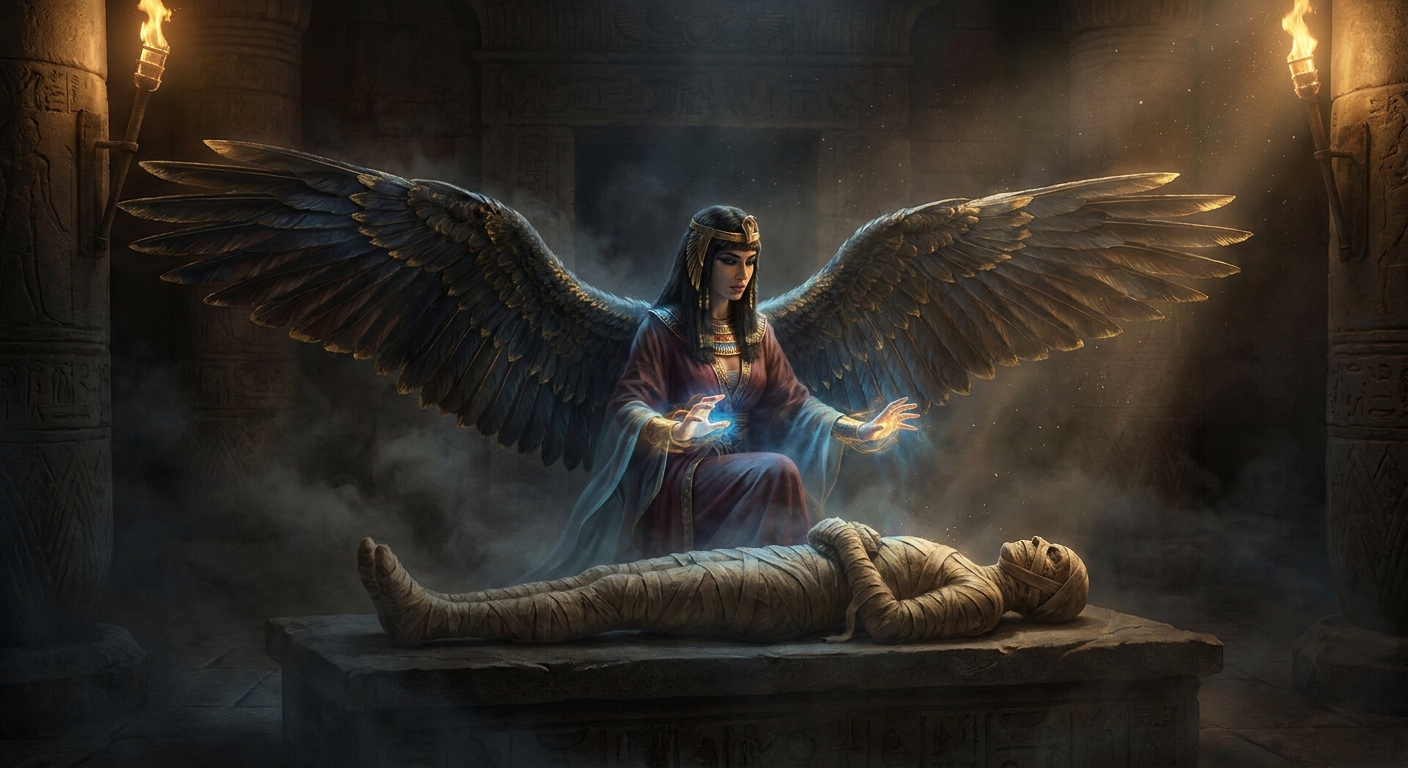
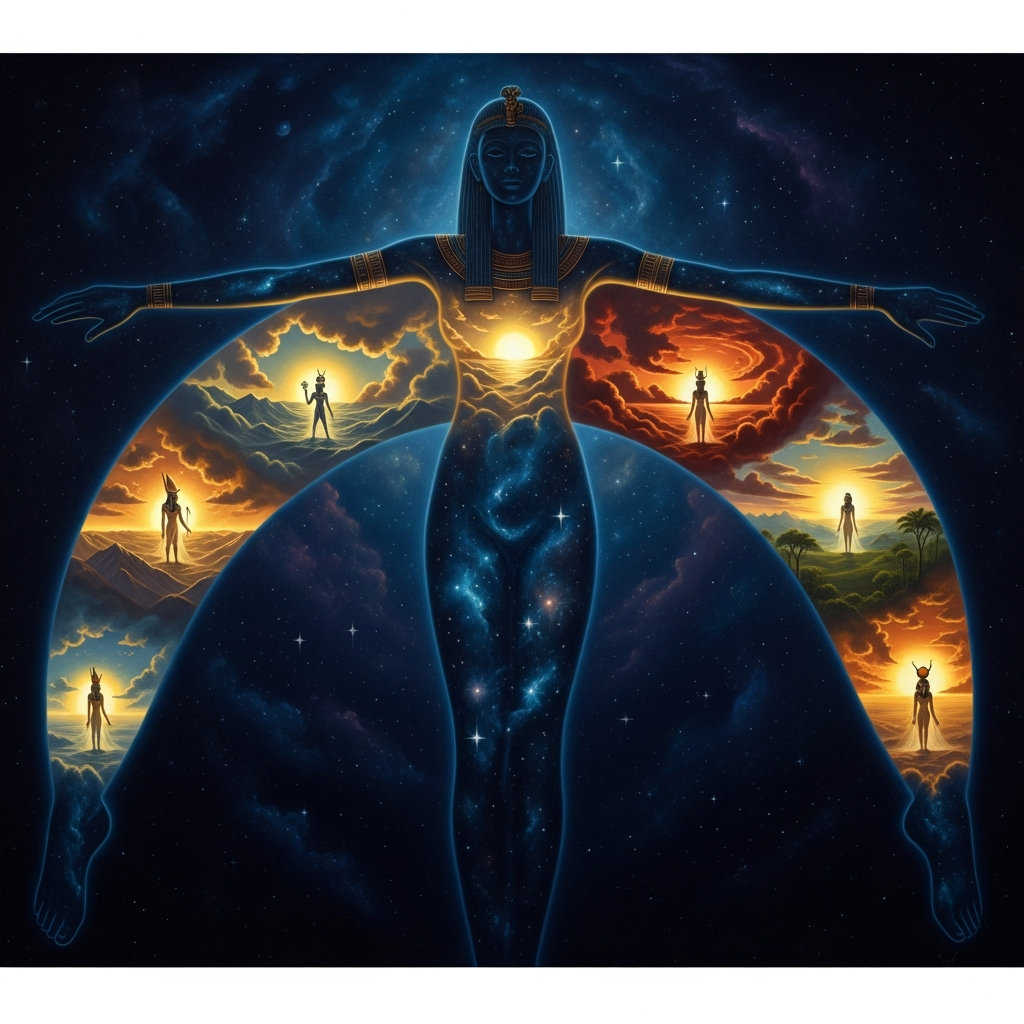
 Nut stretched across the sky, her body the deep blue of the night vault, giving birth across five consecutive dawns — five children emerging into the extra days that exist outside the calendar, outside Ra's prohibition, in the space that Thoth made
 Generating art…
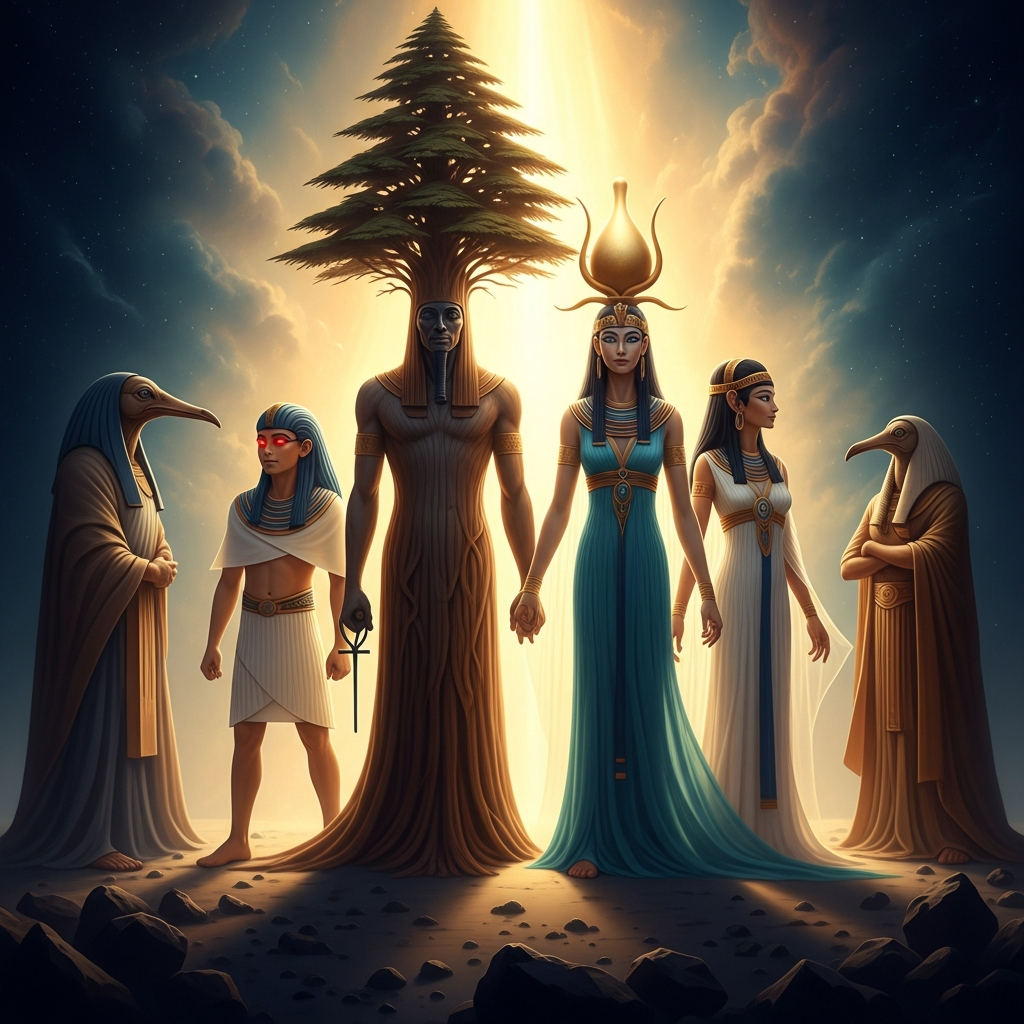
 The five children of Nut on the five epagomenal days: Osiris solemn as a cedar, Horus bright, Set red-eyed and already impatient, Isis and Nephthys paired like the two horizons
 Generating art…
 Echoes Across Traditions
Entities


Sources
- Plutarch, *On Isis and Osiris* (c. 100 CE) — the primary surviving account of the five-day myth
- Erik Hornung, *Conceptions of God in Ancient Egypt: The One and the Many* (Cornell University Press, 1982)
- Richard H. Wilkinson, *The Complete Gods and Goddesses of Ancient Egypt* (Thames and Hudson, 2003)
- Geraldine Pinch, *Egyptian Mythology: A Guide to the Gods, Goddesses, and Traditions of Ancient Egypt* (Oxford University Press, 2004)
- Jan Assmann, *The Search for God in Ancient Egypt* (Cornell University Press, 2001)