The Coffin, the Cedar, and the Fourteen Pieces
Mythic Time · Plutarch's account ~100 CE, Egyptian sources to ~2400 BCE · Egypt — the banquet hall, the river, the cedar at Byblos, the marshes of the Delta
Contents
Plutarch's account of how Set killed his brother Osiris twice — first by trickery in a custom-fitted coffin, then by dismemberment — and how the murder set the template every later resurrection religion would borrow.
- When
- Mythic Time · Plutarch's account ~100 CE, Egyptian sources to ~2400 BCE
- Where
- Egypt — the banquet hall, the river, the cedar at Byblos, the marshes of the Delta
The wager is a coffin.
Set has built it to his brother’s exact dimensions. He has measured Osiris in his sleep, in the garden, at council — quietly, over weeks, the way an embalmer measures a corpse before he begins. The wood is cedar from the north, inlaid with ebony and lapis. It is the most beautiful object in the room. At the banquet — Set’s banquet, with seventy-two co-conspirators in attendance, all sworn — he announces a game. Whoever fits this coffin keeps it.
The guests try one by one. The coffin is too short for some, too long for others, comically wrong for the slender and the broad. Laughter ripples through the hall. Osiris watches, amused, the way a king watches a court entertainment that has nothing to do with him.
Then he steps in. He lies down. The coffin fits.
The seventy-two slam the lid.
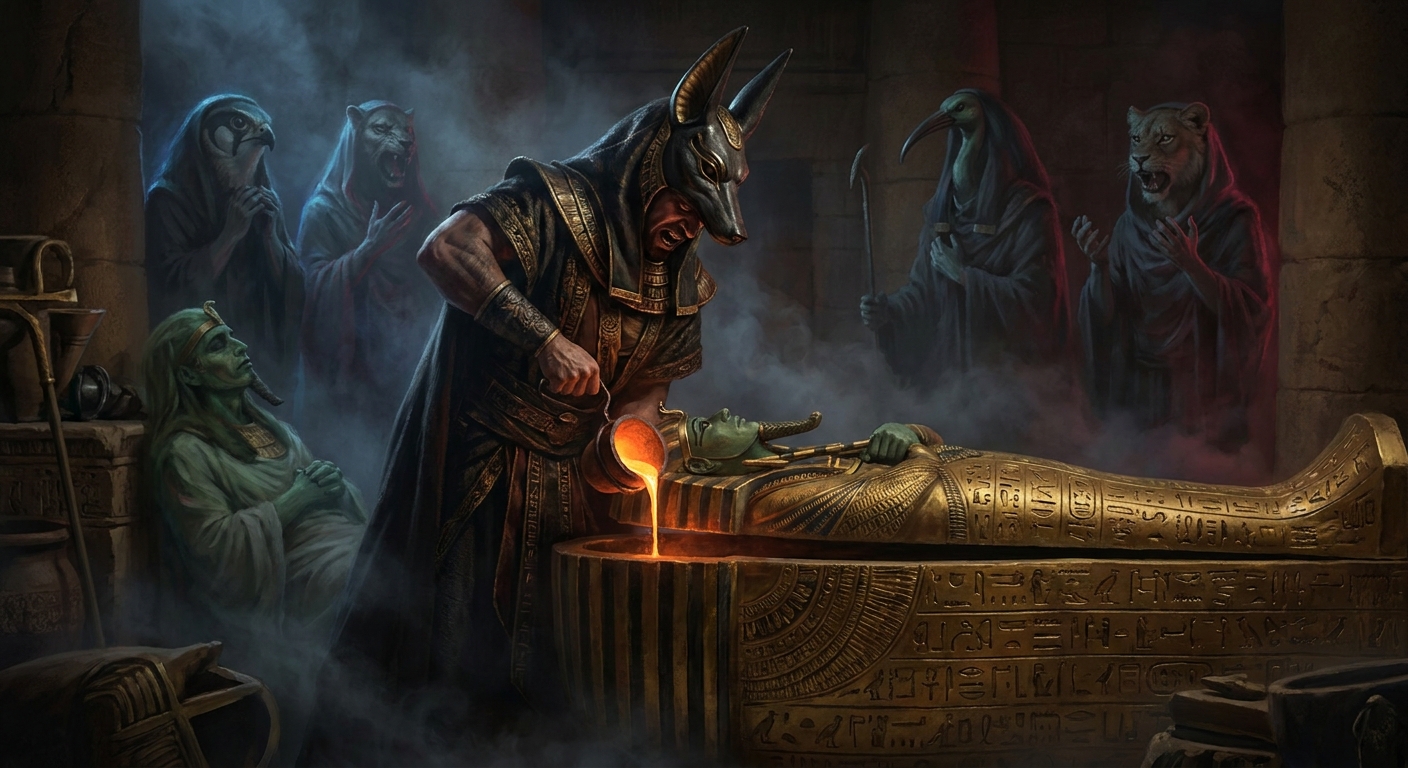
They nail it shut. They seal the seams with molten lead — the metal of binding, of exclusion from the world of breath. They carry the coffin to the Nile and they push it in, and the river takes it north toward the delta, toward the Mediterranean, toward the open sea.
Osiris does not drown. The Egyptian texts are careful about this. He suffocates inside the lead, but suffocation does not destroy a god — it relocates one. By the time the coffin reaches the surf at Byblos, his ka has already begun the descent into the Duat. The body is a vessel that has not yet been emptied.
The coffin lodges against the shore. A young cedar puts down roots beside it. Over a season, perhaps a year, the cedar grows around the coffin, absorbing it into the trunk. The wood swells. The coffin disappears inside the tree. The tree reaches a remarkable size, fragrant beyond explanation, and the king of Byblos sees it and orders it cut down for a pillar in his palace.
The coffin is now a pillar in a foreign hall. Osiris is now load-bearing architecture.
Isis searches.
This is the part Plutarch lingers on, because Plutarch was a Greek writing for Greeks, and a wandering grieving goddess was a familiar figure to his audience — Demeter searching for Persephone, Cybele for Attis. Isis cuts her hair. She wears mourning. She walks the riverbanks of Egypt asking strangers what they have seen, and the children of fishermen tell her — children, Plutarch notes, are sometimes the only ones who tell the truth — that a wooden box passed downstream months ago and did not return.
She follows the current to the sea. She takes ship for Phoenicia. In Byblos she takes employment in the queen’s household as a nurse for the royal infant. She tries, by night, to burn away the child’s mortality in a sacred fire. The queen catches her at it and screams. Isis reveals herself. The pillar in the hall begins to weep resin. The queen, terrified, cuts the pillar open. The coffin is inside. Isis carries it back to the marshes of the Delta and hides it in the reeds and goes to find Horus.
She is gone for one night.
Set is hunting.
He has the dogs of the desert with him — pale, lean dogs that hunt by scent, and the scent of his brother is not difficult for them. They find the reed-bed before sunrise. Set opens the coffin. The body is intact, preserved by sea and resin and Isis’s bandaging. He looks at his brother’s face — the face he has known since they were both small, when their mother Nut bent her star-flecked body over them and called them by their hidden names.
He decides intact is not enough.
He cuts. The Egyptian texts disagree on the count — some say sixteen pieces, some fourteen — but Plutarch settles on fourteen, and fourteen is what later tradition keeps. Fourteen pieces of god scattered across fourteen nomes of Egypt. The phallus he throws into the Nile, where the oxyrhynchus fish — a mottled, pale catfish sacred ever after to Set — eats it before it sinks.
This is the second murder. It is the more thorough one. The first was suffocation; this is annihilation. To dismember a god is to make resurrection theoretically impossible, because there is no longer a unified body to return to.
Isis returns at sunrise to find an empty reed-bed and red sand.
She begins again.
The texts catalogue her search at length — Abydos, Memphis, Philae, Hermopolis — and the sister Nephthys walks with her, and Anubis, who is Nephthys’s son by Osiris (the texts are matter-of-fact about the affair), works the dark places. They gather thirteen pieces across the length of Egypt. Each piece, Plutarch notes, is buried where it was found, with full priestly honors, and a temple is raised over it. This is why fourteen Egyptian cities each claim to be the burial place of Osiris: each has a piece. The cult of Osiris is, in its origin, the cult of distributed relics — every shrine a fragment of the same body.
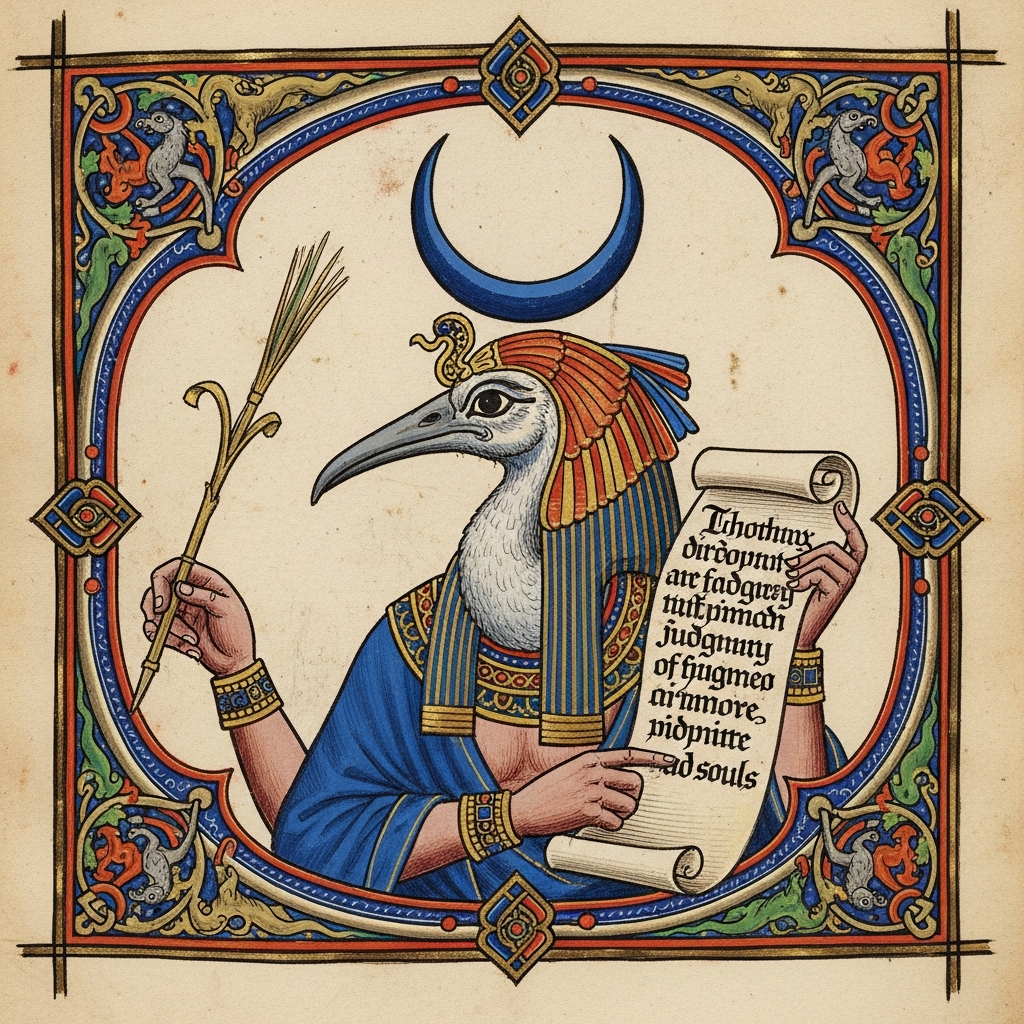
The fourteenth piece — the phallus — is gone. The fish has consumed it. There is no spell, even Thoth admits, that recovers what has entered the food chain.
So Isis fashions a new one.
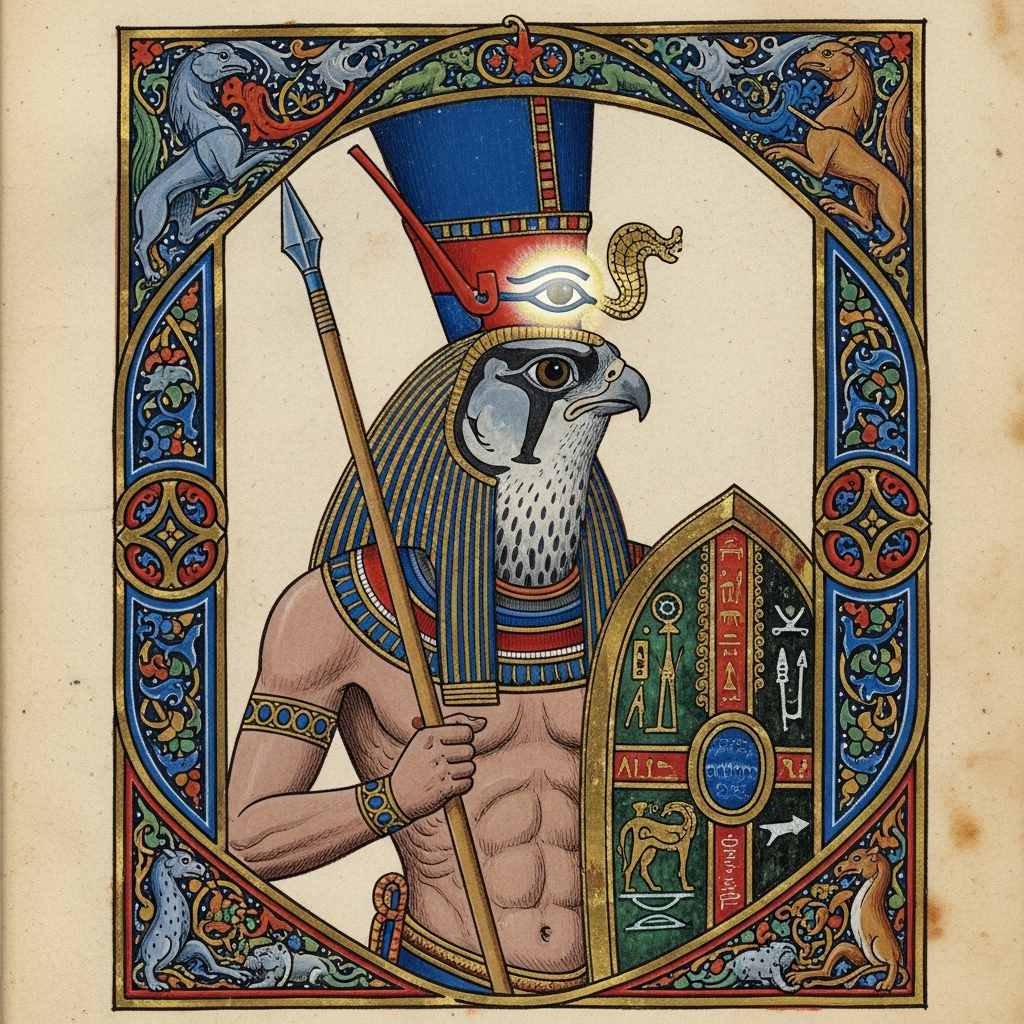
The texts are unembarrassed. She makes a phallus of gold — Plutarch writes simply: she fashioned a typon, a model, of the missing part — and she binds it to the reassembled body, and she works the magic Anubis has taught her on the rest of the wrappings, and for one night she has her husband back. They conceive Horus. The child is the avenger, the heir, the falcon-headed god who will one day challenge Set in court for eighty years and finally win the throne of Egypt back.
In the morning Osiris descends.
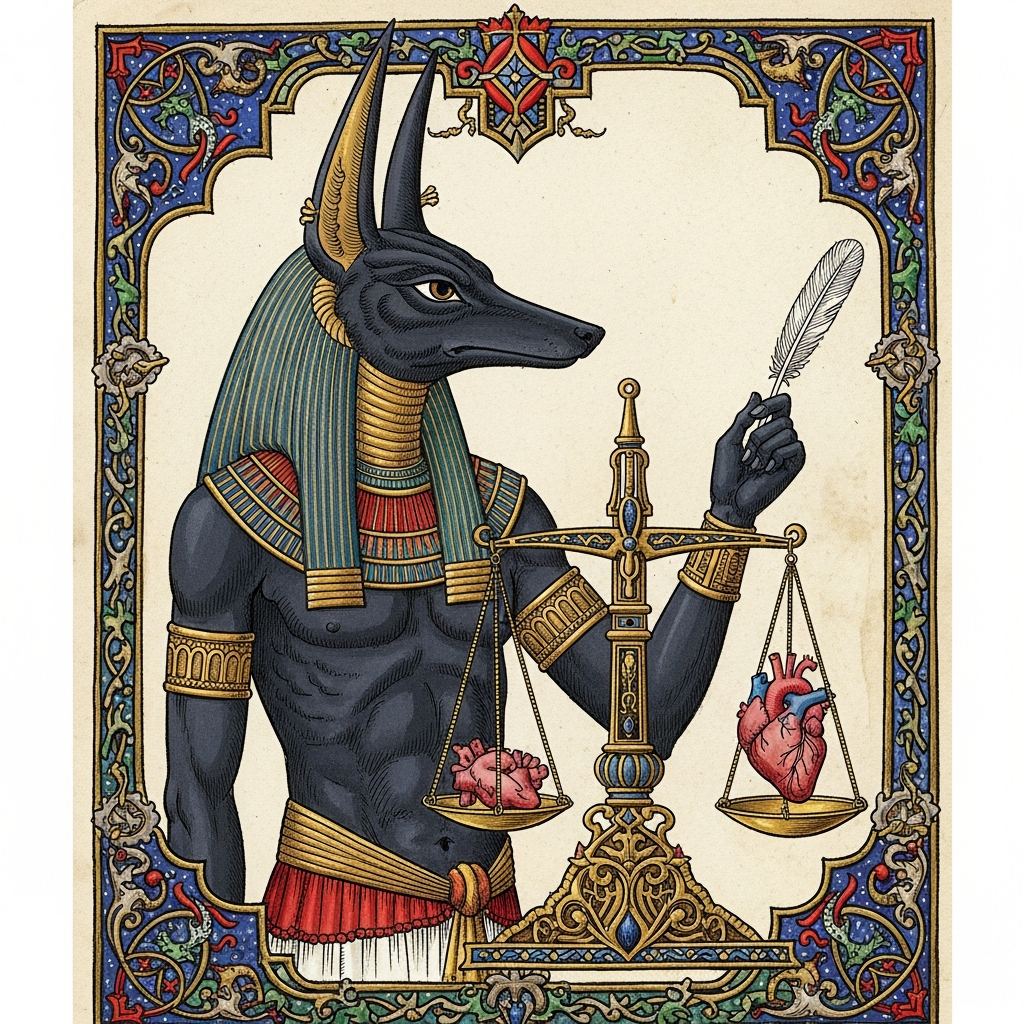
He does not come back to the world above. This is the Egyptian innovation — the part the later resurrection religions will modify or abandon. Osiris becomes the king of the dead. He sits on the throne of the Duat with the crook and the flail crossed against his green chest, judging every soul that comes through the Hall of Two Truths. He is more powerful in death than he was in life, because death is now a kingdom, and he is its king. The throne Set stole from him on earth has been replaced by a throne Set cannot reach.
This is the deal Egypt strikes with mortality. You will die. You will be judged. The judge will be the god who was murdered, who knows what death feels like from the inside, who has been where you are going. It is, in its way, a remarkable theological gesture: the underworld king is not a stranger or a tyrant. He is a victim. He has been you.
And every Egyptian, embalmed at death, is wrapped as Osiris was wrapped. The natron, the linen, the spells over the limbs — these are Anubis’s instructions, given to Isis in the chamber beside the river, repeated for every body since. To die well, in Egypt, is to be re-membered as Osiris was re-membered. The funeral is a re-enactment. The corpse is the god.
Plutarch wrote in Greek, around 100 CE, drawing on Egyptian sources four centuries older than Homer. By the time he set the story down, the Isis cult had reached Britain. Soldiers in the Twentieth Legion at Chester worshipped her. Pompeiian frescoes show her processions. The temple of Isis on the Capitoline Hill stood until Theodosius I demolished it in the 390s.
The Christian historians of the next two centuries noticed the structural overlap and tried to explain it. Some said the devil had pre-figured Christ in Osiris to confuse the faithful (Tertullian’s argument); some said the resemblance proved a universal divine pattern that Christianity had finally fulfilled (Augustine’s argument). Modern scholars have generally given up on the question of which way the influence ran, because the evidence is too tangled and the cultural soil too shared.
What remains is the structure. The custom-built instrument of death. The betrayer at the banquet. The body recovered by women. The descent. The throne in the realm below. The avenger-heir who comes after.
Egypt wrote it first. Everyone since has written variations.
Scenes
The banquet at which Set has measured his brother's body in advance — a coffin built to one man's exact length, offered as a wager
Generating art… Isis at the cedar of Byblos, where the coffin has lodged inside a tree the queen has cut into a pillar of her palace
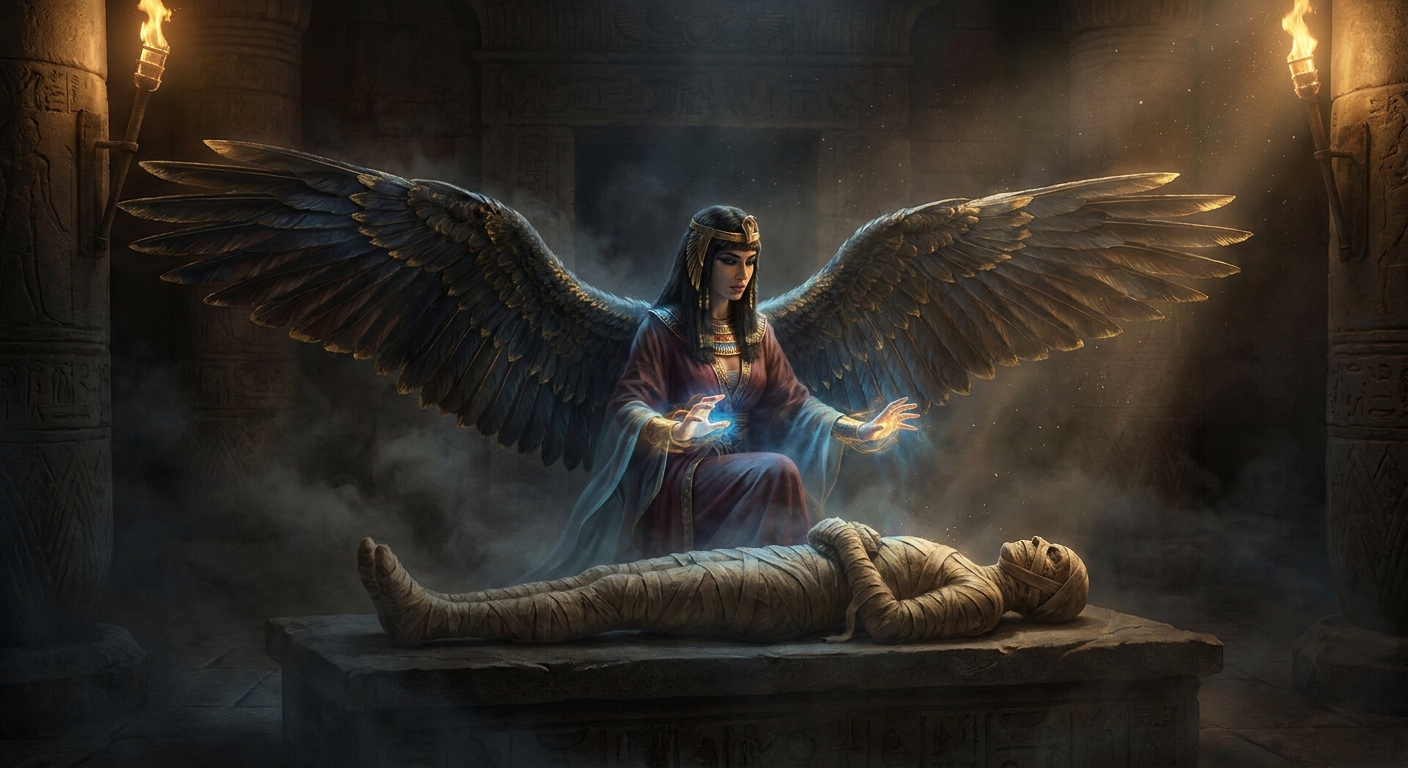 Generating art…
 Osiris on the throne of the Duat — green-skinned, crook and flail crossed, lord of the realm his brother sent him to and his wife pulled him back from
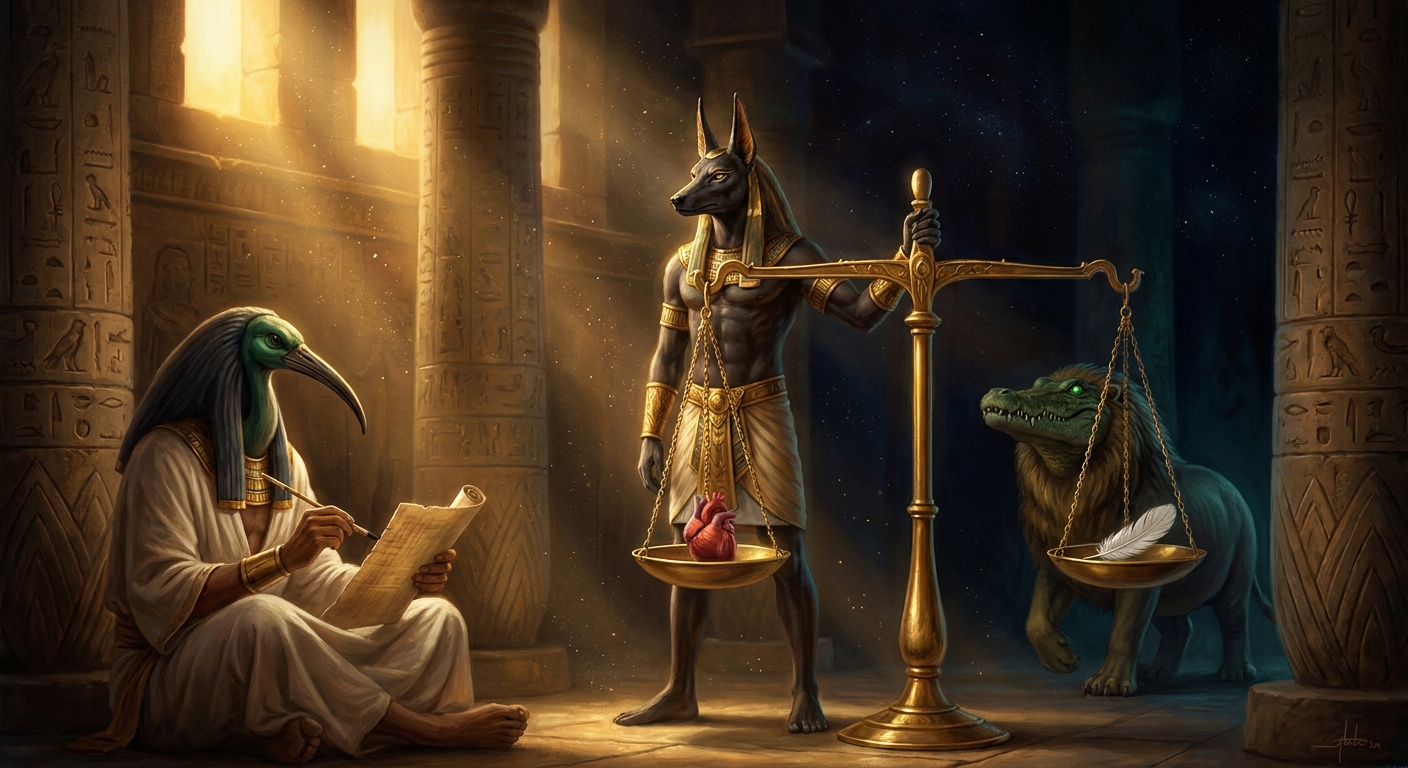 Generating art…
 Echoes Across Traditions
Entities


Sources
- Plutarch, *De Iside et Osiride* (~100 CE)
- *Pyramid Texts* — Utterances 219, 252, 354, 405 (~2350 BCE, oldest Egyptian sources)
- *Coffin Texts* — Spell 148 and others (Middle Kingdom, ~2000 BCE)
- R.O. Faulkner (trans.), *The Ancient Egyptian Book of the Dead* (British Museum, 1972/1985)
- James P. Allen, *The Ancient Egyptian Pyramid Texts* (SBL, 2005)
- Jan Assmann, *The Search for God in Ancient Egypt* (Cornell, 2001)