Isis Reassembles Osiris
Mythic Time · oldest written ~2400 BCE Pyramid Texts · Egypt — the cedar of Byblos, the marshes of the Nile
Contents
Isis searches Egypt for the dismembered body of her murdered husband Osiris, finds thirteen of fourteen scattered pieces, and through magic and bandages restores him to life long enough to conceive the avenger Horus.
- When
- Mythic Time · oldest written ~2400 BCE Pyramid Texts
- Where
- Egypt — the cedar of Byblos, the marshes of the Nile
She stands at the river’s edge at dusk.
The Nile is wide and dark. Somewhere downstream, in the marshes where the papyrus grows thick and the crocodiles lie with their eyes just above the waterline, one of the fourteen pieces of Osiris is still lost. The fourteenth piece — the phallus, eaten by the oxyrhynchus fish the moment Set’s men threw it into the water three days ago. She has found thirteen. Thirteen pieces of her husband, scattered across Egypt like a message written in flesh.
Set’s laughter still echoes from the desert. He had invited Osiris to a feast, had a coffin built to measure, and when Osiris lay down upon it to test its fit (in that moment of trust that precedes catastrophe), Set’s seventy-two conspirators had slammed the lid shut and thrown the coffin into the river. The water had carried it north, to Byblos, where a cedar tree grew around it, beautiful and fragrant, and the palace servants cut it down to make a pillar. When Set learned that the coffin had not been destroyed in the Nile, he became more careful. He broke the coffin open, drew out the body of his brother, and with a sickle sharp as hatred, he cut Osiris into fourteen pieces.
Then he scattered them across Egypt.
Fourteen pieces. One god divided into the length and breadth of the world.
Isis did not mourn. Not yet.
She began walking.
At Abydos, she found the torso, where the servants of Orion had hidden it in a hollow stone. At Memphis, she found the left arm and the right leg, buried in separate temples. At Philae, in a shrine beside the Nile, she found the right arm and left leg, arranged as if someone had meant to reassemble him and had lost faith halfway through. She searched the marshes and found ribs wedged between roots. She searched the limestone cliffs and found the collarbone in a tomb no pharaoh had ever blessed. She found the skull at Hermopolis, where it had been left in a sacred lake. She found the spine scattered in seven pieces across Upper Egypt, each one hidden in a different nome, as if Set had wanted to ensure that no single person could gather him and no single spell could restore him.
Her sister Nephthys walked with her, weeping. Her son Anubis worked the dark, finding the pieces no living person could reach — pulling a femur from a sacred cavern, retrieving fingers from a place where the dead themselves fear to walk.
Thirteen pieces. Gathered. Waiting.
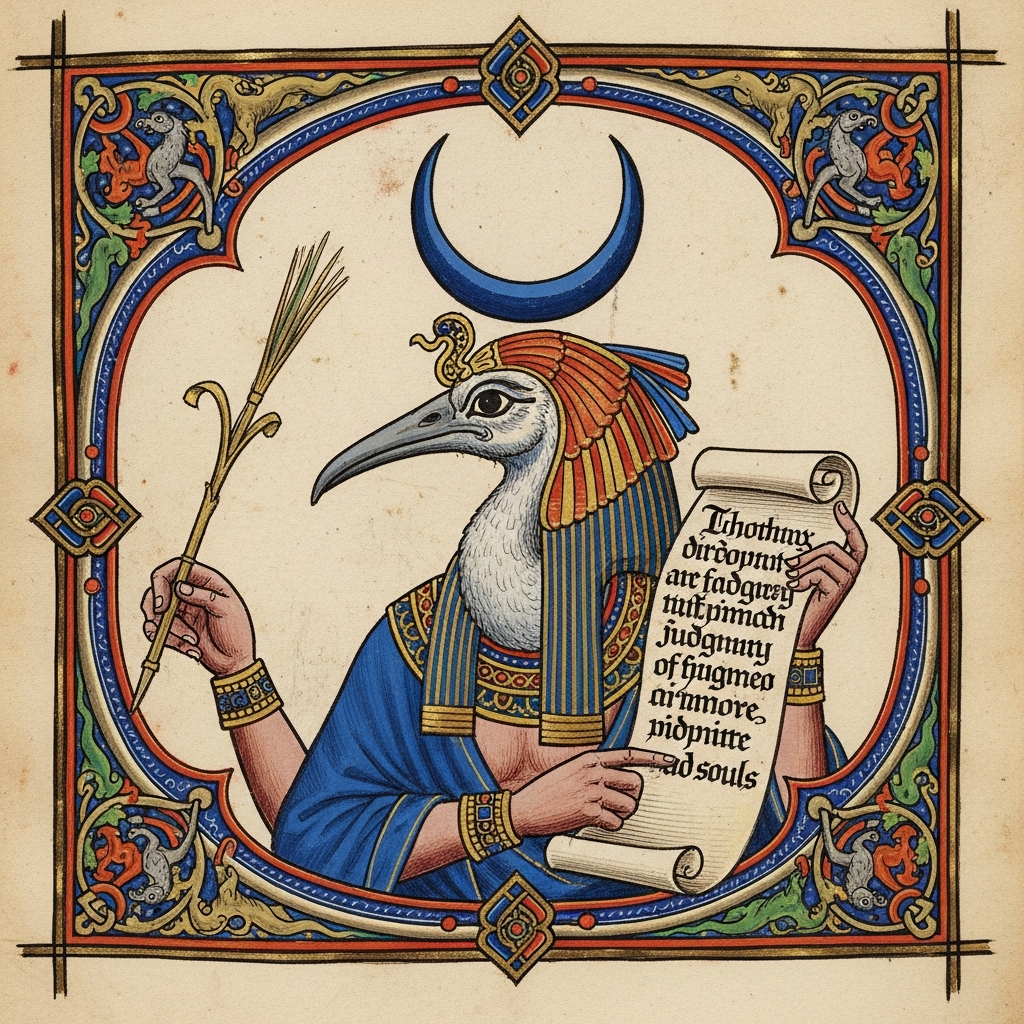
The fourteenth she could not find. The fish had eaten it in the first hours after Set threw it in, and the fish had been caught and gutted by fishermen the same day, and there was no magic that could undo that consumption, no spell that could remake what had been absorbed into the food chain of the world. Thoth told her so, his ibis-head bowed with respect and regret. Even the god of knowledge could not restore what time had erased.
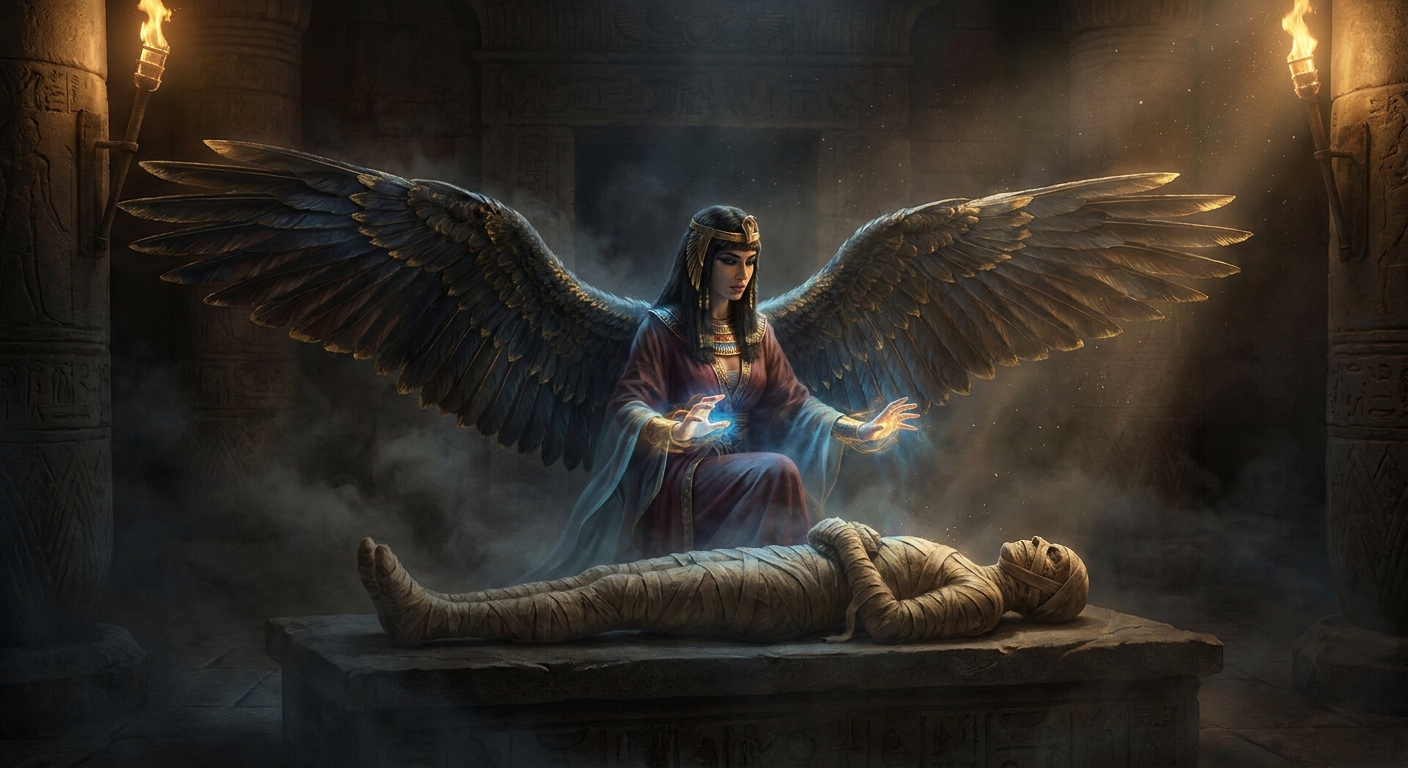
She assembled him in a chamber sealed against the sun.
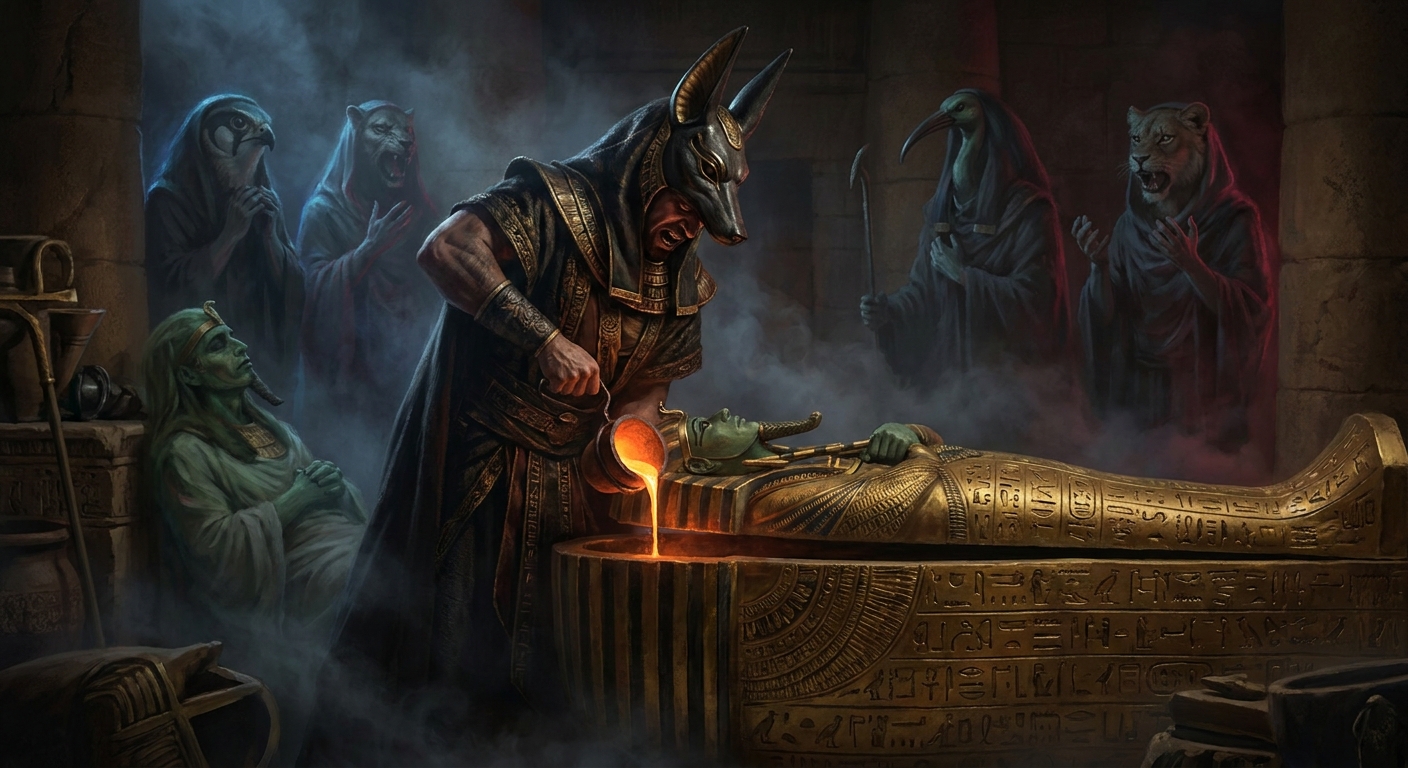
Anubis brought the natron — the salts that preserve the dead — and began the work that would, centuries later, become the art of mummification. But this was not death-preservation. This was resurrection-preparation. The wrappings came not from the burial custom but from the magic; they were blessed by Thoth, inscribed with the names of power, soaked in unguents that carried the scent of resurrection. Each piece was wrapped as it was placed. Each layer was blessed.
The spine first, arranged from sacrum to cervical, each vertebra cradled by another. Then the ribs, interlocked like a cage to hold what must return. The torso. The arms and legs, positioned as a man might lie sleeping. The skull, placed with ceremony, the face turned slightly upward as if listening for a voice.
She left the space where the fourteenth piece should have been.
Thoth stood beside the body, his stylus moving across papyrus, writing the names of power that would stitch the god back into existence. His voice was steady, but his eyes were not. Even he had never done this. Even knowledge had never reached this far into the dark.
Isis stood at the head of her husband’s body and began to sing.
The incantation was not language as living humans speak it. It was older. It was the language that existed before the world had been separated into Egypt and chaos, before the gods had been named. It was the syllables that held the shape of things, the sounds that told light from darkness, the words that kept the Nile flowing and the sun rising. She sang for three days and three nights.
On the fourth day, Osiris breathed.
Not as a man breathes — not yet. But the breath of someone waking from a dream that had lasted longer than any living person could bear. His eyes opened. They were green as the Nile in flood time. For a moment he looked directly at her, and Isis knew that he was seeing the world, not the underworld, not the space between spaces where the dead wait for a mouth to call them back.
“I have come to the boundary,” he said, and his voice was the sound of water flowing. “I cannot stay.”
She held his hand — which was whole, wrapped in linen, smelling of myrrh and resurrection-salt — and she knew this was true. No magic could hold him permanently to the world of the living. The body needed all fourteen pieces to walk the earth as it had walked before. Without the fourteenth, he could only touch life like water touches shore: briefly, against the pull of the tide.
“Then conceive,” she said. “Conceive the avenger.”
And in those three days — while Osiris walked the edge of the underworld, neither entirely here nor entirely there — she did. The child that grew in her womb was not conceived as other children are conceived. This child was made of will, of love, of the determination that justice itself is possible. This child would be born in the papyrus marshes where Set thought him safest, and he would grow into the god who would challenge Set for the throne of Egypt. His name was Horus, and his coming was already written in the very act of resurrection.
On the fourth night, Osiris felt the pull stronger. The underworld was calling. The boundary was closing.
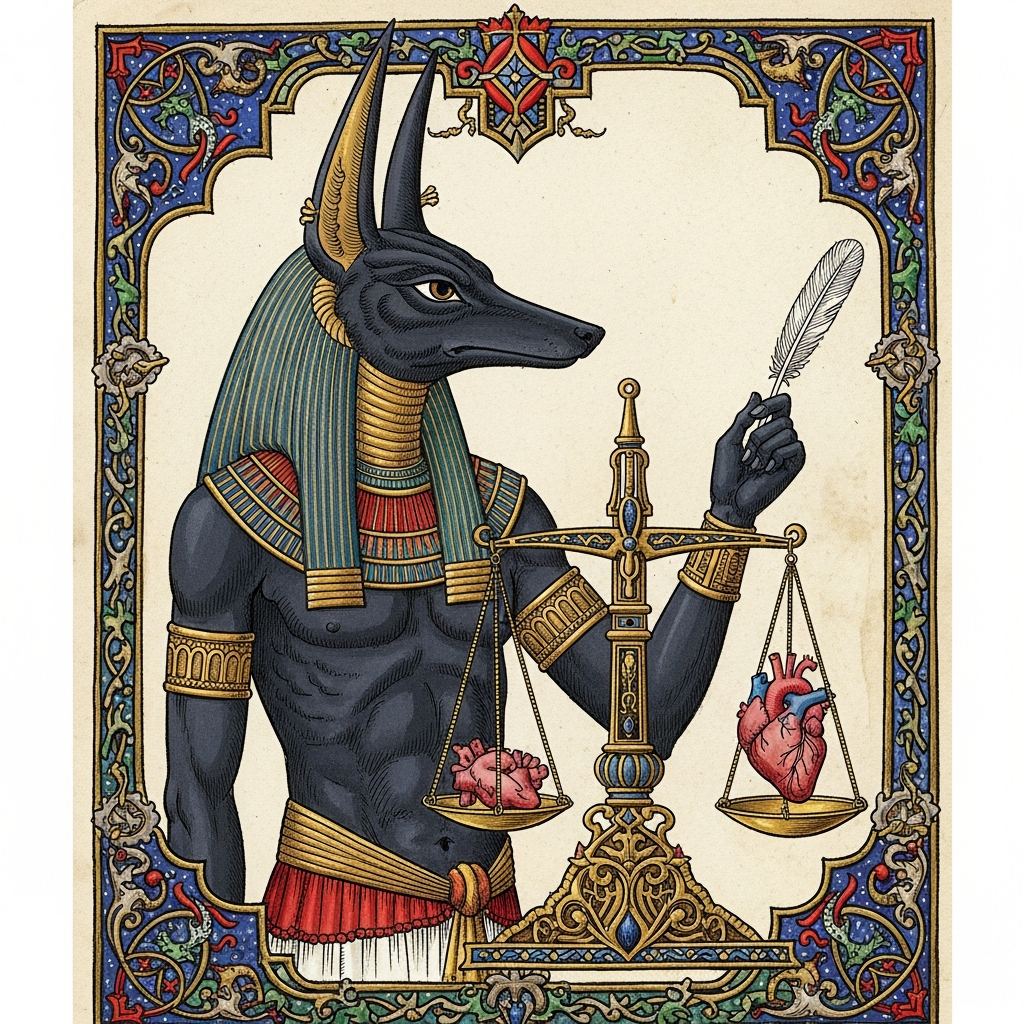
“I must go now,” he said, and she released his hand, and he became something other than what had walked the earth before. Not entirely gone, but transformed. He descended into the Duat — the underworld — and there he remained, as he remains still. Not as a corpse decays, but as a king rules in the dark: as lord of the dead, judge of the underworthy, the standard against which all souls are measured. He became what he had always been becoming.
The first resurrection was not a victory with no cost. It was a boundary crossed and a boundary affirmed. Osiris could not return to the world of light. But he did not dissolve. He did not cease. He became instead the lord of the place-that-comes-after, the ruler of the realm that every living thing must enter, and in that kingdom he was more powerful than he had ever been on earth.
And Isis was left alone with the child growing in her womb — the son who would avenge the father, the boy who would become the god who sits on the throne that Set had stolen, the heir who would prove that even the most terrible division can be made whole again.
Three millennia before the stone was rolled away from another tomb, before another god rose from the dead in a garden near Jerusalem, this story had already been carved in the chambers of Unas. Three thousand years before “He rose on the third day,” the oldest written theology had already said it: the dead return. The god returns. The one who is scattered is made whole. The body that is divided is reassembled.
The template is Egypt. The rest is variation.
Isis did not pray for resurrection. She demanded it. She did not petition the gods for her husband’s return; she worked the magic herself. This is the Egyptian version of resurrection: not grace received from beyond, but will exerted from within. The god rises because the goddess refuses that he not rise. The body is reassembled piece by piece, bandage by bandage, spell by spell — not by the decree of another god, but by the labor of love and the refusal to accept that division is permanent.
Every later resurrection myth carries this echo. Every god that dies and returns was first assembled by Isis. Every child that avenges a fallen father walks in the footsteps of Horus. The oldest writing on earth is also the first prophecy: that to be scattered is not to be ended, that the dead may return, that even in the underworld there is rule and order and purpose.
This is the first resurrection. All others that follow are a conversation with this one.
Echoes Across Traditions
Entities


Sources
- Pyramid Texts (Utterances 219, 252, 354, 405) — ~2350 BCE, oldest written account
- Coffin Texts — Spell 148 and others, Middle Kingdom (~2000 BCE)
- Plutarch, *De Iside et Osiride* (On Isis and Osiris) — ~120 CE, Greek account of Egyptian tradition
- E. A. Wallis Budge, *The Egyptian Book of the Dead* (1895) — scholarly translation with sources
- Jan Assmann, *The Search for God in Ancient Egypt* (2001)