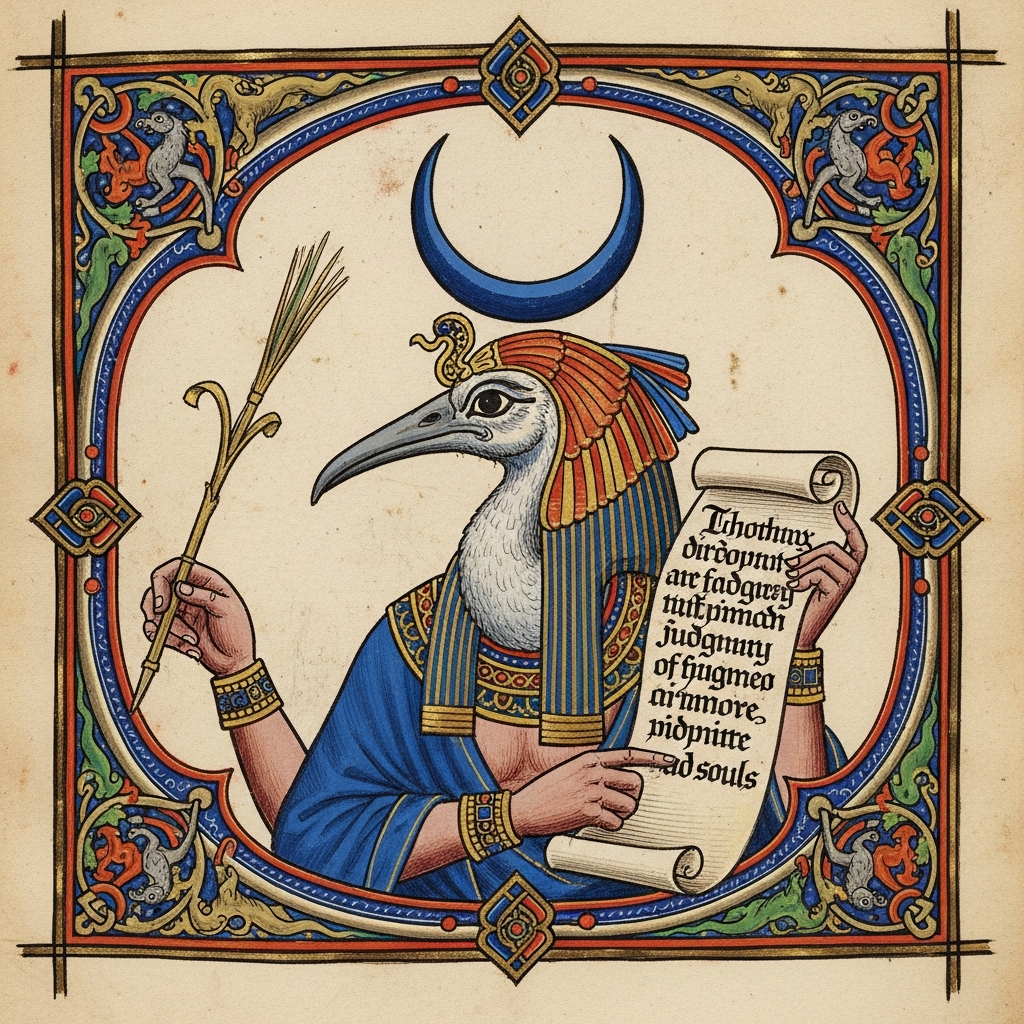
The Gift That Destroys Memory
Mythic Time · Hermopolitan cosmology, New Kingdom; Plato's *Phaedrus* ~370 BCE · Hermopolis Magna (Khmun), Egypt — the city of the eight
Contents
Thoth, god of the moon and all knowledge, brings the gift of writing to the court of the divine king Thamus. Thamus refuses it. Writing, the king argues, will hollow out the very memory it claims to preserve — and Thoth, inventor of the most powerful tool in human history, cannot prove him wrong.
- When
- Mythic Time · Hermopolitan cosmology, New Kingdom; Plato's *Phaedrus* ~370 BCE
- Where
- Hermopolis Magna (Khmun), Egypt — the city of the eight
Before writing, there was only sound.
In Hermopolis — Khmun, the city of eight, the place at the center of the world where the Nile’s eastern and western banks are exactly equidistant from the source — the Ogdoad lived in the watery void before creation. Eight gods, four couples, each pair the embodiment of one primal chaos: Nun and Naunet (the waters), Heh and Hauhet (the infinite), Kek and Kauket (the darkness), Amun and Amaunet (the hidden). They moved through the void without language because there was no word for anything yet. They were the things that words would later name.
Then one of them — the texts disagree on who, or perhaps agreement is the wrong framework for what happened — made a sound. A goose cry, some versions say: the Great Cackler honking in the dark. Or a frog; or a snake; or the simple sound of water moving because something disturbed it. The sound broke open, and light came through the break, and the world began.
Thoth was not there for this. Thoth comes later, once there is already a cosmos to organize. But he was made from what that first sound left behind: the knowledge that the universe began with communication, and that everything which followed is an attempt to repeat, preserve, or improve on that first utterance.
This is the god who invents writing. He carries the weight of the beginning in his ibis-curved beak.
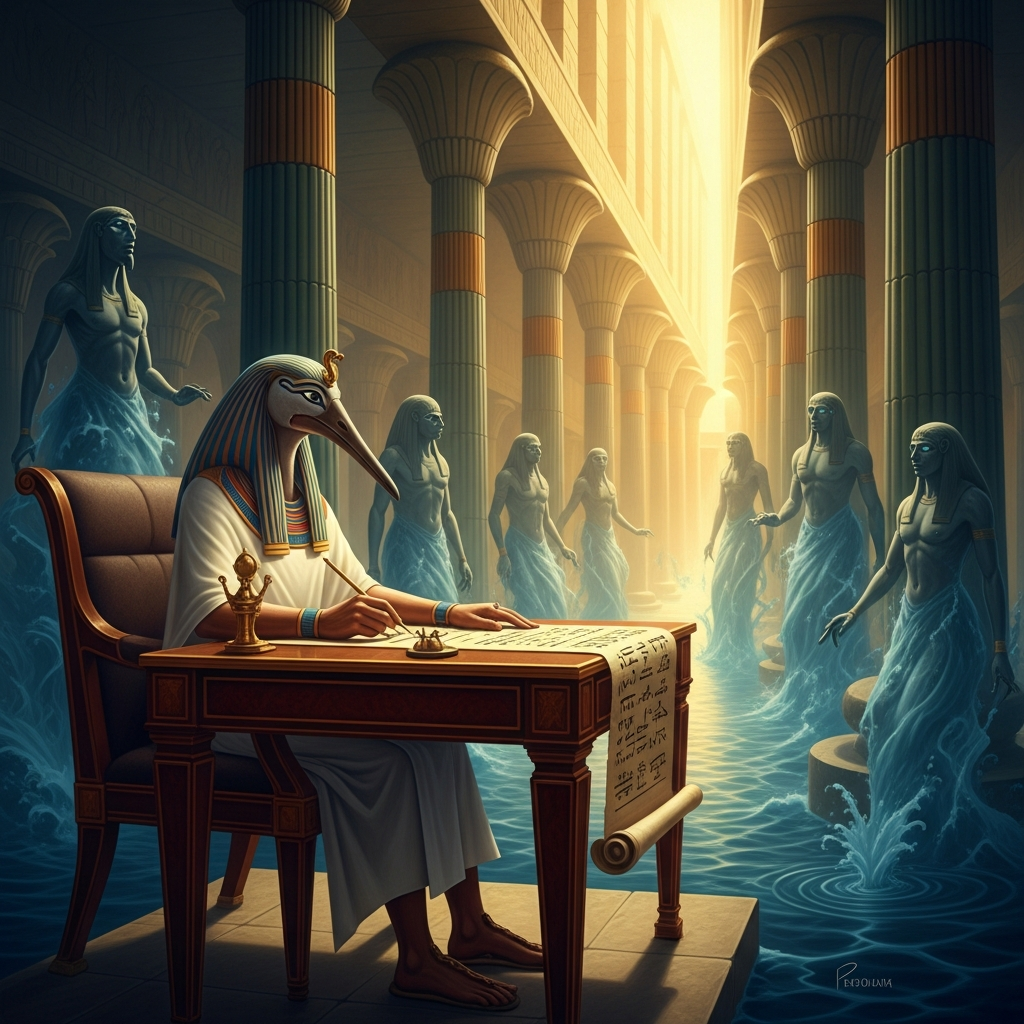
The city of Hermopolis is his. Its temples have eight pillars for the eight primordials; its streets follow the cardinal directions with the precision of a scribe’s grid. Thoth walks them in the hours between midnight and dawn, when the moon he governs is at its height and the scribal schools are quiet and the reed beds along the canal rustle in a wind that carries the smell of papyrus — the plant that will become his medium, that will carry his invention into every corner of the world.
He has already given humanity so much.
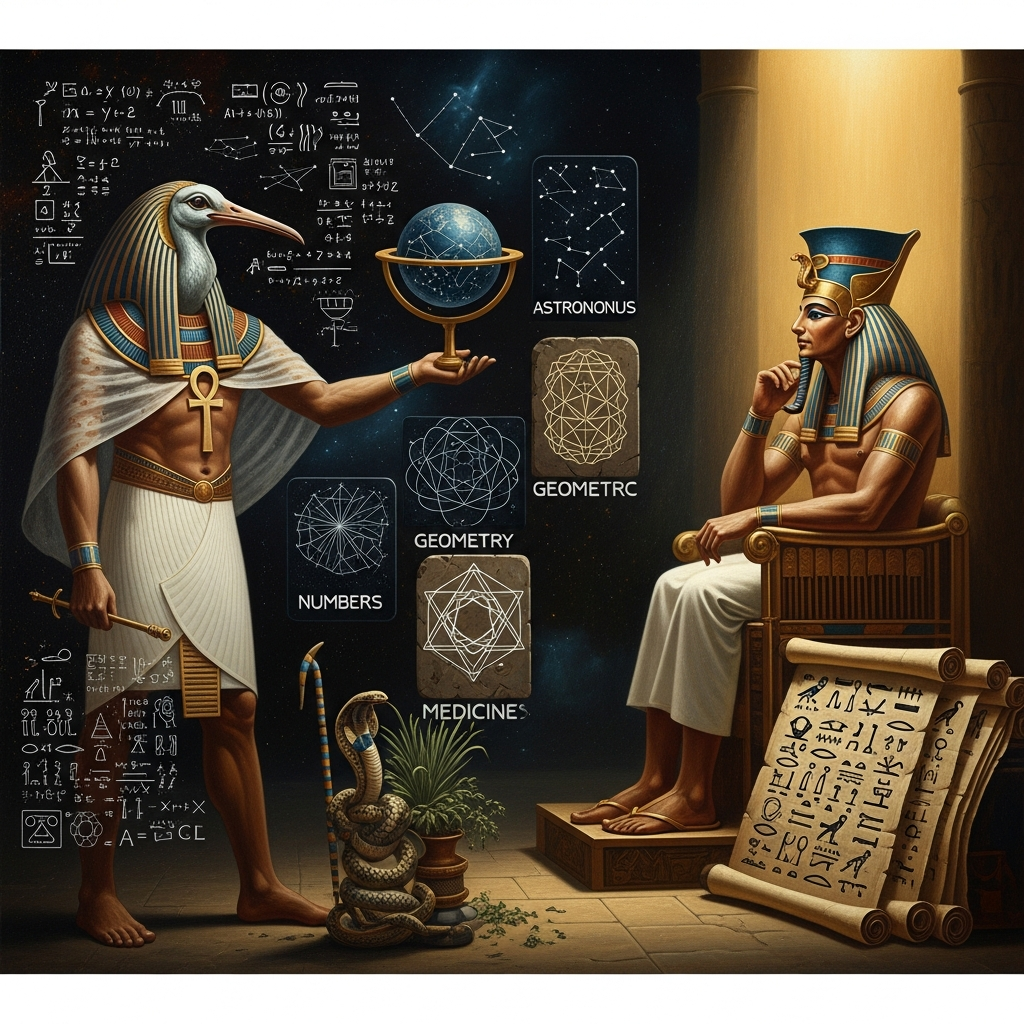
Mathematics — the system for translating the world’s quantities into symbols that can be manipulated without touching the things themselves. The architects who build the pyramids at Giza are building with Thoth’s mathematics, though they do not always name it that. Astronomy — the precise tracking of the sky’s cycles, the recognition that the stars move in patterns that repeat, that the universe is itself a kind of text written in light, legible to those who know the notation. Medicine — the knowledge of herbs and procedures and the anatomy of the body that Anubis first opened in the embalming hall. Geometry — the measurement of land after the Nile’s floods erase all boundaries, the annual mathematics of ownership and property that makes civilization possible.
He has given these things, and the world has used them, and the world has not been broken by them.
But writing is different. He knows this. He walks the reed beds at night and he knows it.
He brings the invention to the court of Thamus.
The god-king sits in a hall that predates dynastic Egypt — a hall older than pharaohs, older than the two lands, a hall that belongs to mythic time, which is the only time where the full argument about writing can be had without the distraction of history. Thoth has prepared. He has the reed stylus, the cakes of pigment, the papyrus cut and smoothed. He has the signs — not the full hieroglyphic system that scribes will spend a generation learning, but the essential marks: this is water, this is a man, this is the sun, this is a bird, this is the sound that starts the word for life.
He presents mathematics. Thamus accepts it. He presents astronomy. Thamus nods. He presents geometry and medicine and the rest, and Thamus receives each one with the consideration of a king who understands the practical value of tools.
Then Thoth presents writing.
This knowledge, he says, will make the Egyptians wiser and will improve their memory. For it is a remedy both for memory and for wit.
Thamus looks at the reed. He looks at the marks Thoth has made on the papyrus — the controlled, beautiful, precise signs that can preserve sound in silence, that can carry meaning across distance and time, that can allow one man to speak to another man who has not been born yet.
He shakes his head.
Most ingenious Thoth, he says — and Plato, who records this exchange five centuries later, attributes the words to an Egyptian temple tradition, as if the Greeks understood that this argument belonged to Egypt, where writing was oldest and its costs most visible — you have attributed to writing the very opposite of its real effect.
The king continues. His voice is the voice of a man who has watched, from the long perspective of divine time, what tools do to the capacities they replace.
Those who acquire writing will cease exercising their memory, and will trust to the external written characters and not remember of themselves. What you have discovered is a remedy not for memory, but for reminding. And you offer your pupils the appearance of wisdom, not true wisdom; for they will read many things without instruction and will therefore seem to know many things, when they are for the most part ignorant. They will be filled with the conceit of wisdom instead of real wisdom.
Thoth holds the stylus. The marks on the papyrus are still wet.
He cannot answer. This is the part of the story that the sources do not dwell on — the moment of the god’s silence — but it is the most important part. Thoth is the god of knowledge, of argument, of the precise deployment of words in service of truth. He invented rhetoric along with everything else. He has an answer for everything; he is the great answerer, the divine advocate, the one who argued Osiris’s case before the tribunal of the gods.
He does not answer Thamus.
Not because Thamus is wrong. Not because Thamus is right. Because the king has described something that cannot be argued with by demonstration — only by time. And time will prove both of them correct simultaneously.
Writing does destroy memory. The scribal class that emerges in Egypt depends on the papyrus so completely that the oral tradition — the priest-singer who holds the entire Book of Coming Forth by Day in his body, who can perform it without a scroll, who carries the dead man’s spells in living tissue — begins to thin. Over centuries it thins further. By the time the temples close and the Coptic Christians break the old scripts, no living person can read hieroglyphics. The text survives. The readers do not.
But writing also preserves what memory alone cannot hold. The Pyramid Texts survive four thousand years because they were cut in stone, not spoken. The medical papyri from Kahun describe procedures that would otherwise be lost entirely, that modern physicians recognize as correct. The love poems of the New Kingdom — the ones where a young man compares a girl’s eyes to the eyes of a goose, to the brightness of a star — would be ash and silence if Thoth had listened to Thamus.
The ibis-headed god packs away the stylus. He rolls the papyrus. He bows, because Thamus is the king, because even the god of knowledge owes the formal acknowledgment of hierarchy.
He walks out of the court and into Hermopolis, into the streets his city has laid out in their precise grid, into the moonlight that is his domain, that pulls the tides of the sea and the cycles of women and the slow crawl of the calendar. He has been given the moon instead of the sun precisely because Thoth is the light that works when Ra is not present — the secondary illumination, the borrowed brightness, the knowledge that operates in the dark spaces where the first knowledge cannot reach.
He will give writing to humanity anyway. He has always known he would. The court of Thamus is not a moment of decision; it is a moment of acknowledgment. He presents the gift knowing the cost. The king refuses it knowing it cannot be refused.
Because there is a deeper logic at work, beneath the argument about memory and forgetting. Writing is not a remedy for memory loss. Writing is the precondition for the particular kind of civilization that can ask what memory is, that can record the question, that can allow a philosopher in Greece five centuries later to read the Egyptian argument and add it to his own, that can allow the word Thoth to be pronounced now, today, by a reader who was not born when these marks were first made.
The marks outlast the maker. This is both the tragedy and the miracle that Thamus saw and Thoth accepted.
Plato sets the argument in Egypt deliberately. He knew that writing in Greece was young — a few centuries old, borrowed from the Phoenicians, still controversial in philosophical circles. He sends Socrates to the oldest civilization in the world to find the oldest critique of civilization’s most indispensable tool. The Egyptian priest who told Solon that the Greeks were children — “You Hellenes are always children; there is no old man among you” — is making the same point. Memory is what makes a people old. Writing is what lets them pretend they are older than they are.
The Rosetta Stone was found in 1799. Napoleon’s scholars published it. Champollion deciphered it in 1822. A tradition that had been silent for fourteen hundred years — since the last person who could read hieroglyphics died sometime in the fifth century CE — began to speak again.
The marks outlasted everything. They outlasted the language they encoded. They outlasted the civilization that made them. They outlasted the argument about whether they should exist at all.
Thamus was right. Thoth was right. The papyrus does not resolve the contradiction. It simply carries it forward.
Scenes
Thoth at the House of the Net in Hermopolis, city of the eight primordial gods, where the first sound broke the silence of the watery void
 Generating art…
 Thoth presents his inventions to the divine king Thamus — numbers, astronomy, geometry, medicine, and last of all, the reed marks that will outlast every memory
 Generating art…
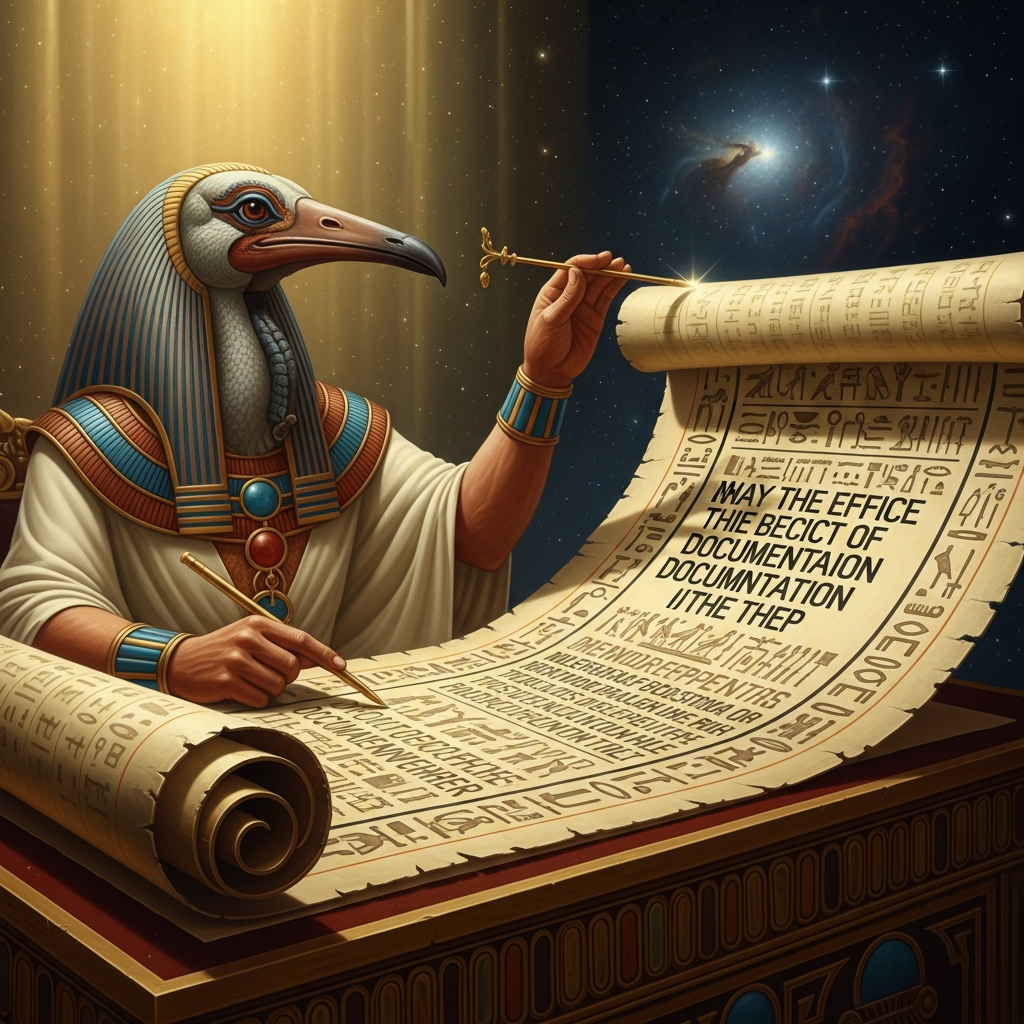
 The ibis-headed scribe of heaven, stylus raised, the papyrus of divine record unrolled before him — recording the very argument about whether recording helps
 Generating art…
 Echoes Across Traditions
Entities
- Thoth
- Thamus
- Ra
- Ogdoad

Sources
- Plato, *Phaedrus* 274c-275b (~370 BCE)
- *Hermopolitan Cosmology* — various temple inscriptions, Ptolemaic period
- Erik Hornung, *Conceptions of God in Ancient Egypt* (Cornell, 1982)
- Christian Jacq, *The Wisdom of Ptah* (Simon & Schuster, 1999)
- Jan Assmann, *Cultural Memory and Early Civilization* (Cambridge, 2011)