Noah and the Ark
Mythic Time · ~2400 BCE traditional dating · The whole world, then Mount Ararat
Contents
God grieves the world he made, chooses one righteous man, and drowns everything else. Noah floats for a year on waters that cover the mountains. A dove returns with an olive leaf. A rainbow is hung in the sky as a promise that will never stop needing to be kept.
- When
- Mythic Time · ~2400 BCE traditional dating
- Where
- The whole world, then Mount Ararat
God looks at what he made and grieves.
That is the sentence Genesis cannot quite recover from. Not anger. Not the cold administrative decision of a deity managing a problem. Grief. “It grieved him to his heart” — the Hebrew is wa-yit’attsev el-libbo, a word used elsewhere for the pain of betrayal, the ache of a wound that cannot be undone. He made this. He called it good. Now every intention of every human heart is evil continually, and the maker of the world sits with that knowledge the way a parent sits with news that cannot be untaken.
He decides to unmake it.
Noah is six hundred years old and blameless in his generation. Genesis says he walked with God — the same phrase used for Enoch, who was translated without dying, taken bodily before his time ran out. To walk with God in the primeval history is to be anomalous, conspicuous, set apart from the general descent. Noah does not argue. He does not ask for proof. He does not negotiate the terms of survival the way Abraham will negotiate for Sodom two generations later. When God speaks, Noah listens.
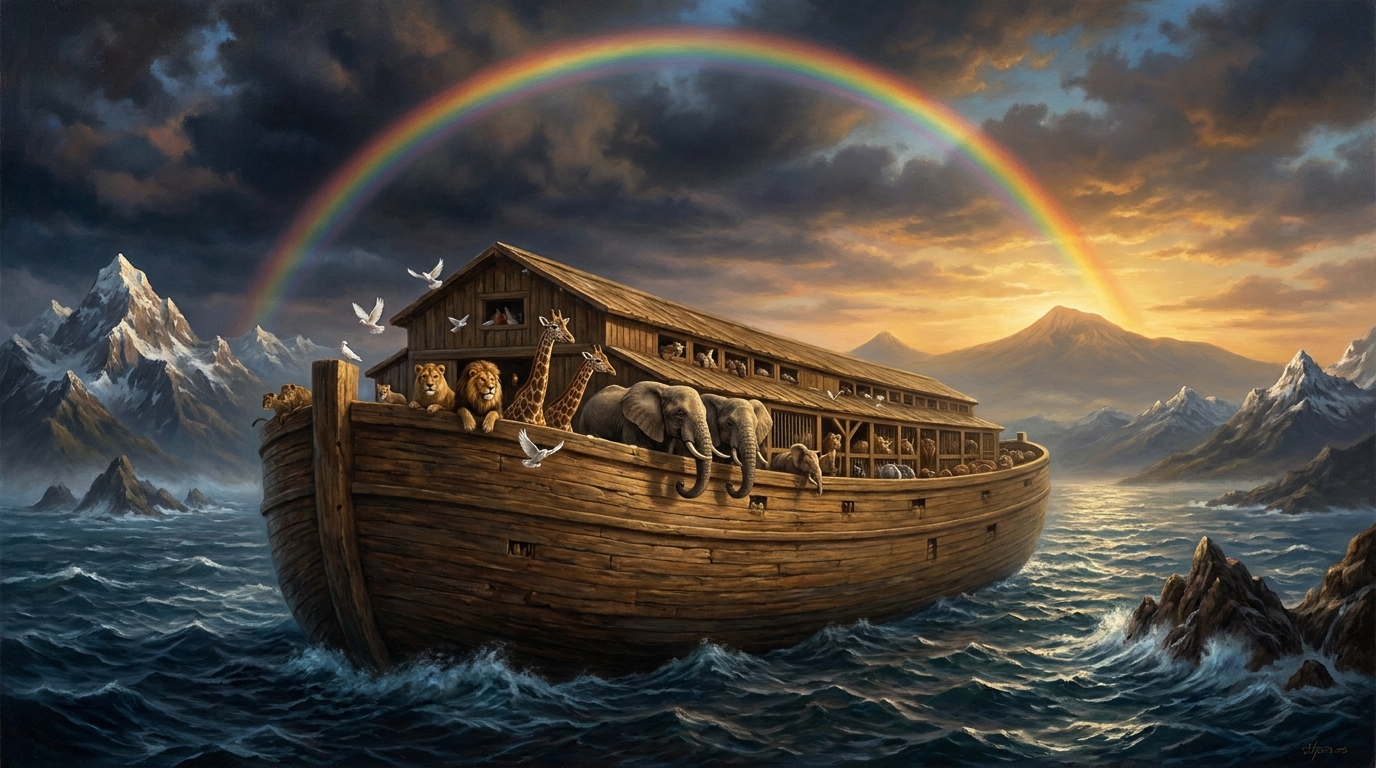
Build an ark, God says. Three hundred cubits long, fifty wide, thirty high. Gopher wood, pitched inside and out, three decks, a door in the side. The dimensions are real — scholars have built scale models. The ratio of 10:1.67:1 produces a vessel with genuine hydrodynamic stability, better suited to open water than the Mesopotamian cube-boat of the Gilgamesh tradition, which was a floating temple in the shape of sacred geometry. Noah builds a ship. The God of Genesis is interested in survival, not symbolism.
Take two of every kind. Clean animals by sevens. Your wife. Your sons. Their wives.
Noah does it. Genesis tells us so in a single sentence: And Noah did all that God commanded him.
He is six hundred years and two months and seventeen days old when the deep opens.
Not just rain. The fountains of the great deep burst — tehom, the chaos-waters held back since creation’s second day when God said let there be a firmament. The boundary between order and chaos dissolves. Creation is running backward. For forty days the rain falls and the deeps rise, and the ark lifts off the ground and floats on waters that have erased the ground beneath it.
Fifteen cubits above the highest mountains. Everything under heaven is covered. Every breathing thing outside the ark dies — every human, every animal, every bird, every thing that moves on the earth. The waters prevail for a hundred and fifty days.
Inside the ark: the smell of animals, the sound of rain on pitch-sealed wood, the particular silence of a world that has stopped. Noah and his wife. Shem and Ham and Japheth and their wives. The animals in their pairs. All of them breathing in the dark while outside there is only water and the memory of mountains.
Then God remembers Noah.
The word remembers is not forgetfulness corrected — God does not forget the way a distracted person forgets a name. In Hebrew covenantal language, to remember is to act. God remembered Rachel and opened her womb. God will remember his covenant at every rainbow. To be remembered by God is to have the full weight of divine attention turned toward you like sunlight focused through glass.
A wind passes over the waters. The fountains close. The rain stops. The ark rests on the mountains of Ararat, 150 days after the waters peaked.
Noah waits forty more days. Then he opens the window and sends a raven.
The raven goes back and forth until the waters dry. It does not return with news. The raven is not interested in Noah’s questions.
He sends a dove. The dove finds no place to set its foot — the waters still cover everything — and comes back. He waits seven days. Sends the dove again. Evening: the dove returns with a freshly plucked olive leaf in its beak. The waters have receded enough for a tree to breathe. He waits seven more days and sends the dove a third time. It does not come back. The world has room for it now.
Noah removes the covering of the ark and looks out.
The ground is dry. The surfaces of the earth are drying. God says: Go out.
They go out — Noah, his wife, his sons, their wives. Every animal. Every bird. Every creeping thing. Everything comes out by families. The ark empties in the order that it was filled: a reversal, a completion, an exhalation.
Noah builds an altar. He takes some of every clean animal and every clean bird and offers burnt offerings. The text says — with a directness that parallels Gilgamesh word for word across three thousand years — that God smelled the pleasing aroma. And then says something that should stop the reader entirely:
“I will never again curse the ground because of man, for the intention of man’s heart is evil from his youth.”
The reason the flood was sent — human wickedness, incorrigible and continuous — is now the reason it will never be sent again. Nothing has changed. Human nature is what it was. The covenant is not conditional on improvement. God looks at the same evidence that drove him to grief before the flood, and this time he draws a different conclusion: not destruction, but endurance. Not erasure, but patience as far as the eye can see.
God speaks the covenant out to Noah and his sons.
Every living creature. Every beast, every bird, everything that came out of the ark. All flesh. The covenant is not with one people — that covenant comes later, with Abraham, with circumcision, with the specific weight of chosenness. This covenant is with the world. With the fish. With the sparrows. With the cedar trees that have no ears and no prayers. God binds himself to the biosphere.
The sign is a rainbow.
I have set my bow in the cloud. In Hebrew, the same word for a warrior’s bow — the weapon hung up in the sky after the battle, decommissioned, pointed away from the earth. Every time clouds gather, God says, I will look at it and remember. Not so Noah will remember. So God will remember. The covenant is written in meteorology. Every storm that builds and breaks without a flood is the sign working as designed.
The story that follows is quieter and harder. Noah plants a vineyard. He gets drunk. Ham sees his nakedness and tells his brothers; Shem and Japheth walk in backward and cover their father without looking. When Noah wakes and knows what happened, he curses Canaan — Ham’s son, not Ham himself — with a harshness that has haunted the text ever since, used for centuries to justify things the text was not designed to justify. The survivor who walked with God ends his story with wine and nakedness and a curse.
That is the tradition being honest with itself. The flood did not fix anything. The waters rose and fell and the world came back and the people in it remained people. God knew this before he promised the rainbow — “the intention of man’s heart is evil from his youth” — and promised it anyway. The covenant holds not because humanity earned it but because God, having grieved once, decides not to grieve that way again.
The Sumerians told a version of this story a thousand years before Genesis. Utnapishtim built a cube-shaped boat because Enki whispered through a reed wall, dodging the oath he had sworn to the divine council not to warn any mortal. He loaded the gold and silver and craftspeople alongside the animals, sacrificed on a mountaintop, and the gods gathered like flies around the food. Enlil, furious that anyone survived, was talked down by the other gods and grudgingly granted Utnapishtim immortality at the ends of the earth. A one-time exception. A consolation prize for having been saved by a loophole.
The God of Genesis is not hungry. Does not need to be talked down. Is not outsmarted by a legal technicality. The covenant is not a consolation prize. It is a choice made in full knowledge of what humanity is, and it is made unconditionally.
That is what distinguishes Noah’s flood from all the others. Not the ark. Not the birds. Not the mountain where the boat comes to rest. Every tradition has those. The distinction is the rainbow: a god who binds himself, in writing, in the sky, to a species that will keep failing, and means it.
The olive leaf arrives in the evening. The dove’s beak is wet with it. Outside the window, the world is still dripping, still settling back into its shape. It smells like wet earth and beginning.
Noah takes the leaf. He does not yet know about the rainbow. He only knows the dove came back with something green, which means somewhere out there, a tree is alive, which means the world has not ended after all, which means there is still time.
He will need it.
Echoes Across Traditions
Entities
- Noah
- YHWH
- Ham
- Shem
- Japheth
Sources
- Genesis 6–9 (Robert Alter translation, *The Hebrew Bible*, Norton, 2018)
- *Epic of Gilgamesh*, Tablet XI (Andrew George trans., Oxford University Press, 2003)
- Stephanie Dalley, *Myths from Mesopotamia* (Oxford University Press, 2008)
- Irving Finkel, *The Ark Before Noah* (Hodder & Stoughton, 2014)
- Ovid, *Metamorphoses* 1 (A.D. Melville trans., Oxford World's Classics, 1986)