Eve and the Serpent
Mythic Time · Genesis ~6th century BCE composition · Eden — the garden eastward
Contents
In a garden planted eastward, between two trees, a woman and a serpent have a conversation that ends paradise and begins history.
- When
- Mythic Time · Genesis ~6th century BCE composition
- Where
- Eden — the garden eastward
The garden is already finished when the woman wakes.
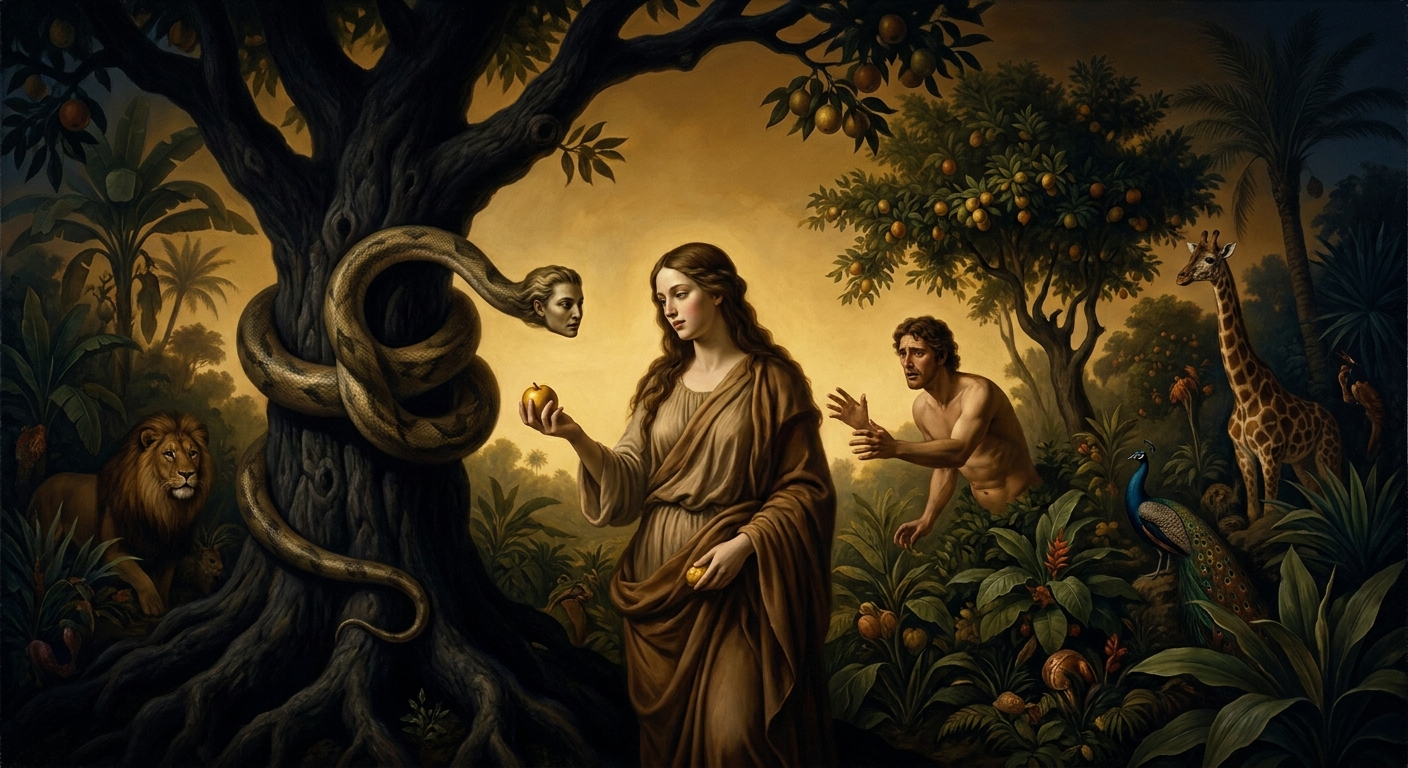
YHWH planted it eastward, in Eden — the rivers already branching, the gold already in the ground, the trees already bearing. Two trees stand at the center. The text names them both: the Tree of Life, and the Tree of the Knowledge of Good and Evil. One God says nothing about. The other God says: do not eat of it, for on the day you eat of it you will surely die.
The man has heard this. He tells the woman. The woman knows.
The serpent is already there.
“Did God really say you are not to eat from any tree in the garden?”
The serpent is described as the shrewdest of all the wild creatures YHWH made. Not evil, not Satan — that identification comes centuries later, in Christian interpretation and the Zohar. In Genesis, the serpent is simply shrewd. It asks a question. The question is not quite accurate — God said one tree, not any tree — and the imprecision is the lever. The woman corrects it. In correcting it, she engages. The dialogue has begun.
She names the tree at the center of the garden. She adds a detail: you shall not touch it, lest you die. God said nothing about touching. Scholars notice this. The woman’s version is stricter than the command. She has already been interpreting.
“You will not surely die,” the serpent says. “For God knows that on the day you eat of it your eyes will be opened and you will be as gods, knowing good and evil.”
Three things in that sentence. A denial. A motive for the prohibition. A promise. And then the serpent stops talking. It does not push. It does not touch the tree. It says its piece and waits.
The woman looks at the tree.
What she sees the text records exactly: the tree is good for eating, that it is a delight to the eyes, and that it is desirable for wisdom. Three perceptions. None of them wrong. The fruit is not poison. The tree is genuinely beautiful. Wisdom is genuinely worth desiring. The rabbinical tradition in Bereshit Rabbah will spend centuries on this moment — she is not deceived about the tree’s qualities. She is deceived, if she is deceived at all, about what eating it will cost.
She takes the fruit. She eats.
She gives some to her husband, who is with her.
He eats.
Three words in Hebrew: va-yochal gam-hu. And he ate also. No deliberation in the text. No serpent for Adam. No recorded moment of reasoning or desire. He eats because she hands it to him. Milton will spend three books on Adam’s inner struggle. The Torah gives him half a sentence.
Their eyes open.
This is what the serpent promised. It is true. They know something now they did not know before. The first thing they know is that they are naked. They sew fig leaves together. The first act of the newly wise is tailoring.
Then they hear YHWH walking in the garden in the cool of the day.
The cool of the day. The phrase is so specific that translators have argued about it for two thousand years — the Hebrew reads l’ruach hayom, in the wind of the day, perhaps late afternoon, the temperature dropping, the God of this text taking the evening air in the garden he made. The intimacy of it. This is not a distant deity managing a cosmos from above. This is a God who strolls at dusk.
“Where are you?”
The man calls out from the trees. He was afraid, he says, because he was naked. YHWH asks: who told you that you were naked? Have you eaten from the tree?
The man says: the woman whom you gave to be with me — she gave me the fruit and I ate.
The woman says: the serpent deceived me and I ate.
Two deflections. The man blames the woman. The woman blames the serpent. The serpent gets no question, offers no defense. YHWH addresses it directly and moves to judgment.
Three sentences fall, one on each.
The serpent: cursed above all cattle. It will go on its belly, eat dust, and the woman’s seed will strike at its head while it strikes at their heel. The enmity is set permanent.
The woman: pain in childbearing, multiplied. And: your desire will be for your husband, and he will rule over you. The relationship that was, in the garden, companionship — bone of my bone, flesh of my flesh — is now skewed. This is not a prescription. The text reads as description: this is what the world outside the garden looks like.
The man: the ground is cursed on his account. It will bring forth thorns and thistles. He will eat bread by the sweat of his face. The soil he was made from will reclaim him: for dust you are, and to dust you shall return.
Before the expulsion, one more act. YHWH makes skin garments for the man and his wife, and clothes them. The fig leaves were not enough. The god who will cast them out first ensures they are dressed for what is coming.
Then the sentence: lest he send out his hand and take from the Tree of Life also and eat, and live forever — YHWH cuts off the sentence mid-thought, as if the possibility is too large for language. He drives them out. He places the cherubim and the flaming, turning sword to guard the way to the Tree of Life.
The gate is shut. The garden remains, inside the fence, unreachable.
They are in the world now.
The woman’s name comes here, after the expulsion: Chavah, Eve, because she is the mother of all living. The naming happens in exile. She is most fully herself outside paradise.
What did they gain? The serpent was not wrong. Their eyes are open. They know good and evil now the way God knows it — by experience, not by nature. They know shame, and labor, and mortality, and they know each other differently. They have, in the precise terms of the story, become like gods.
What did they lose? The Tree of Life stands behind the cherubim, inaccessible. They will not eat of it. They will die. Every human being born after this moment is born into a world that has already been expelled, has already been closed off from that particular fruit, has already had the sword placed at the gate.
The rabbis debate whether this was catastrophe or necessity. Some say the Fall was the precondition of history — you cannot have human freedom, human love, human meaning in a garden where nothing is forbidden. Elaine Pagels traces how the Christian reading of Augustine — original sin, transmitted guilt, the total corruption of the will — diverges sharply from the Jewish reading, where the Fall is a change in condition, not a fundamental poisoning of human nature.
Milton’s Adam, at the end of Paradise Lost, hears the promise of Christ and calls it a “paradise within thee, happier far.” The loss of Eden is reframed as the beginning of a longer story. That reframing is a Christian move. The Torah does not offer it. Genesis 3 ends with the sword and the silence.
The garden still exists, in the text. The cherubim are still there. The Tree of Life is still fruiting inside the fence. The story does not say it was destroyed. It says only that the way back is guarded.
Every tradition that touches this story has to answer the same question: was the expulsion punishment, or was it graduation? Did something break in the garden, or did something begin?
The serpent never answers. It slithers off before the sentencing and does not appear again in the Torah.
Whatever it started, it was finished before the consequences arrived.
Echoes Across Traditions
Entities
- Eve
- Adam
- the Serpent
- YHWH
Sources
- Genesis 2-3 (Robert Alter, trans., *The Hebrew Bible*, 2019)
- John Milton, *Paradise Lost* (1667)
- *Bereshit Rabbah* (~5th century CE)
- James Kugel, *Traditions of the Bible* (1998)
- Elaine Pagels, *Adam, Eve, and the Serpent* (1988)