Jacob at the Jabbok
Genesis 32 · ~1700 BCE traditional · The ford of Jabbok, east of the Jordan
Contents
Alone at the ford of Jabbok, Jacob wrestles a mysterious figure through the night — and emerges at dawn renamed, broken, and blessed. The limp is the blessing.
- When
- Genesis 32 · ~1700 BCE traditional
- Where
- The ford of Jabbok, east of the Jordan
The river is low tonight.
Jacob stands at the ford of Jabbok and listens to the water cross the stones. Behind him, on the far bank, his wives and his children and his servants and his four hundred animals have already gone over. He sent them ahead in waves — first the maids and their children, then Leah and hers, then Rachel and Joseph, last of all — as if distance itself were a kind of shield. As if Esau’s army cannot reach the ones he loves if he stays here alone to absorb the blow.
Twenty years. He stole his brother’s blessing at the end of a lie, wearing goatskin on his arms to fool a dying blind man. Twenty years in Laban’s household, working seven years for Rachel and waking to find Leah, working seven more, watching his uncle cheat him over the flocks, building a fortune out of spite and cunning. Now he is coming home. And Esau — Esau who wept when the birthright was gone, Esau who swore he would kill him — is riding toward him with four hundred men.
Jacob has sent ahead every gift he could think of. Goats, rams, camels, cows, donkeys, in separate droves, each drove announced by a servant saying These belong to your servant Jacob, who is coming behind. Wave after wave of appeasement crossing the desert toward his brother’s face. And still he does not know whether Esau will embrace him or bury him.
He is, as the text will say with its usual economy, alone.
The man comes out of the dark without announcement.
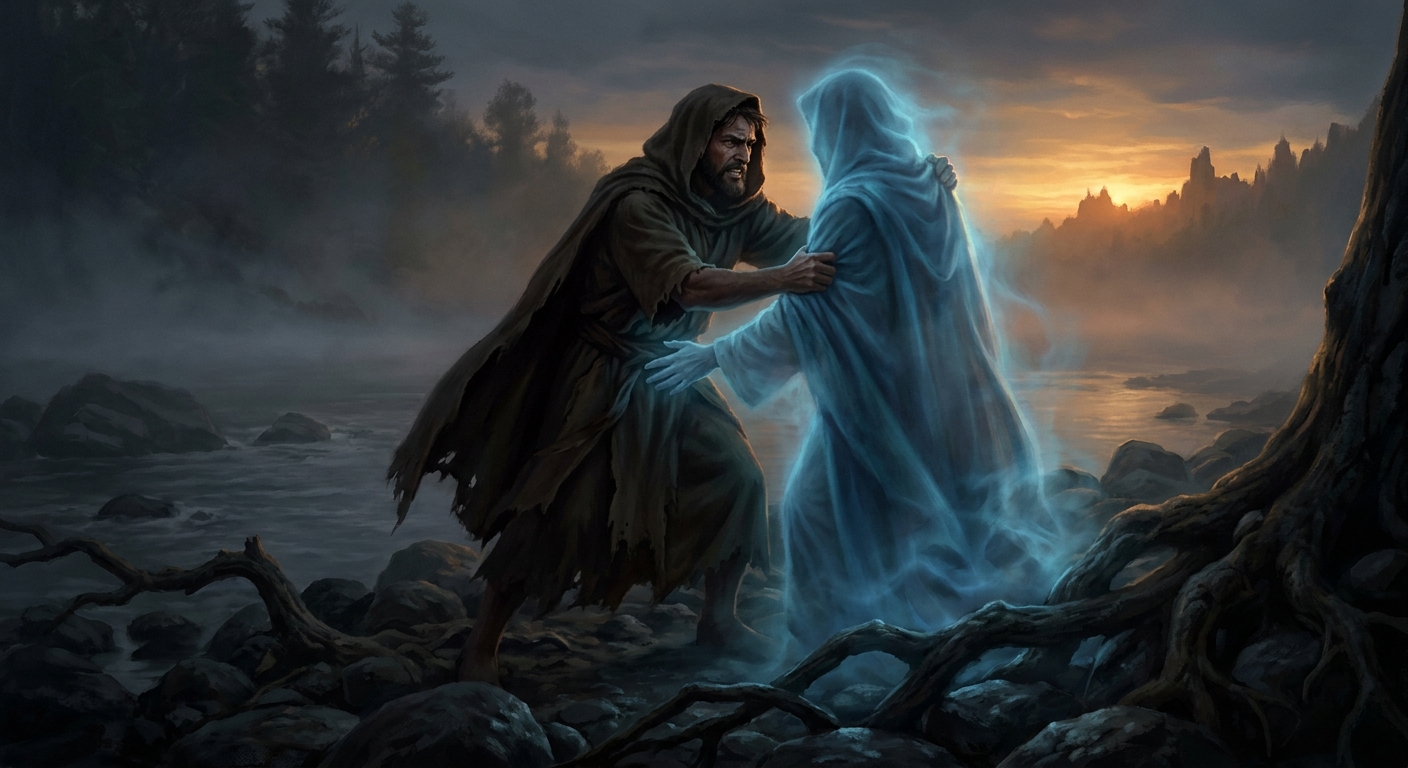
There is no warning, no voice from the heavens, no vision of a ladder. One moment Jacob is standing at the ford. The next moment there is a grip on him — a real grip, hands and weight and the smell of another body — and they are fighting.
Genesis 32:24 says only: a man wrestled with him until the break of dawn. It does not say angel. It does not say God. It says man. Robert Alter renders it with the same restraint the Hebrew insists on: a man. The ambiguity is the point. Jacob does not know what he is holding. He will not know until morning.
What he does know is that he is not losing.
This is extraordinary. Jacob has never been described as a fighter. He is the smooth one, the tent-dweller, the man who prevails by guile and patience, not by force. His brother is the warrior. Yet here, in the dark, against a figure whose nature the text will not name, Jacob holds. He holds through the deepest hours of the night. He holds when his hip is wrenched from its socket — a touch, the text says, barely a touch, the being barely has to reach out — and still Jacob holds, limping now, grinding bone against bone, one hand locked in the grip and the other refusing to open.
Dawn begins to come in at the edge of the horizon.
The figure says: Let me go, for dawn is breaking.
In the Midrash, Bereshit Rabbah asks why the figure must leave at dawn. The rabbis answer that this being has a song to sing at daybreak — the morning praise of the angels — and cannot be late. Something in the cosmos requires it. The night is the jurisdiction. Dawn is the end of the jurisdiction. The figure has been fighting all night against a man it cannot defeat, and now the sky is brightening, and it needs to leave, and Jacob will not release it.
Let me go.
Jacob says: I will not let you go unless you bless me.
Frederick Buechner calls this the magnificent defeat — the moment of losing that is also the moment of winning. Jacob’s hip is destroyed. He is holding on with the last of what he has. And he turns the fight, in four words, into a negotiation. He does not ask to be healed. He does not ask to be spared Esau. He asks for the one thing that has driven his entire life: the blessing. The birthright he bought from Esau for stew. The blessing he stole from Isaac in the dark. He has been chasing this thing for forty years, and he knows, in this moment, that the figure before him has it to give.
What is your name?
Jacob.
The name means heel-grabber. Supplanter. The one who grabs from behind. His mother named him for the way he came out of the womb clutching his twin’s foot. He has spent his life living up to that name — always the second, always reaching for what belongs to someone else, always arriving sideways.
Your name will no longer be Jacob, the figure says. But Israel.
Israel. He who wrestles with God. Or: God wrestles. Or: God prevails. The Hebrew allows all three. A name that carries the fight inside it. A people who will be named not for triumph or peace or piety but for the act of contending — with God, with each other, with history, with the long question of what it means to be chosen and suffering at the same time.
Tell me your name, Jacob asks.
And here the figure does the one thing that confirms everything: it refuses. Why do you ask my name? And it blesses him, and it is gone.
Jacob names the place Peniel: Face of God. He says, with the astonishment of a man who cannot believe what has just happened to him: I have seen God face to face, and yet my life has been spared.
Then he rises and crosses the ford of the Jabbok.
He is limping. He will limp for the rest of his life. The socket is wrenched, the nerve is gone, the body that wrestled God carries the evidence in every step. This is why, the text tells us, the children of Israel do not eat the sciatic nerve of an animal to this day — because the figure touched Jacob’s thigh at the hollow of the sciatic nerve. The dietary law is a memorial. Every kosher meal in the history of Judaism carries, in the part that is removed, the memory of the limp.
He looks up and sees Esau coming with four hundred men.
He arranges his family in order — maids and children first, Leah and children, Rachel and Joseph last. He goes ahead of them all. He bows seven times to the ground as he approaches his brother. And Esau runs to meet him and throws his arms around him and they weep.
The brother he feared has become the brother he lost. Twenty years, and Esau weeps. The gifts are refused — I have enough, my brother, keep what you have. The wound heals at the ford, on the same morning the other wound is given. Jacob limps into his reconciliation.
The rabbis have argued for two thousand years about what happened at the Jabbok. Some say it was the guardian angel of Esau — that Jacob wrestled the spiritual force behind his brother and prevailed before he faced the man. Some say it was the angel of death, and Jacob refused to die. Some say it was God, and the ambiguity is not a failure of the text but its deepest claim: that the line between God and humanity is thinnest at the moment of genuine struggle, that the divine is most present precisely where it most resists.
Buechner says Jacob won everything he ever wanted and paid for it with a limp that lasted his life. That is what blessing costs, at this level.
The people who take his name — Israel, all twelve tribes, all the exiles and the returns and the destructions and the rebuildings, the Talmud and the diaspora and the state and the ongoing argument that has not stopped in four thousand years — carry that calculus forward. They do not take a name that means chosen or beloved or exalted. They take a name that means: we fought.
The limp is not incidental. The limp is the proof.
You cannot wrestle God all night and walk away unchanged. You cannot hold on until dawn, demanding the blessing from the very force that wounded you, and come out of it the same person who stepped into the dark. Jacob goes in as the heel-grabber, the deceiver, the man who spent his whole life arriving sideways at things that were supposed to be someone else’s. He comes out as Israel — still limping, still complicated, still the man who lied to his father with goatskin on his arms — but named, now, for the thing he refused to let go of.
The blessing comes only through the limp. It has always come only through the limp.
Echoes Across Traditions
Entities
- Jacob
- Esau
- YHWH
Sources
- Genesis 32:22-32
- Robert Alter (trans.), *The Five Books of Moses* (2004)
- Frederick Buechner, *The Magnificent Defeat* (1966)
- *Bereshit Rabbah* 77-78 (Midrash)