Marzanna: The Burning of Winter
Pre-Christian Slavic antiquity — spring ceremony documented across Poland, Bohemia, and Slovakia from medieval records through living practice · Village Poland / Bohemia / Slovakia — the road through the village, the river at its edge, the south-facing field at the equinox
Contents
Every spring in villages across Poland, Bohemia, and Slovakia, a straw effigy of Marzanna — goddess of winter, plague, and death — is carried through the village, beaten, set on fire, and drowned. The people must run home without looking back or she will drag them down. The priest refuses to attend. The village holds the ceremony anyway. Winter ends regardless.
- When
- Pre-Christian Slavic antiquity — spring ceremony documented across Poland, Bohemia, and Slovakia from medieval records through living practice
- Where
- Village Poland / Bohemia / Slovakia — the road through the village, the river at its edge, the south-facing field at the equinox
She is the winter that has lasted too long.
Not the beautiful winter — not the first snowfall, not the silence of a field under new snow, not the blue light of a January morning that makes the world look as though it has been remade in crystal. She is the winter of the fifth week and the sixth week: the cold that has become a permanent fact, the firewood running low, the last of the root cellar turnips soft and hollow, the children coughing. She is what winter becomes when spring refuses to arrive. She is the goddess of that refusal.
Her name is Marzanna. Also Morana. Also Morena. The names shift with the village and the century; the goddess does not. She walks the frozen fields at night in a white dress that is the white of old snow, not the white of new snow. She touches the houses that are weakest and the people inside them feel it in their bones — the cold that is not weather but something older, the cold that comes when a season has overstayed its welcome and begun to mean something beyond temperature.
She kills with patience. She does not hurry.
And so, on a specific day in March — the day varies by village and by the state of the weather and by the accumulated desperation of the winter — she must be killed first.
In a Polish village in the year 1247 — two generations after the official Christianization, which the Church has managed in the cities and the monasteries and the noble houses but has not yet fully managed in the mud of the countryside — the women begin the work three days before the equinox.
They gather straw. The dry kind, the kind that has been in the barn all winter, that carries in its smell the whole memory of the last harvest: heat, dust, the specific sweetness of cut grain. They bind it. They wind it around a stick and add more straw and bind again, and the figure that emerges is not beautiful but it is unmistakably she — something female in the bundled linen and the crown of dried reeds, with a face of charcoal on a rag-square and hair of last year’s flax fiber, yellow-white and long.
They dress her in an actual dress. An old dress, the kind that belongs to the oldest woman in the village who can remember the last time they did this poorly and the winter that followed — she contributes the dress because she understands that you do not half-commit to this. The goddess requires a real garment. A goddess who is murdered in a costume is not convinced.
The priest of the village church has heard what is happening. He comes to the elder woman’s house. He is twenty-six years old, educated in a city thirty kilometers away, and he has a strong homiletical position on the matter of Marzanna, which he presents at some length.
The elder woman listens to the whole thing. She is sixty-seven, which in this century and this climate means she has survived things. She says: Father, if the winter stays, you will lose your parish. Come to the river with us or stay home.
He stays home.
The procession forms in the grey afternoon of the fourth day before the equinox. The girls carry Marzanna on her pole — the youngest girls, because the closeness to death that Marzanna carries is less dangerous to the very young, who have not yet accumulated the accumulated weight of winters that she can use against you. The women follow. The men come too, at a distance that is not quite participation and not quite absence.
They walk through the village. They beat the effigy against every fence post as they pass, and the straw makes a sound that is not quite a scream but is something in the register of expulsion — of throwing something out that has been sitting too long in the corner. Children run alongside and throw clods of the frozen mud. Old men stand in their doorways and watch with the expression of people who have done this themselves and know what it costs and what it costs not to do it.
They go down to the river.
The river is still showing ice at the edges. The center of it runs dark and fast with the melt that has come from somewhere upriver — a sign, some say, that the work is already half done elsewhere, that other villages have already drowned their own Marzanna and the melt-water of those ceremonies is coming down to them now.
The girls set the effigy on fire.
They use a torch that has been burning all day in the elder woman’s house, kept lit with the specific care of a flame that is not allowed to go out between the house and the river, because an extinguished flame on the way to Marzanna’s drowning is a sign that she has already gotten inside the ceremony and will not leave easily. The torch touches the straw.
The straw takes. It always takes in the manner of something that is ready — dry from the whole winter in the barn, dry from three days of being handled by warm hands in a warm house, and lit at exactly the right angle. The fire goes up through the whole length of the effigy in a single continuous motion that is almost too fast, as though the straw understood what was required and wanted to complete it.
They throw her into the river.
And they run.
The rule is absolute. You run and you do not look back. Looking back is the thing she wants from you — the glance over the shoulder that lets her see your face, lets her confirm which one you are, lets her pull you back into the winter by the thread of your own attention. She cannot follow you forward. She can only catch you if you turn.
The girls run. The women run. The old men walk very fast, which is their version of running. The child who looks back is grabbed by her aunt before she can complete the turn.
They reach the houses. The doors close. The fire goes out in the river, or it reaches the ice at the edges and goes out there, or the water takes it and carries it downstream and it goes out somewhere else — it does not matter. What matters is that Marzanna is in the river and they are in their houses and between her and them there is a closed door and the specific magic of not-looking.
The priest writes in his chronicle that evening.
This day the people of this parish committed again the idolatrous practice of making and burning an effigy of a pagan spirit called Marzanna, which they persist in calling the goddess of winter, and they threw it burning into the river in a ceremony that the Church has repeatedly condemned, and which I personally instructed them against this morning. The elder woman Bożena led the ceremony. I was not present. The ceremony lasted from mid-afternoon until nearly dark. I intend to address this at Sunday Mass.
He pauses. He dips his pen. He writes:
In the morning, the snow on the south field had melted. The river was open all the way to the bank. My sexton reported seeing snowdrops near the stone wall at the edge of the east pasture. I do not draw a connection between these observations and the idolatrous ceremony described above.
He crosses out the last sentence. He writes it again. He crosses it out again.
He leaves the page as it is.
The next morning is March 21st. The frost is still on the ground in the shadows, but on the side of the old wall that faces south, the specific pale yellow-green of first growth is already showing. Not grass — something earlier than grass, something that does not wait. The sexton counts eleven snowdrops in a place that was bare mud yesterday.
The elder woman Bożena opens her door and puts her hand out into the air and feels the change in it — the thing that is not warmth exactly but the direction of warmth, the angle of the wind having shifted from north to south-of-west, the sun on her hand landing with a weight it did not have yesterday.
She did not look back.
Spring comes.
The Church wins, eventually. It always wins eventually, which is to say it wins on paper and in the records and in the official account of what the people believe. The folk practices thin and become festive and become folkloric and become the kind of thing that tourists photograph in living villages and ethnographers describe in monographs.
But the burning still happens. In Poland today, on the first day of spring, schoolchildren carry straw effigies to the nearest river or pond and drown them. They do not always know who Marzanna is. They know the rule about not looking back.
Winter ends anyway. The snowdrops come up in the mud at the base of old walls on south-facing slopes. The priest’s chronicle survives in a monastery in Kraków, three pages of it anyway, the rest eaten by time.
The elder woman Bożena is not in the chronicle after the Marzanna entry. She may have died that spring, or simply stopped doing things that the priest noticed. The snowdrops are not in the chronicle at all. They were never the kind of thing a chronicle is for.
Scenes
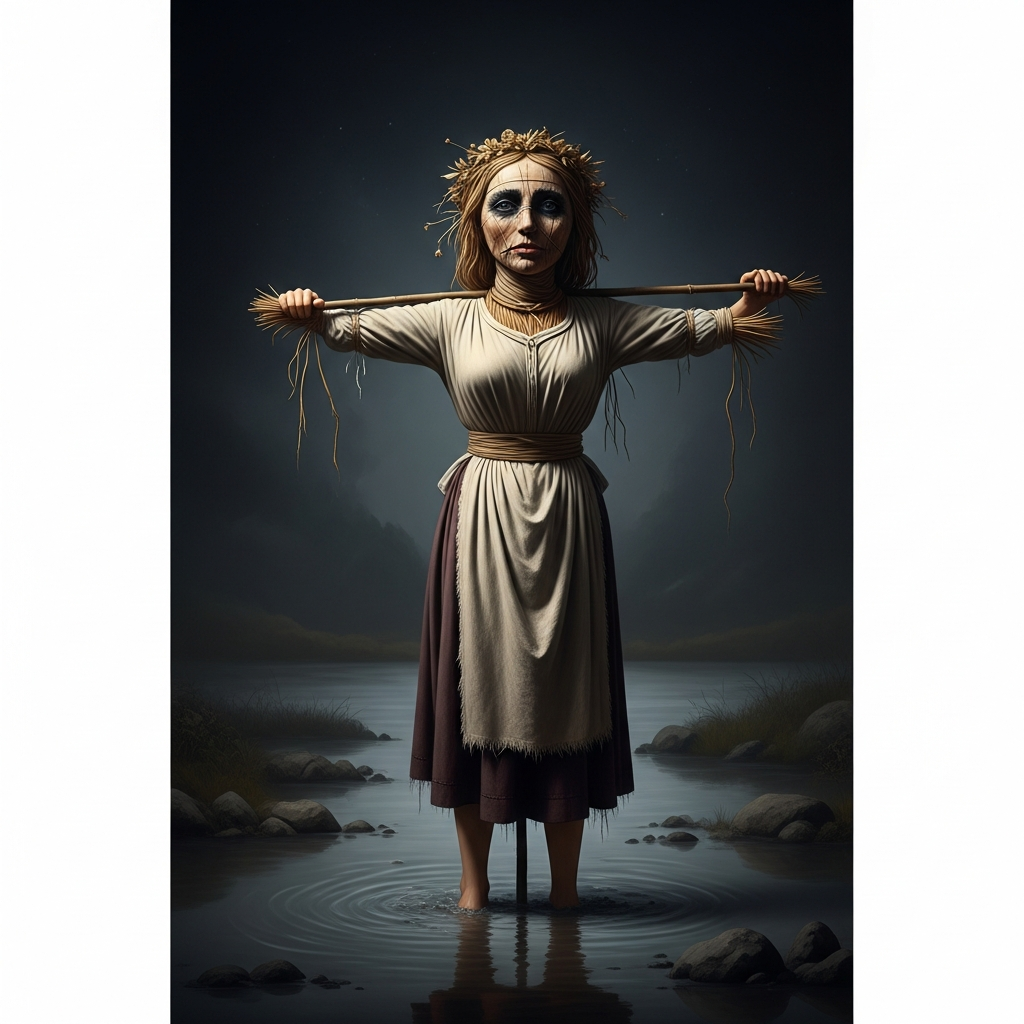
The Marzanna effigy in the hands of the village girls — straw and old linen and the last of the winter wool, her face a rag with charcoal eyes, carried on a pole through the grey March mud toward the river
 Generating art…
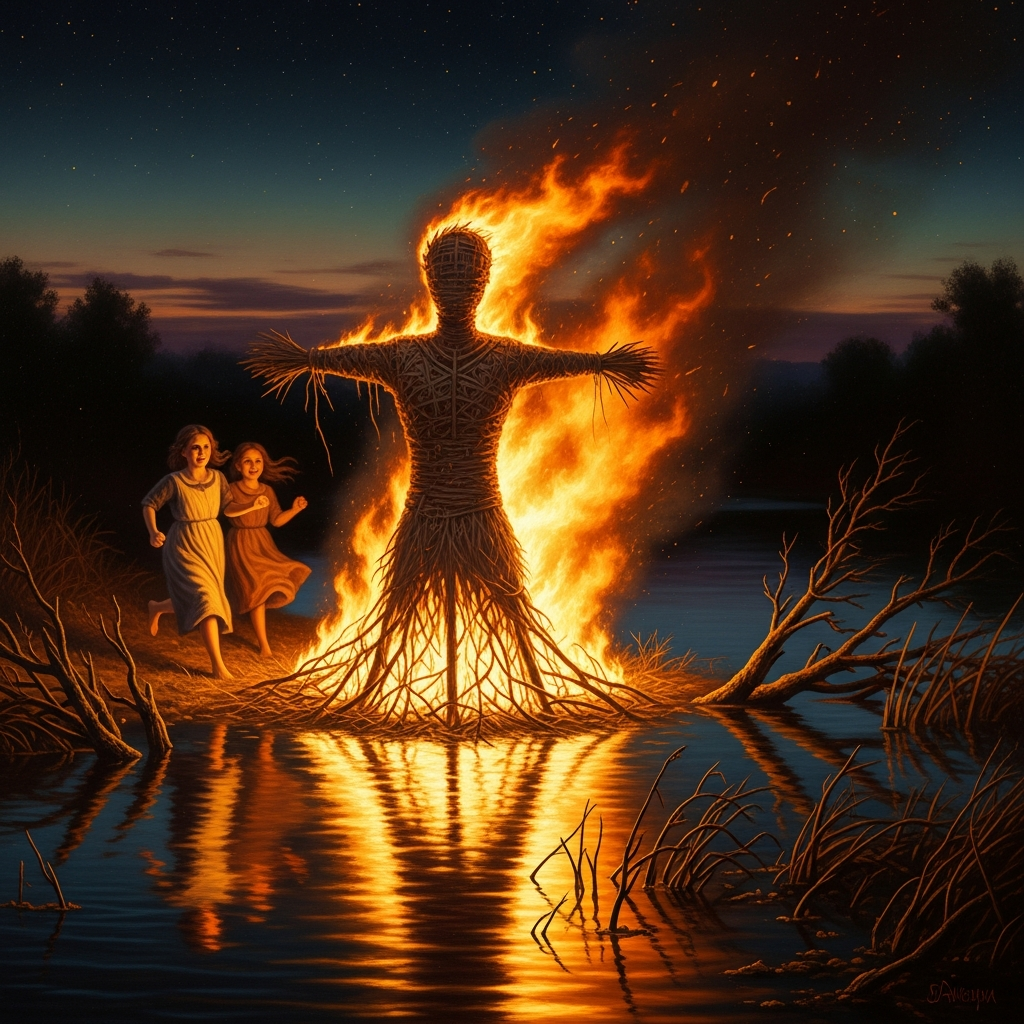
 The effigy burning at the river's edge — the girls who have set it alight already running, faces turned away, the fire catching in the dry straw and the dark water rising to receive what is left
 Generating art…
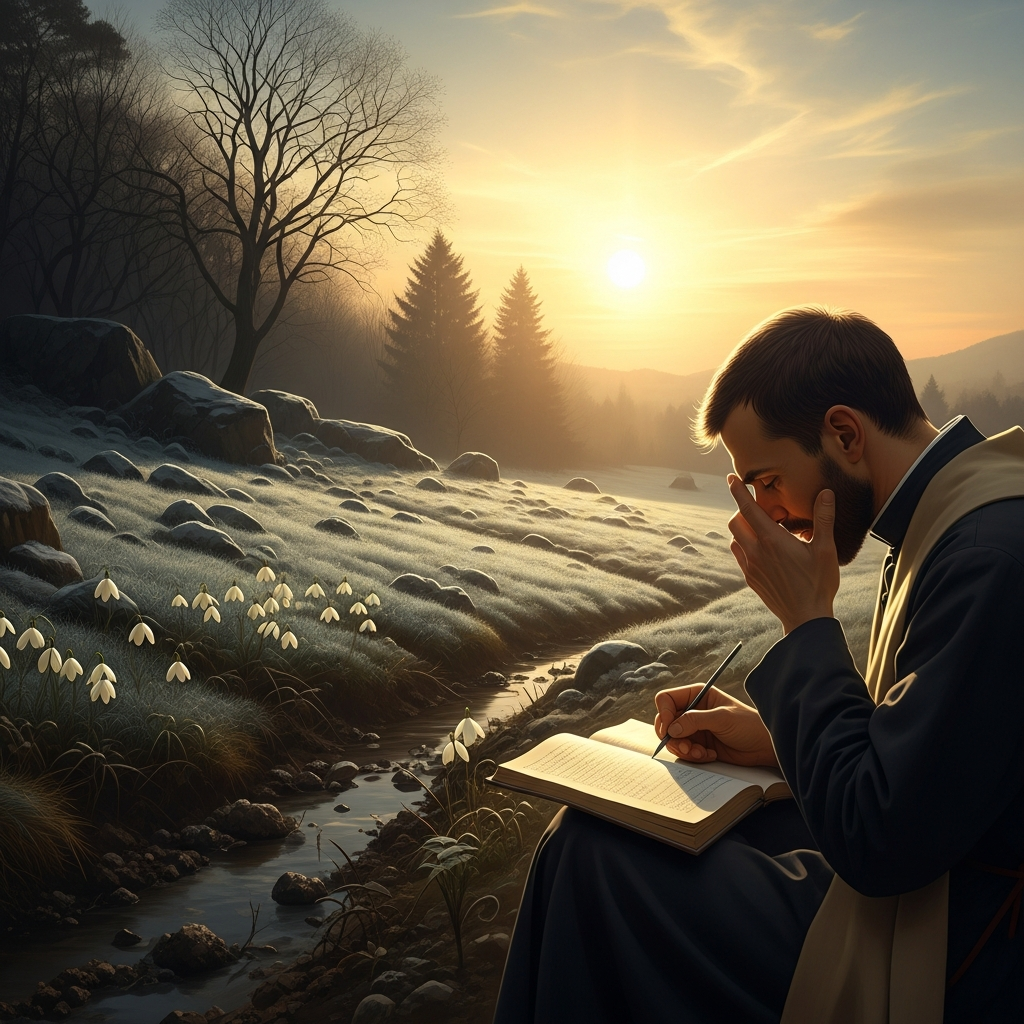
 The morning after Marzanna's drowning — frost still on the shadowed ground but the sun already warm on the south-facing slope, the first mud-colored snowdrops in the churned earth, a priest writing in his chronicle with visible frustration
 Generating art…
 Echoes Across Traditions
Entities
- Marzanna
- the village women
- the priest
- the straw effigy
- spring
Sources
- Evel Gasparini, *Il matriarcato slavo* (1973)
- Marija Gimbutas, *The Slavs* (1971)
- Ludwik Stomma, *Anthropologia kultury wsi polskiej XIX w.* (1986)
- Czesław Hernas, *W kalinowym lesie* (1965)
- Zbigniew Gloger, *Encyklopedia staropolska* (1900-1903)