Markandeya and the Lord of Death
Mythic Time — Dvapara Yuga · Shiva Purana (Kotirudra Samhita), ~10th-12th century CE composition · The ashram of Mrikandu — the sanctum of the Shiva-linga, threshold of the mortal world
Contents
The sage Mrikandu prays for a son and receives a choice: a brilliant child who lives sixteen years, or a dull child who lives long. He chooses the brilliant one. Markandeya is born, learns the Maha Mrityunjaya mantra, and on his sixteenth birthday embraces the Shiva-linga as Yama's noose falls. Shiva erupts from the stone and kicks death in the chest. Markandeya lives forever.
- When
- Mythic Time — Dvapara Yuga · Shiva Purana (Kotirudra Samhita), ~10th-12th century CE composition
- Where
- The ashram of Mrikandu — the sanctum of the Shiva-linga, threshold of the mortal world
The sage Mrikandu knows what a gift from a god costs.
He has spent years in devotion to Shiva, building tapas through austerity and prayer, accumulating the spiritual force that eventually brings the god’s attention around to bear on a single mortal life. When Shiva appears before him and Marudvati, his wife, and offers a boon, they understand they are holding something rare and dangerous. The boon that arrives through the front door of answered prayer almost always carries something unexpected through the back.
Shiva gives them a choice they did not expect to have to make. A son of great virtue, brilliant, a sage already at birth — but one who will live only sixteen years. Or a long-lived son, ordinary, dull, a life that runs its full span without particular height. One child shaped like a flame that burns completely. One shaped like an ember that persists.
Mrikandu and Marudvati choose the flame.
Markandeya is born already facing his horizon.
He knows from the beginning — because Mrikandu tells him, because the knowledge is inscribed in the shape of his days — that the sixteenth year ends everything. There is no mystery about when. There is no hope of miscalculation. The year is fixed, the mechanism is real, and Yama does not misplace appointments. Everything Markandeya will ever know, love, study, or understand has to happen in the space before that appointment.
What he chooses to fill that space with is Shiva.
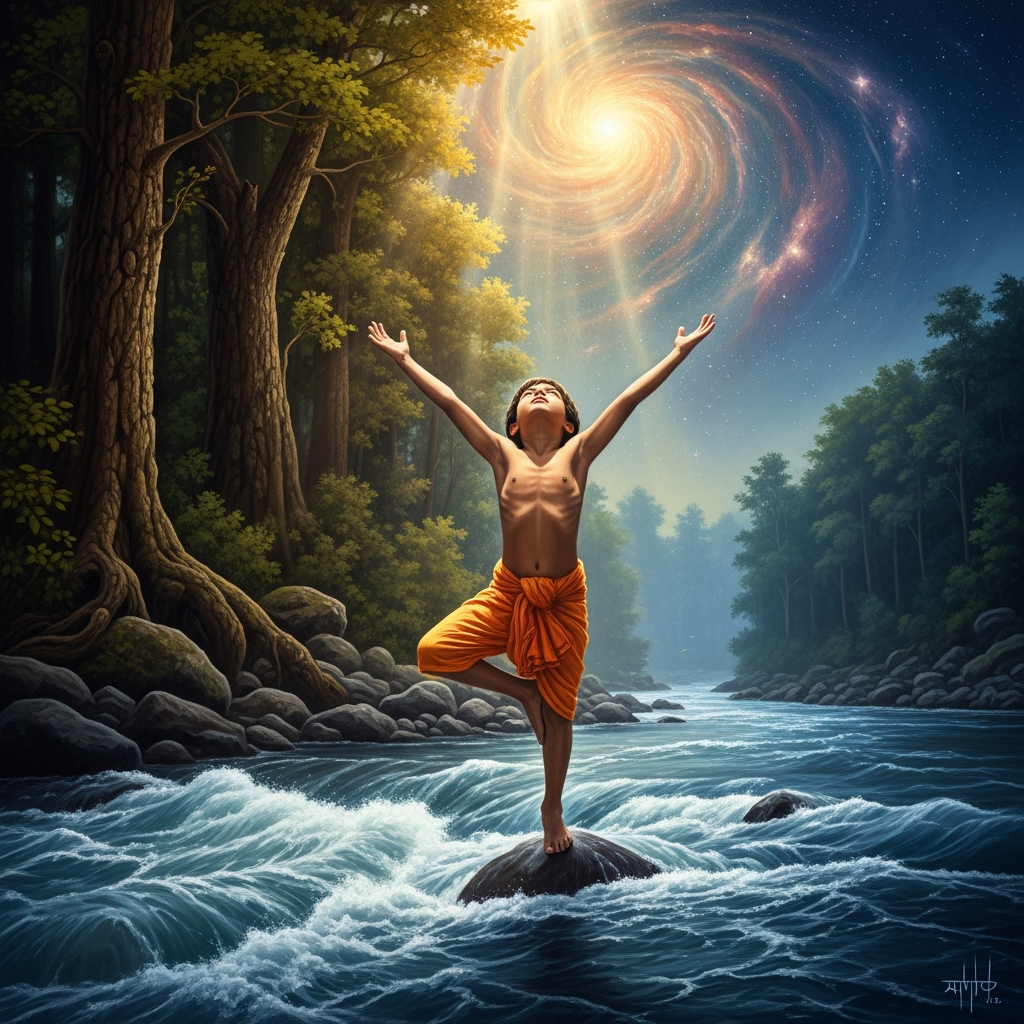
He studies the Vedas with a speed that makes his teachers uneasy. He masters the Shiva-gamas, the tantric texts of divine worship. He receives from Mrikandu the Maha Mrityunjaya mantra — the Great Death-Conquering hymn, the three-eyed prayer, the address to Shiva as the physician who liberates the devotee from death the way a cucumber is released from its vine: not by rupture but by natural completion. He chants it continuously. He builds his practice around it, the way a riverbed is built by water — patient, daily, total.
He has sixteen years. He uses them the way a fire uses wood.
On the last day, Mrikandu can barely speak.
His mother’s eyes do not leave her son. The ashram, which has been a place of learning and morning ritual and the smell of sacred smoke, is now simply the place where the known world ends. Markandeya performs his morning worship as he always does: water, flowers, the Panchakshara mantra, the lamp. He does not perform it differently because it is the last time. The routine is the devotion; the devotion is the same on the last day as on the ten-thousandth.
He sits before the Shiva-linga in the sanctum.
He does not wait for Yama to find him somewhere else. He is exactly where he always is, doing exactly what he always does.
Yama arrives exactly on time.
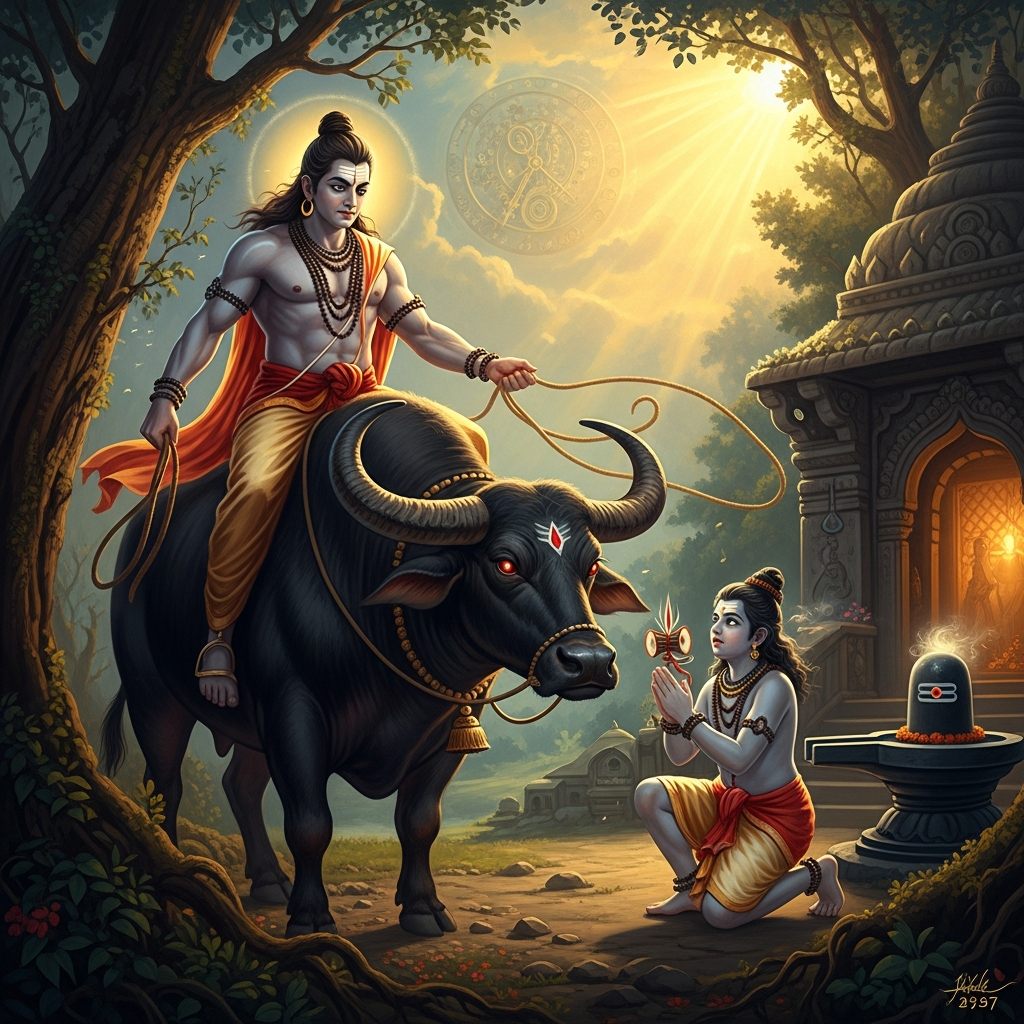
The Lord of Death comes in his full form — the dark complexion, the red garments, the crown, the noose of hemp in his right hand, the staff in his left, seated on the black buffalo whose hooves are the sound of inevitability walking through stone. He is not cruel. He has never been cruel. He is the operation of dharma, the cosmic principle that every action has its appointed term, every birth its matching death. He is the most efficient official in the administration of existence.
He enters the ashram. He sees the boy.
He raises the noose and casts it.
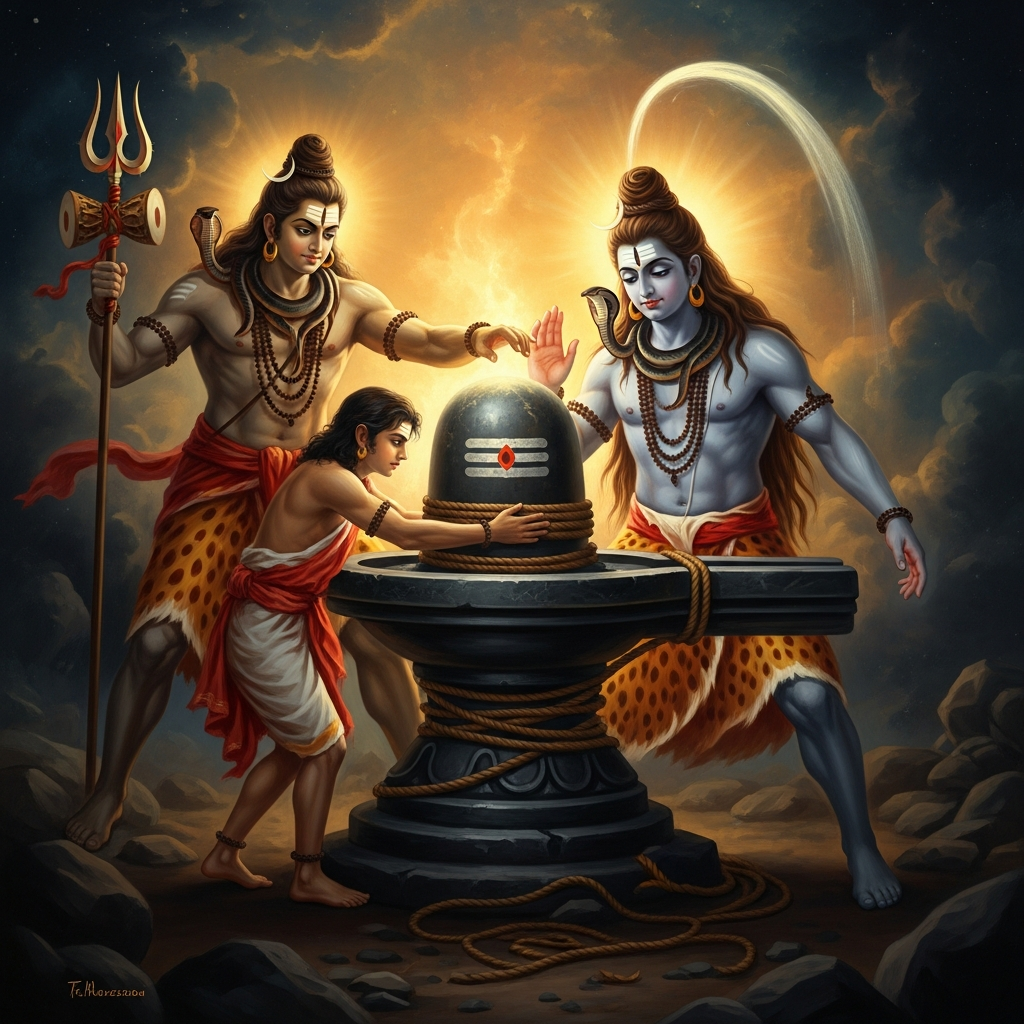
The loop of hemp flies through the sanctum air and drops over Markandeya’s shoulders, and the boy, who does not look up, does not flee, does not cry out, simply presses himself tighter against the Shiva-linga. He wraps both arms around the stone column and holds, and the noose settles over his shoulders and over the stone simultaneously — both the boy and the linga inside the loop.
The rope goes taut.
Yama pulls.
The linga splits.
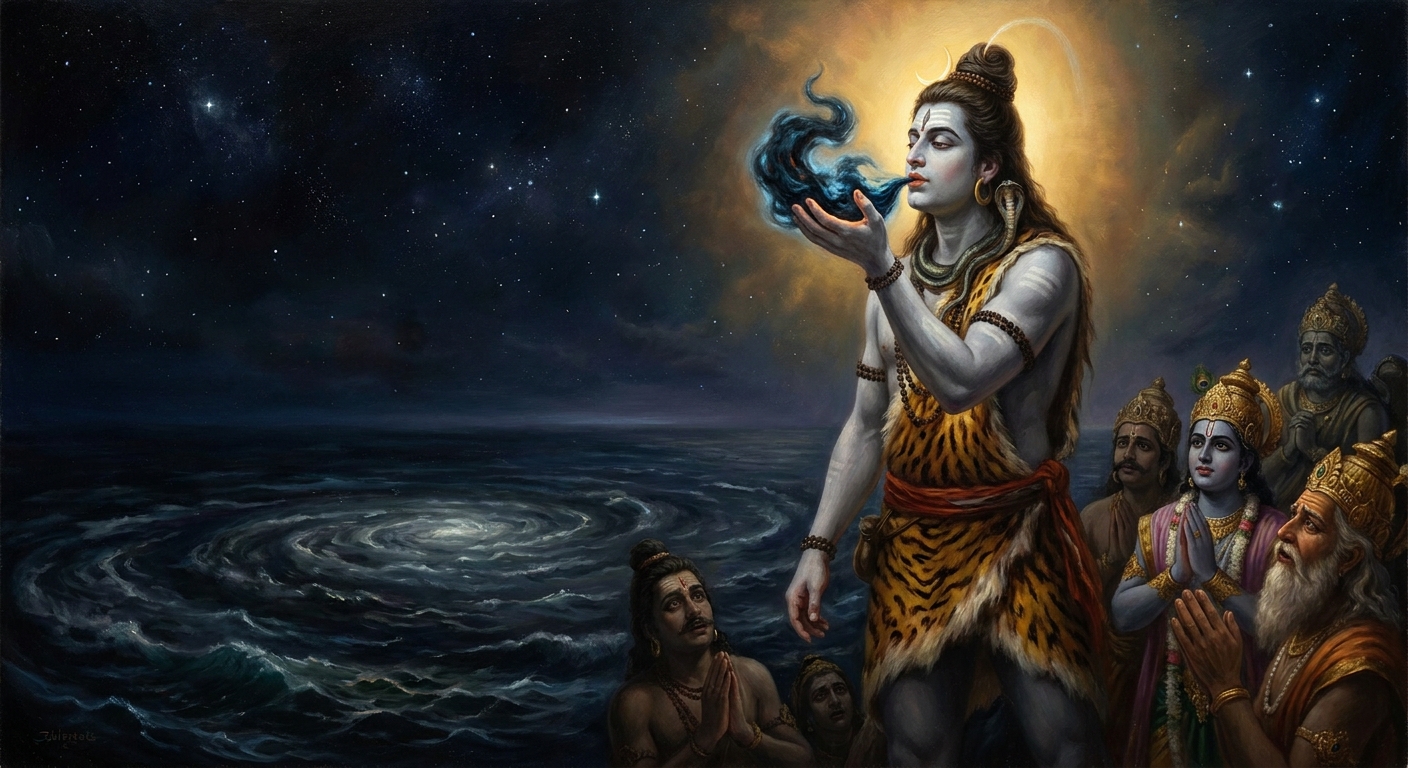
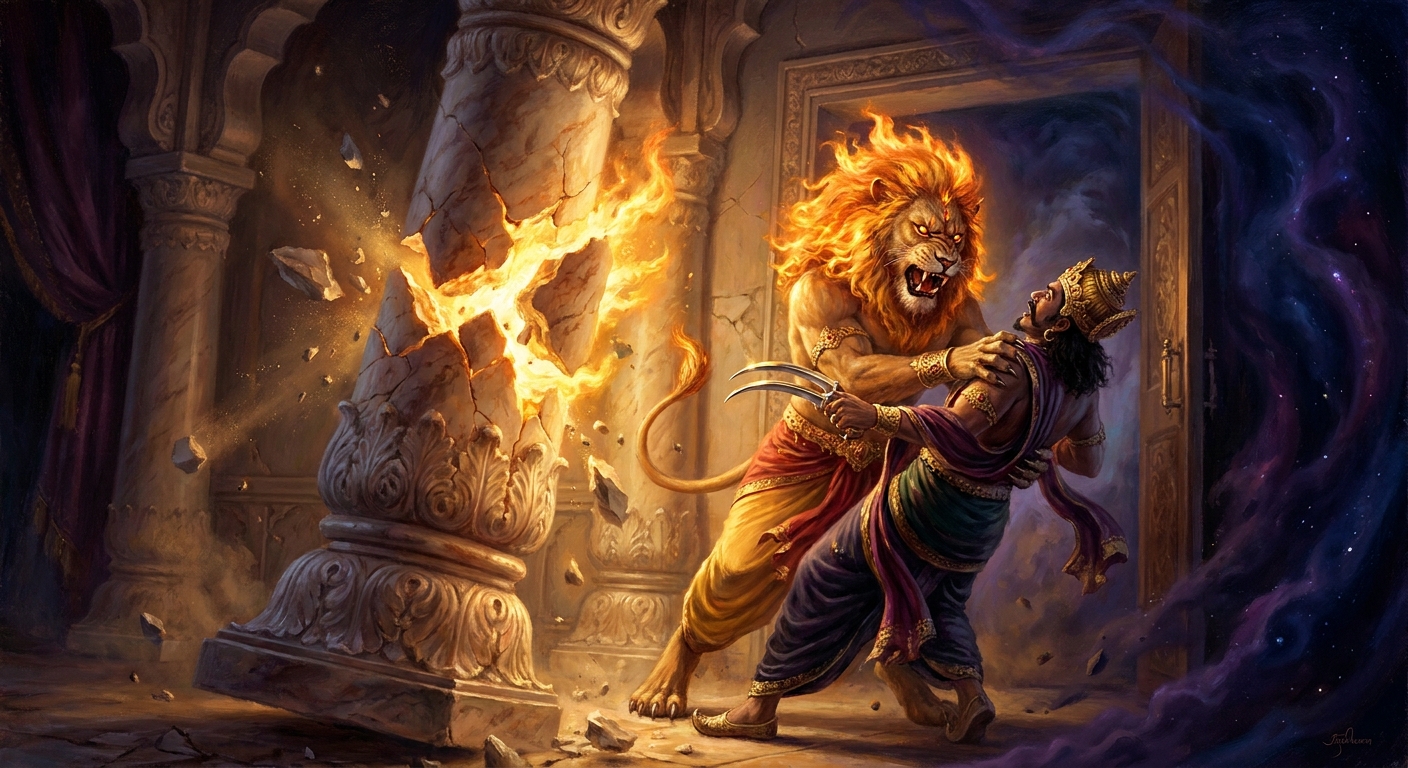
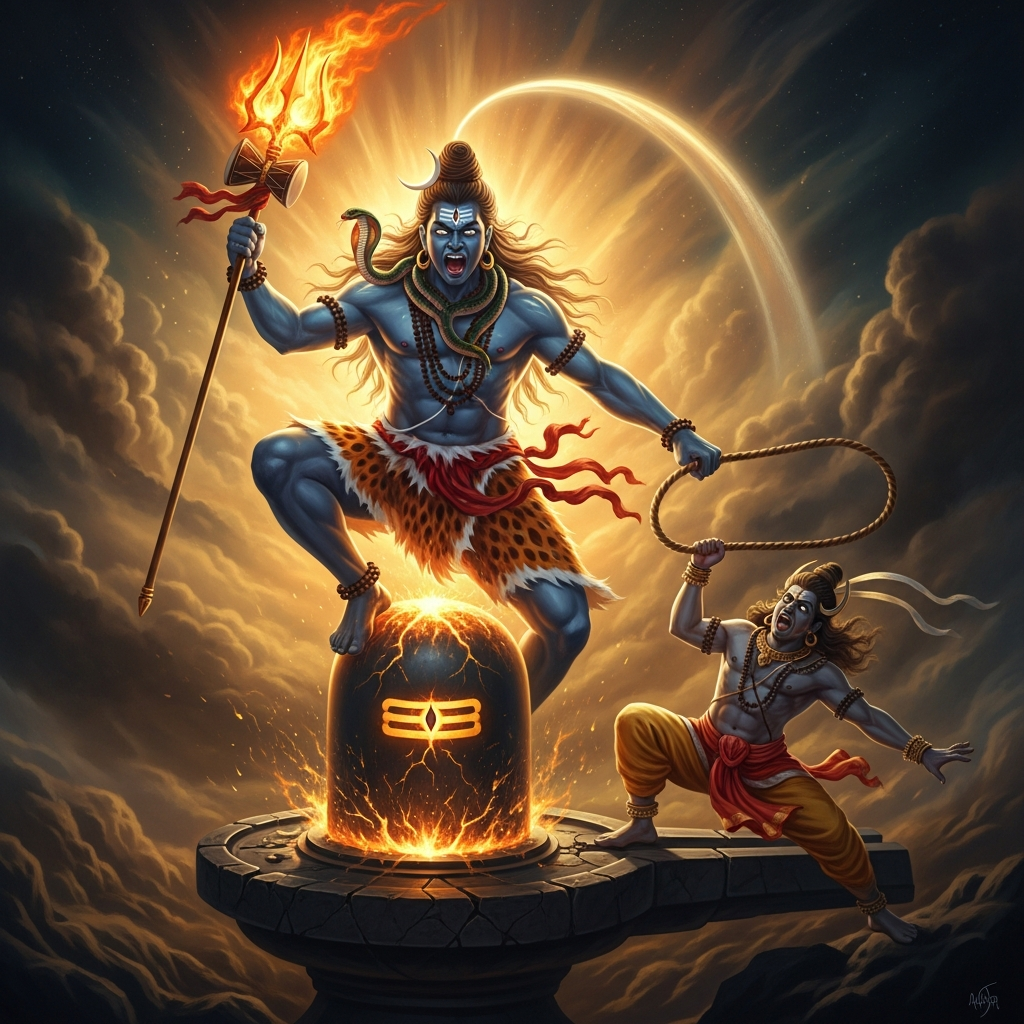
Not breaks, not cracks — it opens, the way a door opens when someone on the other side has been waiting and finally decides the time has come. From inside the stone, from the interior of the aniconic form of the god, Shiva erupts into the sanctum with the full force of what is present in the linga at the moment of devotion — which is everything.
He is in his wrathful aspect. This is important: Shiva as Mritunjaya, the Death-Conqueror, is not the serene meditator of the Himalayan snow. He is Rudra, the Howler, the terrifying aspect of transformation. His third eye blazes open. The trident is in his hand. The matted locks fly. The ash on his skin glows with the light of fires that have been burning since before the current universe.
He kicks Yama in the chest.
The kick sends the Lord of Death backward through the wall of the ashram, off his buffalo, onto the floor of his own domain. This is not metaphorical. The kick is literal, physical, cosmically significant. Yama has never been struck before. He is the agent of the highest natural law — what force in creation could strike him? Only a force that precedes natural law, that was present before the law was formulated, that is the context within which the law operates.
Yama lies on the ground, winded by a god, and dharma itself pauses.
Shiva speaks.
He says: this boy is under my protection. He says: the noose that fell on the linga fell on me, and I do not accept it. He says: Markandeya will live forever — not sixteen years, not a normal span, but the full duration of the kalpa, which is longer than the current universe has existed and longer than the next one will.
Yama accepts this. He is not punished permanently — he will fulfill his office in every other case, in every other life, in every other moment of appointment. This one case is the exception, and the exception is Shiva’s to grant. Yama bows and departs.
The sanctum is quiet. The linga stands whole. Markandeya still holds it.
He does not let go immediately.
The poets imagine him staying there for a while, arms around the stone, while Shiva becomes the still presence inside it again. His parents come in when the light returns to normal. Mrikandu does not say anything. He kneels. Marudvati holds her son’s head.
Markandeya lives, and goes on living, through the rise and fall of kingdoms that have not yet been founded. He is the sage who witnesses the Pralaya — the cosmic dissolution at the end of the age — floating on a banyan leaf as the world is unmade around him. He is the sage who writes the Markandeya Purana, the text that contains the Devi Mahatmya, the great hymn to the Goddess. He becomes one of the chiranjeevi — the immortals who persist across ages, the seven or eight beings who remain when everything else is remade.
He is sixteen forever, the tradition says. His face does not age past the moment Shiva erupted from the stone and granted him what the mantra he had been chanting had already promised: may I be liberated from the bonds of death as the cucumber from the vine, not from immortality but toward it.
The Maha Mrityunjaya mantra is still recited at births, at deaths, at the bedsides of the sick, at the beginning of dangerous journeys. The tradition that preserved it believes: the words carry the memory of this moment. When a child is born, the mantra is whispered in its ear — the same mantra Markandeya chanted while the noose was in the air, the same syllables that drew Shiva out of stone.
Yama is not the enemy. Death is not the enemy. But there is a name that Yama cannot answer, a sound that stops the noose mid-flight, a door that opens from inside the linga when the right weight presses against it from outside.
The Maha Mrityunjaya mantra is not a request — it is a key, and Markandeya found what lock it opens.
Scenes
Shiva erupts from the Shiva-linga in full wrathful aspect — trident blazing, third eye open — as Yama's noose recoils from the stone and the Lord of Death falls back before the force that exists before dharma
Generating art… Sixteen-year-old Markandeya wraps his arms around the Shiva-linga as Yama's noose settles over both of them simultaneously — the boy and the stone and the god inside the stone fused into one inextricable devotion
 Generating art…
 Yama on his black buffalo, noose extended, arrives at the ashram at the precise moment of Markandeya's sixteenth year — fulfilling his duty with the clockwork inevitability of cosmic law, until the law meets its limit
 Generating art…
 Echoes Across Traditions
Entities


Sources
- *Shiva Purana* Kotirudra Samhita, chapters 11-12
- *Skanda Purana* (Markandeya section)
- *Markandeya Purana* (autobiography passages)
- Stella Kramrisch, *The Presence of Shiva* (chapter 5)
- David Frawley, *Mantra Yoga and the Primal Sound*