Dhruva and the Pole Star
Mythic Time — Svayambhuva Manvantara · Bhagavata Purana Book 4, ~9th century CE composition · The Yamuna forest (Madhuvanam) — the deep wilderness north of Vrindavan
Contents
A five-year-old prince, humiliated by his stepmother and denied his father's lap, walks alone into the forest and performs the most severe austerity any mortal has ever attempted — standing on one toe, eating nothing, until the three worlds tremble. Vishnu appears and offers him anything. Dhruva asks for a kingdom. Vishnu gives him the Pole Star instead, the fixed point around which all creation rotates forever.
- When
- Mythic Time — Svayambhuva Manvantara · Bhagavata Purana Book 4, ~9th century CE composition
- Where
- The Yamuna forest (Madhuvanam) — the deep wilderness north of Vrindavan
His stepmother’s name is Suruchi, and she is not a villain.
She is a queen protecting her son’s position, which is what queens do. When the small boy Dhruva climbs onto his father’s throne to sit in the king’s lap — which all children of the king have the right to do — she lifts him off, not cruelly, simply with the finality of a woman who has already calculated the political arithmetic. Her son, Uttama, sits there now. The lap belongs to Uttama’s mother’s child. “If you want to sit on your father’s lap,” Suruchi tells Dhruva, “you should have prayed to Vishnu to be born from my womb.”
Dhruva goes to his mother Suniti. She holds him and weeps with him and says the truest and hardest thing a mother can say: she cannot give him what he needs. She cannot override the king’s preference, cannot undo the hierarchy of wives. She tells him: there is one lap that no one can deny access to. She says: go to Vishnu.
He is five years old. He wipes his face. He goes.
The sage Narada intercepts him on the road out of the city.
Narada — the celestial wanderer, the divine gossip, the one being in creation who moves freely between all three worlds with a vina under his arm — stops the child and asks where he is going. Dhruva tells him. Narada has seen mortals attempt austerity for decades and collapse before a result arrives. He has watched kings offer a thousand rituals and receive a polite silence from the sky. He assesses the five-year-old standing in the road with dried tears on his face and righteous fury in his jaw.
He does not try to dissuade him.
He gives him the directions: go to Madhuvanam on the Yamuna. Begin with food reduced to fruit, then leaves, then water, then nothing. Stand on one foot. Fix your mind on Vishnu and do not move it.
Dhruva listens with the concentration of a child who has no intention of doing anything else for the rest of his life. Then he walks into the forest.
The austerity does not begin in the way the poets make impressive.
It begins the way all real things begin: badly, with difficulty, with the normal suffering of a body that does not want to stand still and a mind that keeps reminding itself of the lap it was removed from and the queen’s voice saying he should have been born from a different mother. The Yamuna is cold. The forest is dark at night and loud with things that have no name in the palace vocabulary. Dhruva eats fruit. After a month he switches to leaves. After two months he switches to water every three days.
Something begins to happen.
The texts describe it from the outside, from the perspective of the cosmos rather than the child: the three worlds start to feel it. The austerity generates tapas — spiritual heat — and the heat radiates upward through the layers of existence the way heat rises through still air. The gods in heaven start to sweat. The stars shift. The Saptarishi, the seven great sages who form the constellation Ursa Major, register the disturbance and look south toward the forest.
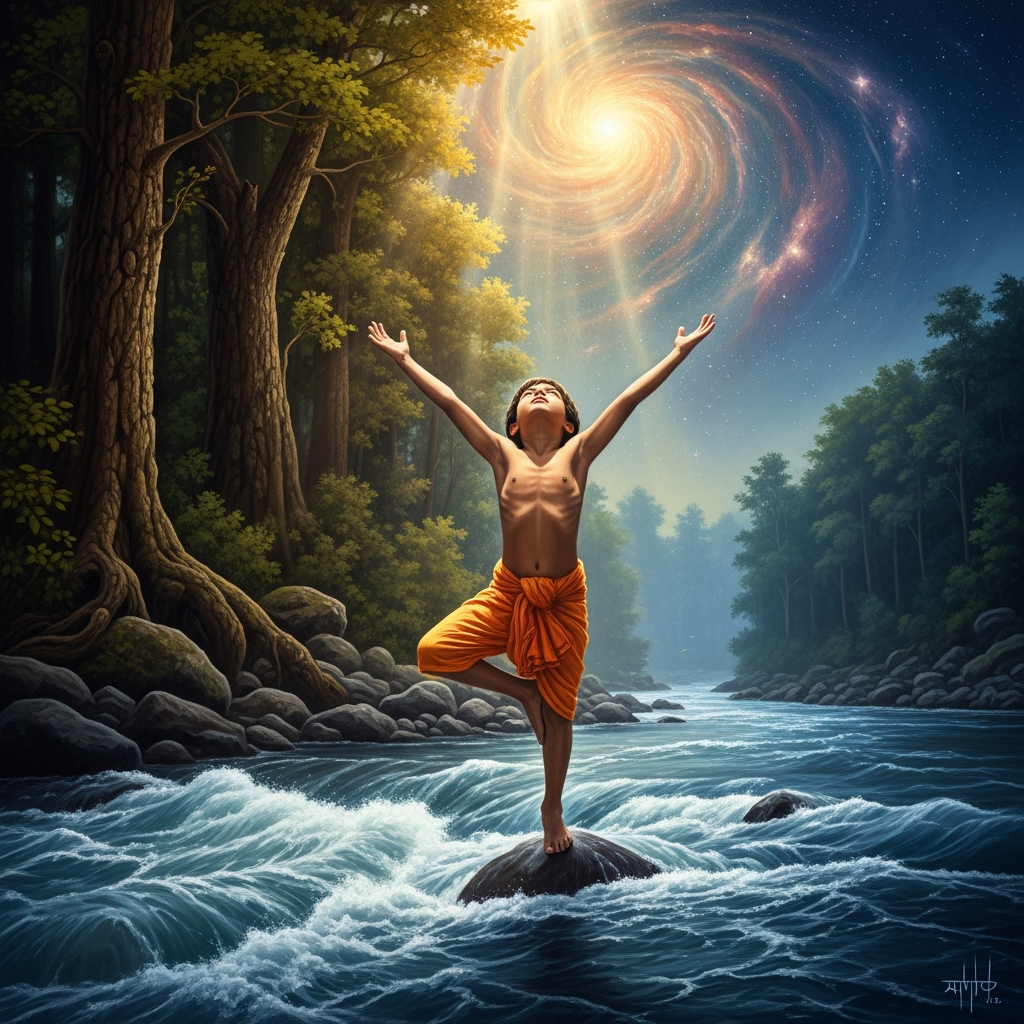
On the sixth month, Dhruva is standing on one toe, having withdrawn one foot from the earth entirely, and his breath is so steady that it has begun to displace the breathing of the cosmos. He is no longer eating. He is no longer thinking about the throne room in his father’s palace. He is no longer thinking about his stepmother. He is thinking about one thing, which is no longer a thought but a presence.
The gods go to Vishnu in a panic and say: do something. The mortal child is about to collapse the three worlds through sheer determination.
Vishnu descends.
He does not arrive with ceremony — no trumpet, no retinue. He walks out from between the trees in the form of a young man, and the light around him is not added light but the light that was always present becoming visible. He stands before Dhruva and the five-year-old opens his eyes, and the text says something remarkable: Dhruva has been meditating on the form of Vishnu in his heart, and when Vishnu appears before him in the world, Dhruva cannot see him — because the outer form has vanished from his inner vision in the same moment it appeared before his eyes.
He blinks and looks for the inner form and finds only the outer, which has displaced it.
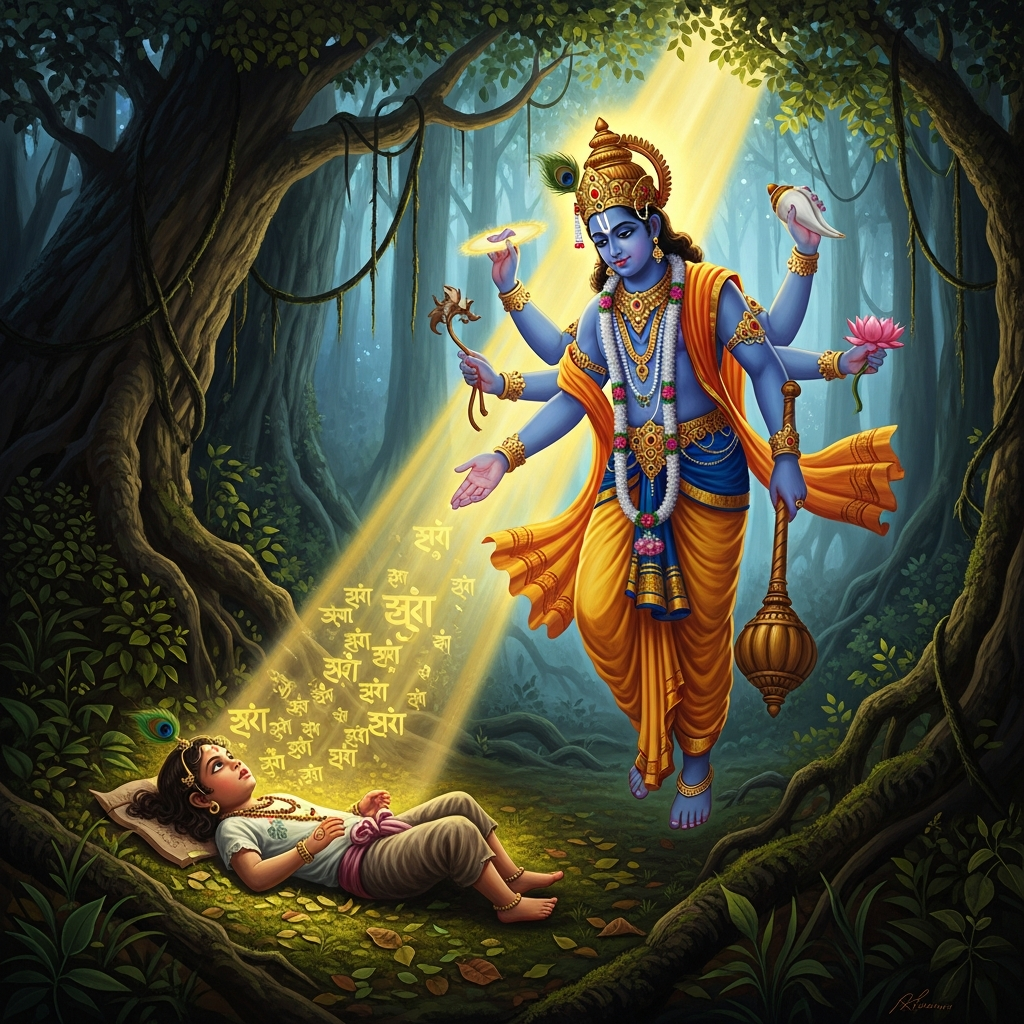
Vishnu smiles and touches his cheek.
The touch opens the words. Dhruva speaks the Stuti — the great prayer of praise — without having learned it, in Sanskrit whose grammar he has never studied. The words come from wherever the devotion comes from, which is the place before learning. He praises Vishnu through twelve verses that the tradition still recites. Then he stops.
He has forgotten what he came for.
Vishnu asks him what he wants.
The question is genuine. Vishnu asks it knowing what Dhruva will say, knowing what he will give, knowing the gap between the two — and asks anyway, because that gap is the teaching. Dhruva remembers the throne room. The lap. The humiliation. The arithmetic of royal preference that placed him below his stepbrother. He says: I want a kingdom greater than any my father, my grandfather, anyone has ever held. I want the world to know that my position is greater than every position that was withheld from me.
He is five years old. The anger is clean and honest. He does not pretend it isn’t there.
Vishnu looks at him for a long moment. Then he says: granted. And he names what he is granting: Dhruvapad — the Immovable Seat. The Pole Star. The fixed point of the celestial sphere around which every star that has ever been named rotates, forever. Dhruva will live thirty-six thousand years as a king, and when that age is complete, he will ascend to that point and remain there for as long as the universe continues to turn.
Dhruva is silent.
He begins to understand what he asked for, and how much larger what he received is than what he asked for, and for the first time since his stepmother lifted him from the throne, he weeps — not from grief but from the shock of being given more than you knew you needed.
He goes back to his father’s palace.
He is received as a king, because the austerity has done to his bearing what six months of standing on one toe does: it has made him still in a way that other people feel before they see. His father weeps. His mother holds him. Even Suruchi kneels and asks his pardon, which he gives without hesitation, because there is nothing left to withhold.
He reigns well and long. He is a just king, a devoted king, the kind of king the Bhagavata Purana uses as evidence that bhakti and governance are not in conflict. His descendants fill the earth. His lineage produces the great kings of the Mahabharata.
At the end of the thirty-six thousand years, the divine chariot comes for him.
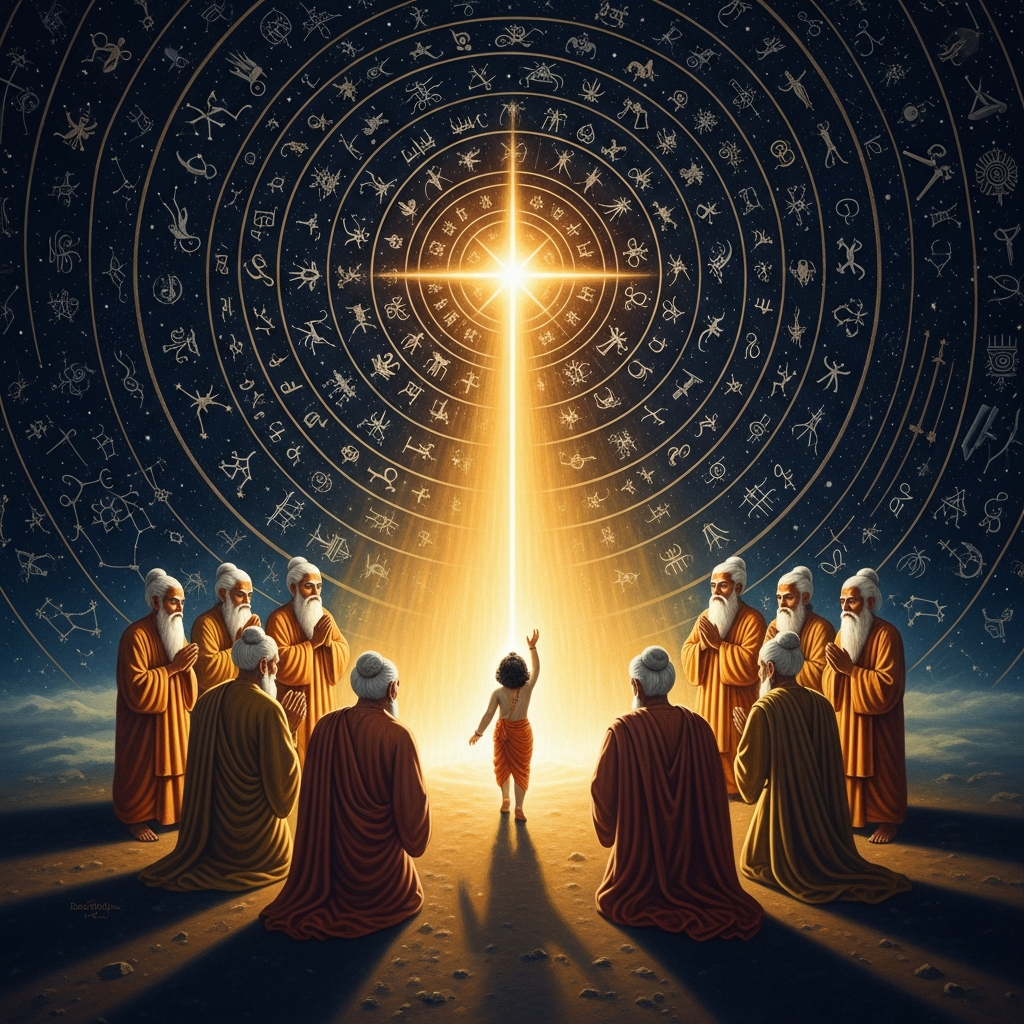
He steps in. He rises through the atmosphere, through the clouds, through the layer where the seven great sages orbit with their slow stellar patience. He takes his place at the center of the heavens — the still point, the one coordinate that the sky’s rotation is defined against. Every other star measures its position relative to Dhruva’s.
The child who was removed from his father’s lap is now the reference point of the universe.
The forest gave him what the palace never could: not a seat at his father’s table, but the only seat that does not move when everything else is moving.
Scenes
Five-year-old Dhruva stands on a single toe in the deep forest, arms raised, face tilted toward the sky, his body still as stone while the Yamuna rushes beside him and the stars wheel overhead
Generating art… Vishnu descends through the forest canopy on a beam of golden light and touches the child's cheek — awakening in him the words of the Stuti prayer that Dhruva speaks without ever having learned them
 Generating art…
 Dhruva rises to the Pole Star, the fixed point of the heavens, while the seven sages (Saptarishi) circle him in reverence and the great stars of every tradition wheel around the child who would not yield
 Generating art…
 Echoes Across Traditions
Entities
- Vishnu
- Dhruva
- Narada

Sources
- *Bhagavata Purana* 4.8-12
- *Vishnu Purana* 1.11-12
- Cornelia Dimmitt, *Classical Hindu Mythology* (Dhruva chapter)
- Barbara Stoler Miller, *The Powers of Art* (essay on Dhruva iconography)