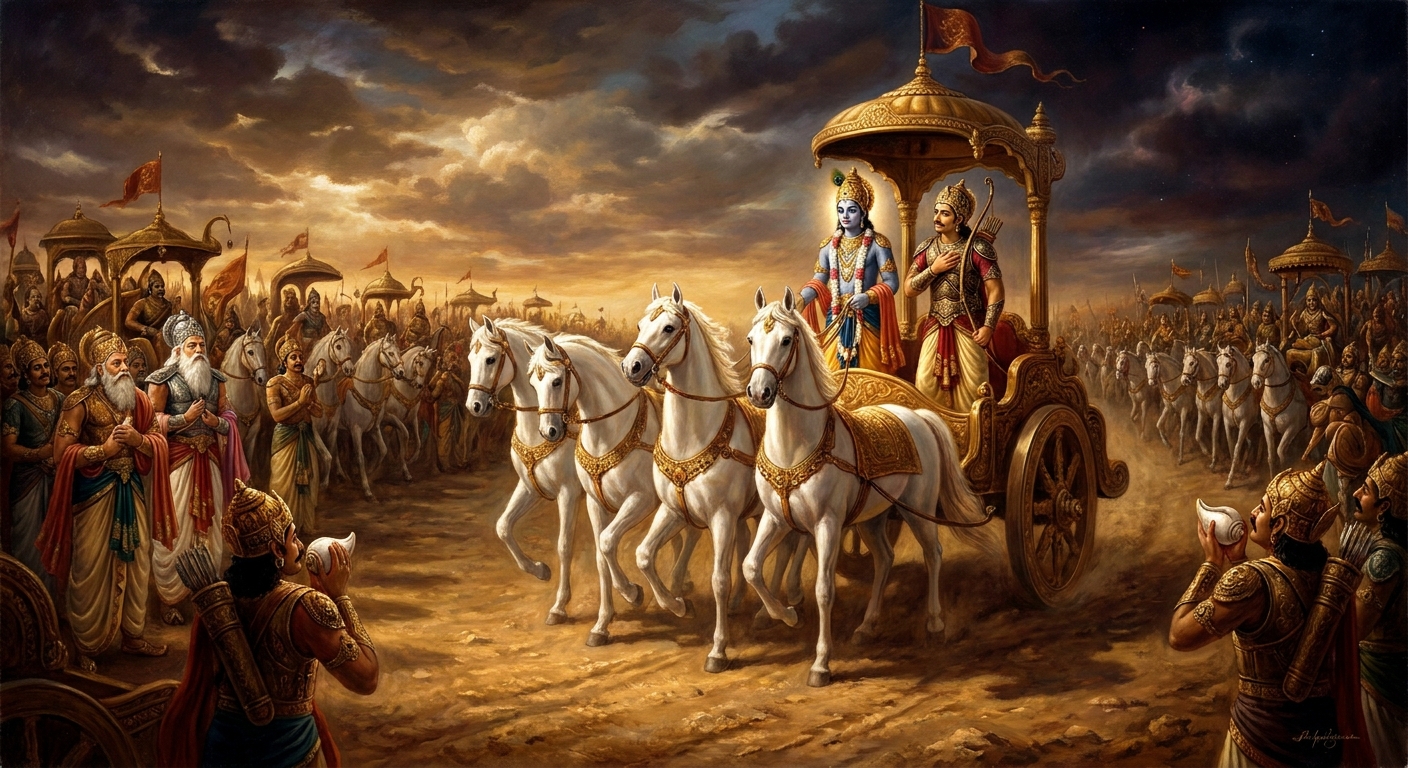
Arjuna Doubts on Kurukshetra
Mythic Time · Mahabharata composed ~400 BCE-400 CE · Kurukshetra — the field of dharma, north of modern Delhi
Contents
Between two armies on the morning of war, the greatest archer of his age looks across at his cousins, his teachers, and his grandfather — and his bow falls from his hand. Krishna, his charioteer, picks up the reins of a different conversation.
- When
- Mythic Time · Mahabharata composed ~400 BCE-400 CE
- Where
- Kurukshetra — the field of dharma, north of modern Delhi
The conches sound first.
Eighteen armies face each other across the plain of Kurukshetra. Bhishma, the grandfather, raises his white conch and the note rolls across the field like a falling wall. Arjuna answers with Devadatta, the conch Indra gave him. The sound of the two shells meeting in the air is the sound of a world about to end and knowing it. Horses startle. Banners crack. Eleven divisions on one side, seven on the other — the largest army ever assembled on the subcontinent, drawn up in the formal patterns the war manuals describe, every warrior in his appointed place.
Then the conches stop. The silence that follows is the silence Arjuna will remember.
Drive me between the armies, he tells Krishna. I want to see who has come to die.
Krishna takes the reins.
The chariot rolls forward into the gap between the lines. Five white horses, golden harness, the Kapidhvaja banner with Hanuman roaring at its peak. Krishna, who could be commanding his own army and is not — who chose, in the negotiations before the war, to be Arjuna’s charioteer rather than Duryodhana’s general — guides the horses to the precise center of the field and stops them.
Arjuna stands in the chariot and looks.
He sees Bhishma first. The grandfather who carried him on his shoulders. The patriarch who taught him the names of the constellations and the holds of every weapon. Bhishma’s white hair is bound for war. He has chosen the other side because his vow to the throne of Hastinapura demands it, and his vow has held for a hundred years and will hold today. He is going to fight his grandson. He has known this for months.
Then Drona — the teacher who taught him archery. Then Kripa. Then his cousins. Then the friends of his childhood. Then men whose weddings he attended. Then men who taught his children to ride.
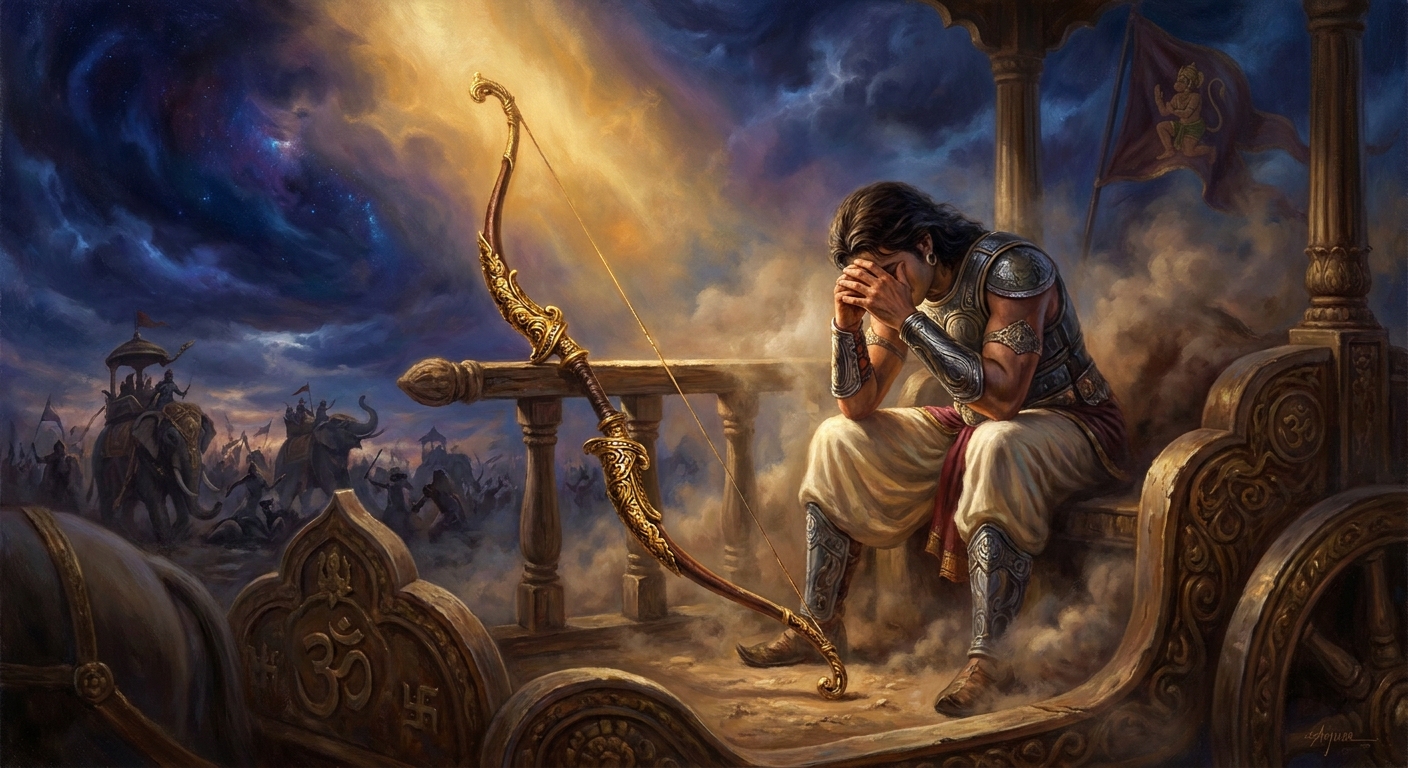
Gandiva slips.
The bow that Indra gave him, the bow that has never failed, the bow that is heavier than any mortal can lift — Gandiva slides from his palm and clatters against the rail of the chariot. He does not catch it. His hand has gone numb. The skin of his face has gone numb. Something is happening in his chest that he does not have a name for, and his knees fold, and he sits down on the floor of the chariot in front of his god, and he begins to speak.
I cannot do this.
The words come out broken. Krishna, I see my own people standing there waiting to be killed. My mouth is dry. My limbs fail. The hair on my body stands up. Gandiva slips from my grip. I cannot stand. My mind reels.
He keeps going. What victory, what kingdom, what pleasures could be worth this? The men whose blessings we sought as children — we are about to put arrows in their throats. The teachers who corrected our grip on the bowstring — we are about to make their wives widows. Better to be killed unarmed and unresisting than to win a kingdom by killing these men.
He drops his head against the rail. I will not fight.
Krishna does not answer immediately.
He sits with his hands on the reins and lets the warrior cry. The two armies wait. No conch sounds. No commander gives the order to advance. Eighteen divisions of men in their war paint and their iron stand absolutely still on the morning that history will eventually call the first day of the great war, and at the center of them a chariot has stopped, and inside the chariot a man is sobbing on his knees in front of his charioteer, and the charioteer is letting it happen.
This is the part the Mahabharata wants us to see. Before the philosophy. Before the cosmic vision. Before the eighteen chapters of teaching that became the Gita and changed every Hindu century after — before any of that — the warrior breaks. The greatest archer of his age cannot pick up his bow. The duty he has trained for his entire life arrives, and it is unbearable, and he says so out loud to the only one who will listen.
The Gita exists because Arjuna doubted. Krishna does not rebuke the doubt. Krishna waits for the doubt — because the teaching cannot land in a warrior who has not yet asked the question.
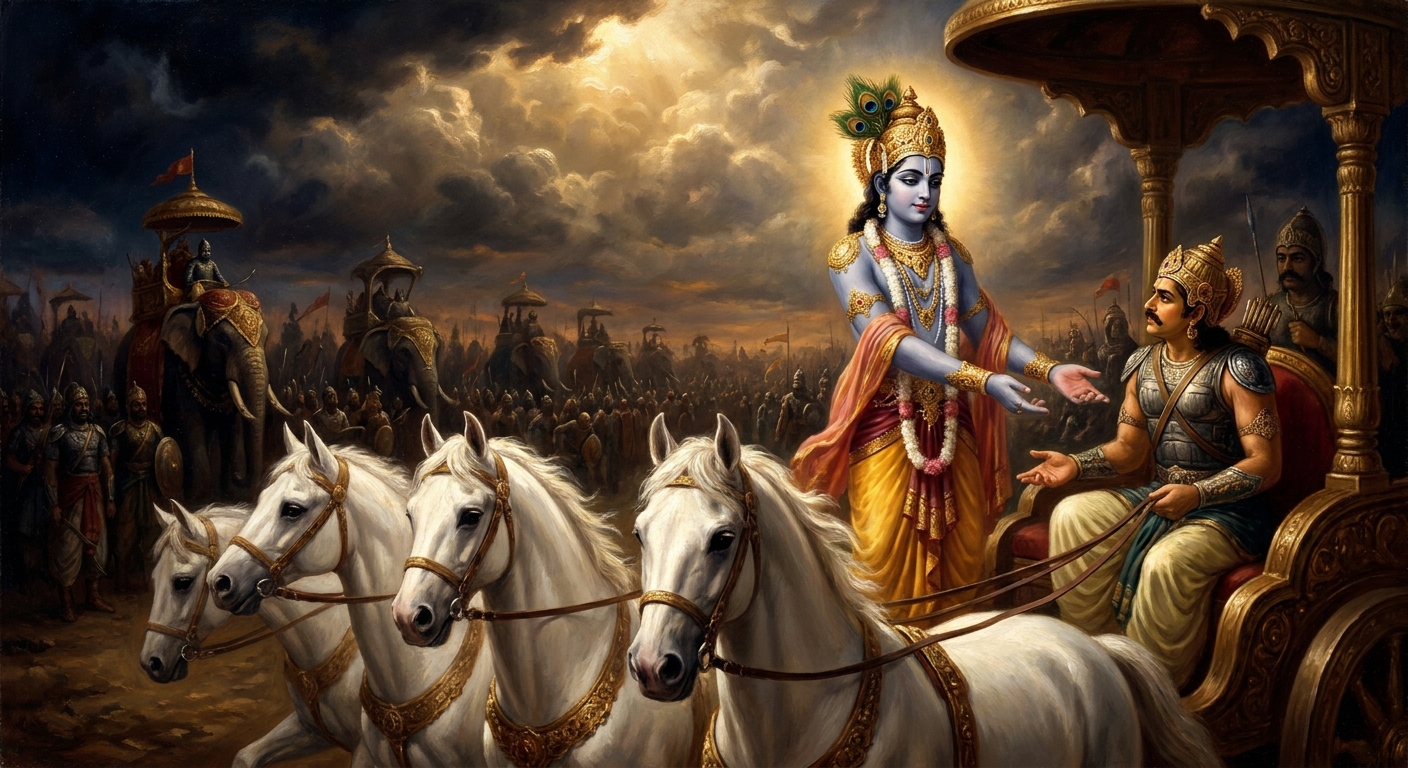
Then Krishna smiles.
It is a small smile, the smile of a friend who has been waiting for this conversation and is glad it is finally happening. He shifts on the chariot bench so he is facing Arjuna fully. The reins lie loose across his knee. The horses stand. The armies stand. The sun is climbing toward the place in the sky where, by the war manuals, the first attack should already have begun.
It does not begin. The chariot in the middle of the field has become, without anyone noticing, the only thing happening on Kurukshetra.
You grieve for those who should not be grieved for, Krishna says. And you speak words of wisdom. The wise grieve neither for the living nor for the dead.
The Bhagavad Gita has begun.
The Gita’s setting is its argument. The teaching does not happen in a temple, or a forest hermitage, or a mountain cave. It happens in a chariot, in the gap between two armies, in the moment when a man’s duty has become unbearable and his god is sitting next to him holding the horses.
Every later Hindu crisis of conscience — the renunciate who cannot leave his family, the activist who cannot reconcile violence with ahimsa, Gandhi reading the Gita on the train — descends from this scene. Doubt is not the failure of the spiritual life. Doubt is its starting point. The bow has to fall before the conversation can begin.
Arjuna’s collapse is not weakness. It is the only honest response to what is being asked of him — and Krishna, the god in the chariot, the friend with the reins, takes it seriously enough to answer for eighteen chapters.
Scenes
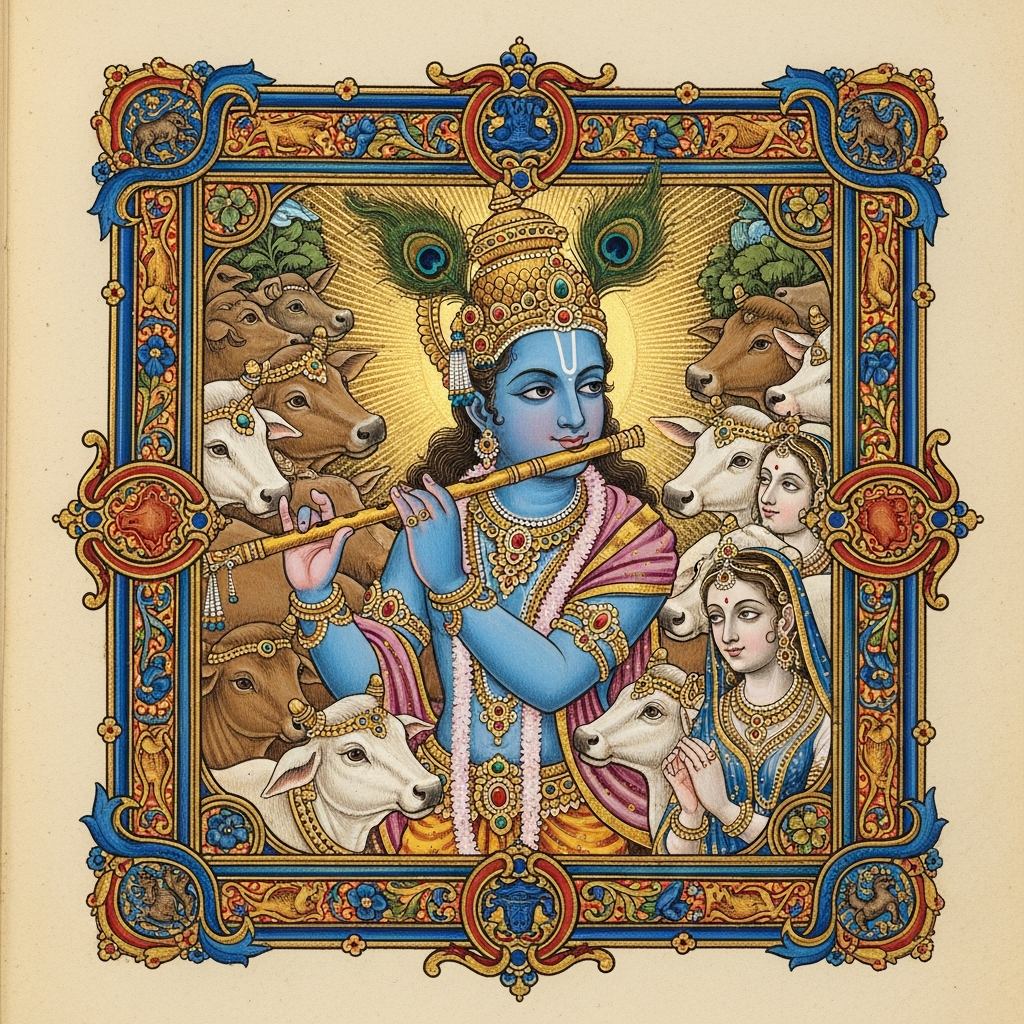
Arjuna and Krishna in the chariot drawn between the two armies — the white horses still, the conches lowered, the warrior staring at the faces he is about to kill
Generating art… Gandiva — the bow Indra gave him, the bow that has never failed — slips from Arjuna's hand and rests against the chariot rail
 Generating art…
 Krishna turns from the reins
 Generating art…
 Echoes Across Traditions
Entities
- Arjuna
- Krishna
- Bhishma
- Drona
- Duryodhana

Sources
- *Mahabharata*, Bhishma Parva 23-25 (BORI critical edition, 1933-1966)
- *Bhagavad Gita* 1 (the Vishada Yoga, 'Yoga of Despair')
- Wendy Doniger, *The Hindus: An Alternative History* (2009)
- Cornelia Dimmitt, *Classical Hindu Mythology* (1978)
- R.K. Narayan, *The Mahabharata: A Shortened Modern Prose Version* (1978)