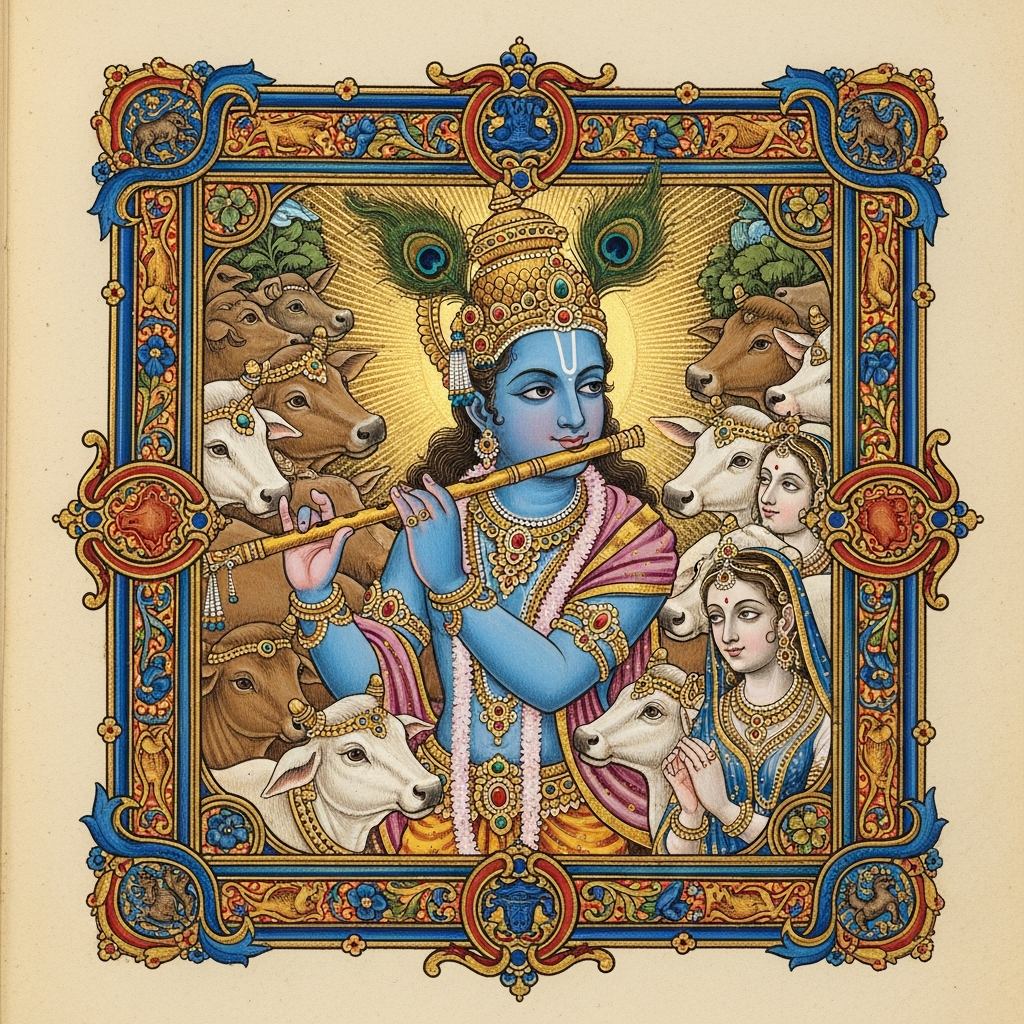
Karna: Death in the Mud
Mythic Time · Mahabharata, Karna Parva ~400 BCE-400 CE · Kurukshetra — the seventeenth day of the eighteen-day war
Contents
Karna is arguably the greatest warrior of the Mahabharata — a man who spent his life fighting to be taken seriously because he was raised as a charioteer's son. On the last day of his life, his chariot wheel sinks into the mud. Arjuna fires. The secret of Karna's birth, withheld until after his death, transforms the war the heroes won into a tragedy about the best man they ever fought against.
- When
- Mythic Time · Mahabharata, Karna Parva ~400 BCE-400 CE
- Where
- Kurukshetra — the seventeenth day of the eighteen-day war
His birth is the first injustice.
Kunti, daughter of the Yadava king Sura, is given as a child in adoption to her childless uncle Kuntibhoja. She grows up in the palace of a good man and serves his guests with the particular attentiveness that guests remember afterward. One guest she serves is the sage Durvasa, who is famous for two things: his knowledge of mantras and his capacity for rage. She serves him so well for a year that he gives her a boon: a mantra by which she can summon any god and receive a child.
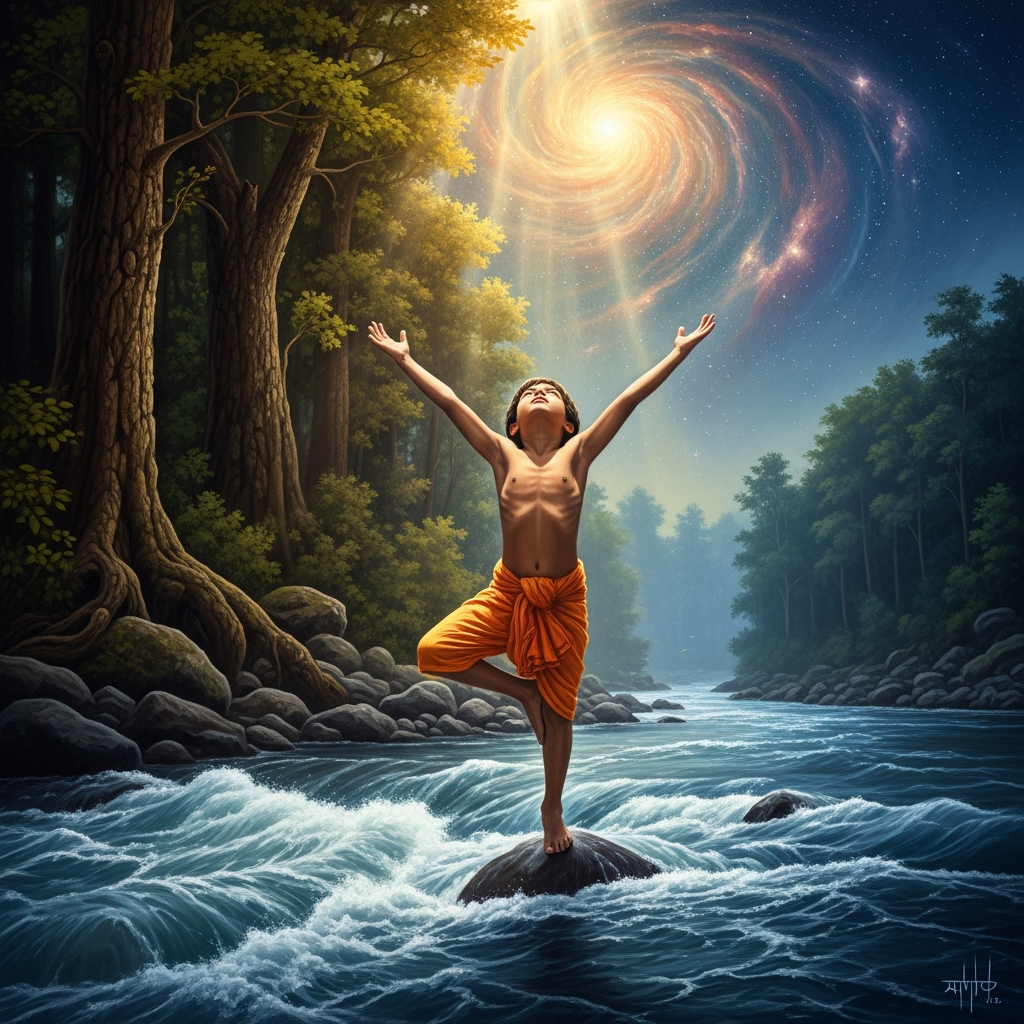
She is a girl. She tries it once, experimentally, to see if it works. She faces the rising sun and recites the words. Surya the sun-god arrives, brilliant and enormous, entirely literal in the way that gods summoned by mantras tend to be. She has not thought this through. She is very young and frightened and the god is already there. Nine months later she places the infant — a boy, born wearing golden armor and golden earrings that cannot be removed without killing him — in a basket in a river.
The basket floats to a charioteer named Adhiratha, who raises him.
His name will be Vasusena. He will earn another name: Karna, the one with the earrings. He will spend his entire life paying for a moment of adolescent curiosity that was not his doing at all. He is the best warrior in an epic full of extraordinary warriors, and every time he enters a room, someone finds a way to remind him that his father drives chariots.
He arrives at the tournament of Hastinapura as a young man, uninvited.
Drona has organized the graduation tournament for his students — a display of the Kuru princes’ skills, the formal demonstration that Arjuna is the greatest archer alive. The tournament is magnificent: chariot racing, mace combat, archery, the princes performing for the assembled court. Arjuna performs last, as the culmination, and he is extraordinary. The crowd cheers.
Then Karna walks in from the back of the arena.
He duplicates everything Arjuna has done, exactly, without warming up, without preparation, with the casual ease of someone demonstrating that what they just watched was not difficult. The crowd falls quiet. Arjuna looks at him. The two men face each other in the arena and the air between them is full of the recognition of equals — the specific tension of two people who have found the only other person in the world who operates at their level.
Then Kripa, the preceptor, asks the procedural question: what is this challenger’s family and kingdom? The rules require a named warrior of equal birth to compete against a Kuru prince. Karna cannot answer. He is a charioteer’s son. He has no kingdom. The tournament rules disqualify him.
Duryodhana, who has been watching from the stands and understands immediately what is in front of him, crowns Karna king of Anga on the spot, making him a peer. It is a beautiful, calculated gesture — Duryodhana is genuinely brilliant in his choices, and his choice of Karna is the best choice he ever makes. Karna spends the rest of his life loyal to the man who gave him a kingdom when the world gave him nothing.
It will kill him.
The war is in its seventeenth day.
Both armies have been destroying each other with a systematic efficiency that the Mahabharata records in staggering detail: generals fall, formations break, the rules of honorable warfare that were announced before the war began — no attacking the unarmed, no attacking from behind, no killing a man whose wheel is stuck — are honored in the breach, day by day, as the desperation accumulates. Abhimanyu was surrounded and killed by six warriors simultaneously on day thirteen. Drona was killed after being told a lie. The war that began with formal oaths has become the war that wars become.
Karna takes the field as commander on day sixteen. He has been waiting for this — waiting through the political machinations that gave Bhishma command for ten days and Drona for five, waiting while lesser men received the honor he earned. He fights two days of extraordinary war. He is everything his reputation promised. He kills Pandava generals who have survived fifteen days of battle. His arrows fall on Arjuna’s chariot with the force of someone who has been carrying a grudge and a quiver for fifty years.
On day seventeen, the ground gives way.
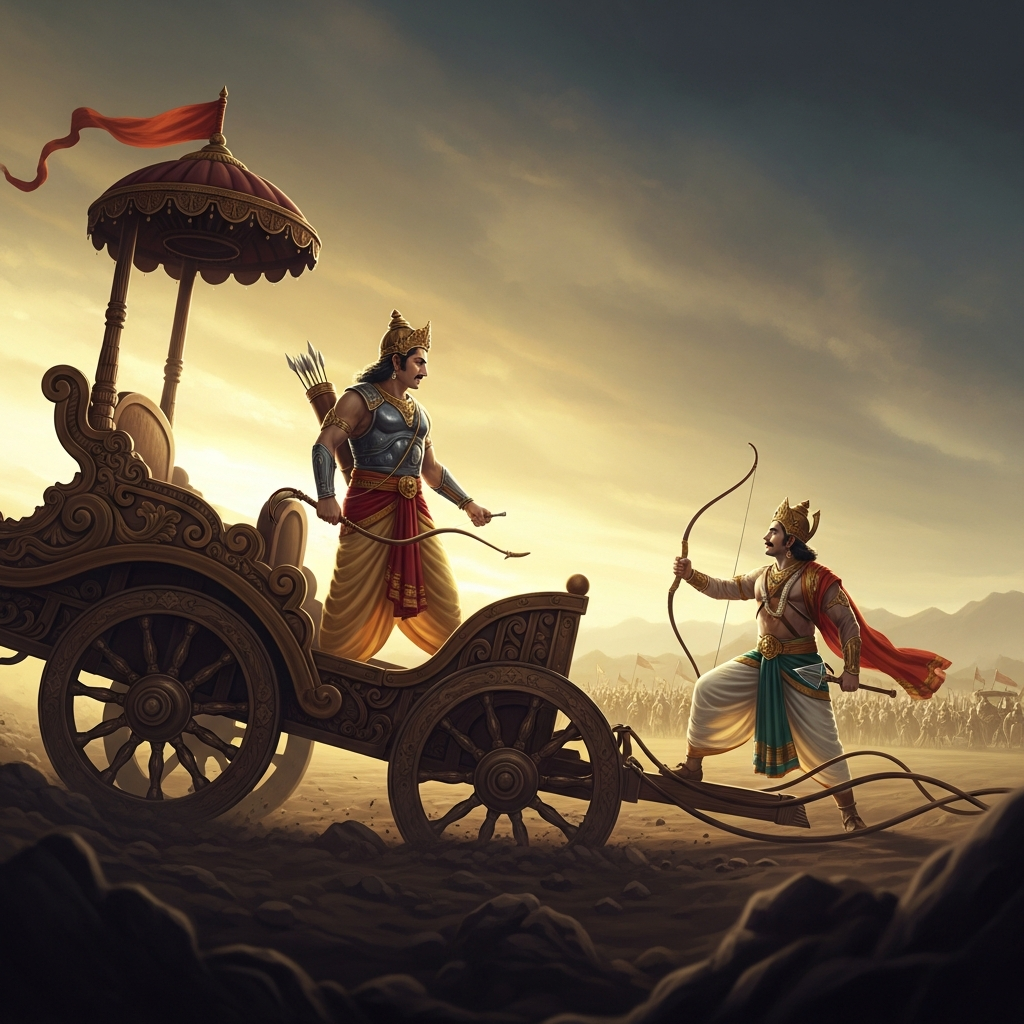
It is a chariot wheel. The left wheel. It goes into a soft patch of the churned Kurukshetra earth, post-seventeen-days-of-ten-thousand-chariots, and it sinks to the axle and stops moving. The chariot tilts. Karna’s footing changes. His driver calls out the problem.
He could abandon the chariot. He is Karna — he could fight on foot, he could continue, he could find another way. But the chariot wheel is the humiliation he will not accept today. He jumps down into the mud and begins to lift it with his hands. He is the son of the sun-god. He has the strength for it. He shouts across the field at Arjuna: Wait. The rules of war — wait.
Arjuna waits.
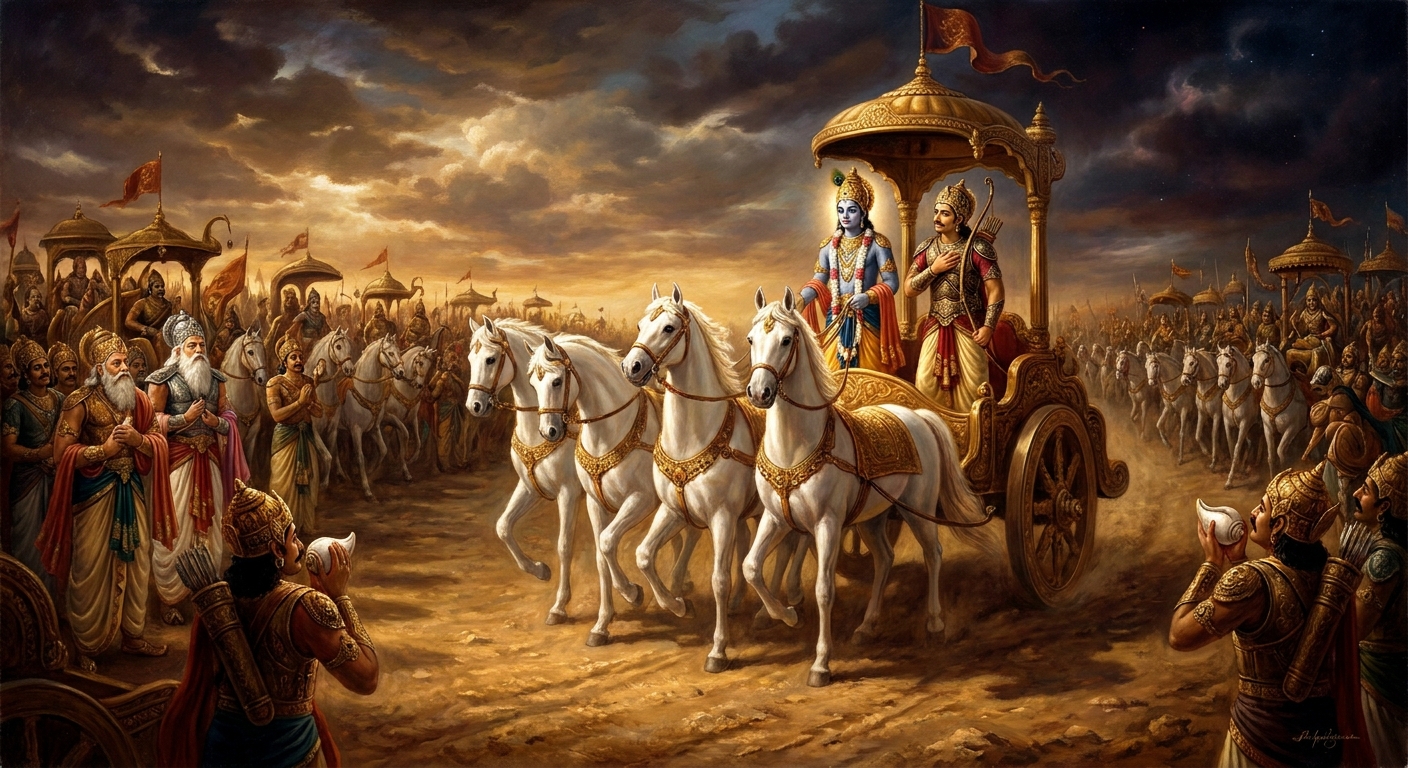
Krishna does not tell him to fire. Not yet. Krishna watches Karna in the mud with an expression the texts describe as unreadable and that modern readers tend to read as the expression of a god watching the mechanism of karma complete itself. He has known this day was coming. He has been arranging this day, in the way that divine charioteers arrange things, since before the war began.
He speaks to Arjuna.
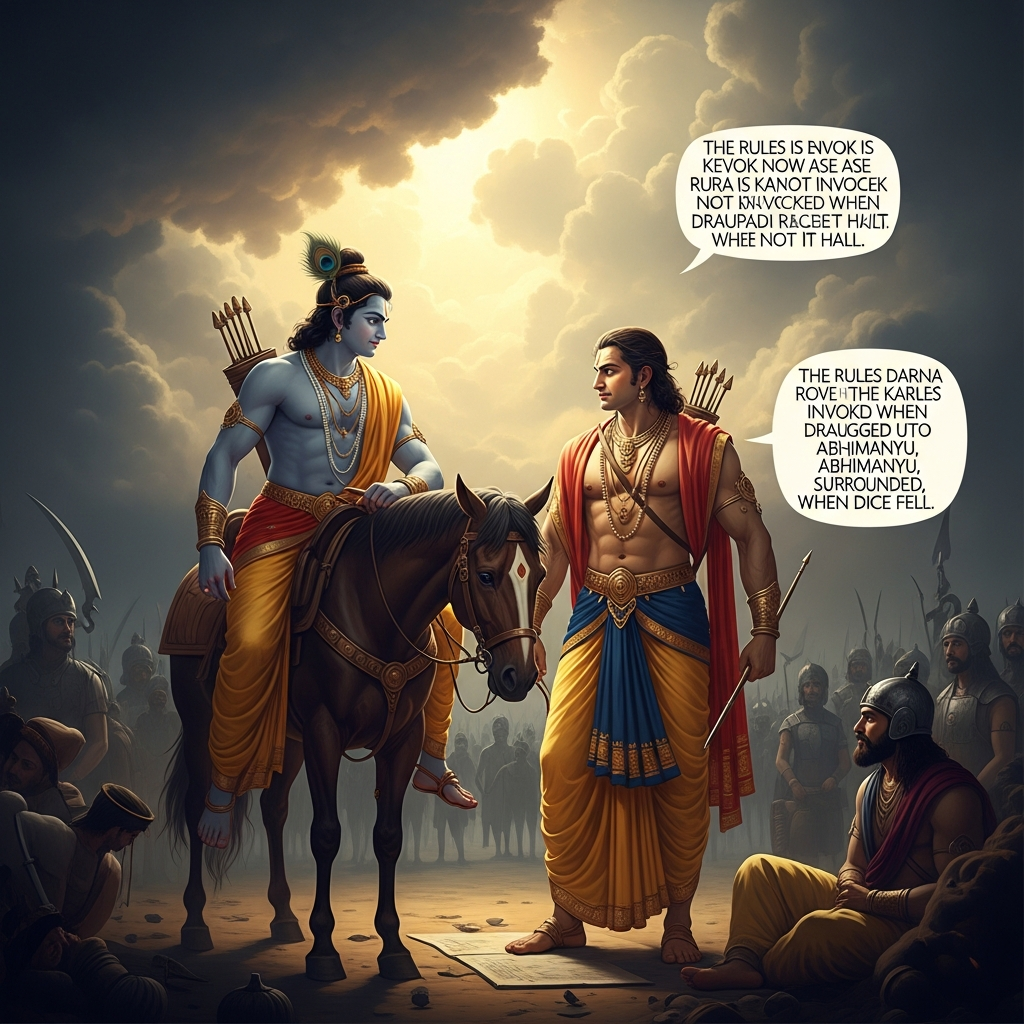
Where was the dharma of war when Draupadi was dragged into the Kuru hall? Where was it when Abhimanyu was surrounded by six? Where was Karna’s mercy for the boy who knew only how to enter the wheel formation and not how to leave it? Where was his voice when the dice fell?
He is not wrong. Every word he says is true. Karna was in the Kuru hall. Karna said nothing. Karna was on the field on day thirteen. Karna said nothing.
Karna’s dharma remembers itself when the wheel is in the mud, Krishna says. Not before.
Arjuna fires.
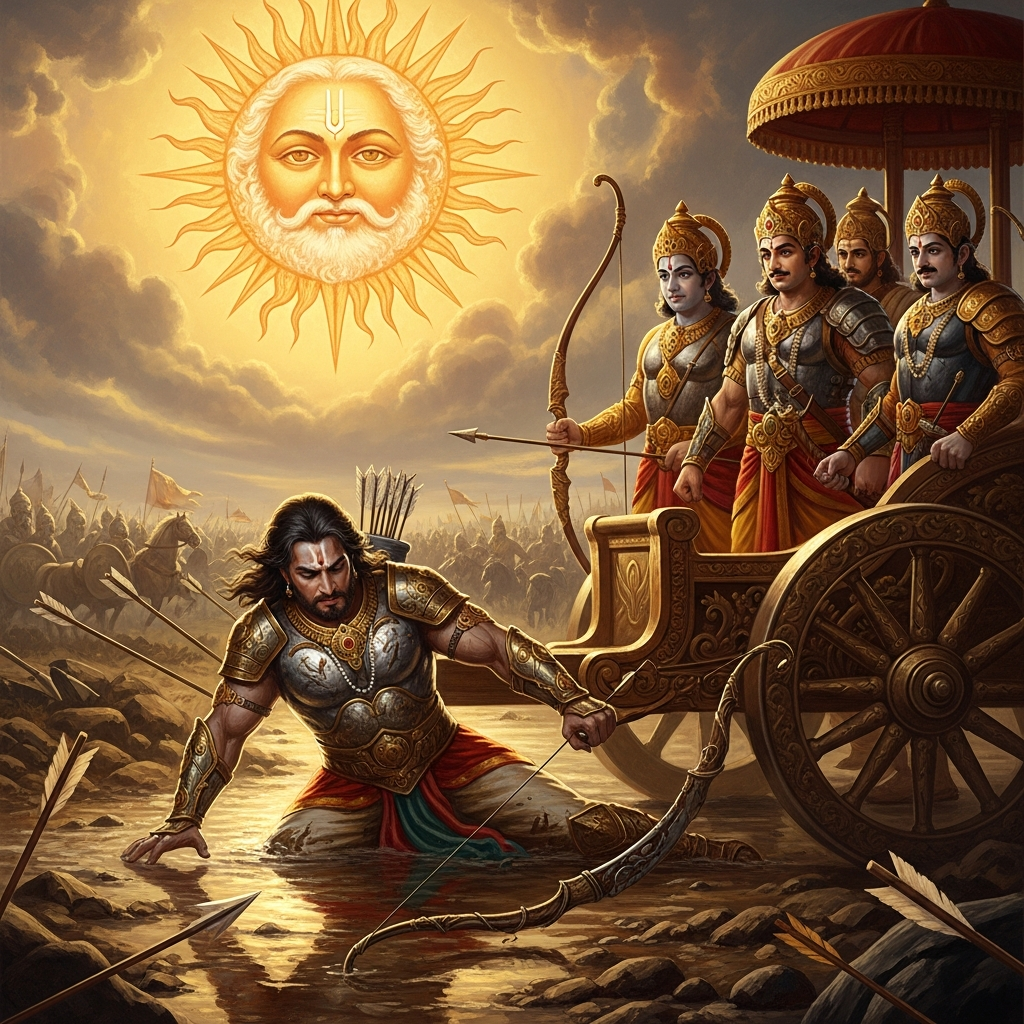
The arrow is Anjalikastra. It is one of the great weapons, the kind that does not miss, the kind that carries its mandate the way thunderbolts carry theirs. Karna is in the mud when it comes — still lifting the wheel, arms locked against the axle, the golden armor shining with the afternoon light that his father Surya has been sending down all day, a brightness that could be read as benediction or as elegy.
The arrow takes him.
He falls in the mud with the wheel, and the wheel falls with him, and the sun dims in the way that the sun dims at the end of the afternoon — gradually, then completely — and Kurukshetra goes quiet in the specific way that battlefields go quiet when something has just happened that everyone on both sides knows they will remember for as long as memory operates.
Duryodhana, watching from the Kaurava side, makes a sound that is not a word in any language.
After the war, Kunti tells her sons.
She has carried this for their entire lives — the first son, the one she put in the river, the boy who grew up with another name and another family and a lifetime of contempt for his birth. She watched the war happen. She knew, every day of it, that her sons were killing their brother. She went to Karna before the war and told him, privately, and asked him to come to the Pandava side. He refused. He would not betray Duryodhana.
She made him one promise: she would not lose a son. If Karna killed the Pandavas, she would have Karna. If Arjuna killed Karna, she would have Arjuna. She would end the war with five sons. He agreed to the terms. He kept them — he fought the war without using his most devastating weapon on anyone except Arjuna, killed Pandava soldiers and generals but held back from the killing stroke when he had the Pandavas at his mercy, saving himself for the duel that would decide everything.
Yudhishthira, who is the eldest surviving Pandava, who is called the king of righteousness, who spent eighteen days of war making the decisions that kings are required to make — Yudhishthira weeps when he learns. He weeps for a long time. Then he does something that no one expected: he curses women.
He curses them to never be able to keep secrets.
It is a small, ugly moment in an epic full of large ones: the grief of a man who cannot reach the actual target of his anger — Fate, Krishna’s management of events, the structural conditions that produced his brother’s death and his own ignorance — and so strikes at the person who kept the secret. The curse lands. The texts record it without commentary.
Karna is dead. The war is won.
The Mahabharata’s scholars note that Karna’s story follows the pattern of the tragic hero exactly, with one difference: he is not brought down by a flaw. He is brought down by circumstances he did not choose and never stopped fighting against. The pride attributed to him is the pride of a man who was given every reason for self-doubt and refused it. The loyalty to Duryodhana that sealed his fate was the loyalty of someone for whom loyalty was the only thing that had ever been extended.
He is the firstborn of the Pandavas. He is the son of the sun. He is the greatest archer of his generation. He dies in the mud fighting for the wrong side, killed by a brother who does not know they share a mother, on a field where the rules of war survived only as long as they were convenient.
The war the Pandavas won at Kurukshetra was fought against the best of them. The victory celebrations that follow in the Ashvamedhika Parva are shadowed by this — by the knowledge, now public, that Karna was there. Every kshatriya in both armies respected him. Most of the great warriors of the epic list him among the finest who ever lived. He is in the mud at Kurukshetra.
The Mahabharata keeps both things. It does not resolve them. This is what it means to be the world’s longest poem: long enough to hold contradictions that shorter texts have to choose between.
Scenes
The wheel sinks at the worst moment
 Generating art…
 Krishna turns from the reins and speaks quietly to Arjuna: the rules Karna is invoking now are the rules Karna did not invoke when Draupadi was dragged into the hall, when Abhimanyu was surrounded, when the dice fell
 Generating art…
 Karna falls in the chariot mud with the wheel still sunken and the arrows still in the air
 Generating art…
 Echoes Across Traditions
Entities


Sources
- *Mahabharata*, Karna Parva (BORI critical edition)
- *Mahabharata*, Aadi Parva (Karna's birth, Kunti's secret)
- Iravati Karve, *Yuganta: The End of an Epoch* (1969)
- Shivaji Sawant, *Mrityunjaya* (1967, trans. P. Lal)
- Wendy Doniger, *The Hindus: An Alternative History* (2009)