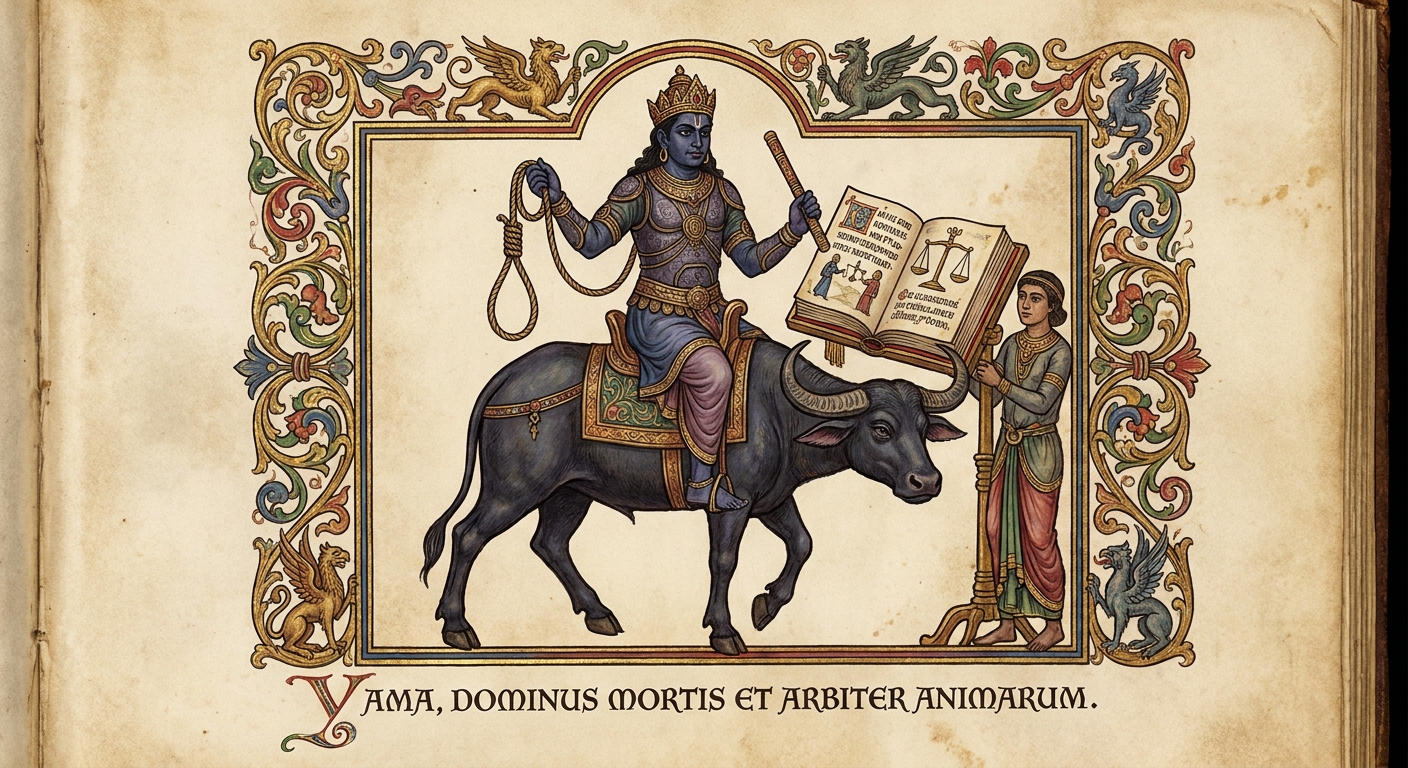
Savitri and Satyavan
Mythic Time · Mahabharata, Vana Parva ~400 BCE-400 CE · A forest hermitage at the edge of a kingdom — and the road south, into Yama's country
Contents
Savitri is a princess so accomplished that no man dares approach her. She chooses for herself: Satyavan, a prince in exile, who will die in exactly one year. She marries him anyway. When Yama arrives to collect his soul, Savitri follows the god of death on foot — and argues him into returning her husband's life through the precise logic of three carefully chosen boons.
- When
- Mythic Time · Mahabharata, Vana Parva ~400 BCE-400 CE
- Where
- A forest hermitage at the edge of a kingdom — and the road south, into Yama's country
She has been everywhere and returned with no one.
Savitri’s father, King Asvapati, sent her out with her retinue and his blessing to find a husband among the kingdoms. She traveled for a year through courts and forests, meeting kings and princes and scholars, and came home alone. The men had seen her coming — her reputation preceded her like a second sun. She was too learned. Too accomplished. She composed poetry in five languages and won debates against her father’s best philosophers before she was fourteen. The men who should have been suitors turned away the way ordinary men turn away from things that make them feel small.
Asvapati does not blame his daughter. He asks her what she found.
She found a prince, she says. Satyavan. He lives in the forest with his father Dyumatsena, who was king of the Shalwas before he went blind and lost his throne and retreated into exile. Satyavan chops wood and studies the texts and tends his aging parents with a care that makes the forest hermitage, which has nothing, feel like something. He is, she tells her father, exactly what she wants.
Narada the celestial sage, who appears at inconvenient moments with information that cannot be gracefully ignored, speaks up from the corner.
Satyavan, Narada says, is perfect in every way. He is also going to die in exactly one year.
Savitri says: I know.
She has known since she first found him in the forest. There are signs — a kind of luminous completeness about certain people, a fullness of presence that looks like beauty but is also, for those who can read it, the radiance of something close to its end. She watched him split wood for an afternoon and she knew, with the certainty of someone who has spent her life reading things carefully, that the year with this man would be worth everything that followed.
Her father begs her to choose again. There are other men — men without death sentences, men whose futures are open rather than closed. She is Savitri, daughter of Asvapati, granddaughter of the sun’s lineage. She could have anyone. She should not bind her long life to a man who has one year remaining.
She says, gently and completely: a woman of good character chooses once.
They marry in the forest tradition. She takes off the silk and gems of a princess and puts on the bark robes and coarse cloth of a forest-dweller. She learns to gather roots. She rises before dawn to tend the sacrificial fire. She takes care of her blind father-in-law and her mother-in-law as though they are her own parents, which, in the relevant sense, they now are. She has twelve months with Satyavan. She intends to use every hour.
Three days before the appointed day, she begins a fast and a vigil. No one has asked her to do this. The texts suggest that she has calculated exactly when Yama will come and she is preparing herself — sharpening herself the way a weapon is sharpened, not with anger but with the calm accumulation of clarity that will be required.
On the morning of the appointed day she insists on going with him into the forest.
Satyavan tells her she can rest — she has been fasting for three days, her vigil has been severe. She says she will come. She does not tell him why. She has not told him about Narada’s announcement, because telling him would transform every day of their year together into a dying, and she refused to give Yama that. She has carried the knowledge alone, like a stone in a closed hand, for eleven months and twenty-seven days.
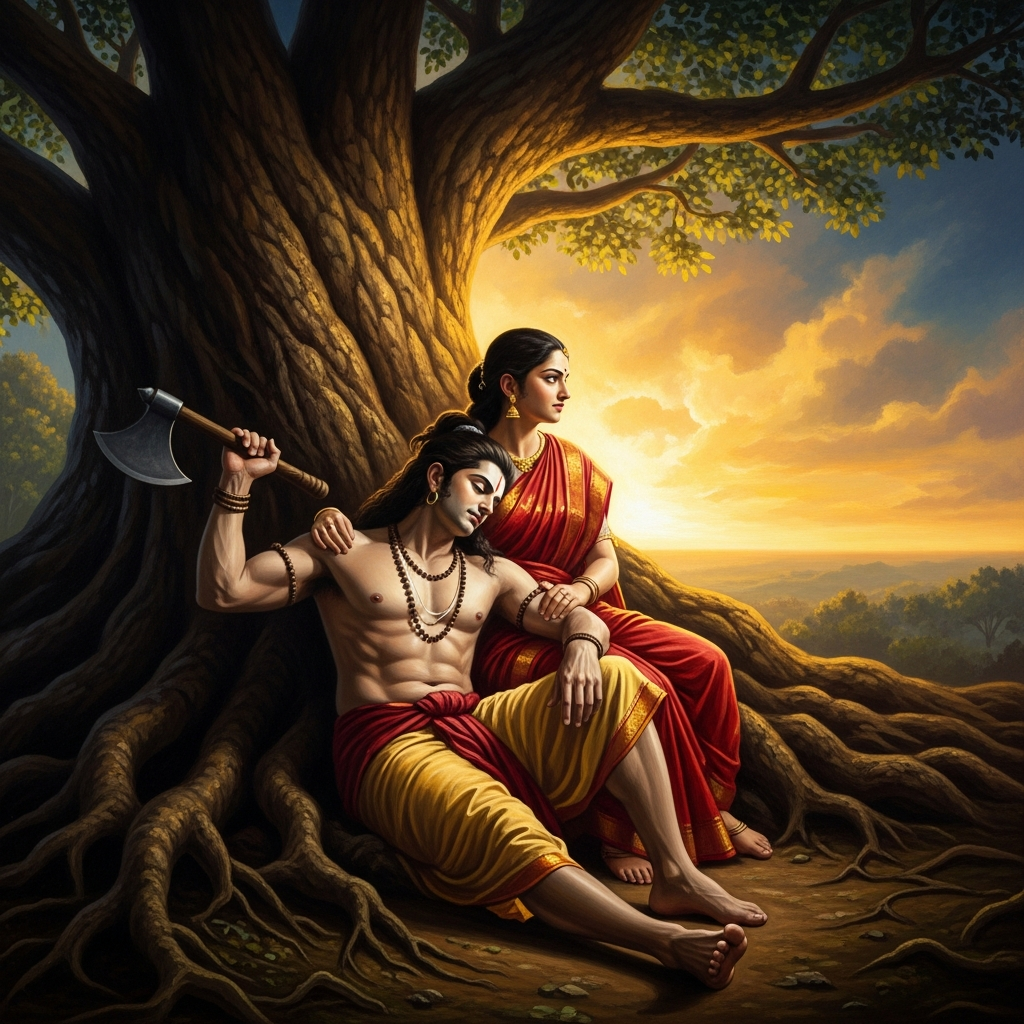
In the forest, midmorning, Satyavan’s axe stills.
He sits down at the base of the tree he was cutting. There is a pain in his head, he says — a sudden, gathering pain. He puts his head in her lap. She holds him with the stillness of a woman who has been waiting for this moment and has decided how she will meet it. The pain worsens. His eyes close. His breathing changes.
When she looks up, Yama is already there.
He is everything the texts describe: the god of righteous judgment, dark as a storm cloud, dressed in yellow, carrying his noose. He is not unkind. He is simply the function of time made manifest — the force that takes what the cosmos has set a term on, not because it wishes to destroy but because impermanence is the structural condition of existence, and someone must administer it.
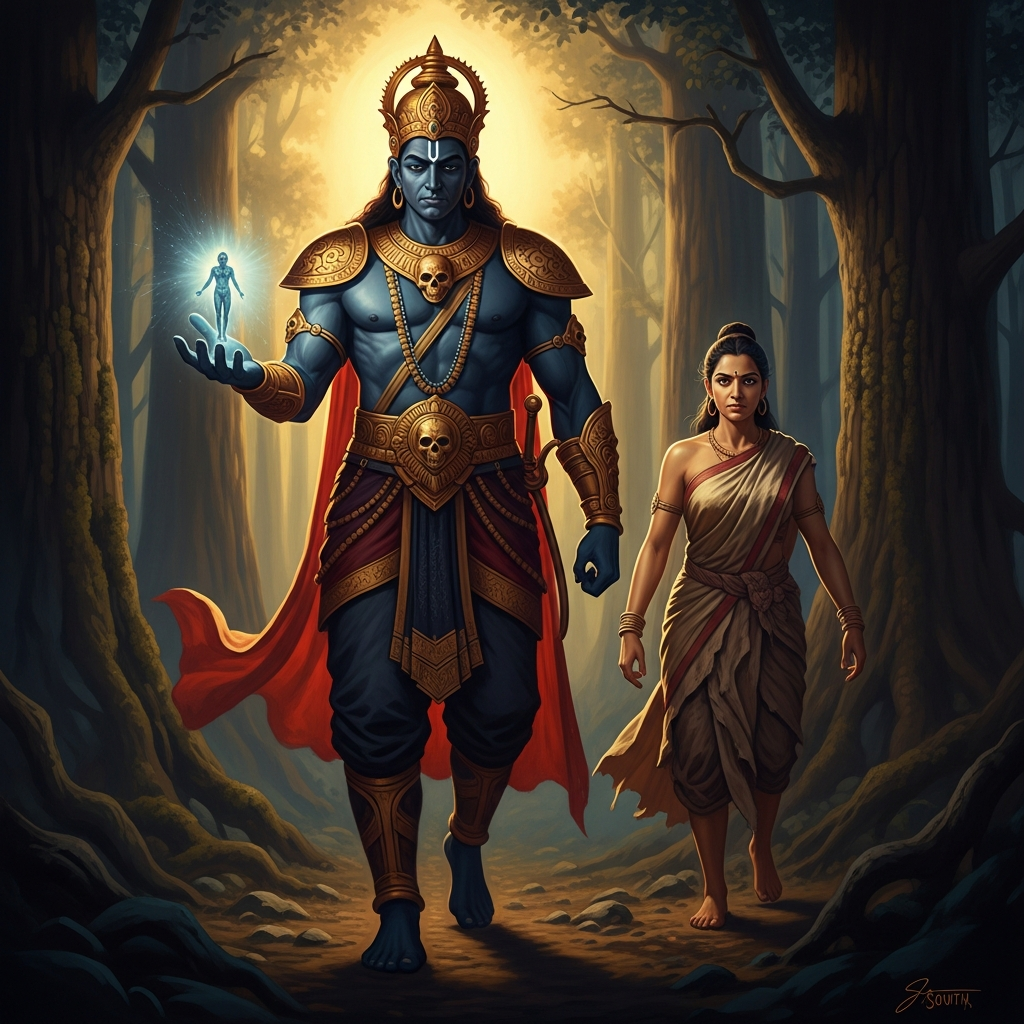
He draws Satyavan’s soul from his body — the texts say it is thumb-sized, radiant, tied with Yama’s noose — and turns to walk south, toward his kingdom.
Savitri follows.
Yama walks. She walks. He walks faster. She keeps pace. He stops and looks back at her with the expression of someone encountering an unprecedented situation.
He tells her she cannot follow. The living do not walk this road. She has done her duty — she tended her husband faithfully, she was an exemplary wife. She should return to the body she has left behind and perform the funeral rites and live the long life that remains to her. He offers her a boon: anything she asks, except Satyavan’s life.
She chooses carefully.
Restore my father-in-law’s sight, she says.
It is, of course, a perfectly framed request. Yama grants it without hesitation and turns back south. She is still walking behind him.
He stops again. He speaks to her again — her wisdom and her devotion are extraordinary, he says, and she deserves a second boon. Anything, except Satyavan’s life.
She says: Restore my father-in-law’s lost kingdom.
Yama grants it. He turns south. She follows.
She is still keeping pace with the god of death through the landscape that exists south of the living world — the texts do not describe it in detail, but it has the quality of dreams: present, real, without the texture of the familiar. She has been walking for what might be minutes or what might be ages. Her feet know the road. She follows without hesitation, without drama, with the steady purposeful step of a woman who has somewhere to be.
Yama stops a third time. His expression, which death does not commonly require to change, has shifted into something that is not quite admiration but is its close neighbor. He grants her a third boon. Anything, he says again — and this time he adds an emphasis — except Satyavan’s life.
She says: Grant me many children from Satyavan’s body.
The silence that follows is the sound of a logical system discovering its own constraint.
Yama has told her she may have anything except her husband’s life. She has asked for children who can only exist if her husband lives. A deity who is also the god of righteous judgment — who is, specifically, the enforcer of the terms of things — cannot grant a boon that requires its own exception clause. The request is not a trick. It is precise. She has been precise in everything she has done in this story: in choosing Satyavan knowing what she was choosing, in asking for his father’s sight and kingdom before asking for anything that benefited herself, in walking without being asked and not stopping when told to stop. The precision was always leading here.
Yama pauses for what the text renders as a very long moment.
Then he unloops his noose.
Satyavan wakes up at the foot of the tree with his head in his wife’s lap.
He says he slept very deeply. He says there was a dark figure in his dream — massive, radiant, very still. She says yes, she saw him too. She helps him up. They gather the wood. They walk back to the hermitage as the afternoon darkens into evening.
Dyumatsena, waiting at the hermitage, finds that he can see. He does not know why. He blinks at the returning light of the world — the trees, the fire, his wife’s face — with the slow wonder of someone who has been in darkness long enough to forget what illumination was. When Savitri and Satyavan arrive, she tells them, carefully and completely, everything that happened: the year of knowledge, the three days of fasting, the walk south, the three boons. She leaves nothing out.
The hermitage sits in its forest clearing and listens. The fire burns. Dyumatsena puts his restored hands over his restored eyes and weeps. Satyavan looks at his wife across the fire and does not have words for what he is looking at, because there are not words, in Sanskrit or in any other language, for the person who followed death on foot and argued it into giving you back.
Narada’s announcement, as it turns out, was correct: Satyavan died. Yama came. The soul was collected.
The term was simply revised.
The Savitri story is told in the Mahabharata by the sage Markandeya to Yudhishthira’s wife Draupadi — who is, in the moment of hearing it, herself in exile, herself questioning whether fidelity to an apparently hopeless situation is worth the cost. Markandeya does not preach at her. He tells her about Savitri. He lets the story carry what the argument cannot.
The name Savitri, derived from the sun, is invoked every day in the Gayatri Mantra — the most recited prayer in Hinduism, addressed to Savita, the sun’s generative light. The woman who argued Yama into a corner shares her root with the prayer that begins every orthodox Hindu day. This is not incidental. She is the principle of illumination applied to the problem of death: methodical, warm, impossible to argue with, ultimately unstoppable.
Every Indian woman who has been told what is inevitable and refused it has a name for what she is doing. The name is Savitri.
Scenes
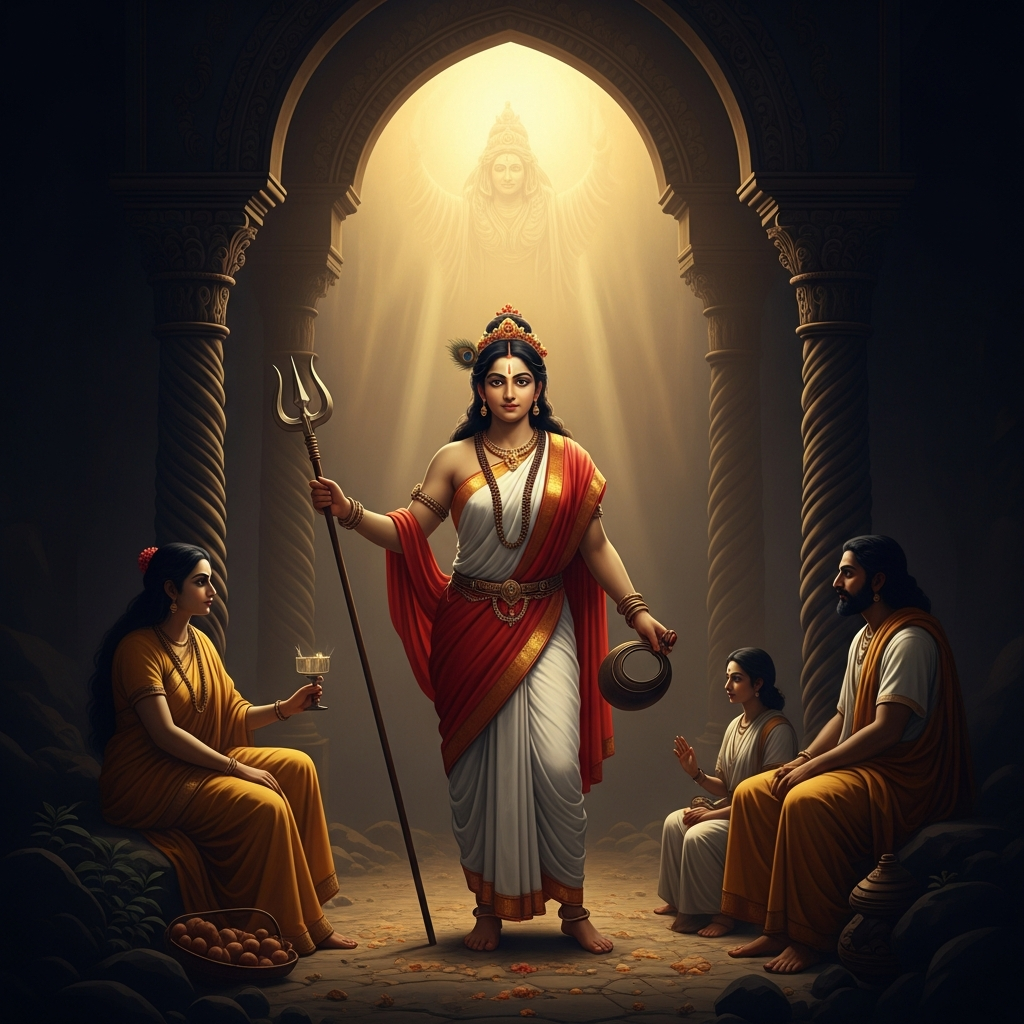
Savitri returns from her search through the kingdoms and reports to her father: she has found Satyavan, a woodcutter's son living in a forest hermitage, and she will marry him
 Generating art…
 In the forest on the appointed day, Satyavan's axe stills mid-swing
 Generating art…
 Yama walks south through the forest with Satyavan's soul in his hand
 Generating art…
 Echoes Across Traditions
Entities
- Savitri
- Satyavan
- Yama
- Narada
- Dyumatsena

Sources
- *Mahabharata*, Vana Parva 277-283 (Savitri Satyavan Parva, BORI critical edition)
- Wendy Doniger, *The Hindus: An Alternative History* (2009)
- A.K. Ramanujan, *Folktales from India* (1991)
- David Shulman, *The Hungry God: Hindu Tales of Filicide and Devotion* (1993)
- R.K. Narayan, *The Mahabharata: A Shortened Modern Prose Version* (1978)