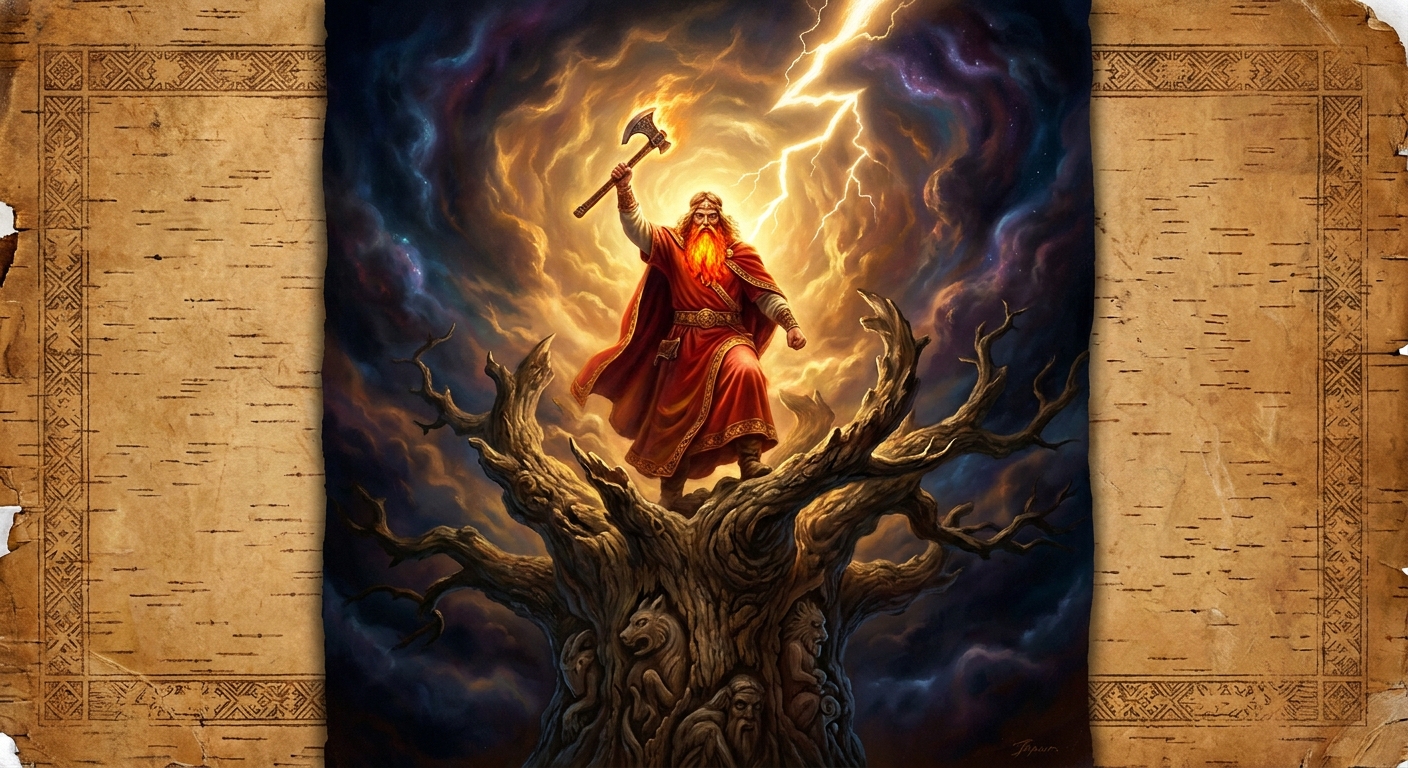
Mokosh: The Goddess Who Would Not Die
Pre-Christian Slavic antiquity through the 19th century — Mokosh recorded on Vladimir's idol-list, 980 CE; folk survivals documented into the 1900s · Kievan Rus and Eastern Europe — the forest spring, the village well, the domestic threshold
Contents
Mokosh is the only goddess recorded on Vladimir's hill of idols in Kiev before the 988 Christianization. When the idols burn, she does not. She retreats into the wells, the spindles, the springs at the forest's edge — and a thousand years of village women keep leaving thread and wool beside the water to appease her, long after the priest has said his morning prayers.
- When
- Pre-Christian Slavic antiquity through the 19th century — Mokosh recorded on Vladimir's idol-list, 980 CE; folk survivals documented into the 1900s
- Where
- Kievan Rus and Eastern Europe — the forest spring, the village well, the domestic threshold
Her name means wet, or moist, or the moist one — scholars argue the etymology the way they argue about the nature of water, which resists clean definition. Mokosh. She is the earth in its productive state: not dry earth, not frozen earth, not the dead earth of winter, but the earth when it holds water and gives back grain. She is the moisture in the wool. She is the thread that the Fates spin, and she spins it herself, walking the furrows of the field at night, checking the work of women who have left their spinning unfinished.
This last detail is important. She checks your work. She is not a distant goddess. She enters houses.
On Vladimir’s hill in Kiev in 980 CE, she stands among the six. Perun with his silver head. Khors, Dazhbog, Stribog, Simargl — all male, all sky-facing, all the kind of god that a warlord prince would choose to display to his people as emblems of a conquering power. And then Mokosh: the only woman, the only earth-deity, the only one whose domain runs underground and through the hands of women who weave and spin and birth children in the darkness of houses in winter.
Vladimir erects her on the hill. Vladimir burns her from the hill. He does not understand what he has done.
In a village two days’ walk from Kiev, in the year 1042 — fifty-four years after the baptism of Rus, three generations into official Christianity — there is a spring at the edge of the forest. The oak that grows beside it is old enough to have been old when the first Slav family settled in the valley. Something lives in the roots.
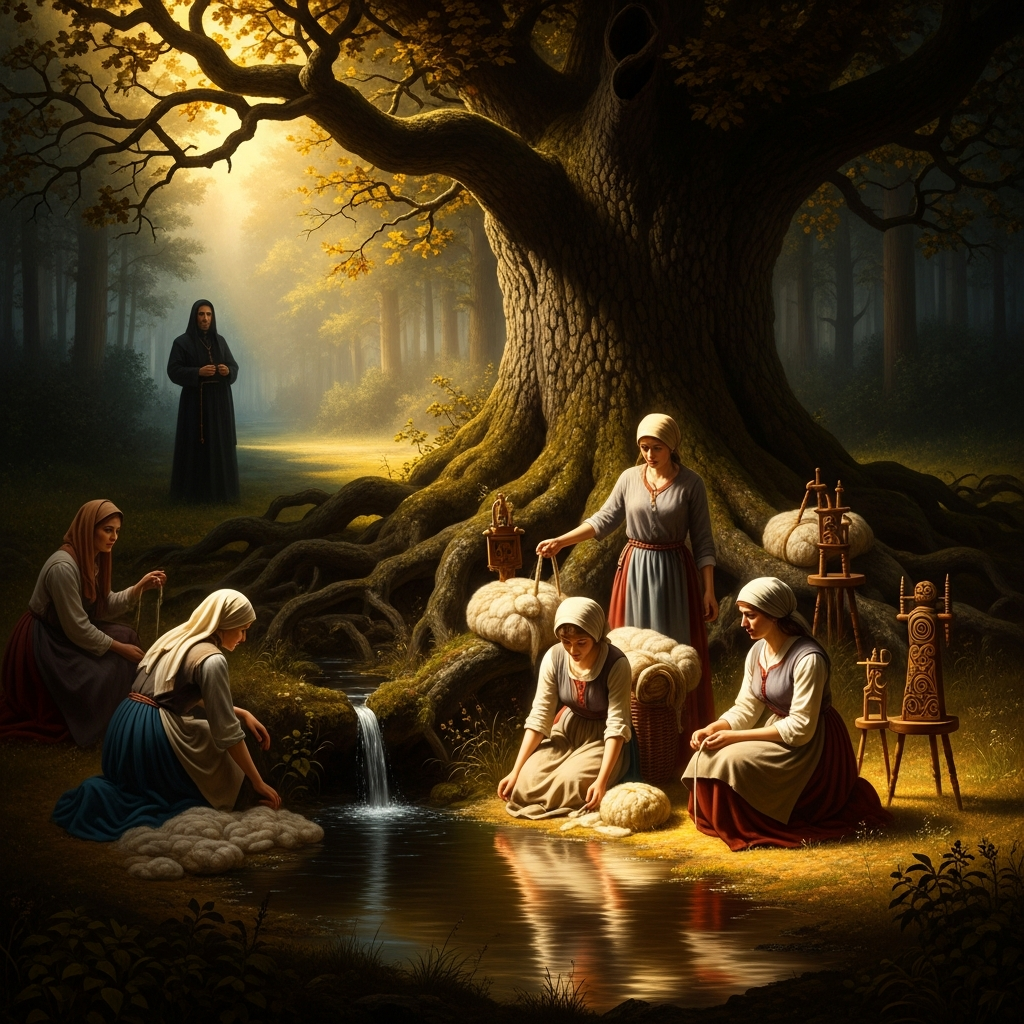
The priest of the village church has been there for eleven years. He knows about the spring. He knows about the offerings: spindles left in the roots, bundles of raw wool tied to the lowest branch, sometimes a portion of milk poured directly into the water. He has preached against it twice in Lent and once on the Feast of the Apostles. The women smile at him with the specific smile of people who have been sinning longer than he has been alive and intend to continue.
This morning there has been a difficult birth.
The wife of the miller, Halyna, thirty-one years old, mother of four living children and three buried ones, has been in labor since the day before yesterday. The midwife, old Oksana, has done everything that skill and experience provide. The priest has come and prayed. The labor does not progress. Halyna is exhausted in the way that passes exhaustion and becomes something adjacent to the translucency of the very sick.
Oksana makes a decision. She sends a girl to the spring.
The priest follows the girl. He means to stop her.
He stops at the treeline. He is not afraid. He tells himself he is not afraid. The oak is very large. The root system breaks through the soil in visible ribs, and between the ribs there are small objects he has chosen not to examine closely during previous patrols of the area: worn things, mostly, objects that have been handled until their edges are smooth. Wool. Spindles. Small carved figures. And now the girl crouches at the largest root and presses a length of thread into a crack in the bark, and she whispers something, and the spring behind her moves.
The spring does not stop moving. There is no wind. The ripple is not a ripple from a stone; it moves from the center outward, the way a ripple moves when something rises.
The girl whispers: Mokosh, mother, hear us. Halyna has given you her labor for thirty-one years. She has left thread and milk and wool at your spring. Now she needs your hands. Her child will not come out. Put your hand in, mother. Put your wet hand in.
The priest means to go forward. He does not go forward.
In the house, twenty minutes later, the child comes out.
The priest writes in his chronicle that evening. The chronicle survives, barely, in a monastery copy three hundred years removed from the original, and what he writes is this: The women of this village continue to perform idolatrous rites at a spring in the forest, leaving offerings of thread and wool to a spirit they call Mokosh or Paraskeva, which is the same devil wearing different names, and this despite repeated instruction in the faith. I confess that I do not know how to stop them, for the midwife Oksana, who is the worst offender, is also the only one who can safely deliver a child in this valley, and the women will not hear the word of God on this matter from a man who has never borne a child and does not know how.
He is, for 1042, surprisingly clear-eyed.
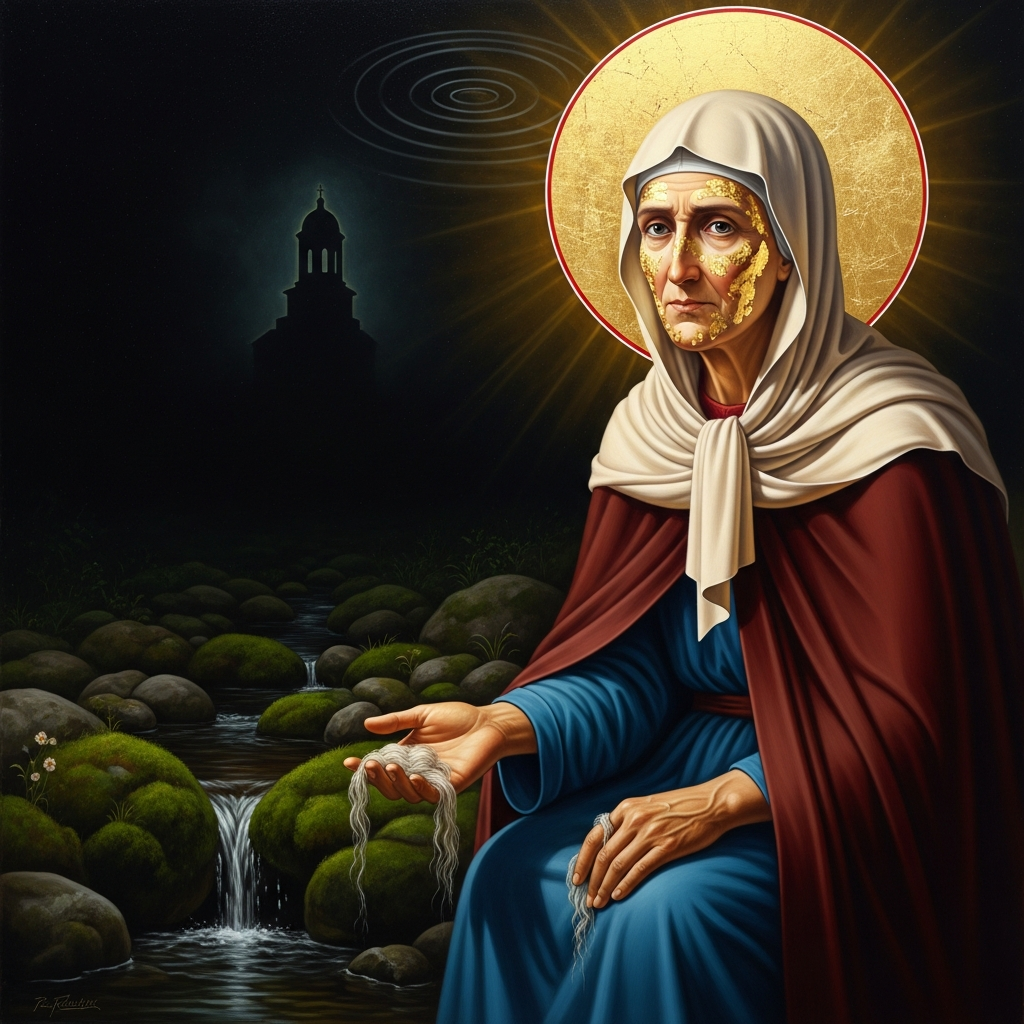
He calls the spirit Paraskeva because that is the Christian name now layered over the old one. Saint Paraskeva Friday — Piatnitsa, Friday, the goddess’s old day — is the official replacement: a Christian martyr from Asia Minor who was tortured and killed for the faith, whose feast day falls in autumn, who is the patron of women and weaving and water. The Church supplied the name. The spring did not change. The women who come to it bring thread because Mokosh always wanted thread, and Saint Paraskeva Friday, it turns out, also wants thread, and the roots of the oak still hold the memory of every spindle pressed into them since before the village had a name.
She survives this way for another nine hundred years.
She is in every spring that women mark. She is in the prohibition on spinning on Fridays — do not spin on Friday or she will come in the night and tangle your work, which is also the threat of Mokosh walking the house, checking the unfinished spindle with a hand that is cold and damp. She is in the custom of throwing a ball of thread into a well when you want to know who you will marry: the thread unspools, and something below holds the other end. She is in the icon of Saint Paraskeva that every peasant house keeps near the door, facing the same direction the old idols faced, for the same reasons.
When folklorists come in the nineteenth century and ask old women in the villages of Ukraine and Belarus and Poland what they believe, the women describe a figure who walks the roads at night checking on women’s work, who protects births, who lives in springs, who is angry when you waste wool and pleased when you leave an offering at the right tree at the right hour. They call her Mokosh. They call her Piatnitsa. They call her the moist mother. They call her the old one who knows the threads.
The priest finishes his chronicle entry for that October evening in 1042. He records that the child born to Halyna the miller’s wife was a healthy boy. He performs the baptism himself three days later and gives the boy the name of an apostle.
He does not record what the midwife Oksana calls the boy in the privacy of the house, in the language women use among themselves.
Every goddess has two deaths. The first death is official: the idol burns, the temple closes, the chronicler writes ‘these practices were abolished.’ The second death is actual, and it takes much longer, and Mokosh has not yet had it.
She is still at the spring. The oak is still there, or another oak is, which amounts to the same thing. Women in the villages of central Poland still sometimes leave thread at wayside shrines on Fridays without knowing exactly why, only that their grandmothers did and their grandmothers’ grandmothers did and the custom has the specific gravity of things that are kept not because anyone remembers the reason but because stopping would feel like forgetting something important.
The wet earth is the wet earth. It does not require a name to do its work.
Scenes
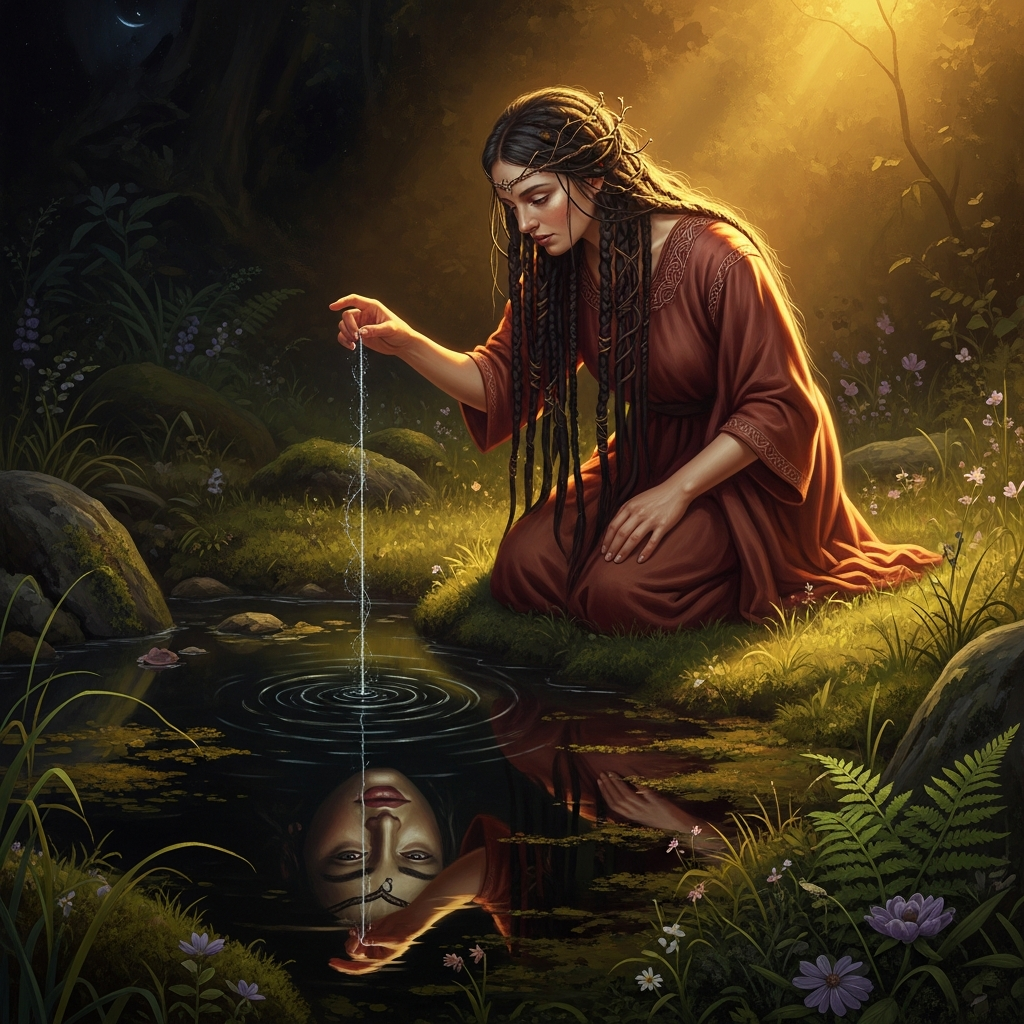
Mokosh at the spring before dawn — braided hair loose, fingers pulling the thread of a fate, the dark water reflecting a face that is neither young nor old but wet with everything that grows
 Generating art…
 Village women at the forest spring in the 11th century, leaving bundles of wool and carved spindles in the roots of the oak — the priest watching from the treeline, unable to cross
 Generating art…
 The icon of Saint Paraskeva Friday beside the spring — her face ancient under the gold leaf, her hand open in the gesture of Mokosh receiving wool, the church bell audible in the middle distance
 Generating art…
 Echoes Across Traditions
Entities
- Mokosh
- Saint Paraskeva Friday
- the village women
- the spring at the forest's edge
Sources
- Vyacheslav Ivanov & Vladimir Toporov, *Slavic Antiquities* (1974)
- Marija Gimbutas, *The Slavs* (1971)
- Natalie Kononenko, *Slavic Folklore: A Handbook* (2007)
- *Primary Chronicle* (Povest' vremennykh let, ~1113 CE) — Vladimir's idol-list at Kiev, 980 CE
- Eve Levin, *Sex and Society in the World of the Orthodox Slavs, 900-1700* (1989)