Manasa and the Merchant Who Would Not Bow
Mythological time; medieval Bengali narrative tradition c. 1300-1600 CE · Bengal; the great rivers; heaven
Contents
Manasa, the Bengali snake goddess, needs one more devotee to complete her divine legitimacy: Chand Saudagar, the greatest merchant in Bengal, who is devoted to Shiva and will not acknowledge her. She destroys his ships, kills his sons, kills his son-in-law Lakhindra on his wedding night. His daughter-in-law Behula floats Lakhindra's corpse to heaven on a raft and argues with the gods for his resurrection. She wins. The price is Chand's worship — given, finally, with his left hand in contempt. It is enough.
- When
- Mythological time; medieval Bengali narrative tradition c. 1300-1600 CE
- Where
- Bengal; the great rivers; heaven
Manasa has almost everyone.
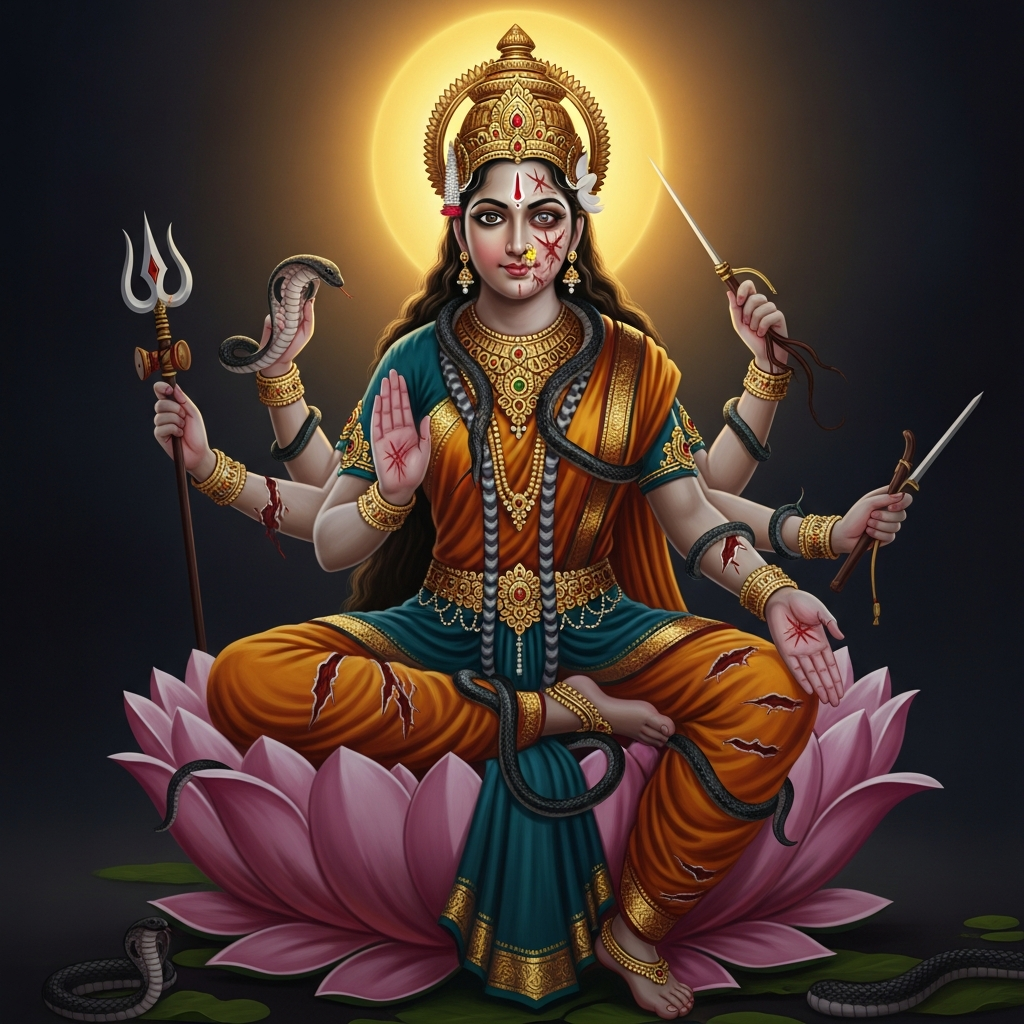
The snake goddess of Bengal — one-eyed, her face half-beautiful and half-scarred from the acid her stepmother Chandi threw at her, born from Shiva’s semen that fell on a flower when his attention was elsewhere, raised with resentment by a family who did not want her — has spent decades accumulating worship. She is not a great goddess of the Sanskrit pantheon. She is local, particular, the goddess you propitiate when someone in your household is bitten, when the rains have brought the cobras into the courtyard, when a child is running a fever that looks like venom. Her cult has spread through the villages of the delta by the logic of fear and necessity.
But she needs legitimacy. A regional goddess without a great patron’s endorsement is always one generation of forgetting from irrelevance. What she needs is someone whose worship would announce, publicly and permanently, that Manasa is real and her power is real and her claim on Bengal is authorized.
She needs Chand Saudagar.
Chand is the great merchant of Bengal, which in the medieval narrative tradition means he is the richest and most powerful man in the world short of kings. He has seven ships, each so large that when they are loaded with silks and spices and the gold of distant trade the Ganges sinks perceptibly. He has six sons who manage different aspects of his trading empire. He is a man of genuine piety and genuine principle, devoted to Shiva with the disciplined fervor of someone who has thought carefully about which deity deserves his worship and committed to that decision completely.
Manasa approaches him and asks for worship.
He refuses. He is polite about it, or polite enough for a man of his status refusing a petitioner. He has his god; she is not his god; the situation is not complicated.
She makes it complicated.
The first ship founders in a storm that comes from nowhere on a clear day. The crew survives; the cargo does not. Chand rebuilds. The second ship sinks at its moorings, the hull found riddled in the morning with holes that look, the harbor workers say in lowered voices, like bite marks. The third ship, which Chand personally inspects before it departs, turning the hull over in his hands looking for any weakness, sinks in shallow water off the delta coast where the depth does not allow for large waves.
By the fifth ship Chand knows what he is dealing with. He invokes Shiva, who does not intervene — this is an internal matter among lesser divinities, and Shiva, who is not particularly interested in the economic affairs of Bengal, remains on Kailash.
He builds the sixth ship. He loses the sixth ship.
His sons begin to die of snakebite. One after another, in the way that successive catastrophes accumulate a terrible rhythm — first the eldest, then the third, then the fourth and fifth together, found in the same room in the morning with the marks on their ankles, then the second. One son remains, the youngest, Lakhindra. He is newly married. His wife is Behula, daughter of the goldsmith Saha, and the wedding has been arranged since their childhood.
On the wedding night Manasa sends the snake.
Chand has prepared for this. He has had an iron house built — a house with no gap in the walls wide enough for a snake, its seams soldered, its windows screened with metal mesh. He has had every inch inspected. The house is a masterwork of anxious engineering.
Manasa sends a snake that enters through a crack no wider than a hair, a crack left by the smith Netai Dhobi who is secretly Manasa’s devotee and who has left his mark in the wall at the goddess’s instruction. Lakhindra dies before morning. Behula, lying beside her husband of twelve hours, hears the snake retreat through the wall and understands exactly what has happened.
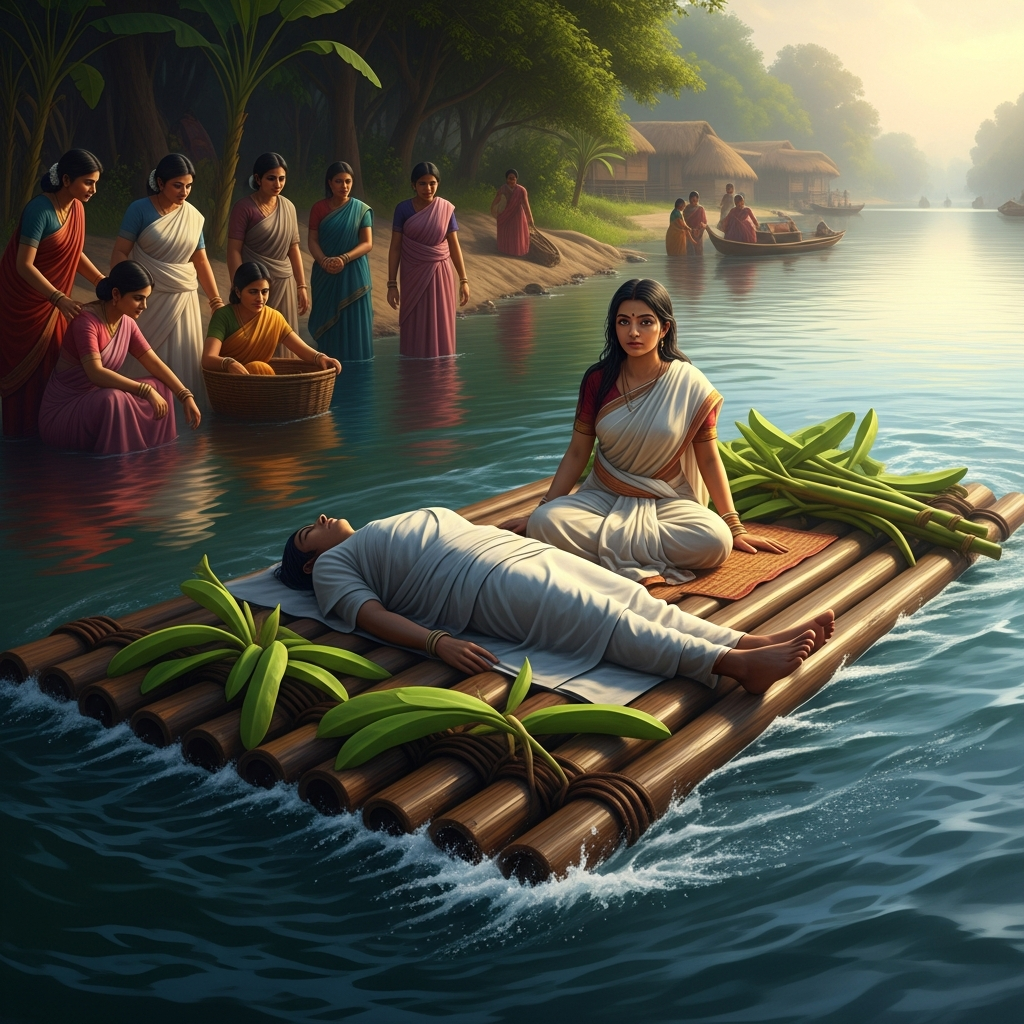
She does not flee. She does not mourn in the way the women of the neighborhood mourn, the way she would be expected to mourn. She builds a raft from plantain stems — the white, fibrous trunk of the banana tree, which floats — and she lays her husband’s body on it and she gets on the raft and she pushes off into the river.
This is, by any measure, an insane plan.
She floats for months.
The Ganges carries her through Bengal, past the cities and the villages and the burning ghats and the temples on the riverbank and the children who wade in to watch the woman on the raft go by, the woman on the raft with the white-wrapped body beside her that has been on the raft as long as anyone in this stretch of river can remember. She does not eat much. She begs from the riverbanks. She keeps the body from decomposing through the same ritual disciplines that Tantric practitioners use to maintain their composure in cremation grounds — she is young and she has no formal training and she improvises from the scraps of knowledge available to a merchant’s daughter, and somehow it works.
She reaches the realm of Indra. She dances before the assembly of gods. She has been told — by whom is unclear, perhaps a saint she encountered on the river, perhaps simply by the logic of the divine economy — that if she can demonstrate sufficient piety, the gods will return Lakhindra to life. She dances until the apsaras of heaven come to watch. She dances until Indra is moved.
Indra restores Lakhindra to life. He does this with conditions, which are Manasa’s conditions, which Behula accepts on behalf of a family that does not know it is being negotiated for: Chand Saudagar will worship the snake goddess.
They return to Bengal. The reunion is not simple. Chand has lost everything — six ships, six sons, and now he has been told by his surviving son’s wife that the cost of his son’s continued life is his worship of the goddess who destroyed his life. He is a man with nothing left to lose and nothing left to protect except his dignity, which is the thing that was never negotiable.
He goes to the river shrine where Manasa’s clay image stands.
He stands before her for a long time. The image is not elaborate — a local goddess’s clay image, painted with ochre, given snake-hood by the village artisan, small and provincial and exactly the kind of goddess he has spent his life declining to acknowledge. She has one eye. She is not beautiful in the way Lakshmi is beautiful, not serene in the way the great goddess is serene. She looks, if a clay image can look, like someone who has been waiting and has been angry about the waiting and is now watching him with the patience of someone who has already won.
He raises his left hand.
The left hand is the wrong hand for worship — in the tradition, the right hand is pure, the left hand is for polluting tasks, for the body’s demands, for what is beneath one’s dignity. He knows this. He chooses it deliberately, consciously, with the full weight of everything he has lost. He places a flower in his left hand and extends it toward the goddess.
He does not bow. He does not close his eyes. He does not recite the prayer. He gives the flower and nothing more.
Manasa accepts it.
This is the detail that makes the myth philosophically interesting, that the tradition has preserved and puzzled over for centuries: she accepts the left-handed flower. She does not demand a right-handed flower, or a full prostration, or a sincere heart. She does not require that Chand mean it.
The Manasa Mangal texts — the Bengali narrative poems that tell this story, composed and performed across centuries by multiple poets — are divided on what to make of this acceptance. Some read it as the goddess’s magnanimity, the god who accepts imperfect offerings because the alternative is receiving nothing. Some read it as the revelation of divine power: her legitimacy is established regardless of Chand’s feelings about it, because the act has occurred and the act is what counts. Some read it — quietly, between the lines — as a recognition of what Chand is actually giving her.
He is giving her everything. The flower is contemptuous. The contempt is the complete testimony of a man who has been brought to this point against his will and knows it and cannot pretend otherwise. That is not a small thing. That is the whole of a life’s conviction, offered in defeat.
She gives back his son. She gives back one ship, the accounts vary on the details of commercial restoration. She receives, from Bengal’s greatest skeptic, a worship that is technically correct.
The great merchant eventually becomes the figure through whom Manasa’s cult spreads among the merchant communities of Bengal. His name becomes the authorization. Chand worships Manasa, they say in the villages. If Chand worships her, she is real.
He does not repeat the worship. He does not install a shrine in his house. The one flower, the one moment, the left hand — this is everything she gets from him, and it is enough because it has to be enough, because Manasa is a goddess who operates in the world as it is rather than the world as theology says it should be.
Behula floated a corpse for months on a plantain raft and danced for the gods of heaven. She gets her husband back. She gets a father-in-law who is broken and correct. She gets to live in the house of a man who gave everything he had to a cause and lost and is still standing.
The snake goddess watches from her clay form at the river shrine, one-eyed, precise as a snake, waiting for the next Chand — the next person who believes that what they love is worth more than what destroys them, who will find out what it costs to hold that position to the end.
Scenes
Manasa sits on a lotus throne wound with cobras, her one eye bright and her face asymmetrical with the history of her own violent becoming
 Generating art…
 The great river at monsoon flood
 Generating art…
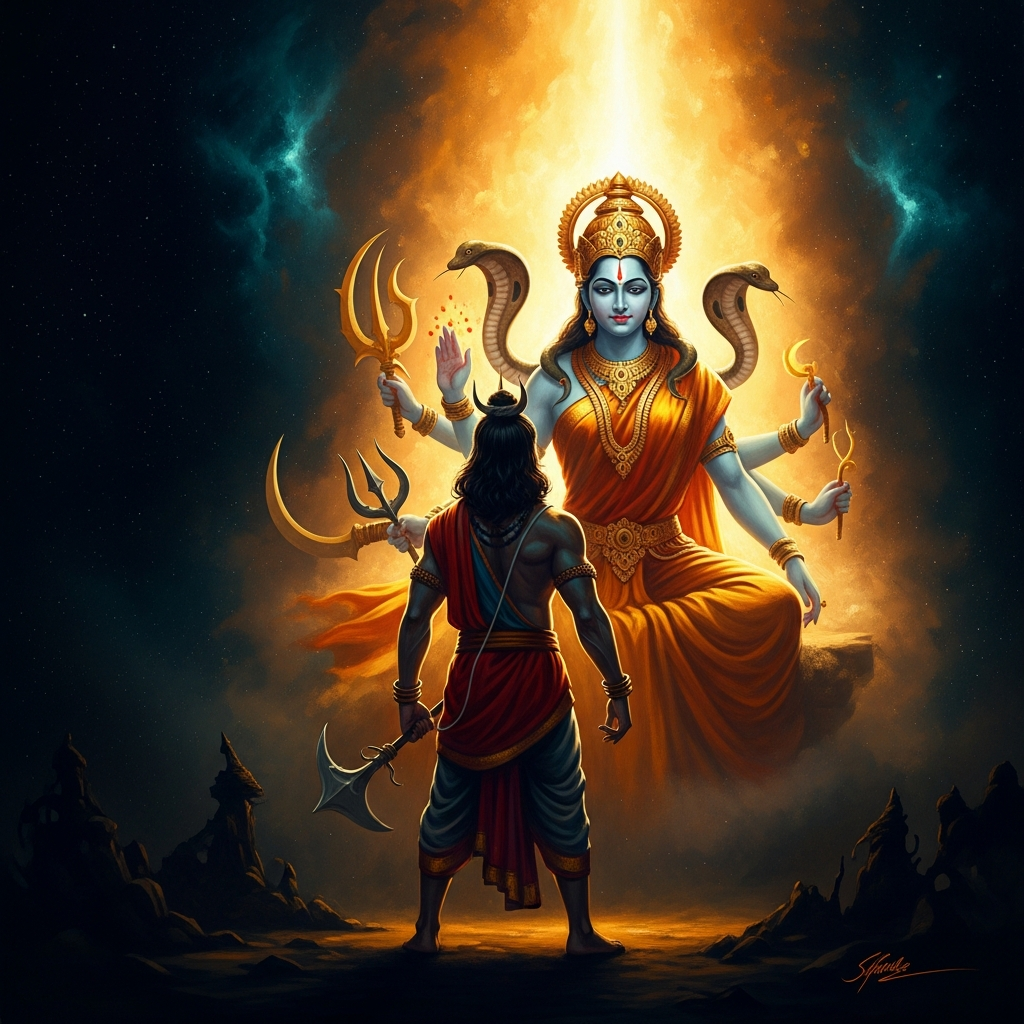
 Chand Saudagar stands before Manasa's clay image at the riverside shrine, his right hand clenched at his side
 Generating art…
 Echoes Across Traditions
Entities
- Manasa
- Chand Saudagar
- Behula
- Lakhindra
- Netai Dhobi
Sources
- June McDaniel, *Offering Flowers, Feeding Skulls: Popular Goddess Worship in West Bengal* (Oxford University Press, 2004)
- David Kinsley, *Hindu Goddesses: Visions of the Divine Feminine in the Hindu Religious Tradition* (University of California Press, 1986)
- Edward C. Dimock Jr., *The Place of the Hidden Moon: Erotic Mysticism in the Vaishnava-Sahajiya Cult of Bengal* (University of Chicago Press, 1966)
- Tony Stewart, *The Final Word: The Caitanya Caritamrta and the Grammar of Religious Tradition* (Oxford University Press, 2010)
- Mandakranta Bose (ed.), *Faces of the Feminine in Ancient, Medieval, and Modern India* (Oxford University Press, 2000)