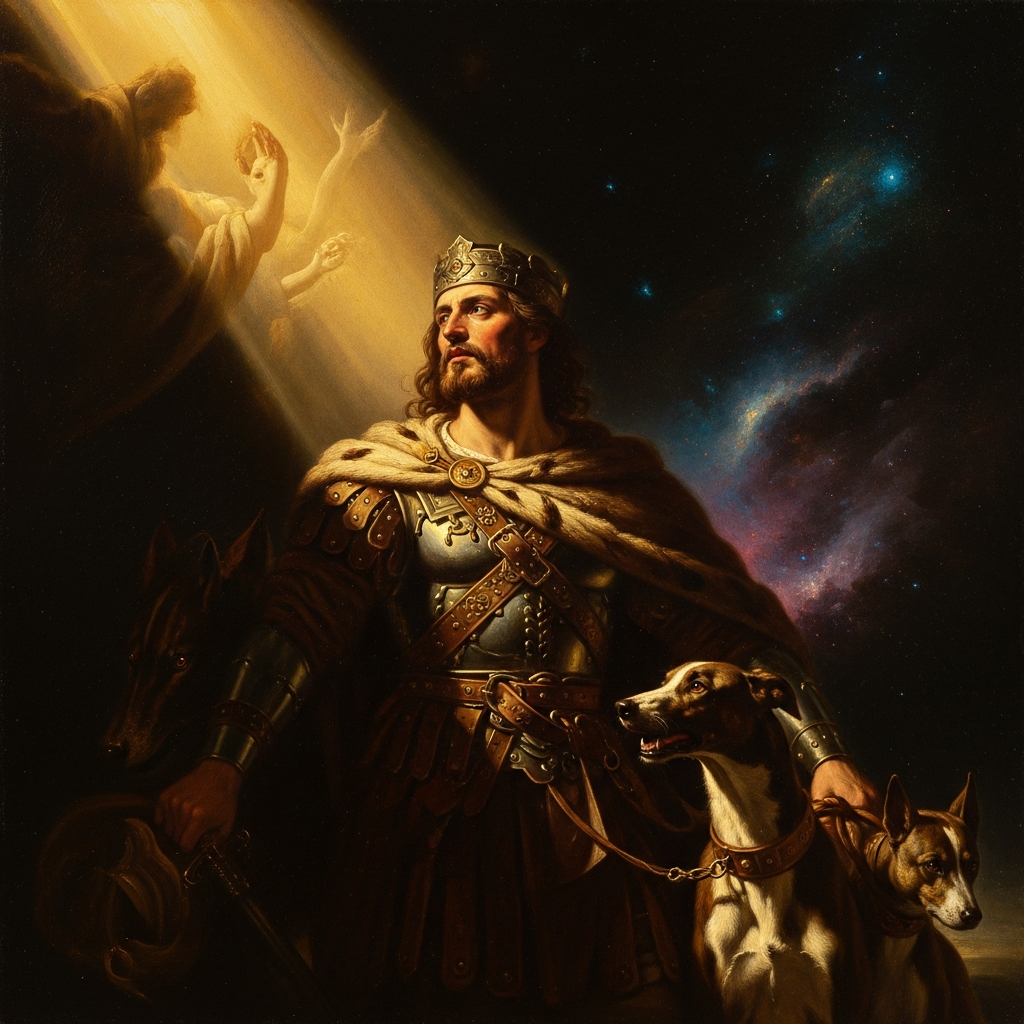
Pwyll, Prince of Dyfed, in the Underworld
Mythic time · First Branch of the *Mabinogi*, written down c. 11th century CE · Dyfed (southwest Wales) and Annwn (the Welsh Otherworld) — the forest of Glyn Cuch, the mound of Arberth
Contents
Pwyll lets his hounds take a stag a stranger's pack has cornered. The stranger is Arawn, king of the Welsh Otherworld. The penalty is strange: the two men exchange lives for a year. Pwyll rules Annwn in Arawn's form. He fights Arawn's enemy with the rule of the single stroke. He returns to Dyfed transformed, a friend of the realm beyond the world.
- When
- Mythic time · First Branch of the *Mabinogi*, written down c. 11th century CE
- Where
- Dyfed (southwest Wales) and Annwn (the Welsh Otherworld) — the forest of Glyn Cuch, the mound of Arberth
The forest is called Glyn Cuch.
It is in the south of Dyfed, in southwest Wales, in the kingdom Pwyll has just inherited from his father. He is a young king. He is testing the kingdom by hunting in it, learning where the streams run, where the boars are, where his hounds will work and where they will refuse. It is autumn. The leaves are still on the trees but the light is already low and yellow.
He hears another pack.
This is unusual. He has not given anyone permission to hunt in this part of the forest. His pack hears the other pack too — and stops, and turns its ears, and is afraid. Pwyll’s hounds are a working pack of mortal dogs. They do not understand what they are hearing.
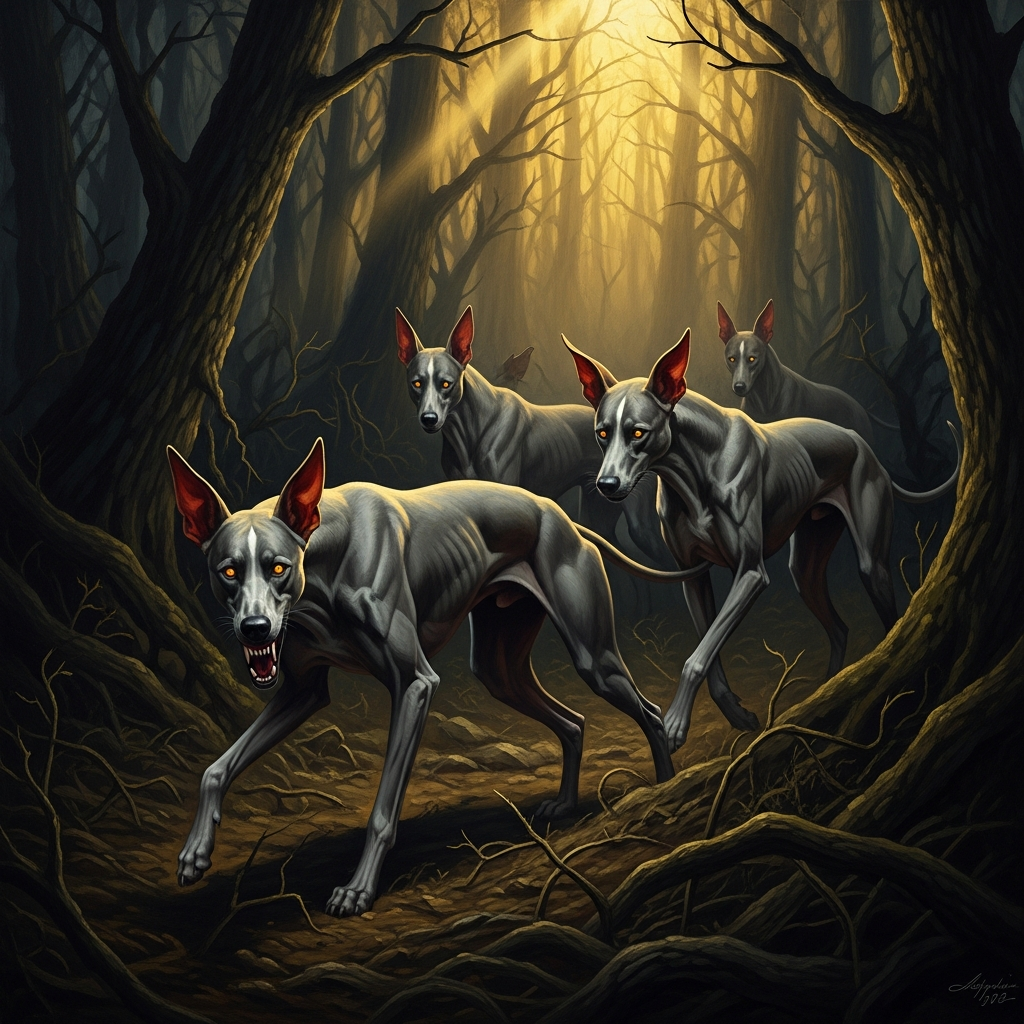
What they are hearing is a pack of gray hounds with red ears.
The hounds of Annwn are described in the text with a brief and devastating economy: their bodies are the gray of old bone, their ears are the bright red of fresh blood, their eyes shine. They are silent at the chase. When they take a stag, they do not bay. They simply close their teeth on its throat and the stag stops being a stag. They are working an animal in a clearing ahead of Pwyll’s path. He rides through the underbrush and finds them at the kill.
He does what no person who knows what they are looking at would do.
He drives them off the carcass and lets his own hounds take it.
The horseman appears.
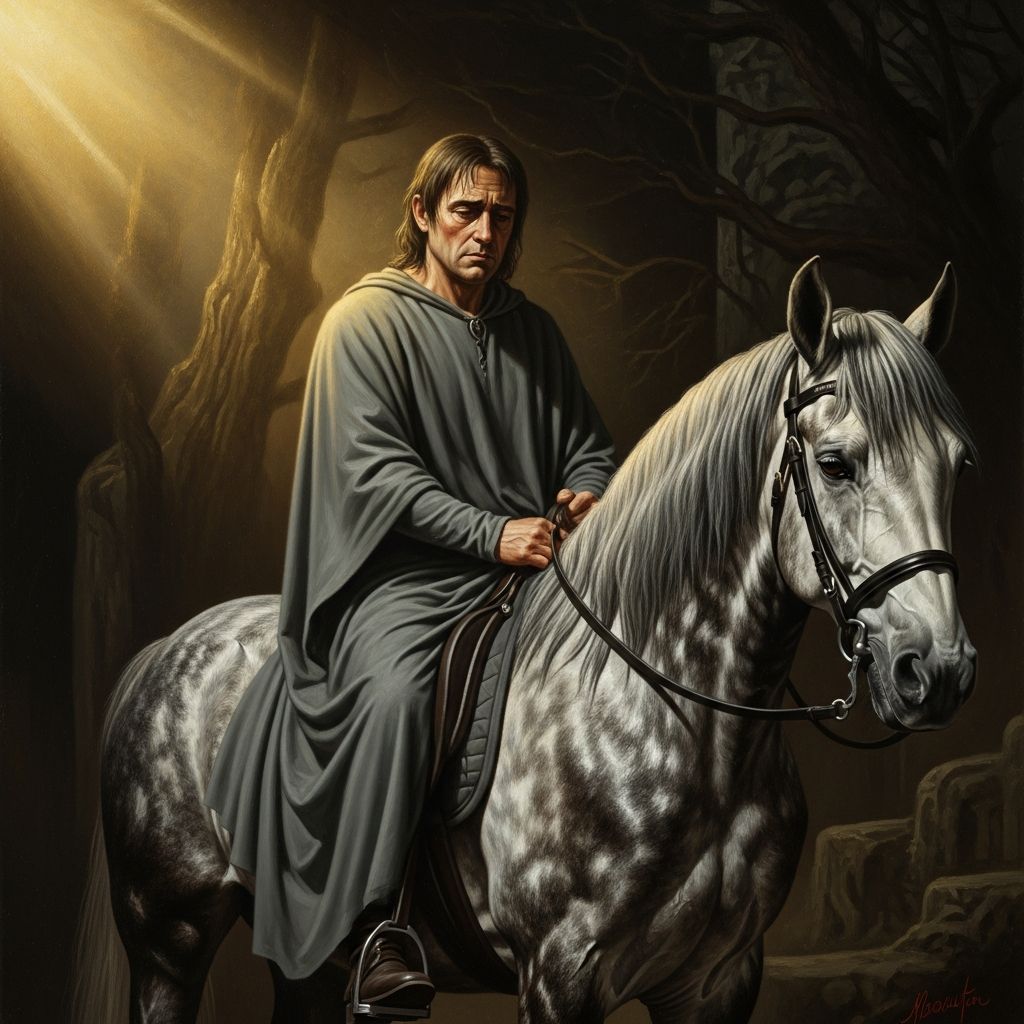
He is dressed in gray. He is on a gray horse. He is calm, the way a person is calm when the failure of someone else has been more disappointing than insulting. He stops his horse a polite distance from Pwyll and asks Pwyll if he knows who he is.
Pwyll says no.
The horseman tells him: I am Arawn, a king in Annwn. He says it without emphasis, as a fact a man might supply if asked his name at an inn. Pwyll understands what this means in the same instant the words land. Annwn is the Welsh Otherworld. He has driven the hounds of the Otherworld off their kill. He has insulted the king of the realm beyond the world by letting his mortal pack take what the immortal pack had earned. There is no apology that can fix this in any normal way. He waits to see what Arawn will say.
Arawn says: you have done me a wrong worth a hundred stags.
Then he says: but I will tell you how to undo it.
The exchange is this: for one year, the two men will live each other’s lives.
Arawn will give Pwyll his shape. Pwyll will go to Annwn, ride into Arawn’s court in the form of the king of the Otherworld, sit on the throne, sleep in the bed beside the queen, rule the kingdom for one year, and at the end of the year Pwyll will fight Arawn’s enemy Hafgan in single combat at a ford on the appointed day. If Pwyll wins, the wrong is canceled. If he loses, he goes back to Dyfed and they will think of something else.
Meanwhile, Arawn will go to Dyfed in the form of Pwyll. He will ride into Pwyll’s hall, sit on Pwyll’s throne, rule the kingdom of Dyfed for one year, and no one will know the difference because the magic of Annwn is sufficient that the substitution is invisible to anyone except the participants.
Pwyll agrees because he has no other option. There is also something in him that wants to see Annwn — the curiosity of a young king who has not yet been outside his own province. He says yes. Arawn touches him. The shape changes. Pwyll, in the form of Arawn, mounts a horse he has never seen before and rides toward a country he has never visited.
Arawn, in the form of Pwyll, takes Pwyll’s horse and rides back to Dyfed.
The text is careful with what happens at the court of Annwn.
Pwyll is received as the king. The court does not notice that anything has changed. The food is good. The hall is warm. The hunting is excellent. The hounds know him. The horses know him. The harpers play the songs Arawn likes. He moves through the year as Arawn moves through the year.
The queen of Annwn is beautiful. She comes to bed beside him every night, as she has come to bed beside her husband for as long as the marriage has existed. Pwyll lies down beside her. He does not touch her. He turns his face to the wall every night. He does not explain. He stays in the bed in his own husband’s form so that no one in the household will wonder why the king has begun sleeping elsewhere, but he does not consummate. For a year, every night, he turns away.
The text does not tell us what the queen thinks about this. The text tells us what Arawn thinks about it later, which is the thing that matters.
The combat day arrives. The ford is the agreed place. Hafgan rides up on the other side. Hafgan is the rival king who has been at war with Arawn for as long as anyone can remember. The terms are absolute: each man will deliver one stroke, and one stroke only. If both men survive the first exchange, they ride away and meet again at another agreed time. Whoever falls in the single stroke is dead. There is a rule beneath the rule: if the loser is given a second stroke after the first has felled him, he revives.
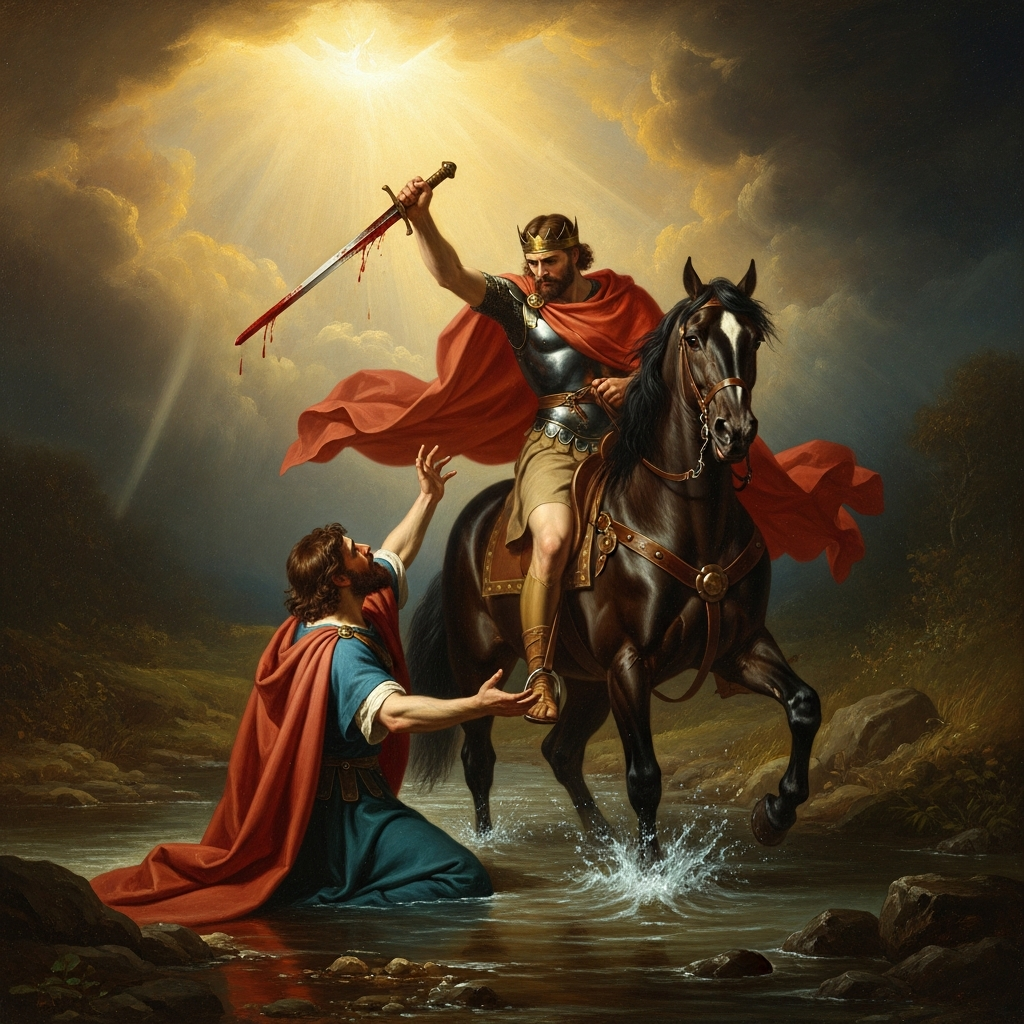
Pwyll spurs his horse. He strikes Hafgan with the spear. The blow is true. Hafgan falls from his horse. He rolls onto his back in the water of the ford. He looks up at Pwyll, recognizes that the stroke has gone through him, and says: for the love of God, give me the second stroke. Finish me.
Pwyll says: I will not.
Hafgan understands. He says: then take my men and my country. I have been killed by the rule. He dies in the ford. His army accepts Pwyll as their new king. Annwn is unified for the first time in a generation. Pwyll has done what Arawn could not do because Arawn had been fighting Hafgan too long — Pwyll’s hand was not yet tired, his honor not yet entangled with the rivalry, his stroke clean.
The year ends. Pwyll rides back to Glyn Cuch. Arawn meets him in the same forest. They exchange shapes again. Pwyll returns to Dyfed. Arawn returns to Annwn.
Arawn rides home to his own court. He sits down to dinner with his queen. He eats. He goes to bed. He turns to her and pulls her close, the way he has not done — from her perspective — for a year.
She is silent for a long moment. Then she asks him why, after a year of turning his face to the wall, he has changed his mind.
Arawn understands what Pwyll did. He understands what was done for him in his own bed, by a man who had every excuse to do otherwise and chose not to. He tells the queen everything. The exchange. The combat. The year of turning to the wall. The friendship that has been built in the silence of the ford and the silence of the bed without either party speaking of it.
The queen is astonished. She has never heard of a man who would do that.
Arawn sends a message to Dyfed. You have my friendship. Pwyll receives the message and sends one back. And you have mine. The two kingdoms — the kingdom of mortal Wales and the kingdom of the Welsh Otherworld — are joined in the alliance of the two kings, and from that day Pwyll is no longer Pwyll, Prince of Dyfed. He is Pwyll Pen Annwn — Pwyll Head of the Otherworld — a mortal king who has been into the country beyond the world and has earned the right to walk in both realms.
The story does not end there.
A year after his return, Pwyll holds a feast on the mound of Arberth. The mound is a sídhe — a fairy-mound, an axis mundi of the Welsh landscape, a place where anyone who sits on it at the right hour will see something from the Otherworld. Pwyll sits on it. The court watches. There is a hush.
A woman appears on the road below. She is on a white horse. She is moving at a walking pace, but no rider on any horse can catch her. Pwyll’s men ride after her. They ride harder. They ride at full gallop. She does not move any faster, and they do not gain a single yard on her. After three days of this, Pwyll himself rides out and calls to her, for the sake of him you love best, stop.
She stops at once. She turns. She says: I would have stopped earlier if you had asked. I have been waiting for you to ask.
Her name is Rhiannon. She is the queen Pwyll will marry. She is also, in the older Celtic substrate beneath the Mabinogi, the goddess of horses and sovereignty — Epona in her Welsh form, the Great Queen who rides the white horse, the Otherworld bride who has chosen the mortal king. Pwyll marries her. The First Branch follows them through the next decade — the loss of their child, the wrongful accusation against Rhiannon, the strange penance she serves at the gate of Dyfed carrying visitors on her back like a mare, the eventual recovery of the child by Teyrnon Twrf Liant — and the whole of that story, with all its sorrows, is possible only because of what happened at Glyn Cuch.
The forest gave Pwyll a year in the Otherworld. The Otherworld gave him a wife from the sídhe. The single stroke at the ford made him the kind of king Rhiannon could marry. The rule that cannot be violated — one stroke only — is the rule that organized everything.
The First Branch ends with Pwyll an old king, his line continued, his kingdom intact, his friendship with Arawn unbroken. Annwn and Dyfed remain in alliance for the rest of his life.
The mound at Arberth is still there. You can walk to it. It is a small green hill outside Narberth, in southwest Wales, with a few trees on it. The path up is short. The view at the top is over the kingdom that was Pwyll’s, the country the Mabinogi maps onto the actual landscape. If you sit on it long enough, the text suggests — though it does not promise — you may still see something.
Welsh tradition does not say what.
Scenes
The hounds of Annwn — gray bodies, ears the color of fresh blood — are the first sign that this forest is not the one Pwyll thought he was hunting in
 Generating art…
 Arawn in gray on a gray horse: the king of the Welsh Otherworld arrives without ceremony, his face the face of a man whose anger is more disappointment than rage
 Generating art…
 The combat at the ford — one stroke only, no second blow permitted; Hafgan begs for the killing stroke, and Pwyll refuses him because the rule is the rule
 Generating art…
 Echoes Across Traditions
Entities
- Pwyll, Prince of Dyfed
- Arawn, King of Annwn
- Hafgan
- Rhiannon
- the gray hounds with red ears
Sources
- *Mabinogion*, First Branch (*Pwyll Pendefig Dyfed*), trans. Lady Charlotte Guest (1838); trans. Sioned Davies (Oxford UP, 2007)
- *Pedair Cainc y Mabinogi* — the Four Branches in Middle Welsh, ed. Ifor Williams (1930)
- Proinsias Mac Cana, *Celtic Mythology* (Hamlyn, 1970)
- John Carey, *A Single Ray of the Sun: Religious Speculation in Early Ireland* (Celtic Studies Publications, 1999)
- Patrick Ford, *The Mabinogi and Other Medieval Welsh Tales* (UC Press, 1977)