Lugh and the Eye of Balor
Mythic prehistory · recorded ~9th–11th century CE · Mag Tuired, the Plain of the Pillars — northwest Ireland, between the Tuatha Dé Danann and the sea
Contents
On the plain of Mag Tuired, a young god kills his own grandfather with a sling-stone, driving the death-eye out the back of his skull and onto the army that came to enslave Ireland.
- When
- Mythic prehistory · recorded ~9th–11th century CE
- Where
- Mag Tuired, the Plain of the Pillars — northwest Ireland, between the Tuatha Dé Danann and the sea
A prophecy reaches Balor on his island of glass towers: your daughter’s son will kill you.
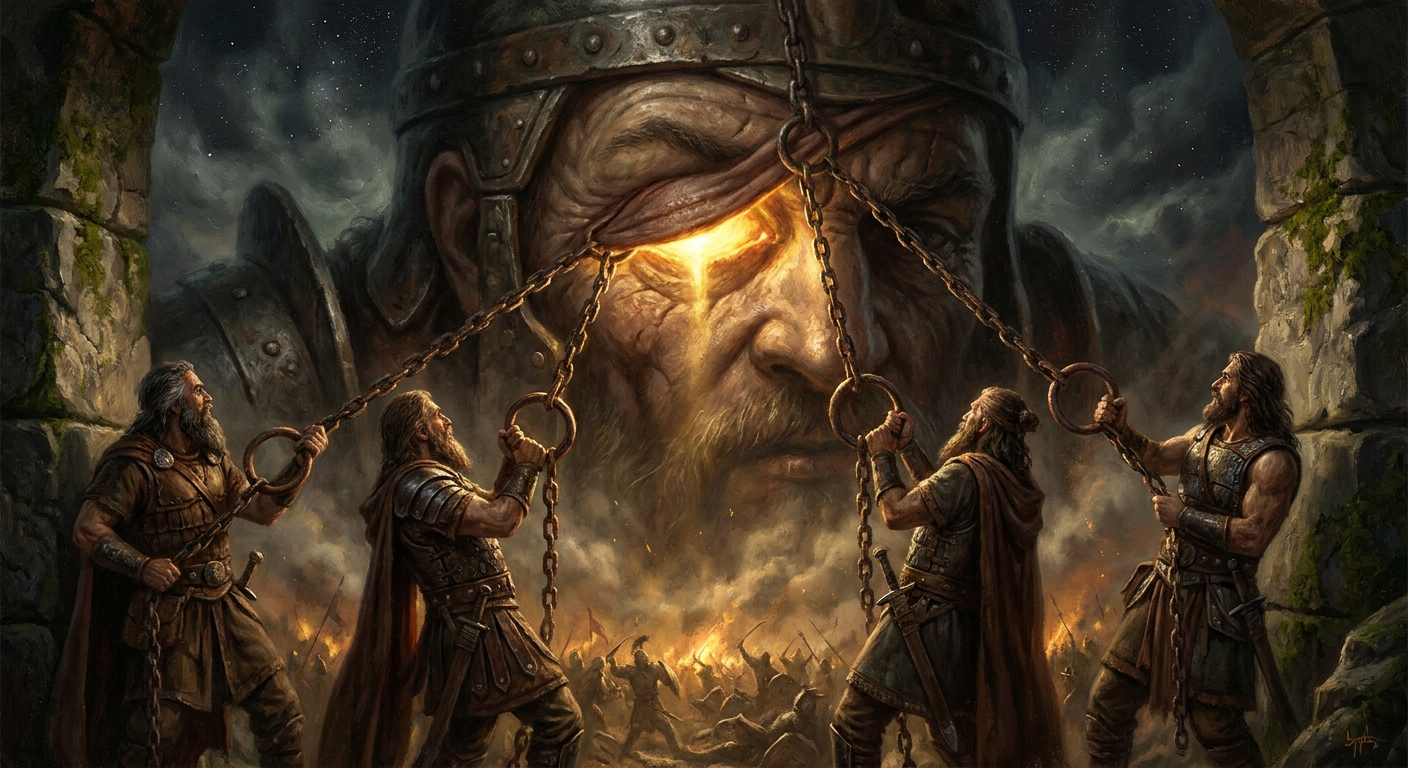
Balor is the high king of the Fomorians — the elder, brutal race that taxes Ireland, eating the children of its harvest, breaking the legs of its kings. His left eye is sealed. It was poisoned in his youth by the fumes of his druids’ cauldron, and it has been growing ever since beneath its shut lid. When opened, it kills whatever it looks at — not by spell, not by curse, simply by being seen by it. Four men are required to hoist the eyelid with hooked rings of iron. He keeps the eye shut.
He hears the prophecy. He locks his daughter Ethniu in a tower of sea-cliff crystal, no man permitted past the door, no opening but a high window, and waits to die of old age instead.
The world has not yet stopped happening.
Cían of the Tuatha Dé Danann reaches her anyway. The how varies between manuscripts — a druid’s mist, a transformation into a small bird, a bribed nurse — but the result is consistent. Ethniu bears triplets. Balor, when he discovers it, orders all three drowned. Two are. The third, swaddled in a cloak, slips from the servant’s grip into a cove and is washed away on the tide, into the keeping of the sea-god Manannán mac Lir, who fosters him and names him Lugh.
The boy grows up offshore.
He learns every art. Samildánach, the Many-Skilled, they will call him: smith, harper, poet, sorcerer, leech, cup-bearer, warrior, champion. When he comes at last to Tara, gatekeeper after gatekeeper turns him away — we already have a smith, we already have a poet — until he asks the question that shames them: but do you have one man who is all of these at once?
They open the gate.
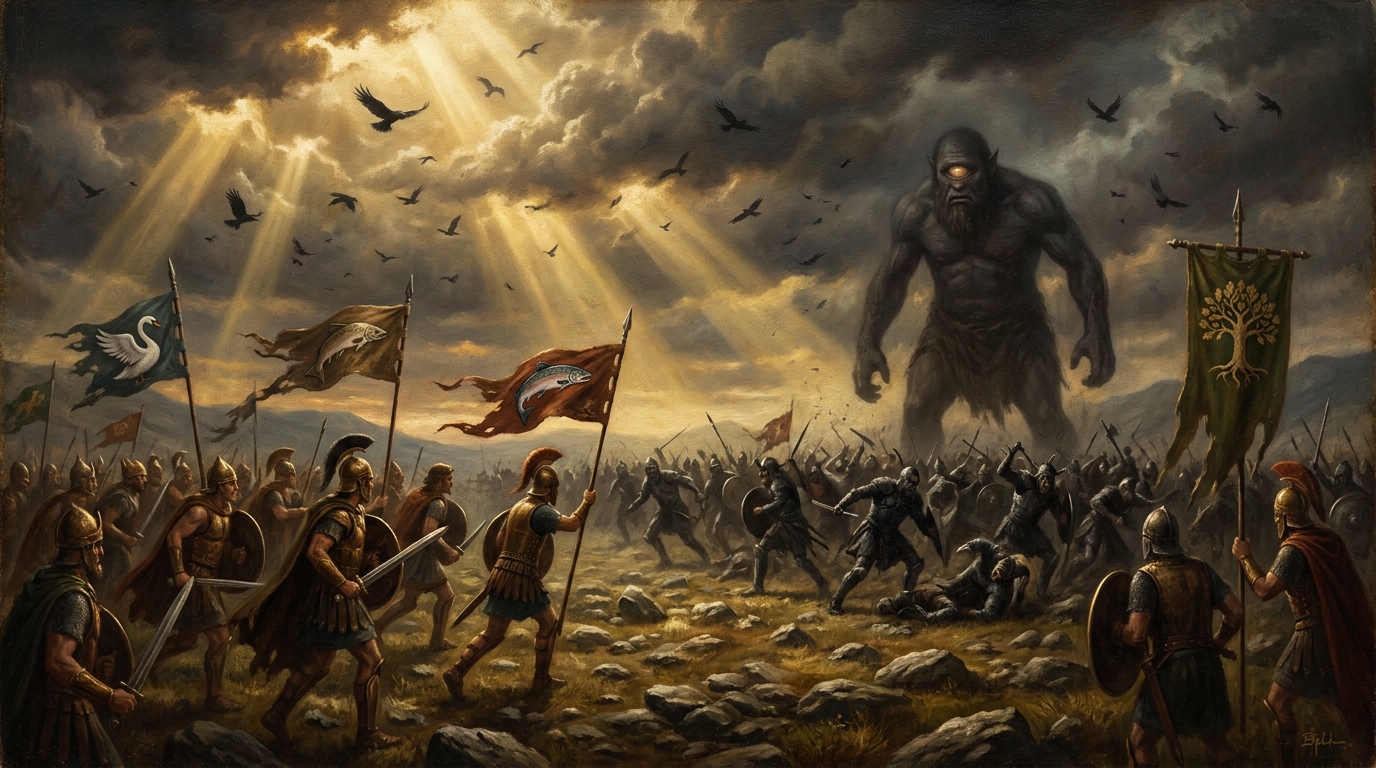
Núada the silver-handed king cedes his throne. The Tuatha Dé Danann assemble. Across Ireland, on the plain of Mag Tuired, the Fomorian host is already gathering — and at its center, on a litter borne by warriors, sits Balor with his eye sealed shut.
The battle opens at dawn.
The Dagda’s club kills nine men with one end and revives them with the other. Ogma cuts a road of bodies through the Fomorian flank. Goibniu the smith forges replacement spears between blows; Dian Cécht the physician dips the dead in a well of healing and sends them back into the line. The Tuatha Dé Danann fight as a guild — every craft of civilization weaponized, the harp pressing back the drum.
But the line bends, and bends, and bends, because Balor is moving forward.
The Fomorians peel back from in front of him.
Four men pace beside the litter, ropes coiled at their belts, hooks in hand. He is going to open it, the cry goes up across the field. He is going to look.
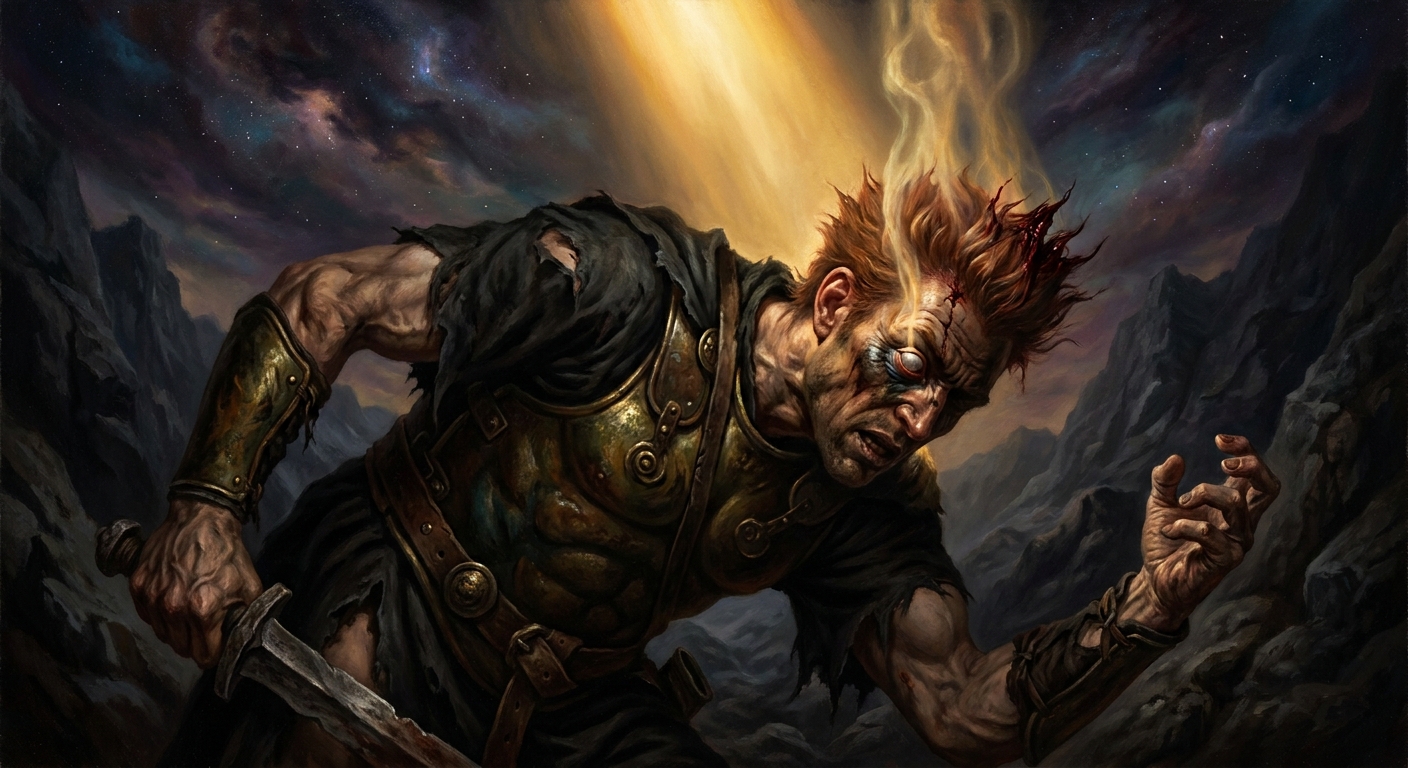
Whatever Balor’s eye sees, dies. Once, in his youth, he glanced at a herd of cattle through a curtain and the cattle dropped where they stood. Once he looked at a single tree and the tree was charcoal before its leaves fell. The Tuatha Dé Danann know this. The fastest among them are already turning to run when the four men set the hooks into the lid and begin to pull.
Lugh sees it from across the field. He is wearing nothing but a sling.
He runs.
He runs at his grandfather across the open plain while Balor’s eye-lid lifts, slow as a portcullis on a winter morning, the killing pupil emerging beneath it like a black moon coming up over a mountain. Behind Lugh the front rank of the Tuatha Dé Danann is dropping where the gaze grazes them.
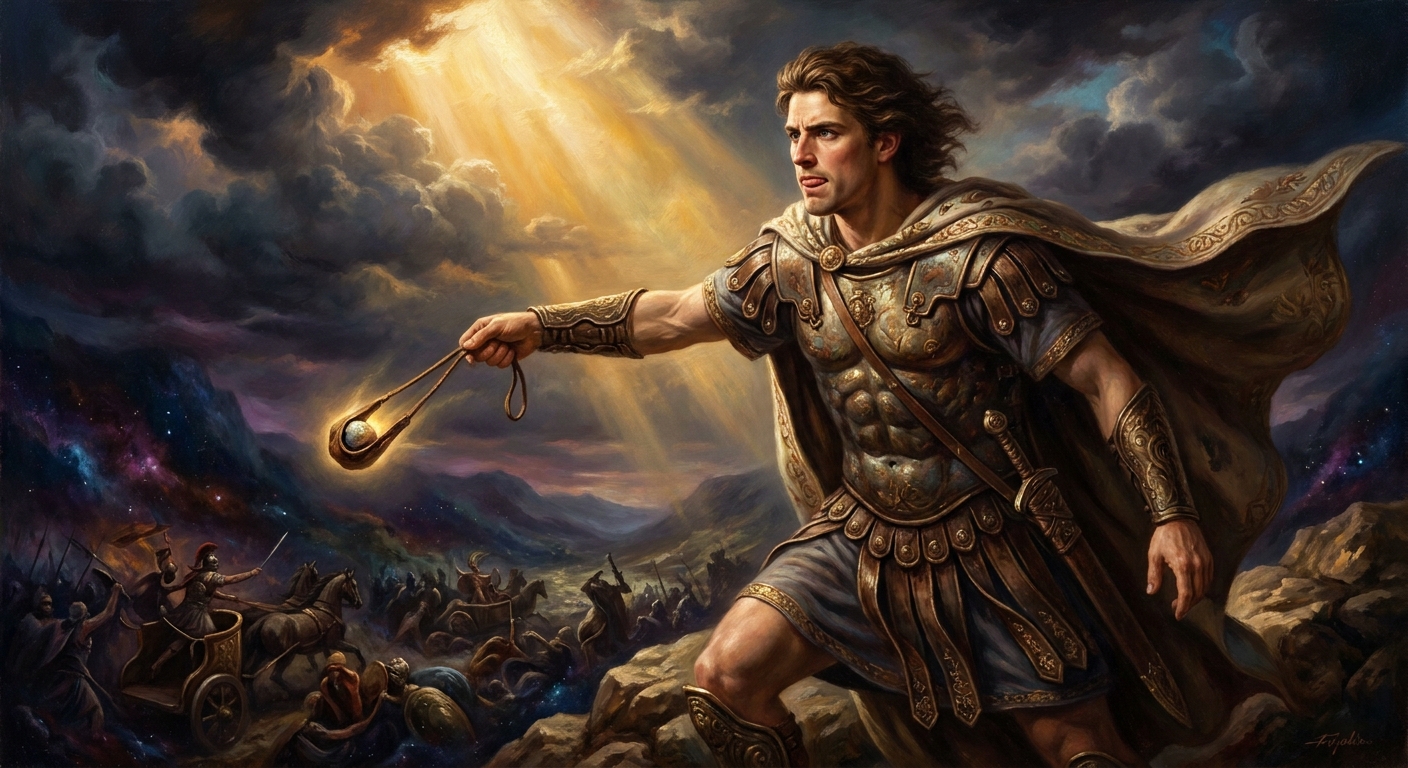
He stops. He fits a stone to the sling. He whirls it once.
He throws.
The stone enters Balor’s open eye while the eye is still rising. It enters at the pupil and travels straight through the skull and exits at the back, taking the eye with it — the killing gaze, the poisoned lens, the entire sealed apparatus of generations — and the eye, still open, still doing its work, lands among the Fomorian host facing them.
Their own king’s eye looks at them.
Whole regiments fall in the next breath. Banners drop because the men holding them have stopped existing. The Fomorian line, pressed forward by ranks behind it that cannot see what is happening at the front, walks itself into the gaze and dies into it. By the time someone has the wit to drop a cloak over the eye, the war is over.
The Tuatha Dé Danann stand on a field of their enemies, killed by their own commander, and do not cheer. They look at the small grandson of Balor standing next to the body of his grandfather, holding an empty sling. The boy who learned every art. The boy the prophecy named.
Lugh kneels and cleans the stone.
The Cath Maige Tuired survives in a single eleventh-century manuscript and a few later copies, but its core is older — the language preserves forms from centuries earlier, and the prophecy-pattern is older still. It is the Indo-European inheritance: the elder generation warned, the daughter sequestered, the grandson hidden in water, the throw that ends the world that tried to prevent him.
Lugh becomes the king of the Tuatha Dé Danann. Centuries later, when his people retreat into the hollow hills and become the Sídhe, he is remembered as the father of Cú Chulainn — a thread the Táin pulls deliberately. The boy with the sling and the boy at the ford are the same lineage, the same lonely arithmetic: one shot, one wound, one war.
The eye still surfaces in Irish folk-speech. To give someone the droch-shúil, the bad eye, is to wish them harm by looking. The grandfather has been dead for two thousand years. The metaphor still works.
Scenes
Lugh of the Long Arm, slingstone in hand, the moment before the throw that ends the war
Generating art… Balor of the Evil Eye, four men hauling open the lid with iron rings — and the killing gaze beneath
 Generating art…
 The plain of Mag Tuired
 Generating art…
 Echoes Across Traditions
Entities
- Lugh Lámfada
- Balor of the Evil Eye
- the Tuatha Dé Danann
- the Fomorians
- Núada Airgetlám

Sources
- Whitley Stokes (ed./trans.), *Cath Maige Tuired: The Second Battle of Mag Tuired* (1891)
- Elizabeth Gray (trans.), *Cath Maige Tuired* (Irish Texts Society, 1982)
- *Lebor Gabála Érenn* (Book of Invasions, ~11th century CE)
- John Carey, *A Single Ray of the Sun* (1999)
- Mark Williams, *Ireland's Immortals* (2016)