Laozi at the Western Pass
~500 BCE · late Zhou dynasty (legendary) · Hangu Pass, the western gate out of China
Contents
The keeper of the Zhou royal archives loads a water buffalo and rides west toward disappearance. A border guard at Hangu Pass sees a purple cloud coming from the east and knows a sage approaches. He begs Laozi to write something down. Three days later, the *Tao Te Ching* exists — 5,000 characters, the most-translated text after the Bible. Then Laozi rides on and is never seen again.
- When
- ~500 BCE · late Zhou dynasty (legendary)
- Where
- Hangu Pass, the western gate out of China
The dynasty is dying and Laozi has watched it die from the inside.
He has kept the Zhou royal archives for decades — cataloguing silk manuscripts, bronze inscriptions, the ritual records of a civilization that was once synonymous with the world. He has read more history than any living man and drawn from it a conclusion that history does not usually produce: that the attempt to save a civilization accelerates its collapse. Every king who grasps harder breaks what he is holding. Every reformer who insists more loudly on the ancient virtues drives the ancient virtues further away. The archive he tends is a monument to the distance between what people say they value and what they actually do, and after enough decades among these records, Laozi has reached the bottom of what language can accomplish.
He loads a water buffalo. He says nothing to anyone. He rides west.
The road to Hangu Pass moves through limestone mountains that have been changing hands for a generation, past villages that no longer know which lord they serve. Laozi does not move at the speed of urgency. The water buffalo sets the pace — slow, reliable, constitutionally indifferent to the political situation — and the old man lets the animal be right about this. He has outlasted Confucius, the other great mind of the age, who rode in exactly the opposite direction: into courts, into the thick of it, trying to remind kings that virtue preceded power and that the ancient rites encoded a social wisdom the warring states were too busy to understand.
Confucius was wrong, Laozi thinks, and wrong in a way that could not be corrected from inside the error. The sage who insists on teaching creates students who mistake the teaching for the thing. The archivist who clings to the archive burns with it. The ruler who governs hard breaks what he holds. The Tao does not announce itself. It does not rally. It does not hold office. It flows, it empties, it yields, and in yielding it outlasts everything that tries to overcome it.
The buffalo does not need this explained. Laozi rides west.
Yinxi sees him coming from a long way off.
The guard at Hangu Pass has read travelers his entire career the way a physician reads a face — merchants, soldiers, refugees, the occasional scholar fleeing a court that has stopped tolerating scholarship. He has learned to trust what he sees before he knows what he is seeing. Now he watches the old man on the buffalo come down out of the limestone hills and understands, with the certainty of a man who has trained his intuition for thirty years, that something irreplaceable is about to pass through his gate.
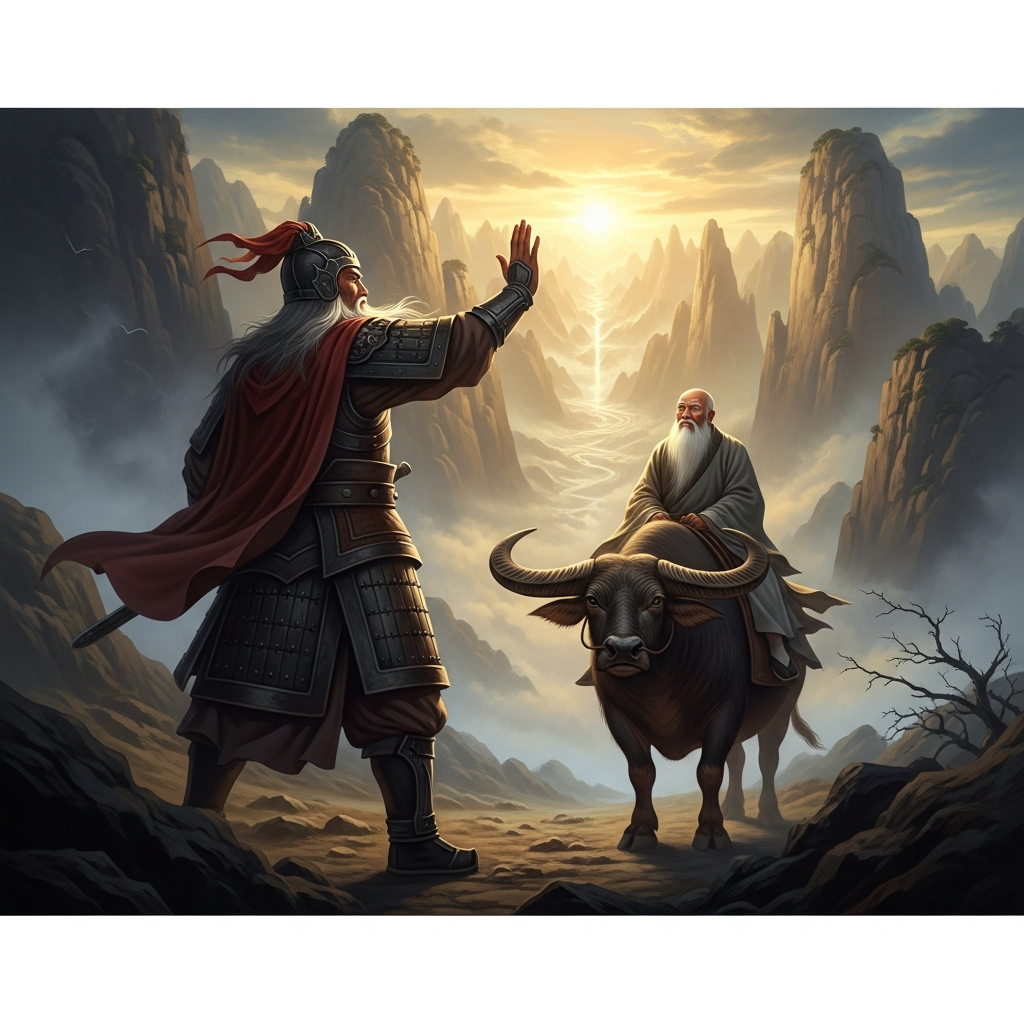
He has noticed the sky. Sima Qian, recording this five centuries later, says that Yinxi saw a purple cloud moving from the east — a purple cloud shaped like a dragon, the color of imperial heaven, the omen of a sage passing. Whether Yinxi sees a cloud or sees a man and the cloud is what posterity adds to make the moment legible, the recognition is real. He steps out of the gate. He raises his hand.
Master. Before you go. Write down what you know.
The request is almost certainly impossible.
Laozi knows this. The whole architecture of his thinking is built on the premise that the most important thing cannot be said — that every attempt to capture it in language produces a cage, a category, a handle that the seeker grasps and mistakes for the thing that cannot be grasped. The Tao that can be named is not the eternal Tao. He could explain this to Yinxi. He has the material. He could unspool the paradox — the way that trying defeats trying, the way that the useful thing about a bowl is not the bowl but the emptiness inside it, the way that the gatekeeper asking a sage to write something down is performing precisely the error the writing would describe.
Instead, he gets off the buffalo.
He sits at the gate.
He stays for three days.
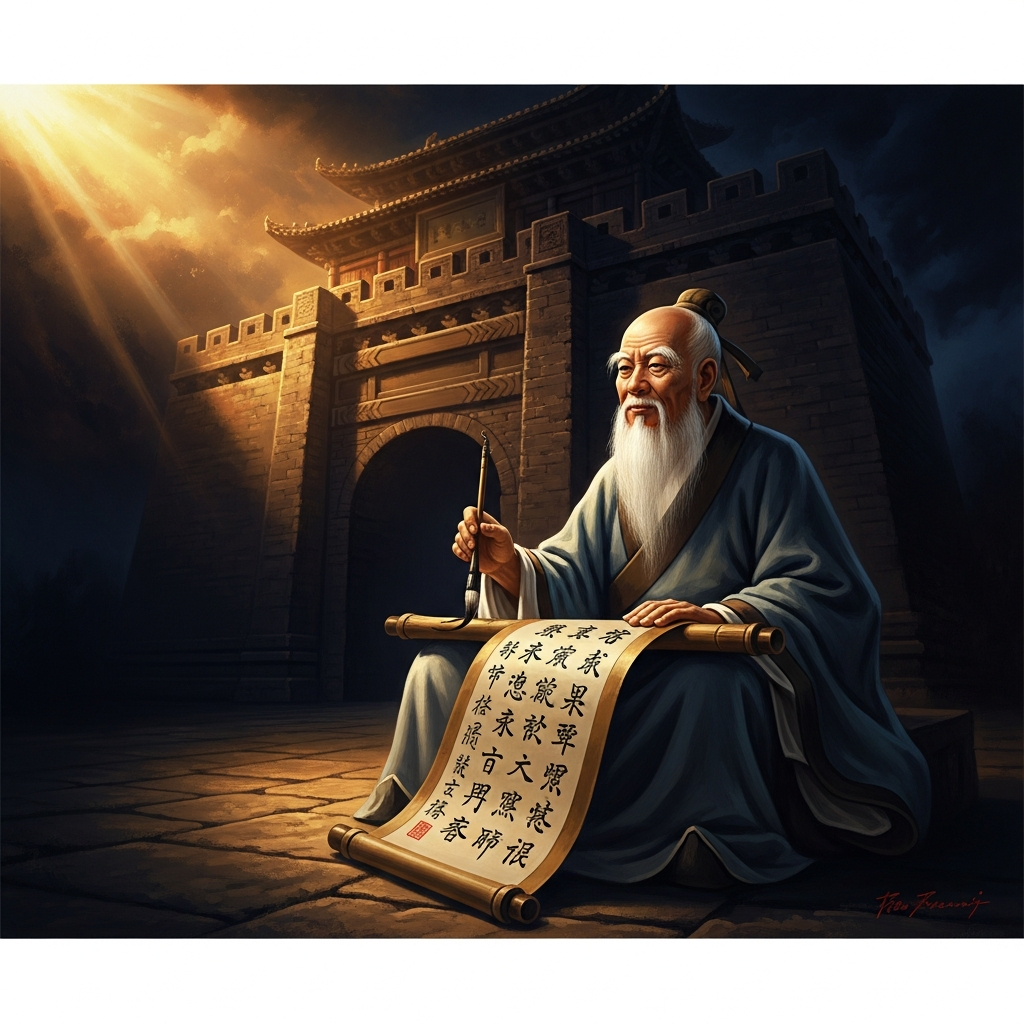
Sima Qian records only the result: five thousand characters, organized into eighty-one chapters, handed to the guard.
What happens in those three days — whether Yinxi asks questions and Laozi answers, whether he writes in silence, whether the gatekeeper and the archivist talk through long nights and the text is what remains when the talking is done — is not in the record. What exists is the Tao Te Ching, the Daodejing, the Book of the Way and Its Virtue. It is not a systematic work. It does not build arguments the way Mencius builds arguments, stone on stone until the structure is inescapable. Each chapter is a compression — a few images held together under pressure until something cracks and the light gets in. Thirty spokes share the wheel’s hub; it is the center hole that makes it useful. The highest good is like water. Water benefits ten thousand things and does not compete. The Tao that can be told is not the eternal Tao.
He opens with an impossibility and does not stop. The book is a deliberate detonation, a text engineered to blow out the reader’s tendency to mistake the map for the territory, written by a man who knows that every map becomes a territory the moment someone trusts it too completely.
He hands it to Yinxi.
He climbs back onto the buffalo.
He rides on.
He is never seen again.
No grave. No school founded in his name by his own hand. No last words beyond the eighty-one chapters. The tradition will deify him — Taishang Laojun, the Most High Lord Lao, appearing in visions, dictating new scriptures, carried in processions across two thousand years of Chinese religious history — but the man on the buffalo reaches the pass, leaves the text, and dissolves into the mountains as cleanly as smoke into open sky.
The book travels east without him. It is translated into Greek under the Han dynasty, into Sanskrit, into Tibetan, into Latin. By the twentieth century it carries more English translations than any text except the Bible — hundreds of them, each one confessing in its translator’s notes that something escaped. Mitchell’s version: luminous, the Tao rendered as grace. Lau’s: scholarly, tonal, attentive to the Chinese that cannot survive crossing. Red Pine’s: annotated with classical commentary, each chapter a palimpsest of interpretation laid over interpretation. Every translator falls into the same trap Yinxi set at the gate: asking the unnameable to give a name.
The unnameable complies and then rides on.
The debate over Laozi’s historicity cannot be resolved. Sima Qian, writing around 100 BCE, already hedges: there may have been multiple men, a conflated tradition, the Yinxi story possibly invented to explain how the text survived its author’s disappearance. The Tao Te Ching itself gives no name and no date. What is not in dispute: the text is very old, it has been read continuously for at least 2,400 years, and it opens by telling you it cannot be written. The man on the buffalo may be legend. The five thousand characters are fact. The border guard asked the impossible question and received the impossible answer, and then the sage rode through the gate and proved, by leaving, that he had been telling the truth from the first line.
Scenes
Laozi sits at the gate of Hangu Pass, brush in hand, writing the *Tao Te Ching* — 5,000 characters, three days, and then silence
Generating art… The border guard Yinxi raises his hand as the old man on the water buffalo approaches — behind him, the mountains; ahead, the end of China
 Generating art…
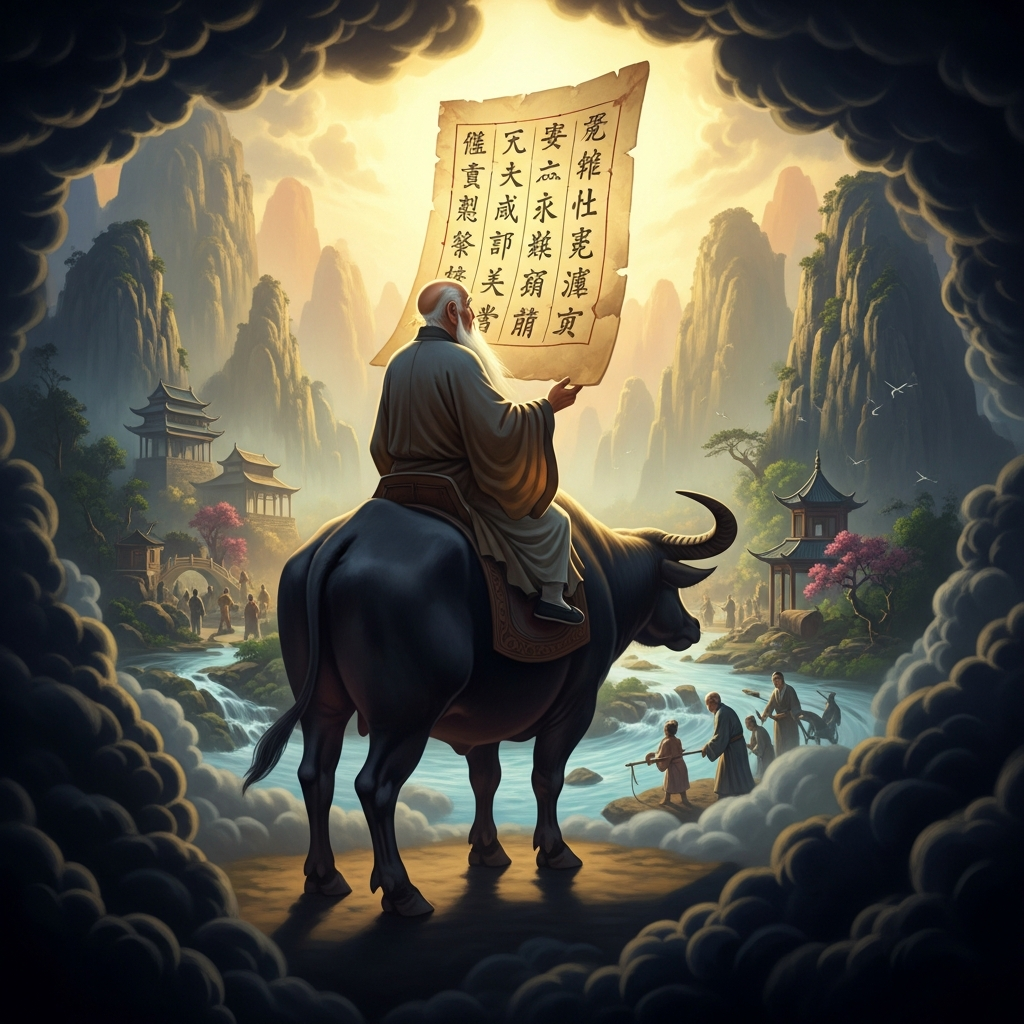
 Laozi rides west on his water buffalo, diminishing against the limestone peaks, the manuscript behind him, the world behind that
 Generating art…
 Echoes Across Traditions
Entities
- Laozi
- Yinxi
- Confucius
Sources
- Sima Qian, *Records of the Grand Historian* (*Shiji*) 63 — the earliest account of the pass and Yinxi
- *Tao Te Ching* / *Daodejing* — D.C. Lau (trans., Penguin, 1963); Stephen Mitchell (trans., HarperCollins, 1988); Red Pine (trans., Copper Canyon, 1996)
- *Zhuangzi*, Inner Chapters — Burton Watson (trans., Columbia, 1968)
- A.C. Graham, *Disputers of the Tao* (Open Court, 1989)
- Holmes Welch, *Taoism: The Parting of the Way* (Beacon, 1957)