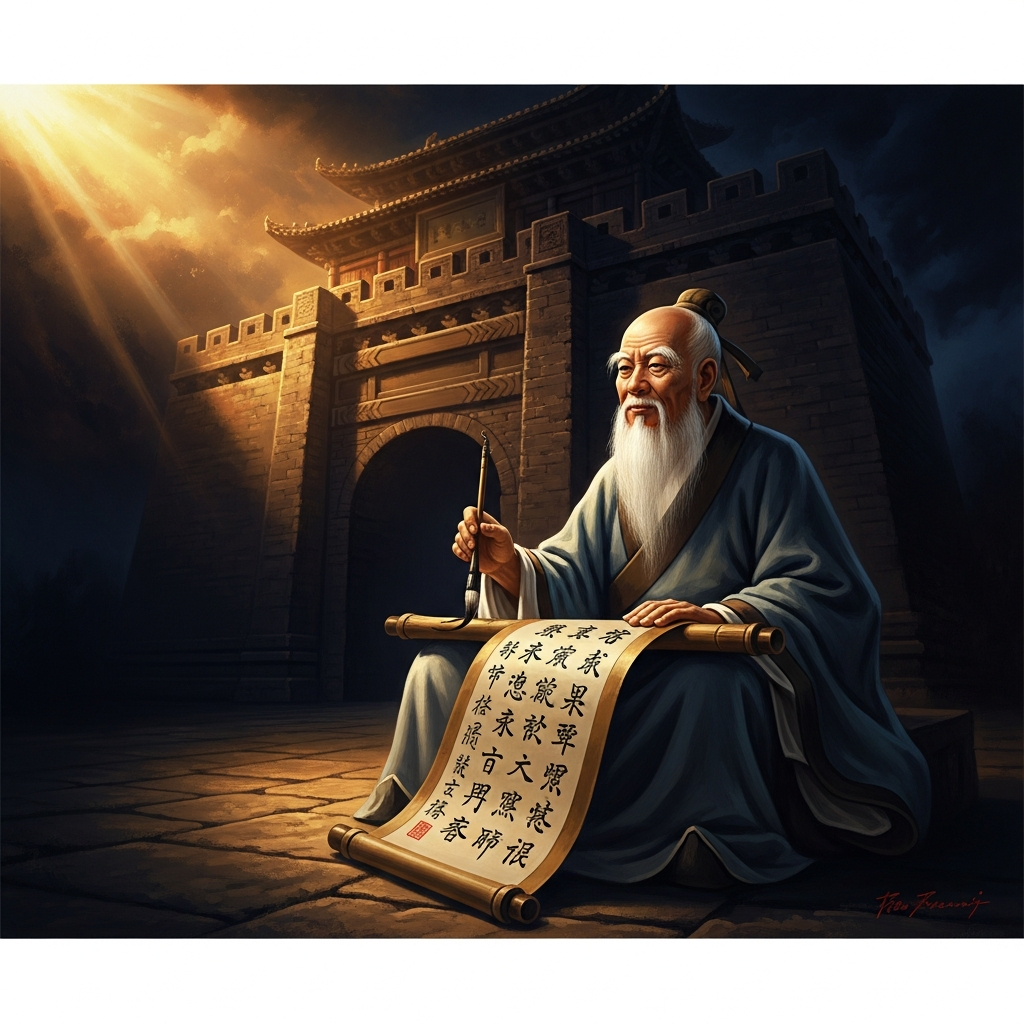
Zhuangzi Drums on a Bowl
~300 BCE · Warring States period, China · Zhuangzi's home — the state of Song or its environs
Contents
Zhuangzi's wife dies. His friend Huizi arrives to mourn and finds Zhuangzi sitting on the ground, singing and drumming on a clay bowl. Huizi is outraged. Zhuangzi explains: at first he wept. Then he considered. She was nothing before she was born. She became something. She lived. Now she has returned to the great transformation. To weep for her return is to misunderstand what she was.
- When
- ~300 BCE · Warring States period, China
- Where
- Zhuangzi's home — the state of Song or its environs
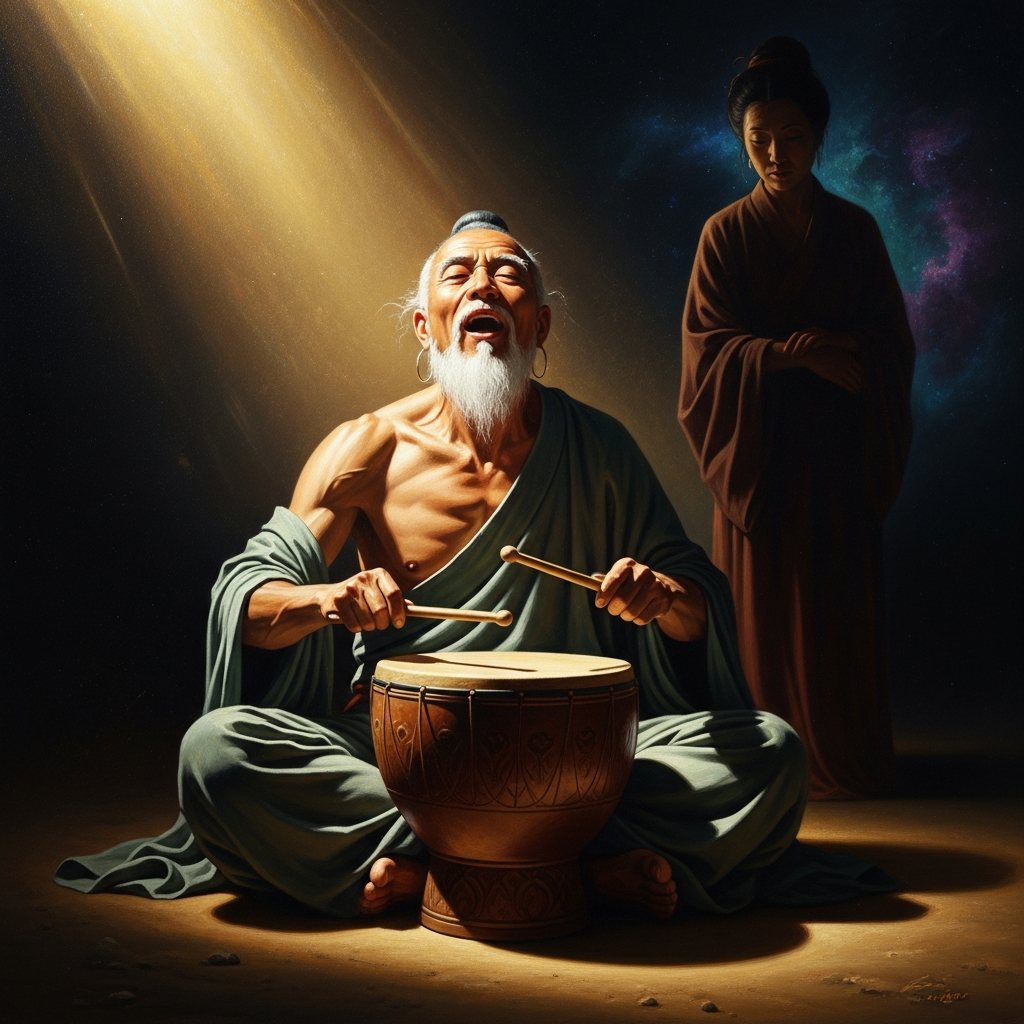
He is sitting on the ground when Huizi arrives.
Not on a mat, not on a chair — on the ground, legs spread, spine straight, a clay bowl upended between his knees. He is drumming on the bowl with his fingers and singing. His wife is dead. She has been dead since morning. The body is nearby, or has been laid out properly, or he has already attended to whatever needs attending to — the account is not detailed about this. What it is detailed about is Zhuangzi himself: sitting on the ground, singing, drumming.
Huizi has come to mourn. He has known Zhuangzi for years — they argue constantly, brilliantly, about everything: the happiness of fish, the usefulness of useless things, the question of whether anything can be known with certainty. Huizi is a logician. He believes in the precision of language and the resolvability of questions. He loves Zhuangzi the way one loves the person who makes thinking feel like a practice rather than a burden. He has come now to sit with his friend in loss.
He stops in the doorway.
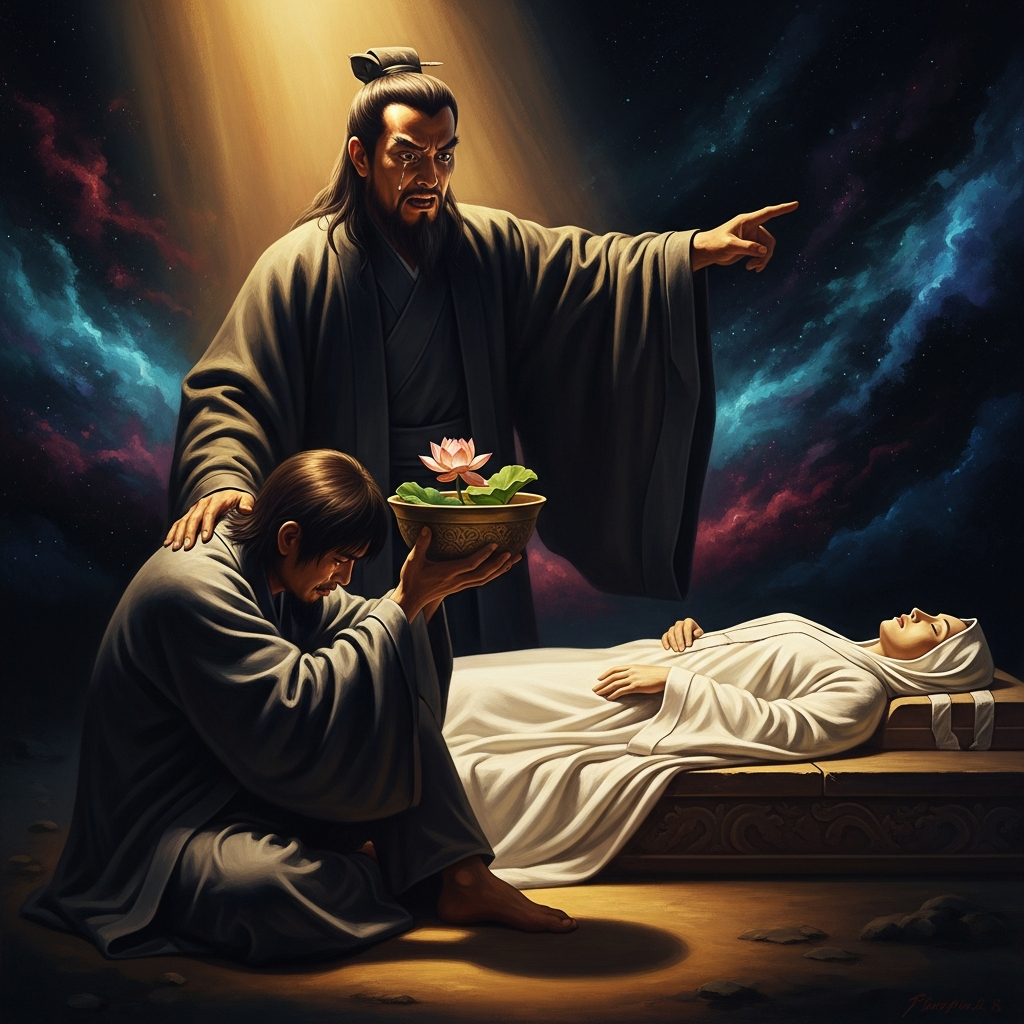
He says: She lived with you, raised your children, grew old with you. It is one thing not to weep at her death. But to sing and drum on a bowl — this is going too far.
Zhuangzi sets down the rhythm but does not stand. He looks at his friend with the expression he usually reserves for the moment when an argument is about to turn — not contempt, not performance, but the particular attentiveness of a man who has thought something through and is about to find out whether the other person can follow him there.
At first, he says, I wept.
He pauses.
How could I not? We spent our life together. But then I considered.
He tells Huizi what he considered.
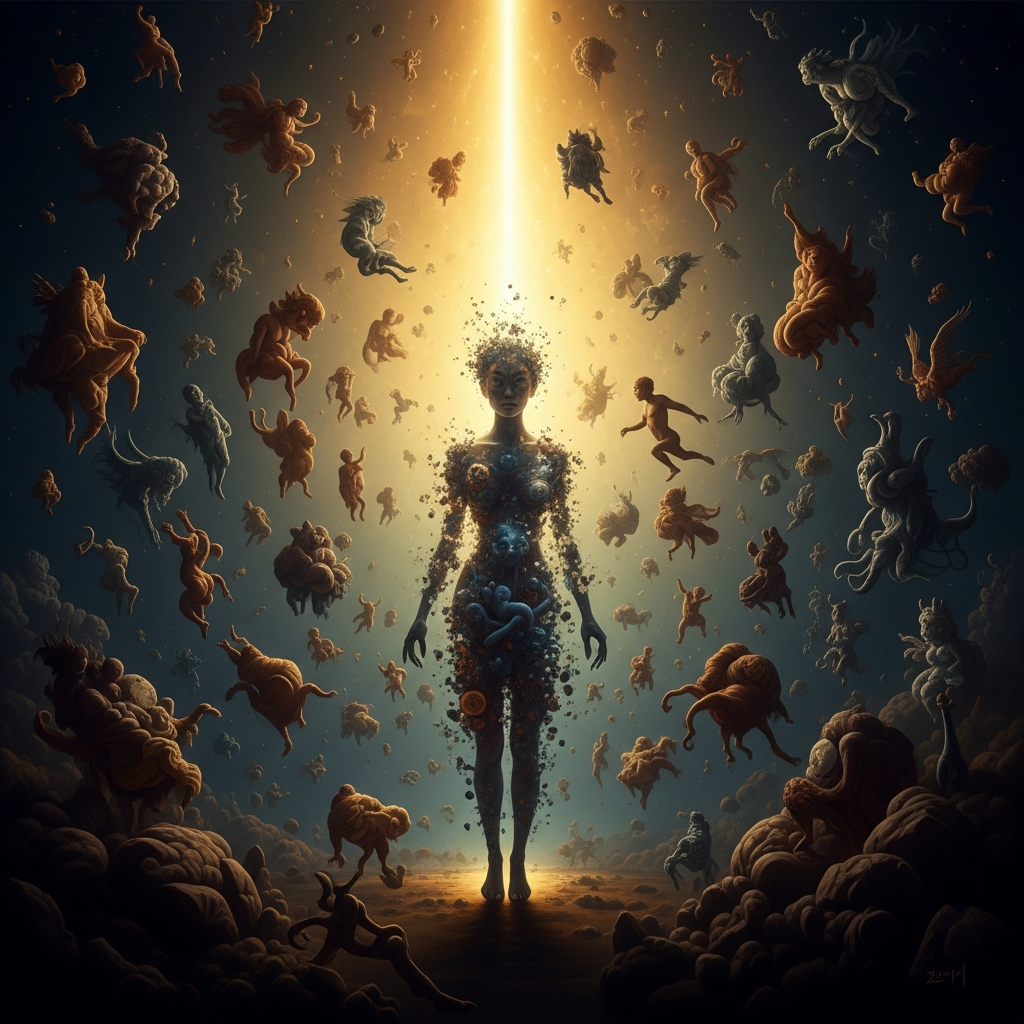
In the beginning — the deep beginning, before the beginning anyone can remember — there was no life. Before the life, there was no form. Before the form, there was no breath. Something was there — some undifferentiated thing, mixed together in the great darkness, vast and without feature. Then from that darkness, something shifted. Breath condensed into form. Form condensed into life. Now life has shifted again — back into form, form back into breath, breath back into the great dark mixing.
She is sleeping, Zhuangzi says, in the great room of the world.
He is not saying she is at peace. He is saying something harder and stranger: that the category of loss does not apply, because loss requires that something be taken from you, and she was never a possession of the world in the form she wore. She was a temporary condensation. The breath that made her is still here, differently arranged. The form that was her is returning to the ground from which forms are assembled. What does it mean to grieve a season that has turned?
Huizi is not convinced.
He never is, entirely. This is what makes him indispensable to the Zhuangzi — he is the man who keeps asking the question that the answer cannot quite answer. He will later stand at a riverbank with Zhuangzi and argue about whether Zhuangzi can know the fish are happy. You are not a fish, Huizi says. How can you know what a fish feels? Zhuangzi replies: You are not me. How can you know I don’t know? They go around like this for days, productively.
Now Huizi stands in the doorway with his grief for a woman he also knew, and he looks at his friend on the ground with the bowl, and he cannot fully enter the argument. He feels what he feels. The logic is not wrong — he has spent enough time with Zhuangzi to see where it goes, to see that it is internally coherent, to see that it is not cruelty dressed as philosophy. But there is something in him that will not let go of the shape of her, the particular arrangement of breath and form that was this specific person in this specific life, and the fact that the arrangement has ended, and the fact that the ending is not nothing.
He sits down.
He does not drum.
He is not Zhuangzi. He was never going to be.
What Zhuangzi demonstrates in the scene with the bowl is the hardest thing in the Zhuangzi: the actual living of the teaching.
The text is full of beautiful and disorienting passages about the great transformation — about Cook Ding who carves an ox along its natural lines and the blade never dulls, about the mushroom of a morning that knows nothing of the alternation of day and night, about the roc that rises ninety thousand li and laughs at the dove who cannot comprehend such a flight. These are images of Daoist alignment: following the grain of things, releasing the grip, recognizing that the self is not the center of the universe and suffering accordingly less. They are easy to admire.
The bowl is harder.
The bowl is what the teaching looks like when it is applied to the death of the person you woke up beside. When Zhuangzi says he wept first, and then considered, he is not claiming he did not weep. He is claiming that grief carried him, if he followed it far enough, through to something that grief alone cannot reach. He did not talk himself out of crying by reciting philosophy. He cried, and then he thought, and the thinking was not separate from the crying but was the place the crying arrived when it went far enough.
He dies sometime around 286 BCE, old by the standards of his era, having never held office, refused several times with the cheerfulness of a man who finds the refusal self-evident.
A prince of Wei once offered him a high position and the use of a river territory, and Zhuangzi replied: I have heard of a sacred tortoise that has been dead three thousand years, preserved in a box in the king’s temple. Would the tortoise rather be dead and honored, or alive and dragging its tail in the mud? The prince said: alive and in the mud. Zhuangzi said: then let me drag my tail in the mud.
When he is dying — this is also in the text, later — his disciples begin to plan an elaborate burial. He tells them to leave his body in the open air for heaven and earth to manage. They protest: the vultures will eat him. He says: Above ground I shall be eaten by crows and kites. Below ground I shall be eaten by mole crickets and ants. To take from one and give to the other is favoritism.
He drums on the bowl.
He knows the seasons do not mourn each other. He knows the breath does not weep for the form it is leaving. He knows this the way a cook knows an ox — from the inside out, along the grain, the blade never dulling.
His wife returns to the great room of the world. He drums until Huizi understands, or until Huizi gives up, or until the argument between them runs out of room and becomes the silence that the Zhuangzi always ends in, on the other side of every paradox: the silence that is not empty, that is where the Tao is, that was there before anything had a name.
The Zhuangzi is not a comfortable book. It is a book that keeps dissolving the frame before you can settle into it — the dreaming man who wakes and wonders if he is a butterfly dreaming he is a man, the cook whose knife finds the spaces between things, the man who drums on a bowl because he has followed grief all the way through grief to the place on the other side. What it offers is not consolation but something rarer: the possibility that what you are grieving was never lost, because it was never, in the way you imagined it, yours. Zhuangzi drummed because he loved her. The drumming was how love sounded when it went all the way.
Scenes
Zhuangzi sits cross-legged on the ground, drumming on a clay bowl and singing — his wife's body nearby, Huizi arriving at the threshold in horror
Generating art… Huizi stands over his friend, gesturing at the bowl, his face torn between grief for the dead woman and disbelief at the living man
 Generating art…
 The cosmos as Zhuangzi imagines it: a vast dark crucible in which forms rise and dissolve — human, animal, mineral — the wife's breath becoming wind becoming cloud becoming rain becoming grain
 Generating art…
 Echoes Across Traditions
Entities
- Zhuangzi
- Huizi
Sources
- *Zhuangzi*, Chapter 18 ("Supreme Happiness") — the episode of the wife's death and the bowl
- *Zhuangzi*, Chapter 6 ("The Great Ancestral Teacher") — on the great transformation and accepting death
- *Zhuangzi*, Chapter 17 ("Floods of Autumn") — Zhuangzi and Huizi debate the happiness of fish
- Burton Watson (trans.), *The Complete Works of Zhuangzi* (Columbia, 2003)
- A.C. Graham (trans.), *Chuang Tzu: The Inner Chapters* (Allen & Unwin, 1981)