Zhuangzi Dreams He Is a Butterfly
c. 350-300 BCE, Warring States period · State of Song, China · and wherever the butterfly was
Contents
The Daoist philosopher wakes from a dream in which he was a butterfly and cannot determine whether he is a man who dreamed of being a butterfly or a butterfly now dreaming of being a man. The question is not rhetorical. Zhuangzi offers it alongside the cook who butchers an ox by feel rather than sight, the cicada who cannot imagine the north sea, and the practice of finding the natural joints rather than hacking through resistance.
- When
- c. 350-300 BCE, Warring States period
- Where
- State of Song, China · and wherever the butterfly was
He wakes up and does not know what he is.
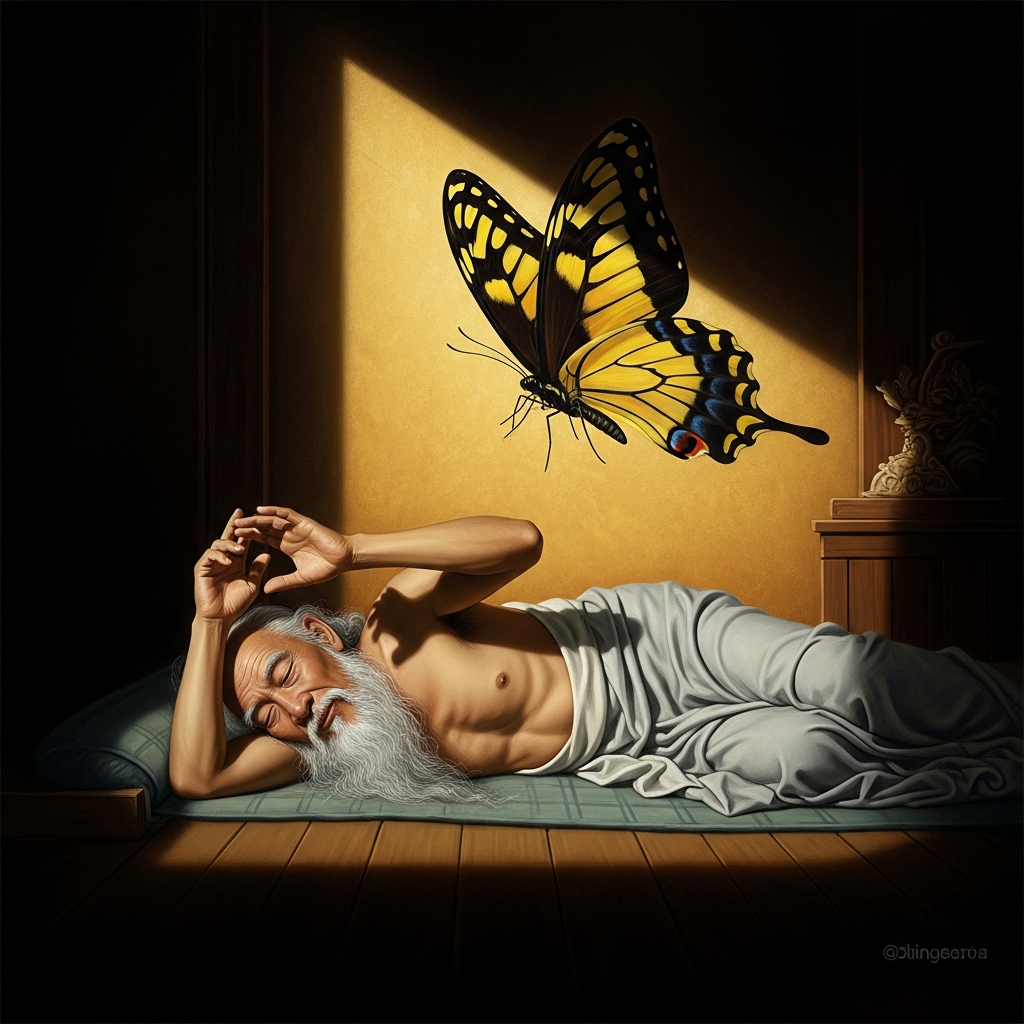
This is not distress. The text is careful about this. Zhuangzi wakes from a dream in which he was a butterfly — fluttering, completely satisfied with what he was, not thinking of himself as Zhuangzi at all — and lies on his sleeping mat in the morning light with a question that most people would dispense with immediately: was that a dream, or is this?
He does not dispense with it.
The question he is sitting with is not whether the butterfly dream was real. It is the more precise and more uncomfortable question: by what criterion, exactly, do I determine that the waking state is primary and the dream is secondary? The butterfly had no awareness of Zhuangzi. Zhuangzi, right now, has awareness of the butterfly. But the butterfly also had — in the dream, which felt completely like waking — complete confidence in its own reality, no sense of being a dream, no thin quality to its colors or sounds that would have marked it as lesser.
He calls the gap between the two states the metempsychosis of things — wu hua, the transformation of things into each other.
The Zhuangzi is not a systematic argument. This is deliberate.
The text is a collection of parables, dialogues, poems, anecdotes, and passages that resist the kind of linear extraction that produces a thesis statement. Scholars have argued about which parts Zhuangzi actually wrote for two thousand years and have not settled the question, partly because the book seems designed to make that kind of question seem slightly beside the point. The Inner Chapters, which are the oldest and densest, do not explain themselves. They demonstrate.
Cook Ding is one of the demonstrations.
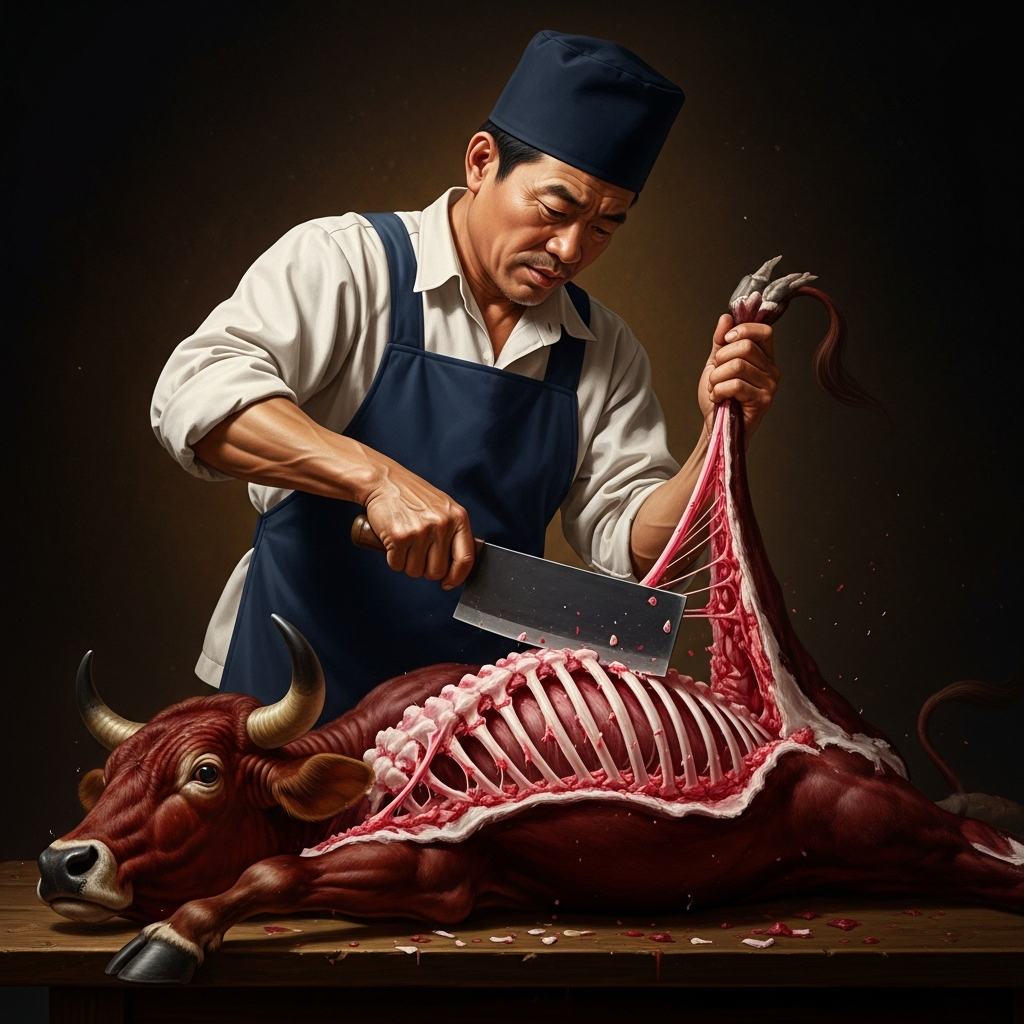
Prince Hui watches his cook butcher an ox and is amazed — the movement is like a dance, perfectly timed, the cleaver singing through the animal without striking bone, every pass going directly to the natural joint, the cavity, the gap where the tendons separate from the skeleton. The prince asks how he does it. The cook’s answer is careful: he stopped seeing the whole ox years ago. He works now with his mind rather than his eyes, and his mind has learned to find the spaces that already exist rather than cutting through the resistance.
There are spaces in the joints and cavities, the cook says. A good cook changes his chopper once a year — because he cuts. An ordinary cook, once a month — because he hacks. My chopper has lasted nineteen years because I insert it where there is already room and do not force it.
This is the same move as the butterfly. The butterfly does not force itself to be a butterfly. Zhuangzi does not force himself to be Zhuangzi. The cook does not force the knife through the ox. There is a way the thing wants to be, a natural articulation, and the practice is finding it rather than imposing an alternative.
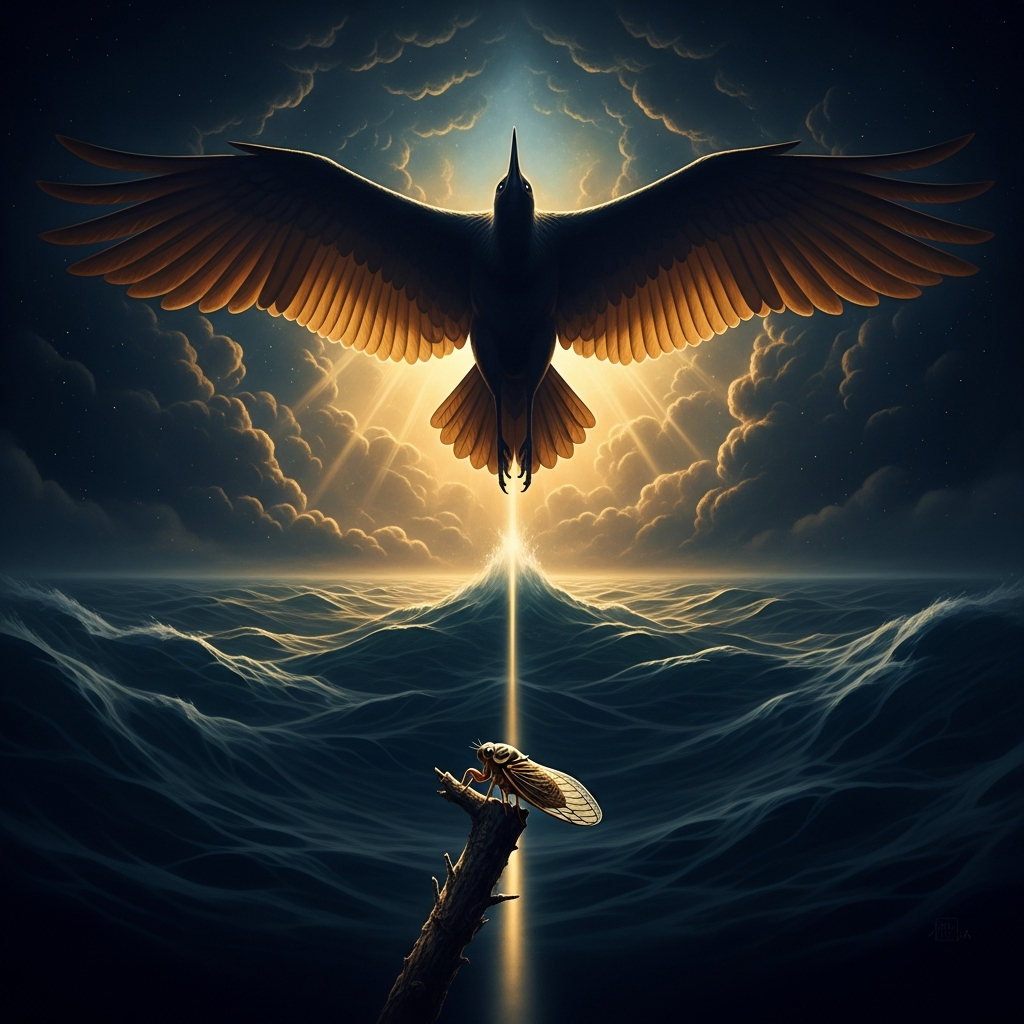
The cicada cannot understand the Pengniao.
The Pengniao is the enormous bird of the north sea, so large that when it rises from the water the displacement creates a storm for three thousand li, so large that it must rise ninety thousand li into the air before it has the atmosphere it needs to carry its weight. It flies from the northern sea to the southern sea. The journey takes some time.
A cicada on a small tree nearby watches the Pengniao rise and comments on the inefficiency. I spring from the elm to the beech, the cicada notes, and if I cannot make it I drop to the ground and try again — what is the use of going up ninety thousand li before flying south?
Zhuangzi is not mocking the cicada. The cicada’s logic is internally consistent. A creature whose entire flight range is between two neighboring trees has no data from which to evaluate the Pengniao’s journey, and the cicada’s assessment — that the elevation is unnecessary — is a perfectly accurate description of what would happen if a cicada tried it. The cicada is applying cicada knowledge to a Pengniao situation. The error is category application, not stupidity.
The butterfly dream is the same teaching from the inside rather than the outside. From inside the dream, the man-category is simply unavailable. The butterfly is not failing to be a man; it is a butterfly completely, at butterfly scale, with no access to the alternative frame. The question Zhuangzi is sitting with on his sleeping mat is: how much of what you call waking is also a frame that you are inside, applying your own categories to a situation that might look entirely different from the Pengniao altitude?
The practice, not the doctrine.
This is what the Zhuangzi is insistent about: it is not a set of propositions to be memorized and applied. Zhuangzi writes about a master swordsman who wins tournaments not because he has the most technique but because he has stopped flinching. He writes about a wheelwright who tells a duke that a book cannot contain the real knowledge because the real knowledge is in the hands of the craftsman and goes to the grave when the craftsman does. He writes about his own response to his wife’s death — his friends find him singing, and when they ask how he can sing at such a time, he explains that he has been thinking about what she was before she was born, and what she will be after, and that grieving is refusing to accept a natural transformation the way the seasons refuse to stay in sequence.
His friends find this unsatisfying. The text does not seem troubled by their reaction.
The butterfly dream is the center of the Zhuangzi not because it answers the question — who is dreaming whom — but because it models the posture the book is trying to teach. You wake up. You hold the question. You do not resolve it prematurely into the comfortable answer, which is that you are the man and the butterfly was just a dream. You sit with the transformation, the wu hua, the fact that things are permeable to each other in ways that your ordinary categorical apparatus does not allow.
The cook’s knife finds the gaps. The dream finds the gap between the man and the butterfly. The Pengniao finds the gap between ninety thousand li of altitude and the cold surface of the northern sea.
Zhuangzi is sitting up on his sleeping mat, probably. The light is coming in at an angle.
He is not anxious. He is not making an argument. He is doing the thing the Zhuangzi recommends: noticing that the effort of maintaining the boundary between the man-state and the butterfly-state is effort — your effort, ongoing, right now — and that the boundary is something you are producing rather than something you are simply reporting.
He will get up in a moment. He will eat breakfast. He will be Zhuangzi all day, with excellent fidelity, because Zhuangzi is what the current configuration of things is doing right now and it is doing it completely. The butterfly was equally complete.
The transformation of things is the Zhuangzi’s subject, and the text is itself a transformation — it arrives in you as philosophy and then keeps moving, becoming parable, becoming joke, becoming the image of a very large bird that you cannot see from where the cicada sits. By the time you try to say what it teaches, it has already become something else.
The butterfly is the book. The book is the dream. You are the one who woke up inside it.
Scenes
Zhuangzi on his sleeping mat, just woken, one hand raised to touch his own face
 Generating art…
 Cook Ding at work — the ox opened along its natural joints, the cleaver never striking bone, moving through the cavities where the tendons meet the skeleton
 Generating art…
 The Pengniao, the enormous bird whose wingspan darkens the sky for ninety thousand li, rising from the northern sea
 Generating art…
 Echoes Across Traditions
Entities
- Zhuangzi
- Cook Ding
- Pengniao
- Liezi
Sources
- Zhuangzi, *Zhuangzi: The Complete Writings* (Brook Ziporyn trans., Hackett, 2020)
- Burton Watson (trans.), *The Complete Works of Chuang Tzu* (Columbia University Press, 1968)
- A.C. Graham (trans.), *Chuang-tzu: The Inner Chapters* (George Allen and Unwin, 1981)
- Martin Palmer, *The Book of Chuang Tzu* (Penguin, 1996)
- Wolfram Eberhard, *A Dictionary of Chinese Symbols* (Routledge, 1986)