Valmiki Becomes the First Poet
~3rd-1st century BCE · Ramayana traditional composition · The forest hermitage above the Tamasa, a tributary of the Ganga
Contents
A bandit named Ratnakara watches a hunter shoot a male krauncha bird mid-mating; grief tears a curse out of his mouth in perfect meter — the first shloka in Sanskrit. The bandit becomes the sage Valmiki, and from that single grieving line the Ramayana unspools.
- When
- ~3rd-1st century BCE · Ramayana traditional composition
- Where
- The forest hermitage above the Tamasa, a tributary of the Ganga
His name was Ratnakara, and for years he killed travelers on the forest road.
He was not unusually cruel. He was not unusually clever. He had a wife and children, and the road provided. He stopped the carts that came down out of the hills, asked for what they had, killed the ones who refused, took the rest home. The villages on either side of the road knew his name. The travelers warned each other. He was the practical fact of the road, the way a flooded crossing is a practical fact: something to be planned around.
The story that turned him says that the sage Narada walked down the road one day and Ratnakara stopped him for everything he had. Narada had nothing — a vina, a blanket, the loose-toothed smile of a wandering man who had outlived his fear of bandits — but he asked Ratnakara a question.
The killing you do for your family — does your family share the karma of it?
Ratnakara had never thought about it. He went home and asked. His wife said no. His children said no. His father said no. The killing, they explained, had always been his to do; the bread it bought was theirs to eat, but the karma was his. He came back to the road and sat down at Narada’s feet.
Narada gave him a single instruction.
Sit here. Sit until I return. Repeat the name of Rama until you forget you are repeating it.
But Ratnakara could not say the name. The syllables tangled in his mouth. Years of speaking the language of the road had stripped his tongue of the sound. Narada watched him struggle for a moment and then offered him a smaller word — mara — death — which Ratnakara could say. Mara mara mara, repeated quickly enough, becomes Rama Rama Rama. The bandit took the syllable he could pronounce and began.
He sat.
He sat for so long that an anthill grew over him. The Sanskrit word for anthill is valmika. When the sage returned and called him out — when the syllables had worn his old name down and replaced it — the man who emerged from the mound was no longer Ratnakara. He was Valmiki. He of the Anthill. He had been buried alive in his own repetition and come up with a new mouth.
The hermitage above the Tamasa river is where he settled. A small clearing, a thatch hut, a few disciples, the long quiet of a man who had finished being one thing and was waiting to find out what came next.
It was an ordinary morning when it happened.
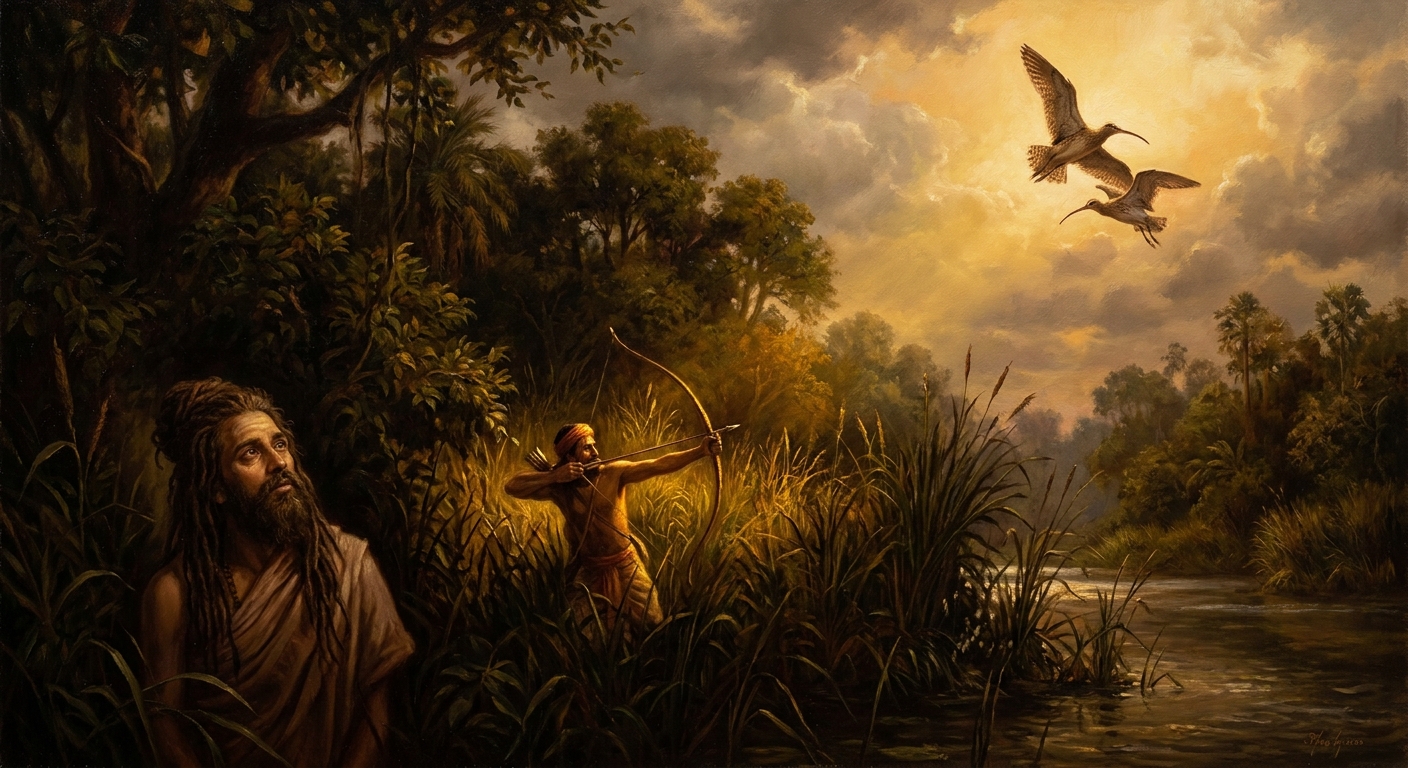
Valmiki walked down to the river to bathe. The Tamasa moved low and clear over its stones; egrets stood in the shallows; the air smelled of wet bark and woodsmoke from a distant village. A pair of krauncha birds — sarus cranes, white-throated, red-headed, the species that mates for life — were spiraling together in the air above the water. A male and a female, in flight, calling to each other in the deep paired note that krauncha mate-pairs call. They landed on the sandbar. They began the slow ritual of mating, the bowing of the long necks, the fluttered wings, the brief moment when the male arches above the female.
A hunter stepped out of the reeds.
He had been waiting, motionless, for exactly this moment. His bow was already drawn. He did not see Valmiki. He did not see anything except the cleared shot — the male bird, perfectly exposed, head thrown back in the cry that mates make when they meet. He released the arrow.
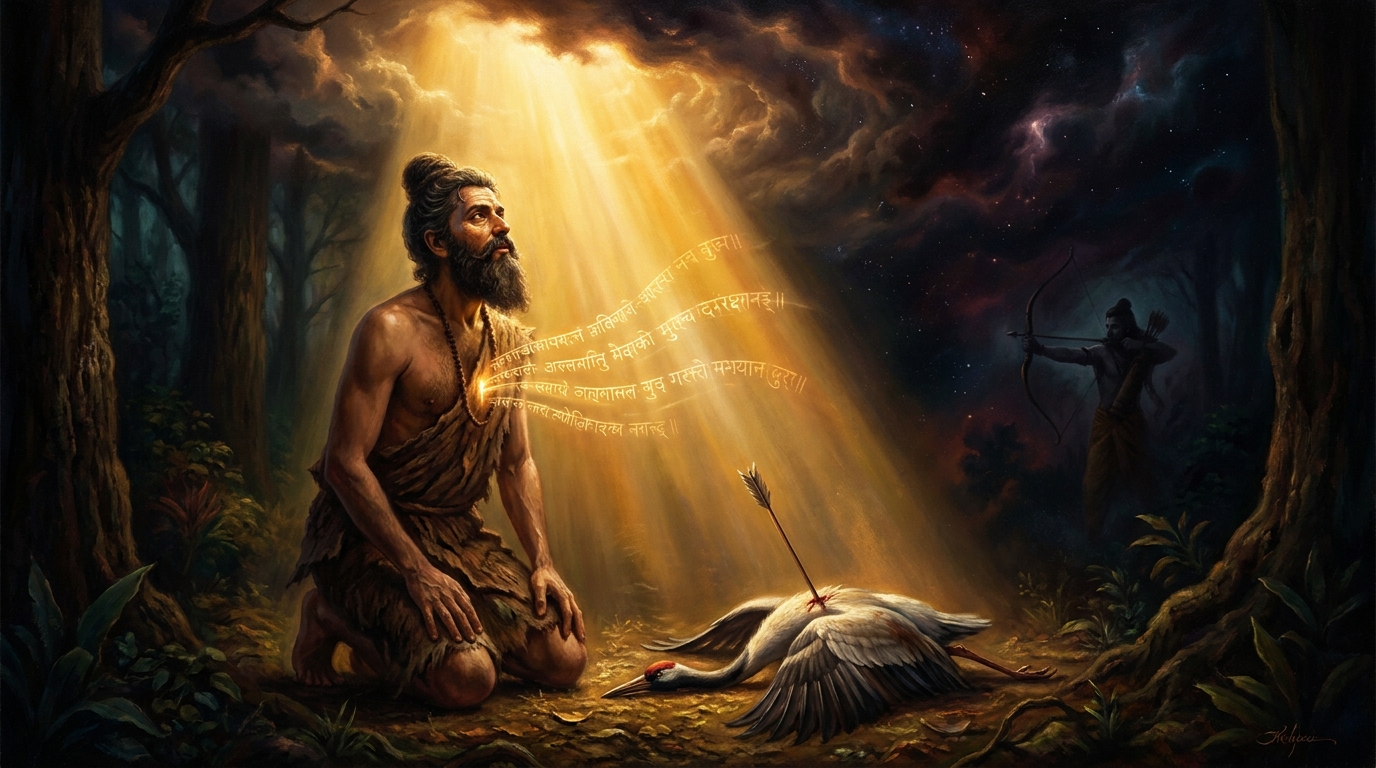
The arrow struck. The male krauncha came down on the sandbar in a tangle of feathers and red blood. The female stood beside him, beating her wings against the air, calling the paired note to a body that would not call back. She would not stop calling. The hunter began to move toward the kill.
Valmiki — without planning to, without thinking — opened his mouth.
What came out was metered.
Ma nishada pratishtham tvam agamah shashvatih samah Yat krauncha-mithunad ekam avadhih kama-mohitam
Hunter, may you find no resting place for endless years to come — for you have killed one of this pair of krauncha birds in the moment of their love.
It was a curse. It was also, he realized as the second line completed itself in his mouth, a verse. Two lines. Each line eight syllables, then eight more — sixteen syllables a line, thirty-two total. The syllables had arranged themselves around his grief like crystal around a seed. They had a structure that he had not chosen. They had a meter that had not existed in Sanskrit before this morning. They had emerged in form.
He stood on the bank of the Tamasa with the dead bird in his eye-line and the female still calling, and he understood, slowly, that he had just spoken something the world had not previously contained.
His disciples, who had walked down behind him to bathe, were staring. Master, one of them said carefully, what was that?
Valmiki did not know. He repeated the lines. They came out the same way the second time — exact, eight-by-eight, the cadence locked.
A shloka, he said, hearing the word as he chose it. I think we will call this a shloka.
He climbed back up to the hermitage in silence.
He sat on the ground outside his hut. The grief had not finished moving through him. The female krauncha’s call still echoed somewhere behind his sternum. He could feel the meter still in his mouth — the shape it had cut, the way the eight syllables wanted to fall against eight more — and he could feel that it wanted more. The shloka had not been a single utterance. It had been the first cell of something. Other shlokas were waiting in the same shape behind it. He could feel them coming up.
The afternoon was strange. He spoke to no one. He kept saying the lines under his breath and finding new ones forming behind them. By evening the disciples had stopped trying to ask him questions and were just sitting nearby, watching their master invent a thing.
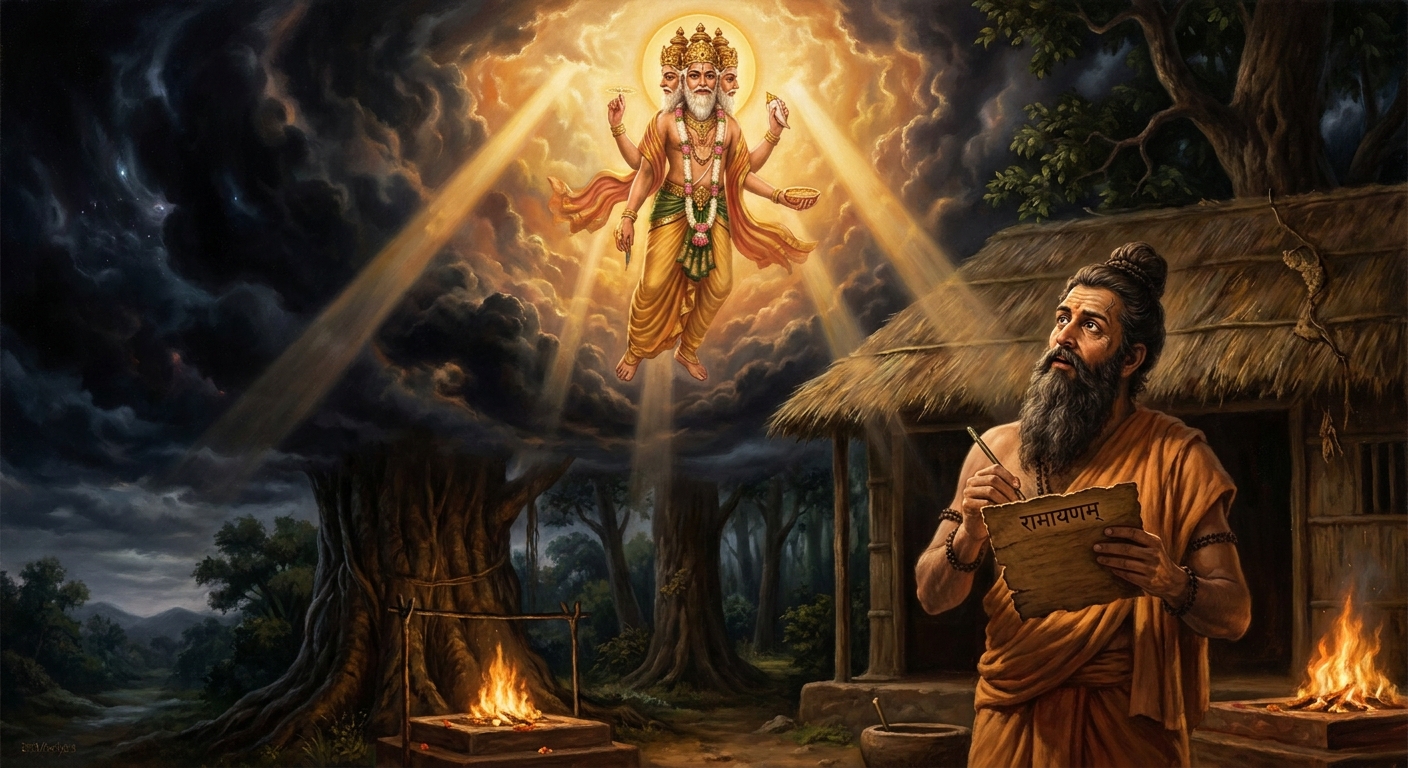
Then Brahma walked into the clearing.
The four-faced god of creation came down personally — the texts insist on this, even with their characteristic disregard for plausibility — and stood in front of the seated sage and smiled. I have been waiting for the meter, he said. The cosmos has been waiting for it. You composed it this morning. Now I will tell you what to compose in it.
He gave Valmiki the assignment. Tell the story of Rama. Every detail you do not know, you will see directly as you need it. Every line you set in this meter will be exactly true. The story will outlast the language. Begin.
He left.
Valmiki sat with the bark sheets in his lap.
He picked up the stylus. The female krauncha was still calling somewhere down at the river — or perhaps she had stopped, perhaps the silence he heard was his own. The first shloka of the Ramayana came into his mouth the way the curse had come into his mouth, fully formed, eight by eight, the cadence locked.
The second shloka came. The third. The fourth. By dawn he had a hundred. By the end of the year he had filled rooms. The story had been waiting for the meter; the meter had been waiting for the grief; the grief had been waiting for a hunter who would shoot a bird in the wrong moment so that a former bandit could open his mouth and become a poet.
Twenty-four thousand verses. Seven kandas. The journey of the prince Rama from his palace to his exile to the forest to the kidnapping of his wife to the army of monkeys to the burning of Lanka to the great war and the contested return — all of it composed in the meter that had walked into a man’s mouth on a riverbank because two birds had been mating and a hunter had not waited.
Sanskrit poetry, in the tradition’s own account, begins in the wrong moment. Not in a temple. Not at a sacrifice. On a sandbar by a small river, when a man’s grief at someone else’s killing tore a shape out of him in eight-by-eight syllables and the shape held.
Hindu literary theory has spent centuries on this. Why grief? Why a curse? Why does the foundational poem in the language begin not with praise of the gods but with a recoil at violence interrupting love? The answer the tradition keeps arriving at is: because grief is more honest than praise. Praise can be performed. Grief comes whole, in its own meter, before the speaker has decided whether to speak.
Valmiki’s curse never fell on the hunter. The hunter walked away. But the meter the curse arrived in became the vehicle for the entire moral imagination of South Asia for two thousand years. The bird died. The female kept calling. The bandit became the poet. The shloka became the Ramayana. And every Indian poet since has been writing inside a meter that began as someone’s grief on a riverbank that no one would have remembered if a krauncha had not been killed in the wrong moment.
Scenes
On the bank of the Tamasa, two krauncha birds spiral together in mid-mating flight
Generating art… The arrow flies
 Generating art…
 Brahma descends to the hermitage
 Generating art…
 Echoes Across Traditions
Entities


Sources
- Valmiki *Ramayana*, Bala Kanda 1-2 (the Krauncha-vadha episode)
- *Adhyatma Ramayana*
- Robert Goldman (trans.), *The Ramayana of Valmiki, Vol. I: Balakanda* (1984)
- Wendy Doniger, *The Hindus: An Alternative History* (2009)
- R.K. Narayan, *The Ramayana: A Shortened Modern Prose Version* (1972)