Krishna Reveals Himself
Mythic Time · Mahabharata composed ~3rd century BCE · Kurukshetra — between two armies
Contents
On the eve of the Kurukshetra battle, Arjuna begs his charioteer Krishna to show his true form. What opens before him is not a god but the architecture of existence itself — all creation, all destruction, time swallowing worlds — and the vision nearly breaks him.
- When
- Mythic Time · Mahabharata composed ~3rd century BCE
- Where
- Kurukshetra — between two armies
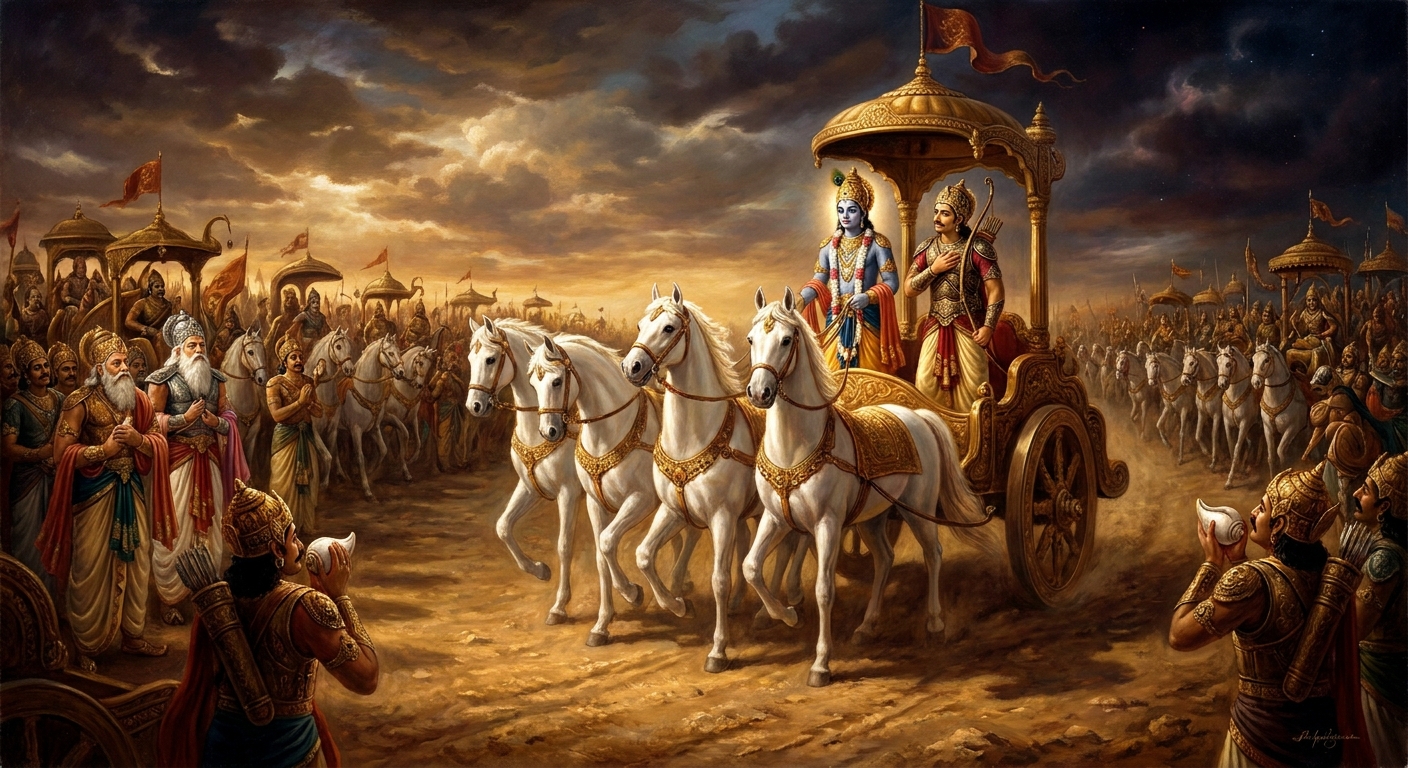
The armies stand facing each other in the grey before dawn.
Arjuna stands in the chariot between the lines with his bow in his hand and looks at the men he is about to kill. Not enemies. His grandfather Bhishma, white-haired, in Duryodhana’s ranks. His teacher Drona, who taught him everything. Cousins. Uncles. Half the men he has loved. He looks at them and his legs stop working. The bow falls. He sinks into the chariot floor and says to Krishna: I cannot do this. It is better to be killed unarmed than to kill these men.
Krishna listens.
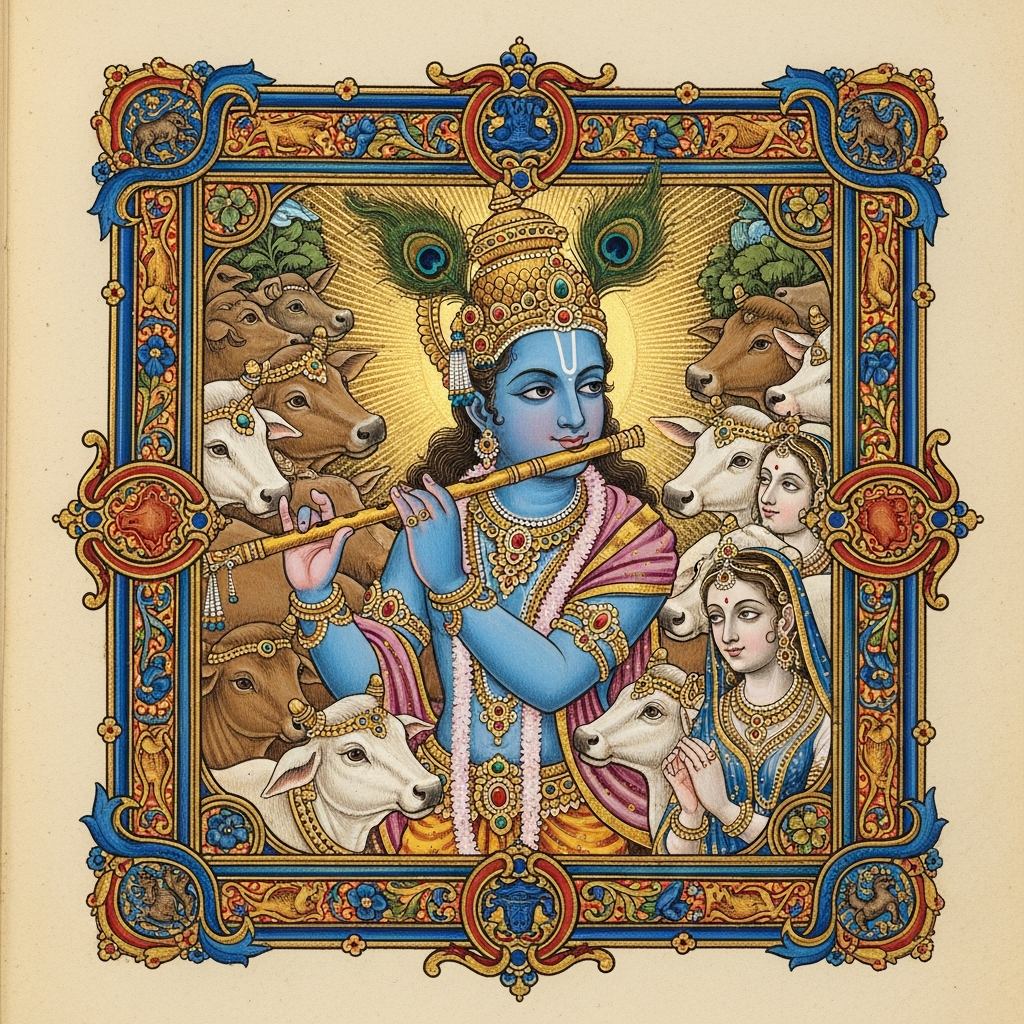
Then Krishna speaks — and what begins as a lesson in duty becomes something else entirely. The charioteer who has been riding beside Arjuna for years, blue-skinned, laughing, unhurried, begins to say things no charioteer should know. He speaks of the soul that cannot be cut by weapons or burned by fire. He speaks of action without attachment, of the cosmos as sacrifice, of the self as the field and the knower of the field. He speaks for eleven chapters in a voice that keeps getting quieter and quieter as Arjuna keeps leaning in.
Then Arjuna makes the mistake of asking to see the truth.
Show me your real form, he says. If you are what you claim to be, show me.
Krishna warns him. He warns him the way a physician warns a patient before cutting: This will be difficult. He gives Arjuna divine sight — the eyes that can receive what ordinary eyes would simply close against — and then he opens.
What opens is not a body. It is everything at once.
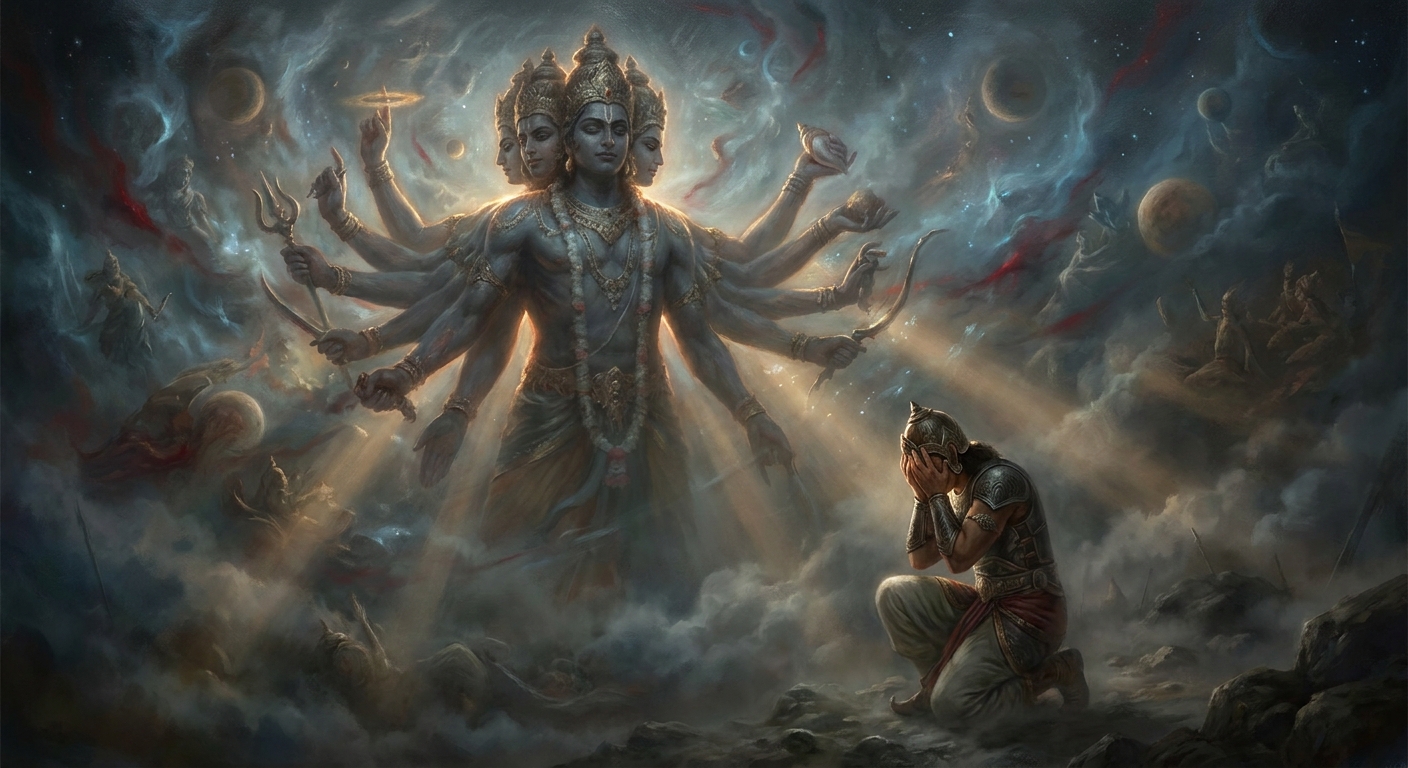
Thousands of mouths. Thousands of eyes. Thousands of arms spreading in every direction without ending. Sun and moon as his eyes. The sky as his form. Every direction filled. Gods, demigods, celestial beings — all present, all inside. The brightness of a thousand suns igniting simultaneously in the sky — that brightness, the Gita says, might resemble the radiance of that great being.
Might. Because there is no comparison that holds.
Arjuna stares into the face of time.
He sees the warriors on both sides of the field — the ones he could not bring himself to kill — flowing into the mouths of Vishvarupa the way rivers flow into the sea. Flowing and not returning. He sees Bhishma going in. He sees Drona going in. He sees himself reflected in a thousand eyes and understands that he is also inside this, also going in.
Who are you? he asks. His voice, the Gita says, is filled with fear.
I am Time, Krishna answers. The great destroyer of worlds. I am here to devour them. Even without you, these warriors will not survive. You are only the instrument.
This is the moment Oppenheimer remembered in the desert in New Mexico in 1945, watching the first atomic fireball eat the sky. He said afterward, in his careful voice: “Now I am become Death, the destroyer of worlds.” He was quoting the eleventh chapter of the Bhagavad Gita as it came back to him while the mushroom cloud climbed. The text travels. The vision does not wear out.
Arjuna’s hair stands on end.
He cannot stand. He cannot find the thread back to the practical world — to the battle, the tactics, the decision about whether to fight. All of that has become very small. He is looking at the machinery beneath the surface of everything, and it is not comforting machinery. It is not a benevolent engine. It is indifferent, which is worse. It would eat the righteous and the wicked with the same open mouths, and the eating is not punishment — it is simply what time does, which is what Krishna is, which is what this form is showing him.
He covers his eyes. Then he uncovers them because covering does not help.
I cannot look at you, he says. Have mercy. Go back. Be my friend again.
This is the sentence that cuts the scene open.
Arjuna does not say: show me more. He does not say: I understand now, I am enlightened. He says: go back. Be the charioteer again. Be the one who is my size, who rides beside me, who I can argue with. The vision of the absolute is not something the human can live inside. It is a visit, not a residence.
Krishna closes. The universal form folds back. The charioteer stands in the chariot again, blue-skinned, four-armed — then two-armed, then simply a person, simply the friend Arjuna has known for years.
This form, Krishna says, which you have seen — even the gods are always wishing to see it. Not by study, not by austerity, not by charity, not by ritual, can a man see me as you have seen me. Only by devotion.
Arjuna gets up off the floor of the chariot.
He picks up his bow. He does not pick it up because the vision convinced him that war is just, or that his enemies deserved to die, or that the cosmos approves of violence. He picks it up because he has seen the scale. Against the scale of what is actually happening — time consuming worlds, the machinery of existence going about its business without consultation — his personal anguish about one battle on one field on one morning is precisely as large as it is and no larger. The grief is real. The cousins are real. Their deaths will be real. And the cosmos does not pause.
This is not comfort. It is orientation.
He breathes. The conches sound on both sides of the field. The battle of Kurukshetra begins.
The Vishvarupa appears in the Bhagavad Gita as a gift nobody asks for twice. Arjuna asks once. He gets it. He immediately asks for it to stop. Every theophany in every tradition lands the same way: Moses hides his face, Ezekiel falls prone, Paul goes blind, the disciples fall on their faces on the mountain. The real thing, unmediated, cannot be received without losing the receiver.
The Gita’s answer is not to pursue that vision. It is to act — in the world, with the world’s tools, with devotion as the method and equanimity as the goal. You have seen what time actually is. Now pick up your bow.
Oppenheimer understood this. He quoted the text correctly. He also, by most accounts, never recovered.
Echoes Across Traditions
Entities


Sources
- *Bhagavad Gita* 11 (the Vishvarupa chapter)
- *Mahabharata*, Bhishma Parva
- Eknath Easwaran (trans.), *The Bhagavad Gita* (2007)
- Robert Oppenheimer, quoting the *Gita* after the Trinity test, 1945: *'Now I am become Death, the destroyer of worlds.'