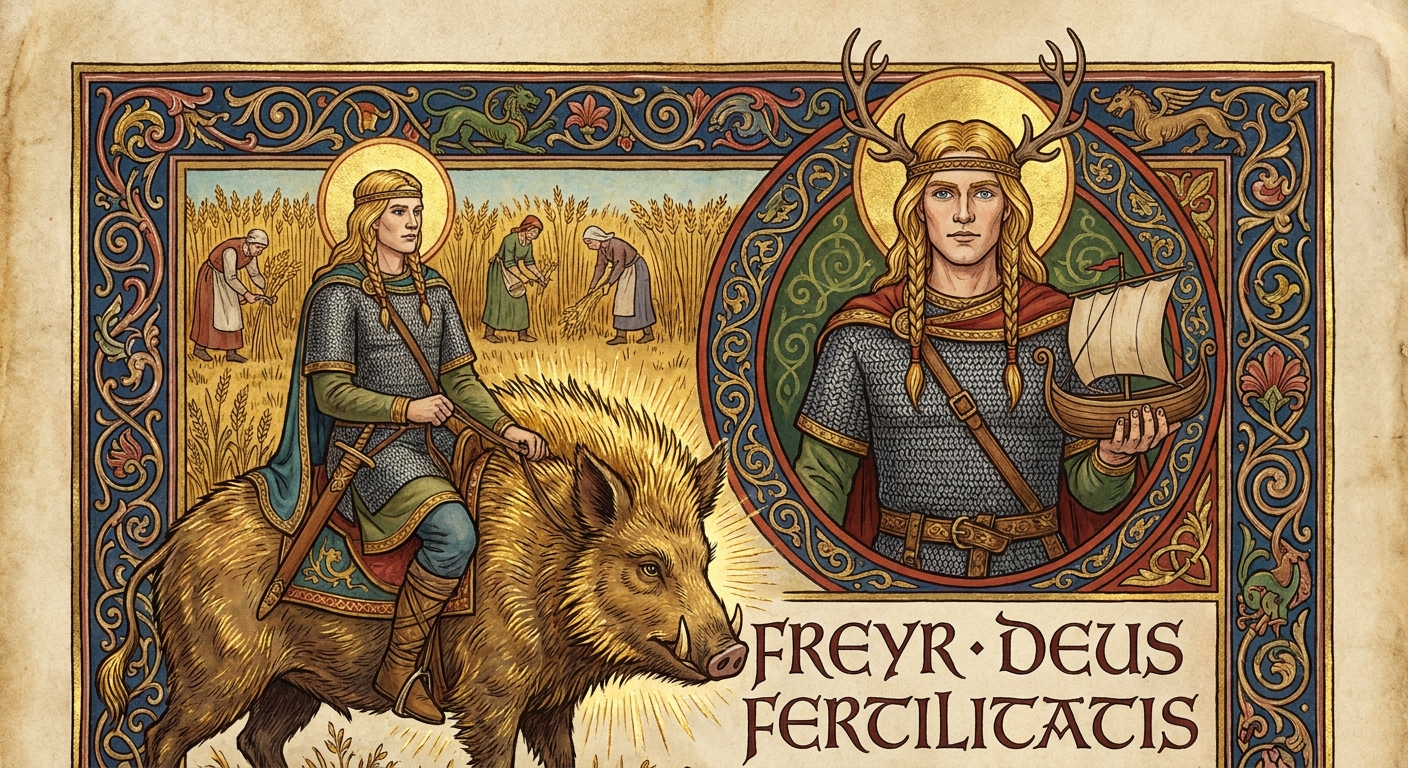
Freyr and Gerðr: The Price of Desire
Mythic time (recorded in *Skírnismál*, Poetic Edda; Snorri Sturluson, *Prose Edda*, Gylfaginning 37) · Hlidskjalf in Asgard; Jotunheim, the hall of Gymir; the grove of Barri; and finally the plain of Vigrid at Ragnarök
Contents
Freyr, the god of sun and rain and harvest, sits in Odin's forbidden seat and sees a Jotun woman whose raised arms fill the sky with light. He gives away his magic sword to win her. At Ragnarök, he faces the fire-giant Surtr without it and dies. The trade was made with open eyes.
- When
- Mythic time (recorded in *Skírnismál*, Poetic Edda; Snorri Sturluson, *Prose Edda*, Gylfaginning 37)
- Where
- Hlidskjalf in Asgard; Jotunheim, the hall of Gymir; the grove of Barri; and finally the plain of Vigrid at Ragnarök
He is not supposed to be in that seat.
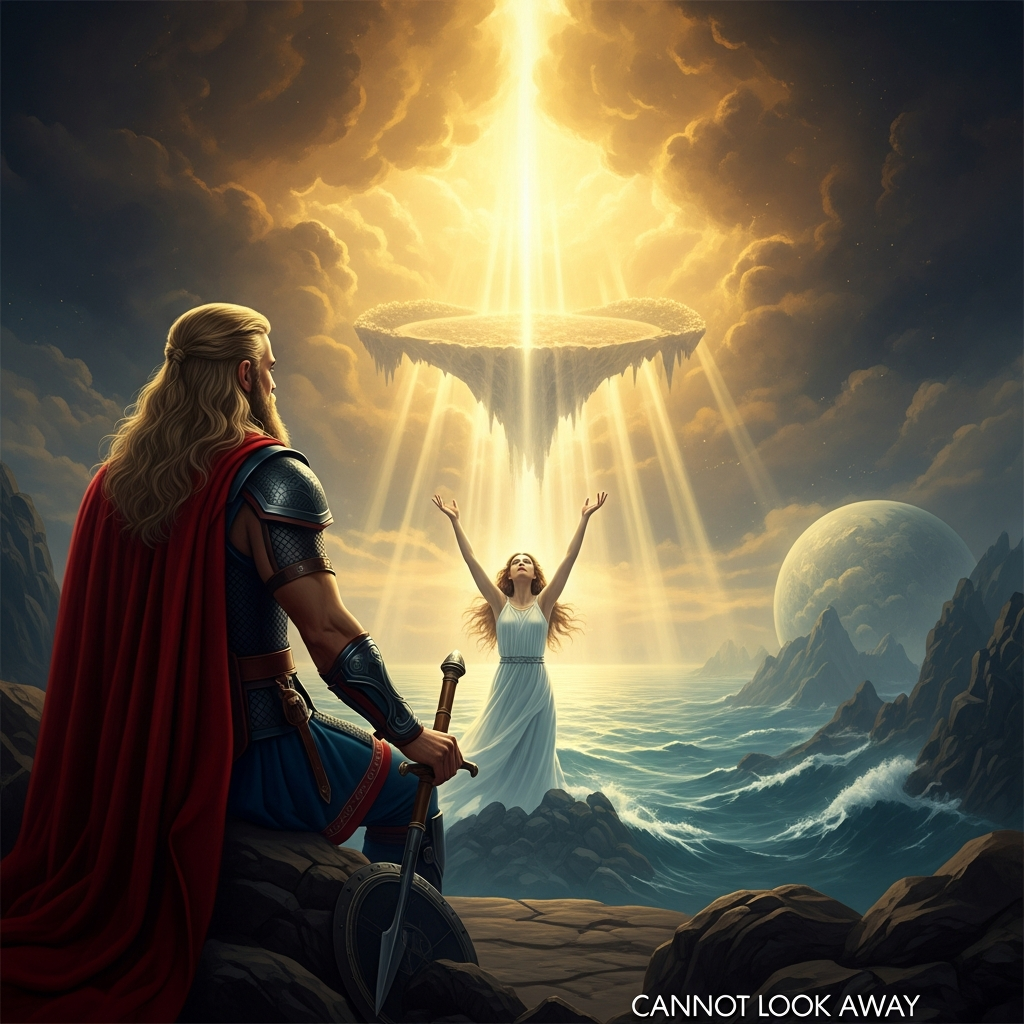
Hlidskjalf is Odin’s — the high seat at the top of his tower, from which the All-Father can look out and see everything that moves in the nine worlds at once. It is not shared. The prohibition is not a rule so much as a property of the thing: looking from Hlidskjalf without being Odin does something to you that cannot be undone. He sits in it anyway.
He is Freyr, son of Njörðr, lord of the Vanir, the god who makes grain grow and rain fall and cattle multiply, the god whose erection carved in wood stands in every farmyard in Scandinavia because he is what the land needs. He has sat in Hlidskjalf because he was curious, or bored, or because the seat was there and Odin was not and he is the god of abundant things and abundance has never taught him restraint.
He looks out across the nine worlds.
Jotunheim is gray and cold and enormous — the home of the giants, the enemies, the things from before the gods arranged the world into something habitable. He has looked at Jotunheim before without feeling anything except the watchfulness appropriate to looking at a place full of things that want to destroy what he loves.
Then Gerðr opens the door of her father’s hall.
She raises her arms. He will never be able to explain what happens in that moment, not to Njörðr, not to Skírnir, not to himself. Her skin is not illuminated; it is illuminating. The light that comes from her raised arms crosses Jotunheim and reaches the sea that separates the worlds and keeps going, and for a moment — for a long, arrested, terrible moment — the sky and the sea are lit together from a single source that has nothing to do with the sun, and Freyr, from Hlidskjalf, sees all of it.
He leaves the seat. He walks back to his hall. He does not eat. He does not sleep. He does not speak.
His father Njörðr comes. His sister Freyja comes. He does not speak to either of them. He sits in the particular silence of a creature who has looked at something it cannot look away from and has not yet figured out what to do about that.
Skírnir comes.
He is Freyr’s servant, his man, the one who does what Freyr requires when Freyr requires something done. He asks: what is wrong with you? And Freyr tells him. He is specific — specific in the way of people who have been silent for days and have organized everything they want to say while waiting for someone to ask. He describes the hall in Jotunheim. He describes the arms. He describes the light.
Skírnir says he will go to Jotunheim and win Gerðr for him. He says: I need your horse, which goes through dark and fire. He says: I need your sword.
The sword is not an ordinary sword. It fights of its own accord in the hands of a wise man — the Prose Edda says this, and it says it plainly, with the meaning fully attached. It is the sword that would have fought for Freyr at Ragnarök, the day when the fire-giant Surtr comes out of Muspelheim with his blade brighter than the sun. Without the sword, Freyr has no weapon equal to what he will face.
Freyr gives Skírnir the sword.
He does this knowing. The eddas are careful about this. He is a god; he has seen enough of fate to understand the shape of what he is trading. He gives the sword to Skírnir in the full knowledge of what the sword is and what it will be unable to do in a world where Skírnir has it instead of him.
He gives it away because the alternative is not having tried.
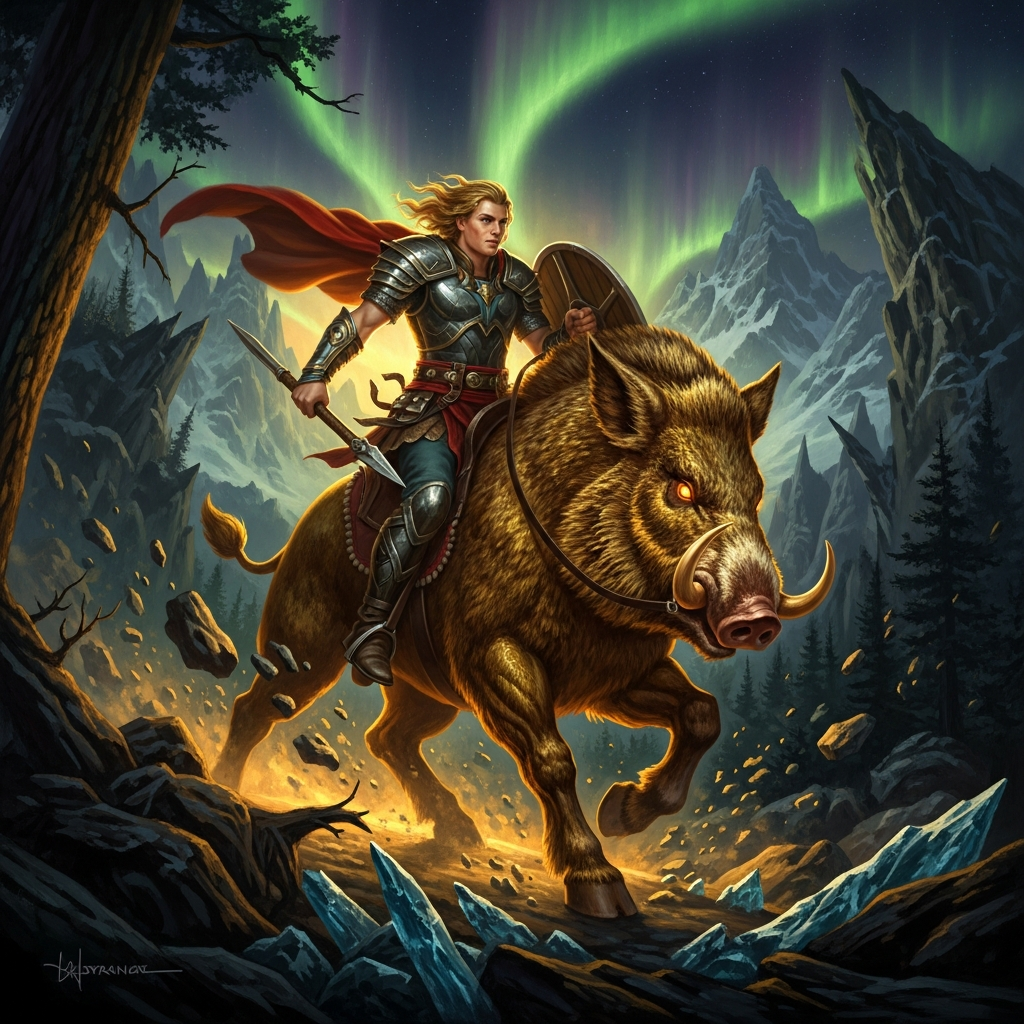
Skírnir rides to Jotunheim on Freyr’s horse, which crosses the fire at Jotunheim’s border as casually as a horse crosses a stream. He finds the hall of Gymir — Gerðr’s father, one of the great old giants — and it is ringed by fire, and the dogs outside are enormous, and the shepherd he meets on the way warns him that nothing good has ever come out of trying to speak with Gerðr.
He speaks with Gerðr.
He offers her golden apples — eleven of them, the apples of eternal youth. She refuses. He offers her the ring Draupnir, which drops eight equal rings every ninth night. She refuses. He sits for a long moment in her courtyard, thinking about this, and then he does what people do when gifts fail: he reaches for fear.
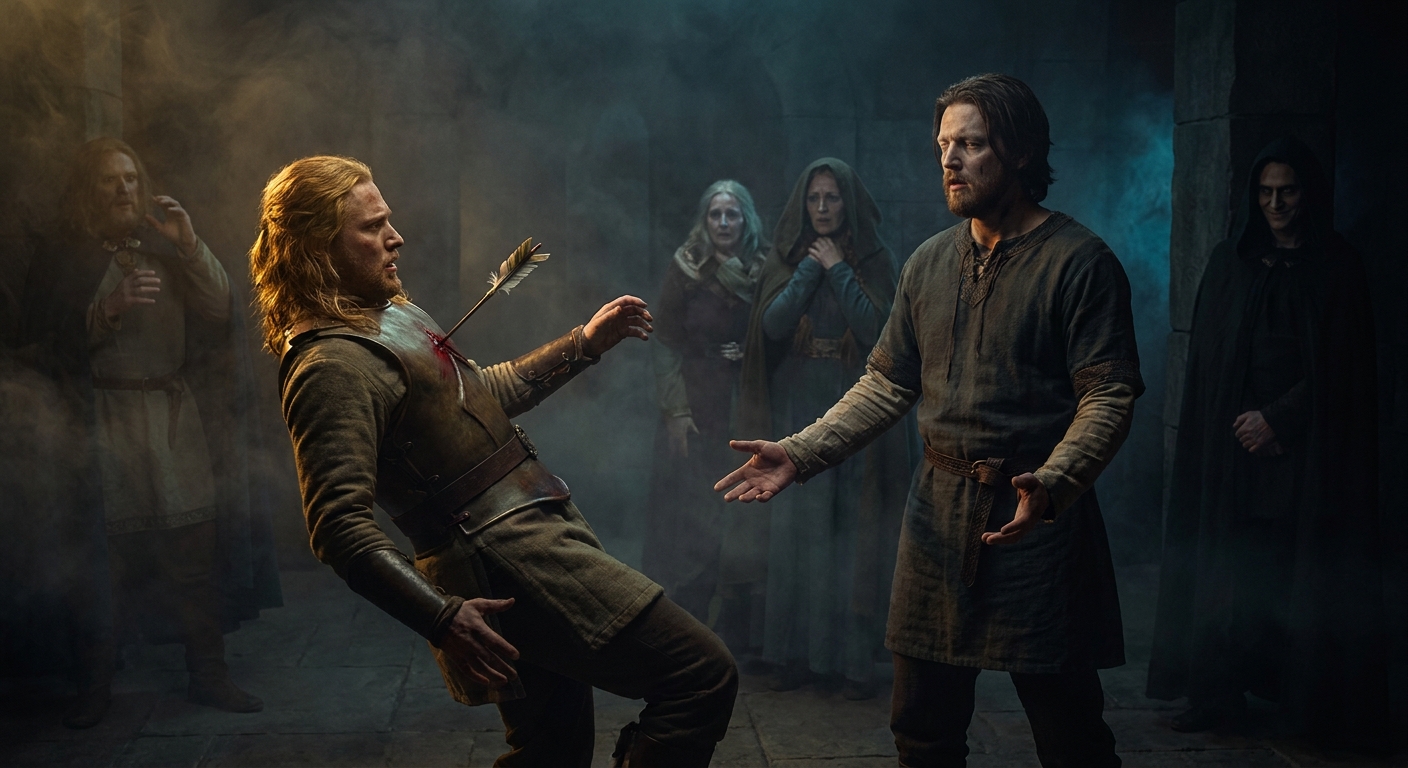
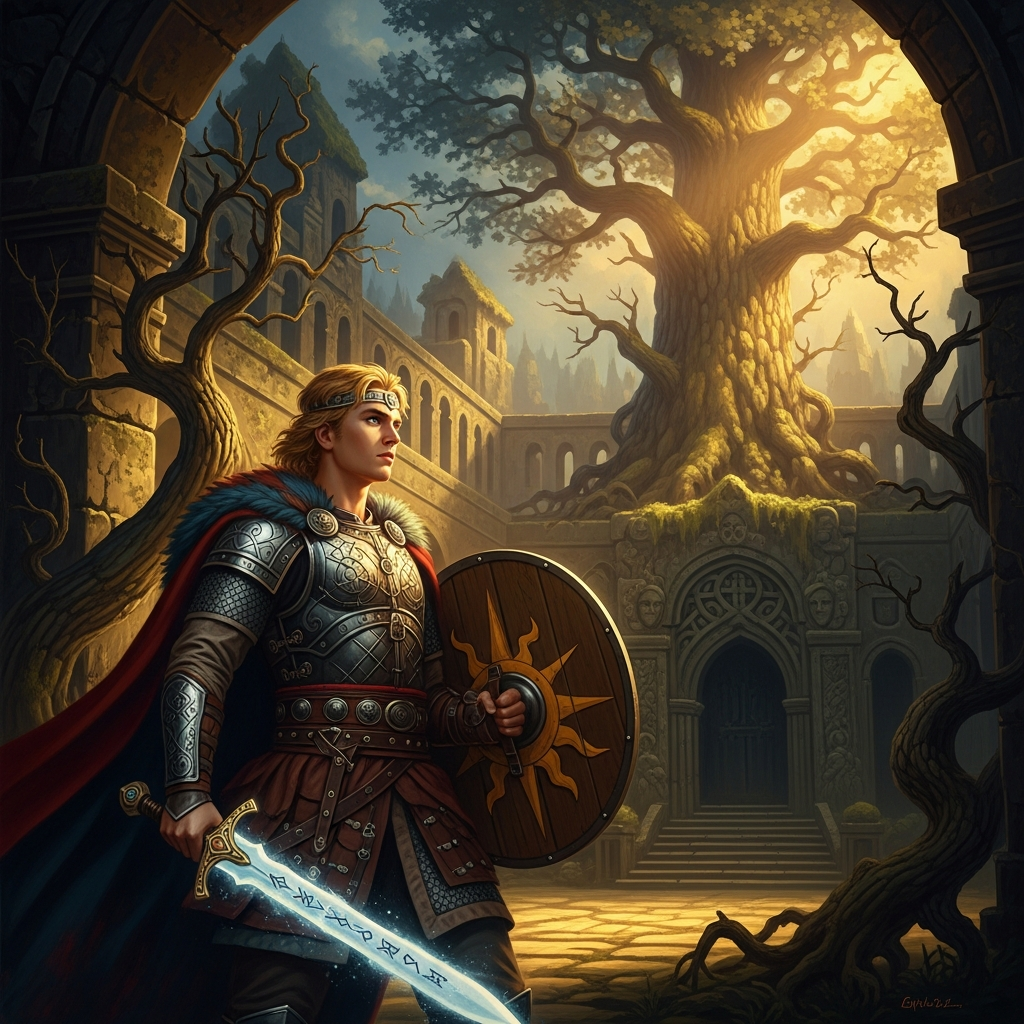
He threatens her with the magic staff he carries. He threatens to carve runes into it that will give her to a three-headed giant in a place below the worlds where she will sit at the edge of Hel and watch giants piss and be fed on nothing but goat’s urine and never have anything she wants. He carves the runes while he speaks. He speaks the curse into the wood. The runes go into the staff and the staff goes into the air and the words enter Gerðr’s hearing the way curses enter when the caster knows what he is doing.
She agrees.
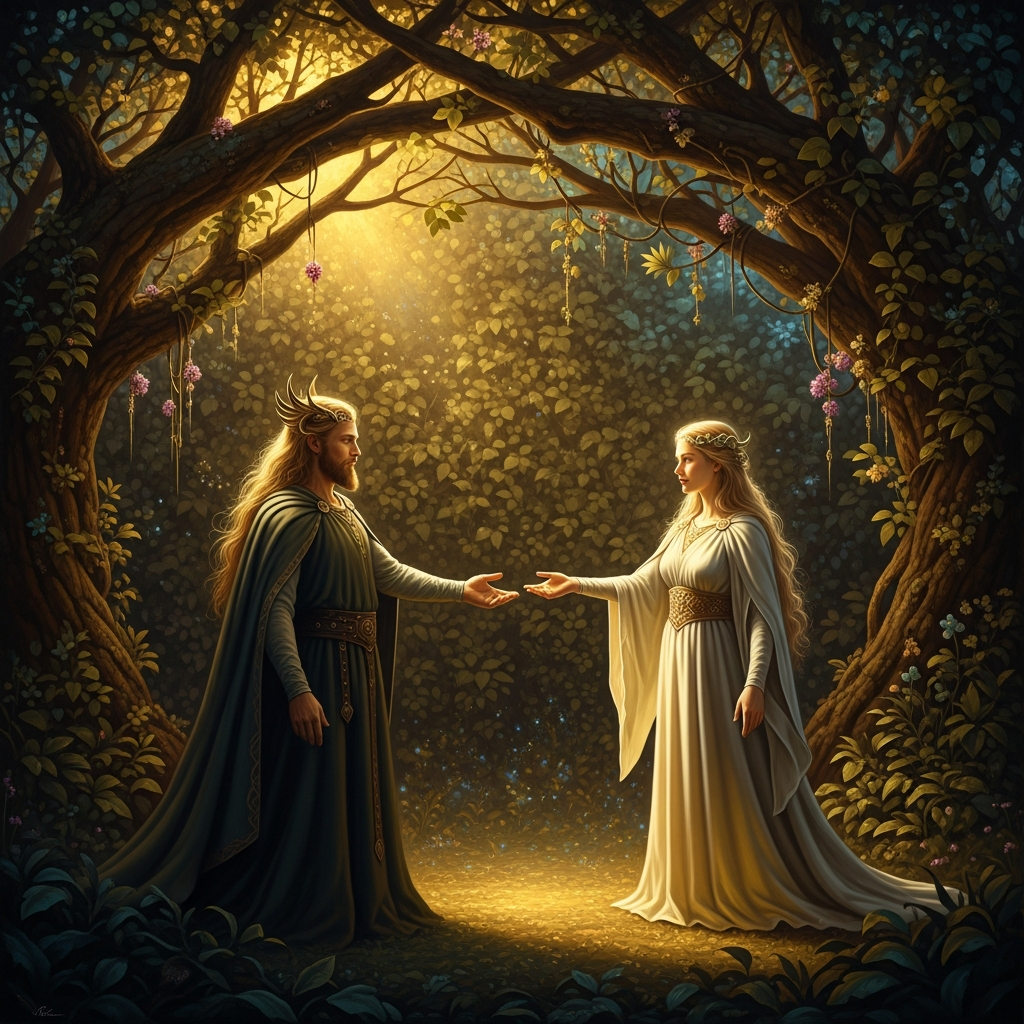
She names a grove — Barri, the grove of barley — and she names a time: nine nights. She will meet Freyr in nine nights in the grove of Barri.
Nine nights is too long.
The Skírnismál ends with Freyr’s voice, which is the voice of a god who has never waited for anything in his life and is now waiting for nine nights in the worst possible weather, which is the weather inside his own head. He says: long is one night, longer are two, how shall I endure three? The solstice was shorter than this half-month in which I awaited my woman.
Nine nights pass.
He goes to Barri. What happens in Barri is not described. The poem has them meet and then moves on, which is the correct decision: what passes between Freyr and Gerðr in the grove is not the theology of the story. The theology of the story is the sword, already gone, and what will happen at Ragnarök without it.
Ragnarök comes in its time.
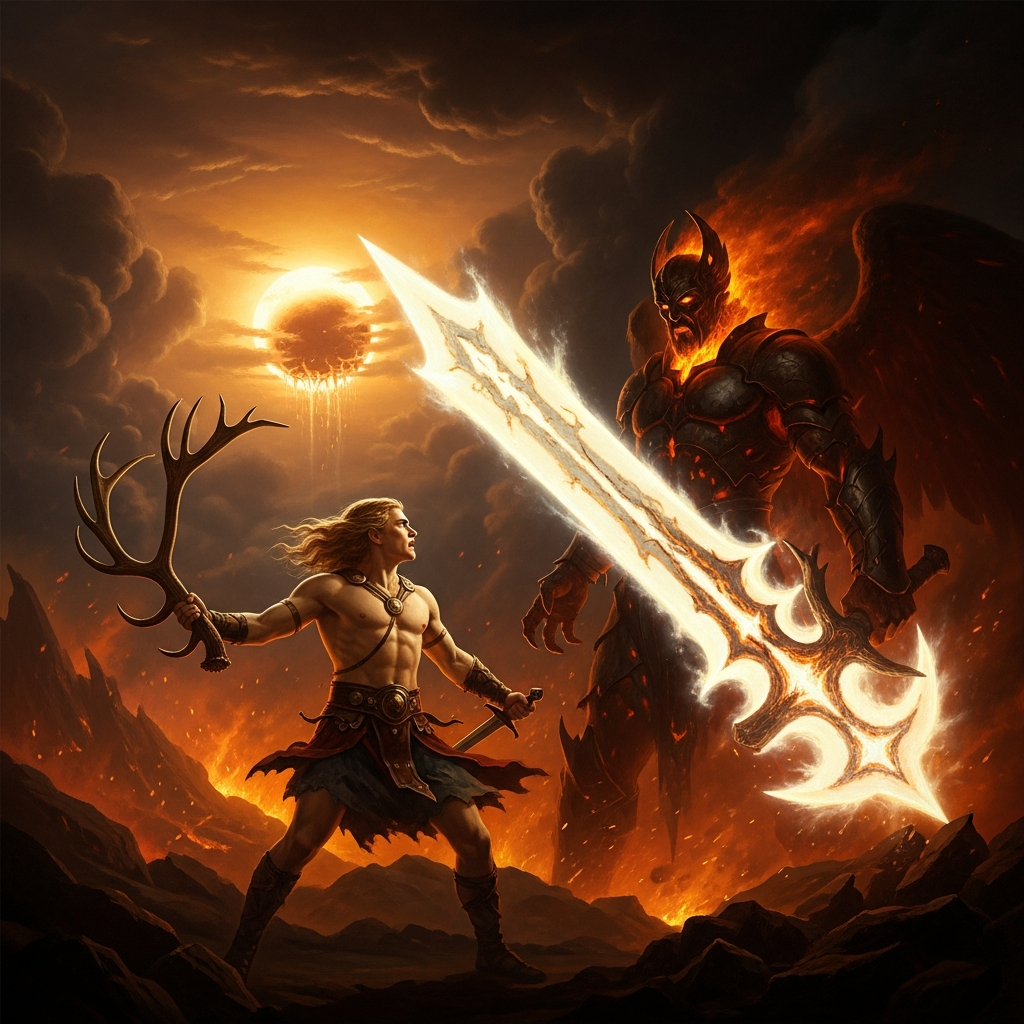
Freyr is on the plain of Vigrid with the other gods, and the fire-giant Surtr is there with his army, and Surtr’s sword is brighter than the sun the wolves have eaten. Freyr faces Surtr. He has given away the only weapon that could have stood against that sword.
He fights with an antler.
The sources say this — a deer’s horn, picked up somewhere, an improvised weapon in the hands of the god of harvest facing the thing that will burn the harvest along with the world that grew it. He holds out longer than he should, which is what the god of abundance does: he gives more than he has, past the point of strategy, past the point of survival, into the place where giving is all that remains of him.
Surtr kills him. The world burns. The sword that might have ended it differently is somewhere in Jotunheim with Skírnir, who may or may not know what it was, who was paid with it for a night in a barley grove nine months before the end of everything.
The Skírnismál is one of the oldest poems in the Poetic Edda and one of the most debated. Scholars argue about whether Gerðr consents freely or under coercion — the answer the poem gives is that she agrees, and that the space between compulsion and choice in Norse mythology is narrower than later morality would like.
The more durable argument is about the sword. Why did Freyr give it away? The answer the myth offers is that he could not help it — not in the sense of weakness, but in the sense of a god who is the god of the earth’s abundance deciding that what he sees in Jotunheim is worth everything the earth requires. He looks at Gerðr and he makes the trade.
At Ragnarök, the trade comes due. He faces Surtr without his weapon and dies in the world-fire he might have prevented.
Norse mythology does not say this was wrong.
Scenes
Freyr in Hlidskjalf, the seat that is not his, looking out across the nine worlds
 Generating art…
 Skírnir riding into Jotunheim on Freyr's horse, which can travel through fire and dark
 Generating art…
 Skírnir in the courtyard of Gymir's hall, the runic staff raised
 Generating art…
 Freyr and Gerðr in the grove of Barri, nine nights after the agreement
 Generating art…
 Ragnarök
 Generating art…
 Echoes Across Traditions
Entities


Sources
- *Skírnismál* (Lay of Skírnir), Poetic Edda, Codex Regius c. 1270 CE
- Snorri Sturluson, *Prose Edda*, Gylfaginning 37 (c. 1220 CE)
- *Vǫluspá* 52–53 (Freyr's death at Ragnarök)
- Britt-Mari Näsström, *Freyja: The Great Goddess of the North* (Lund, 1995)
- Carolyne Larrington (trans.), *The Poetic Edda* (Oxford, 1996)
- John McKinnell, *Meeting the Other in Norse Myth and Legend* (2005)