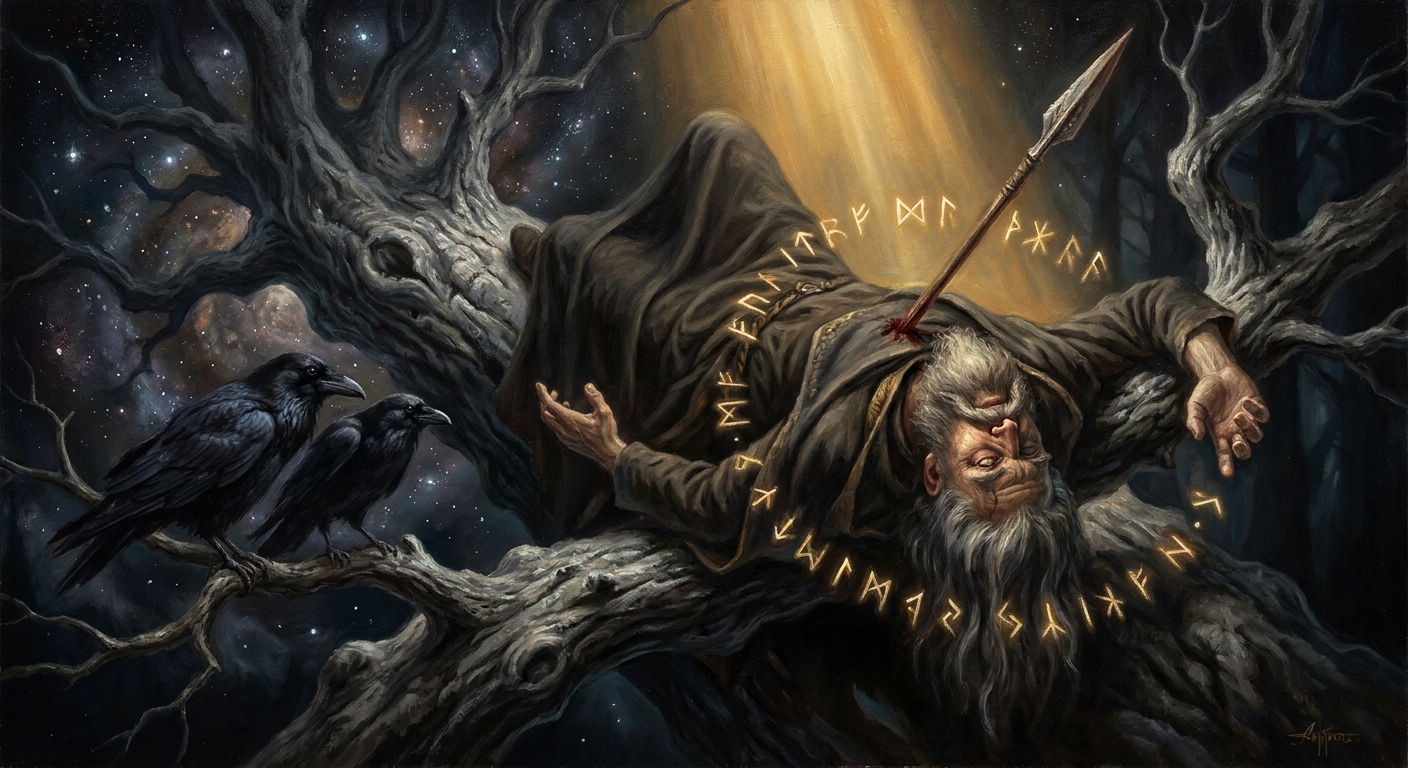
Odin on the Tree
Mythic Time · recorded ~10th century CE · Yggdrasil, the World Tree — the cosmic axis joining the Nine Realms
Contents
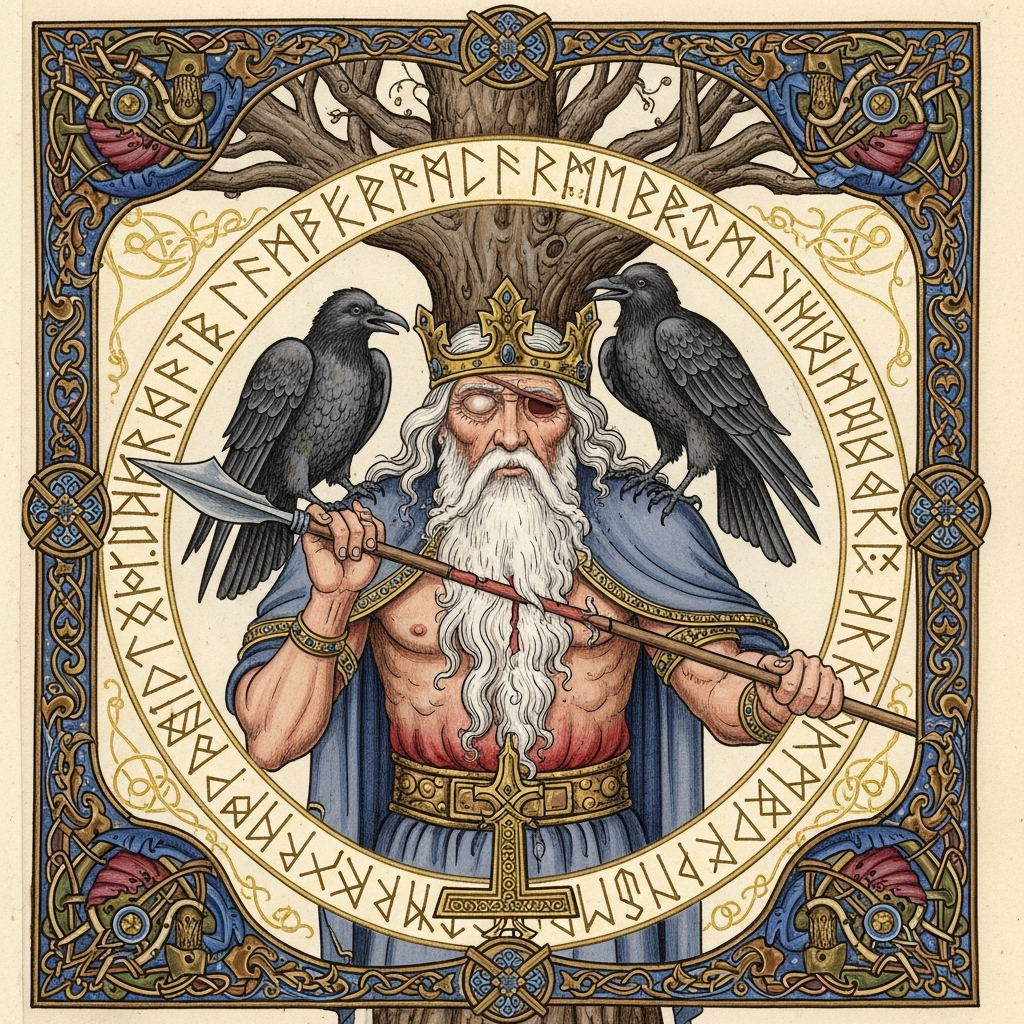
The All-Father hangs himself on the World Tree for nine nights, pierced by his own spear, to wrest the runes from the dark beneath the roots.
- When
- Mythic Time · recorded ~10th century CE
- Where
- Yggdrasil, the World Tree — the cosmic axis joining the Nine Realms
He climbs the tree at dusk.
The branches do not move for him. The bark does not soften. Yggdrasil has held the cosmos since before the gods were named, and a god is no exception to its weight. He drives Gungnir through his own ribs to make the wound, ties the cord around his throat himself, and lets the world fall away beneath his feet.
There is no audience. The ravens do not come. Frigg does not speak. The Æsir watch from Asgard the way mortals watch a man set out alone into a storm — they cannot help him, and they know it.
“I know that I hung,” he will say later, in his own voice, in the Hávamál. “On that windswept tree, swung there nine long nights, wounded by my own spear, given to Odin, myself to myself.”
The first night, the wind. Niflheim’s cold rises through the lower roots and licks at the soles of his feet. He counts his breath the way a warrior counts the heartbeat of an enemy: slowly, deliberately, with the certainty that one of them will run out first.
The second night, thirst. Audhumla’s milk, the mead of Suttung, the wells he has bargained for and stolen — all forgotten. Just the rope, the wound, and the dark.
The third night, hunger. He has eaten gods at feasts. Now he is a thing the tree is digesting.
The fourth night, the visions begin.
He sees the cosmos in cross-section. The Nine Realms branch from the trunk like a body’s organs: Asgard above where his own hall stands, Vanaheim where Freyr was raised, Midgard at the center where men squabble over fields, Jotunheim where his enemies sharpen their teeth, Alfheim of the light elves, Svartalfheim of the dark, Niflheim of ice, Muspelheim of fire, and Hel below all, where his daughter waits with the dishonored dead. He has seen the map before. He has never seen it from inside.
The dragon Niðhöggr gnaws the lowest root. The squirrel Ratatoskr sprints up and down the trunk carrying insults between the dragon and the eagle at the crown. None of them notice him. He is, for the first time in his existence, unobserved.
The fifth night, his eye begins to weep. Not the one he gave to Mímir’s well. The other one — the one he kept. It weeps without his permission, and the tears do not fall; they hang in the air like beads of glass, refusing to obey gravity. He cannot decide whether this is a vision or a wound.
The sixth night, the runes appear.
Not as letters. As cuts. They surface beneath the bark of Yggdrasil the way bones surface in a wound that will not close — Fehu, Uruz, Thurisaz, Ansuz, Raidho, Kenaz — each shape a small violence done to the tree, each one a syllable of fate’s own grammar. They are not waiting for him. They have always been there. He has simply never been low enough to see them.
He understands, then, what the price has been.
The runes are not a gift the cosmos hands to the worthy. They are a thing you have to fall far enough to read. The All-Father, ruler of Asgard, drinker of the wisdom-mead, sacrificer of his own eye — he has not yet been low enough. The throne is too high. The hall is too bright. To see the alphabet of fate, you have to hang where the dragon chews and the dead drip down.
The seventh night he stops being a god.
The eighth night he stops being anything.
The ninth night he reaches.
Both hands, broken-fingered, blood-emptied, he reaches out into the dark of the lower trunk and seizes the runes — not gently, not as a student takes a book, but as a drowning man seizes a rope. He screams as he takes them. The scream travels up Yggdrasil and out through every branch in every realm. In Asgard, Frigg sets down her spinning. In Vanaheim, Freyja stops in the middle of a sentence. In Midgard, a boy fishing in a fjord looks up, and for the rest of his life he will not be able to say what he heard.
The runes come into him. The cord parts. The tree gives him back.
He falls.
He lies at the base of Yggdrasil for a day and a night, breathing the way a newborn breathes — like he has not done it before. The runes are inside him now, beneath his skin. He can feel each shape against the inside of his ribs. He has been hollowed and re-furnished. He is not the god who climbed the tree. He is the god who came down with the alphabet.
He stands. He walks back to Asgard. He does not speak of it for a long time.
When he finally does speak — generations later, in the stanzas that became the Hávamál — he does not boast. He does not threaten. He says only: I know that I hung. Wounded by my own spear. Given to Odin, myself to myself.
It is the most honest sentence in any mythology.
Knowledge has a price. The highest god pays it. That is the Norse claim, and it has been the claim of every wisdom tradition since: there is no shortcut to the runes. You hang for them, or you do not get them.
The Christ-on-the-tree parallel has been argued for two centuries. It is real. Whether it precedes Christianity or was shaped by Iceland’s slow conversion is a question scholars have not settled and likely will not. Either way, the message survives both readings.
To see what fate is written in, you have to fall low enough to read it.
Echoes Across Traditions
Entities
- Odin
- Yggdrasil
- the Norns
- Mimir

Sources
- *Hávamál* 138-141 (the Rúnatal)
- *Vǫluspá* (the seeress's prophecy)
- Snorri Sturluson, *Prose Edda* (~1220)
- Carolyne Larrington (trans.), *The Poetic Edda* (1996)