Roro Jonggrang and the Thousand Temples
Ninth century CE; Prambanan temple complex built c. 850 CE under the Sanjaya dynasty · Prambanan, Central Java, Indonesia
Contents
The Javanese princess Roro Jonggrang agrees to marry the demon king Bandung Bondowoso only if he builds one thousand temples in a single night. He assembles an army of spirits and is about to succeed when she tricks the village women into pounding rice, making the roosters crow, convincing the spirits that dawn has come. He fails by one. He curses her to become the thousandth temple. She stands in Prambanan to this day.
- When
- Ninth century CE; Prambanan temple complex built c. 850 CE under the Sanjaya dynasty
- Where
- Prambanan, Central Java, Indonesia
The temples stand at Prambanan.
You can see them from the road between Yogyakarta and Solo, rising from the flat agricultural plain of Central Java — the three great spires of the Trimurti compound, dedicated to Brahma, Vishnu, and the central tower to Shiva, surrounded by the smaller temples of their vahana, their divine vehicles, and the outer ring of smaller shrines that the complex has accumulated over centuries of development. The tallest spire reaches forty-seven meters. The stone is volcanic andesite, grey-black, carved in intricate narrative relief panels — the Ramayana cycle runs along the galleries, the panels depicting Rama and Sita and Hanuman in a visual language that would be legible to worshippers across the Hindu world.
The complex was built in the ninth century, under the Sanjaya dynasty. Its architects left no account of the building. The folk tradition has supplied one.
Roro Jonggrang is the daughter of Prabu Baka, the demon king who rules the territory around Prambanan before Bandung Bondowoso conquers it.
Her father is killed in the battle. Bandung Bondowoso, victorious, encounters his enemy’s daughter and is captured by her — not physically, but in the specific way that beauty captures the conqueror who thought the conquest was complete. He decides he must have her.
She is not free to refuse him outright. Her father is dead. She has no army. She has no kingdom. The terms of conquest do not typically include the option of the conquered princess simply declining the victor’s interest. She cannot say no.
What she can do is make the yes impossible.
She agrees to marry him on one condition: he must build her one thousand temples in a single night. Not a year. Not a season. One night, from sunset to sunrise, one thousand temples of stone, each one completed.
The condition is designed to be impossible. She knows he cannot do it. He agrees to it. He does not know what she knows about herself.
He calls the spirits.
Bandung Bondowoso has resources that the folk tradition describes as jin — spirits, djinn in the Arabic loan-word that has worked its way into Javanese, the beings of fire and air who are subject to the command of those with sufficient power. He calls them from the mountains and the forest and the underground places. They come in numbers. They are willing.
The building begins at sunset.
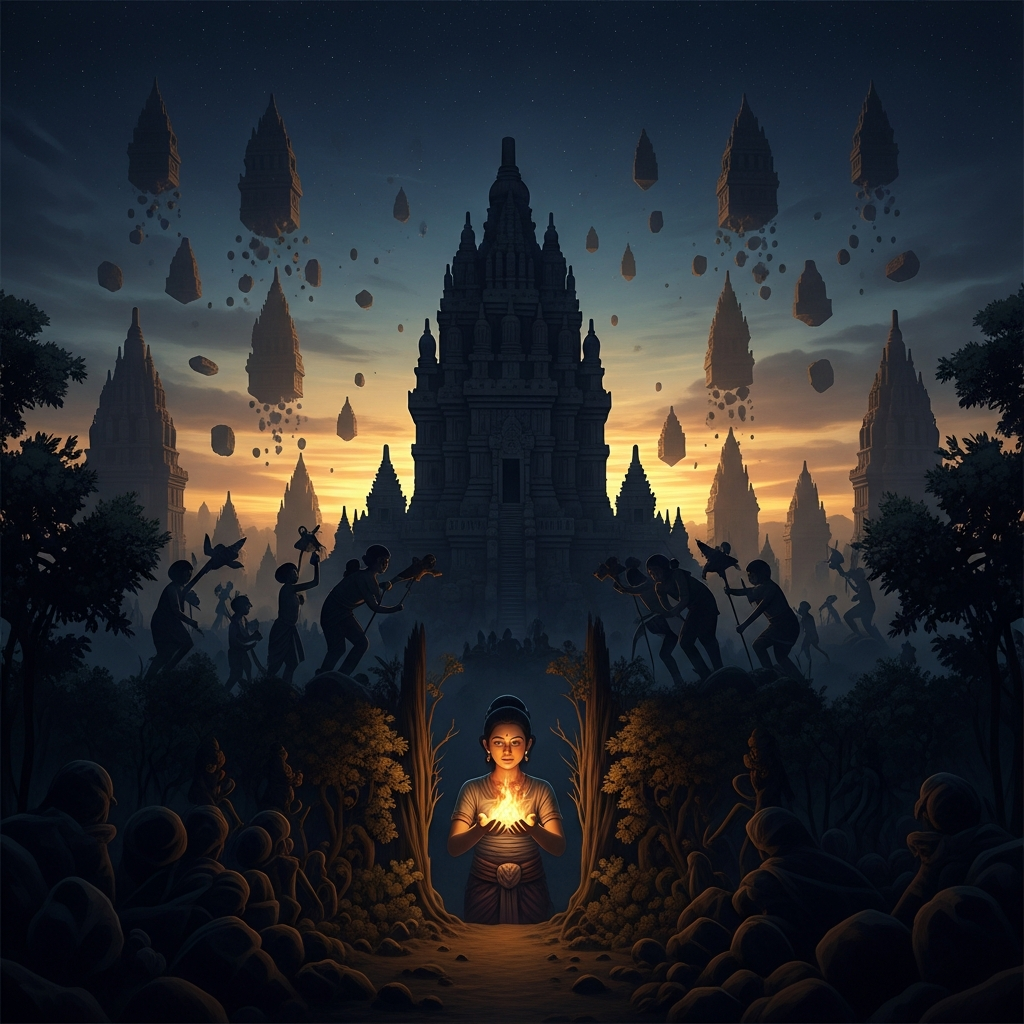
The spirits work as spirits work — not with human tools and human time but with the logic of the non-physical world, where the relationship between intention and material outcome is more direct. Stones rise. Foundations set. Walls assemble themselves in the dark. The Prambanan plain fills with shapes. Nine hundred. Nine hundred and fifty. Nine hundred and ninety.
Roro Jonggrang watches from the edge of the forest and counts.
Nine hundred and ninety-six. Nine hundred and ninety-seven.
She has very little time.
She goes to the village women.
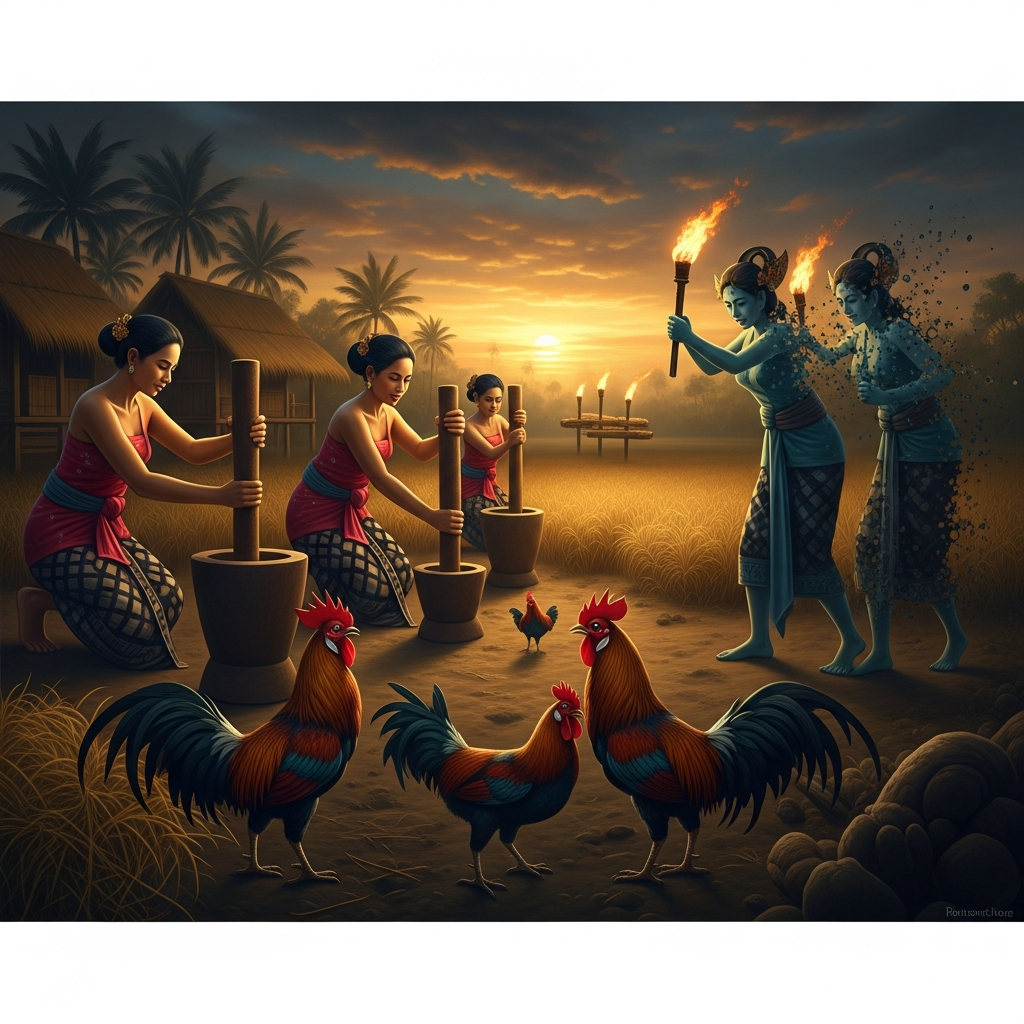
The instruction she gives them is specific: pound rice. Now. In the dark, before dawn, light fires and pound rice in the stone mortars that every Javanese household uses for this purpose. The sound of rice being pounded — the rhythmic thudding of pestle against stone — is a sound that belongs to morning. It is the sound of women preparing the day’s food before the light comes fully.
She also tells them to light fires on the eastern horizon. Eastern torches in the dark before dawn.
The roosters hear the fire and the sound. The roosters live in a world where morning is a complex of signals, not simply a matter of light: the sound of rice pounding, the smell of cooking fires, the specific quality of the air as it changes before the sun arrives. The roosters do not wait for the actual sun. They respond to the signals.
They crow.
The spirits stop.
Nine hundred and ninety-nine temples stand on the Prambanan plain. The thousandth is begun but not completed. And the roosters are crowing, and fires are visible on the eastern horizon, and the sounds of the waking village are in the air.
The spirits dissolve back into whatever they came from. They do not negotiate with dawn. Dawn is the boundary of their power.
Bandung Bondowoso stands on the plain among nine hundred and ninety-nine temples and the unfinished frame of the thousandth, and he understands what has happened. He understands exactly what has happened.
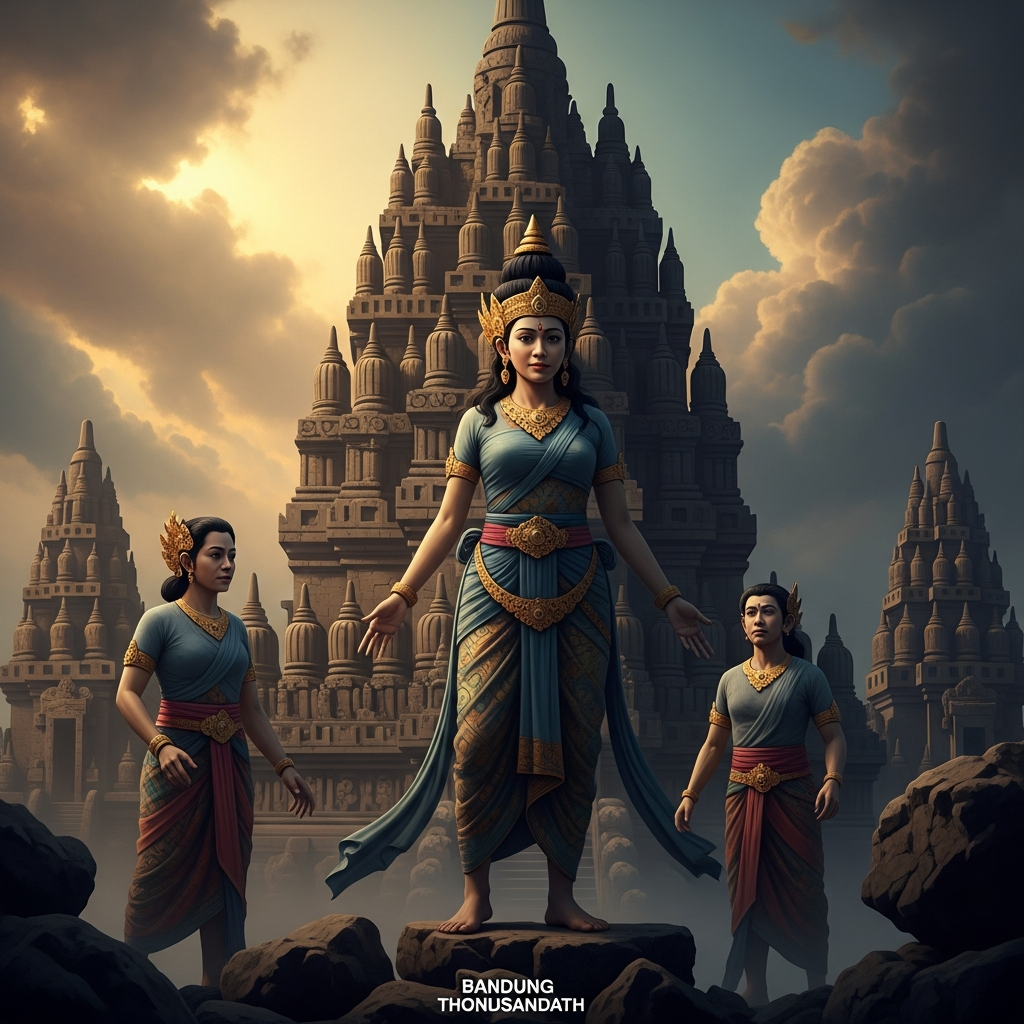
His fury is the specific fury of someone who has been defeated by their own willingness to agree. He agreed to the terms. The terms were met by sabotage that worked within the terms. She did not change the condition. She did not break the agreement. She made the condition fail by the specific method of making dawn come before dawn came, and the method worked, and the task is incomplete, and the marriage is impossible.
He will not accept this.
He curses her.
The curse is the specific curse of the demon king who has been outmaneuvered: you will become what you tried to prevent me from completing. You will become the thousandth temple. You will stand here on this plain in stone for as long as the other nine hundred and ninety-nine stand.
The stone rises.
The tradition describes the transformation with the specific detail of a curse that is witnessed: her feet go first, then her legs, then her body, the stone climbing upward as the curse takes hold. Her expression in the moment of turning — this is the detail that the Javanese tradition considers most important — is not fear. It is recognition. She understands what she has made. She was trying to avoid a marriage she could not refuse. She has successfully avoided it. The method of her avoidance will stand in stone on the Prambanan plain for as long as the temples stand.
She is the thousandth.
The Prambanan complex was damaged by an earthquake in 1549 and lay partially in ruin for centuries. Restoration work began in the 1930s under Dutch colonial authority and continues today. The main Shiva temple, Candi Loro Jonggrang — the temple of Roro Jonggrang — contains a statue in its northern chamber that the tradition identifies as her. It is a statue of Durga, the goddess, in the mahishasura mardini aspect. Art historians classify it as a typical representation of Durga in the Javanese Shivaite tradition. The Javanese folk tradition has a different identification.
The statue stands 1.96 meters tall. Its face is composed. It does not look defeated.
The story the Prambanan tradition tells is not a simple morality tale. It does not say Roro Jonggrang was right to use deception or wrong to try to escape the marriage. It says she was in a situation where deception was the only available tool and she used it, and the consequences of using it were the consequences she accepted.
She is still there. The stone has been standing for over a thousand years, which means the terms of the curse have been met for over a thousand years, which means she has been winning the bet she made for over a thousand years.
Bandung Bondowoso got nine hundred and ninety-nine temples. She got permanence. She got the one thing that the conquered daughter of a dead demon king could not otherwise obtain: a thousand years of being remembered.
The temples stand. She is inside the tallest one. She is looking north, the way the statue has always looked, at something the visitor cannot see from where they stand.
Scenes
The spirit army of Bandung Bondowoso building temples at night, the air filled with stone blocks rising and setting by supernatural force, nine hundred and ninety-nine temple silhouettes already completed against a dark sky
 Generating art…
 The village women pounding rice in the darkness before dawn, the sound of mortars carrying across the plain, the roosters lifting their heads and beginning to cry
 Generating art…
 Bandung Bondowoso standing before the nine hundred and ninety-ninth temple, his face stripped of everything but fury
 Generating art…
 Echoes Across Traditions
Entities
- Roro Jonggrang
- Bandung Bondowoso
- Praka Indra Denta
Sources
- Ann Kumar, 'Prambanan in the Ninth Century: Politics and Poetry,' *Indonesia* 64 (1997)
- John Miksic, *Borobudur: Golden Tales of the Buddhas* (Tuttle, 2012)
- Soekmono, *Pengantar Sejarah Kebudayaan Indonesia* (1981)
- Jan Gonda, *Sanskrit in Indonesia* (Nagpur: International Academy of Indian Culture, 1973)
- R.M. Savitri Schefold, *Symbols of the Sacred in the Hindu Javanese Tradition* (1988)