Bayazid Bastami and the Annihilation
c. 850 CE · Bastam, Khorasan (present-day Iran)
Contents
Bayazid Bastami — the ninth-century Persian mystic who first articulated *fana*, the complete annihilation of the self in God — speaks the most scandalous sentence in Sufi history, and then explains what it means: the 'I' that spoke was not the 'I' that breathes.
- When
- c. 850 CE
- Where
- Bastam, Khorasan (present-day Iran)
The disciple arrives early.
He is not a suspicious man — he follows Bayazid Bastami out of love, not surveillance, and the distinction matters. He comes to the Friday prayer at the mosque of Bastam in the ordinary way, in the ordinary pre-dawn dark, because his teacher has taught him that the quality of attention one brings to the first moment of the day shapes everything that follows. He is early enough that he can still hear his own footsteps on the courtyard stones.
He hears, through the mosque wall, a voice.
The voice is saying: Subhani! Ma azama sha’ni!
Glory be to Me. How great is My Majesty.
The disciple stands still.
He has enough theology to understand the crisis. These words are the words of God — specifically, the class of divine utterance (hadith qudsi) in which God speaks in the first person through the Prophet’s tongue. They are not the words a human being says. A human being says Subhana Allah — glory be to God. The shift from third person to first person is the entire distance between worship and claim. The shift from him to me is the distance between devotion and what the ulama will call blasphemy.
But the voice is his teacher’s voice.
He waits. After a long interval — how long, he cannot say with any reliability because time inside such a moment is unreliable — he hears the change. He does not know how to describe it later except to say that something settles, like water that had been disturbed finding its level again. And then the mosque door opens, and Bayazid Bastami walks out into the ordinary morning: recognizable, present, blinking.
The disciple does not speak first. He waits.
Bayazid says: If you hear me say such a thing again, come inside and stop me with your knife.
This instruction is not what the disciple expected, and it is not what most people expect when they first encounter it. It sounds like Bayazid is afraid of himself, or ashamed of himself, or asking to be killed before he says worse things. But none of these readings survive contact with the rest of what Bayazid teaches.
What the instruction means — what it takes the disciple years to understand, and what Bayazid will explain more fully later — is this: the state in which those words are spoken is not a state in which the human will is operative. In fana — the annihilation, the Arabic word that names the doctrine Bayazid is in the process of inventing — the individual self has been so completely dissolved in the presence of the Real that what remains is not Bayazid. The voice that says Glory be to Me is not a man claiming divinity. It is the divine, which has temporarily expanded to fill the vessel that Bayazid vacated. When Bayazid is not there, God is. The shatahat — the ecstatic saying, the scandalous utterance — is not Bayazid speaking. It is what speaks when Bayazid stops.
The knife is a safeguard not against Bayazid but for him. The ordinary man who hears the extraordinary utterance and does not understand it may do harm — to himself by being scandalized, to Bayazid by reporting the words to authorities who will act on them without comprehension. The knife in the hand of a disciple who understands is mercy: it ends the vulnerable moment before it can be misread.
He explains it after.
The gathered disciples are waiting for him. They have heard the reports — in a town the size of Bastam, a voice saying Subhani through a mosque wall is not a private event for long. Some of them are frightened for him. Some of them are frightened by the implication. The one or two who have been studying with him longest are watching with the particular stillness of people waiting to hear their own understanding confirmed or overturned.
Bayazid says:
The snake sheds its skin. The skin lies on the road. Someone who has never seen the snake may think: here is the snake. But the snake is elsewhere, crossing the sand.
He says:
When you hear the shell say “I am the ocean,” do not be confused. The shell has been so completely filled with the ocean that for a moment there is no shell, only ocean, and ocean speaks as ocean speaks. When the water recedes, there is the shell again. The shell did not become the ocean. The ocean was, briefly, all there was.
He says:
The “I” that said subhani is not the “I” that eats bread. You know this because the “I” that eats bread could not say subhani. It would not dare. It has too much self-interest, too much fear of the ulama, too much concern for its own reputation. The “I” that says subhani has none of these things, because it has no “I.” It has been emptied. What you heard was the emptiness speaking.
This explanation satisfies the disciples who are capable of being satisfied by it. It infuriates the ones who are not, and they are not wrong to be infuriated — the explanation does not close the theological problem, it relocates it. If the self can be so completely annihilated that God speaks through its absence, then the mystical path is not a path of increasing virtue culminating in divine proximity. It is a path of decreasing existence culminating in divine identity. And divine identity, even temporary, even explained as an optical illusion of selflessness, is a claim that challenges the absolute distinction between Creator and creature on which orthodox Islamic theology rests.
Junayd of Baghdad — the great systematizer, the man who will develop the doctrine of baqa (subsistence, the phase after annihilation in which the mystic returns to the world) — reads the shatahat with care and attempts to explain them as hal (temporary state) rather than maqam (permanent station): Bayazid was overcome, not transformed. The distinction is crucial and never fully persuasive.
Al-Hallaj will be executed in 922 for saying Ana al-Haqq — I am the Truth — which is the same doctrine applied to a different divine name, spoken louder, in Baghdad rather than Bastam, to an audience that includes the authorities. The Sufis who come after al-Hallaj’s execution spend several centuries developing the full apparatus of encoded mystical language — the wine poems of Hafiz, the gazelle poems of Ibn al-Farid, the allegorical love poetry of the entire Persian tradition — which allows the doctrine to be stated in forms that cannot be prosecuted because they can always be read as metaphor.
Bayazid Bastami is the source of all of this. He says it plainly because the tradition of concealment does not yet exist. He says it plainly because the vocabulary for explaining it is only beginning to exist. He is inventing the vocabulary as he goes.
He is born in Bastam around 804 CE and dies there around 874. He leaves no systematic text — what survives is fragments, sayings, the reports of people who heard him and wrote them down after. He is sometimes called the Sultan al-Arifin — the Sultan of the Gnostics — a title given by later generations who understand, in retrospect, what he initiated.
He never leaves Khorasan. He lives in a small city in northeastern Persia and speaks to local audiences and sends no letters to the caliphate and writes no polemics. He is local in the way that a spring is local: the water that comes out of it travels much further than the ground it comes from.
The disciple who heard the voice through the mosque wall — who stood in the courtyard in the dark, holding his belief in his teacher against the evidence of his ears — is the first reader of a text that will be reread for twelve hundred years. He does not know this. He is standing in the dark, waiting for the door to open.
The Sufi orders encode fana in their initiatory teaching with a care that reflects twelve centuries of institutional memory about what happens when it is spoken plainly. The novice learns about annihilation gradually, in stages, each stage’s language calibrated to what the novice can hold without being overwhelmed or scandalized. By the time he reaches the inner room of the teaching — the room where Bayazid is, where the scandalous sayings live unencoded — he has the frame to hold it.
The frame is everything. Without it, subhani sounds like a man claiming to be God. With it, subhani sounds like what it is: the sound of the ocean, briefly, through an empty shell — the most intimate possible testimony to the total disappearance of the self that was, until this moment, the only self the disciple thought there was.
Bayazid stands in the courtyard and blinks. The extraordinary has passed through him like a wind through an open window. He is, again, a man in Bastam, in the morning, hungry for bread. The mystic does not live in the state of fana. He visits it — is visited by it — and returns. The return is not a defeat. The return is the teaching.
Scenes
A disciple presses against the mosque wall, hearing through the stone what sounds like the voice of God — and then sees Bayazid walk out, blinking, into the ordinary afternoon
 Generating art…
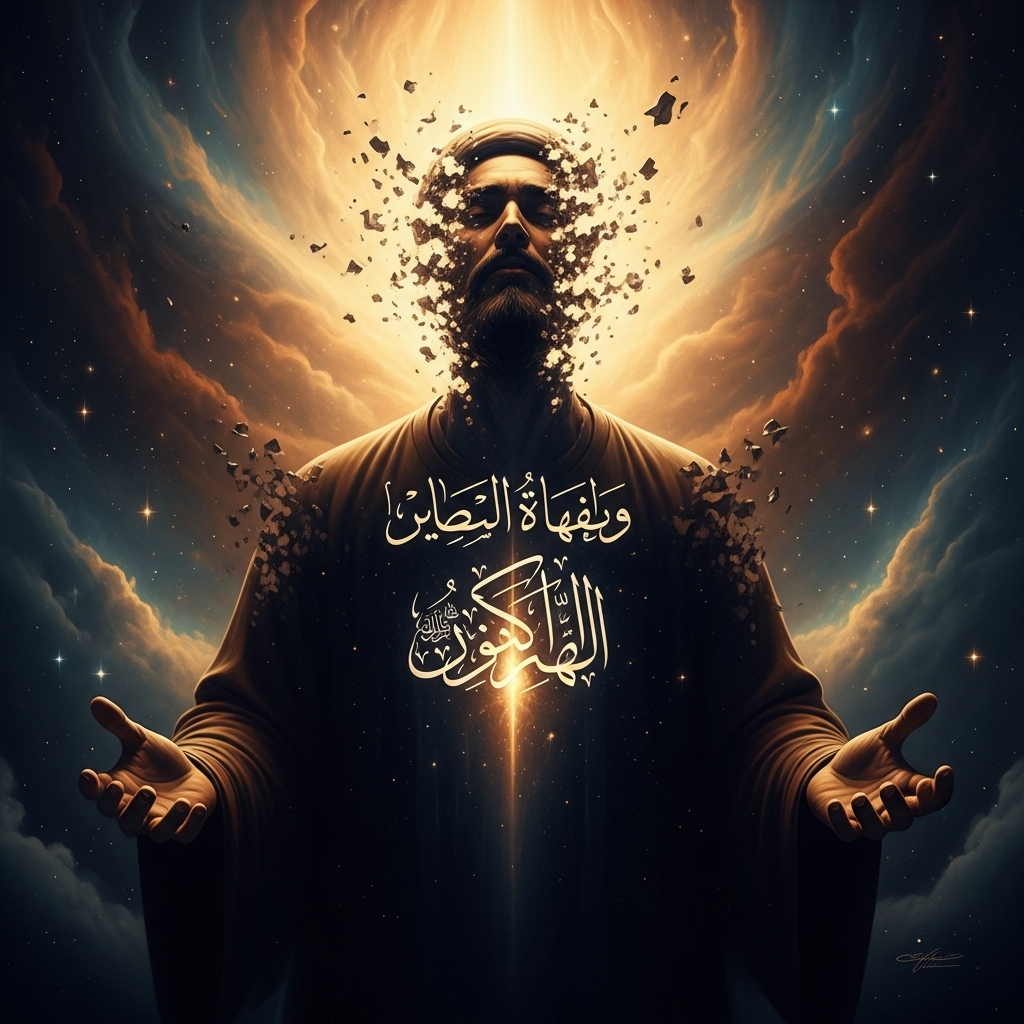
 Bayazid in the state of *fana* — the self dissolved, the vessel emptied, the divine speaking through the hollow of what was a man: *Glory be to Me! How great is My Majesty!*
 Generating art…
 Bayazid explains to the gathered disciples: the 'I' that said *subhani* was not the 'I' that eats bread
 Generating art…
 Echoes Across Traditions
Entities
- Bayazid Bastami
- Abu Ali al-Sindi
- Junayd of Baghdad
Sources
- Abu Yazid al-Bistami (Bayazid), sayings collected in al-Sahlaji, *Kitab al-Nur*
- Farid al-Din Attar, *Tadhkirat al-Awliya* (Memorial of the Saints), ~1220
- Annemarie Schimmel, *Mystical Dimensions of Islam* (UNC Press, 1975), ch. 3
- Carl Ernst, *Words of Ecstasy in Sufism* (SUNY, 1985)
- Abu Nasr al-Sarraj, *Kitab al-Luma fi al-Tasawwuf* (The Book of Flashes in Sufism)