Huangbo Slaps the Emperor
c. 840 CE — late Tang dynasty · Mount Huangbo, Jiangxi — a remote monastery where a future emperor is hiding from his nephew, the reigning emperor who would have him killed
Contents
A Chan master strikes the future Son of Heaven three times across the face. The future Son of Heaven laughs. The lineage of Linji Zen is sealed in the sound of an open hand against an imperial cheek.
- When
- c. 840 CE — late Tang dynasty
- Where
- Mount Huangbo, Jiangxi — a remote monastery where a future emperor is hiding from his nephew, the reigning emperor who would have him killed
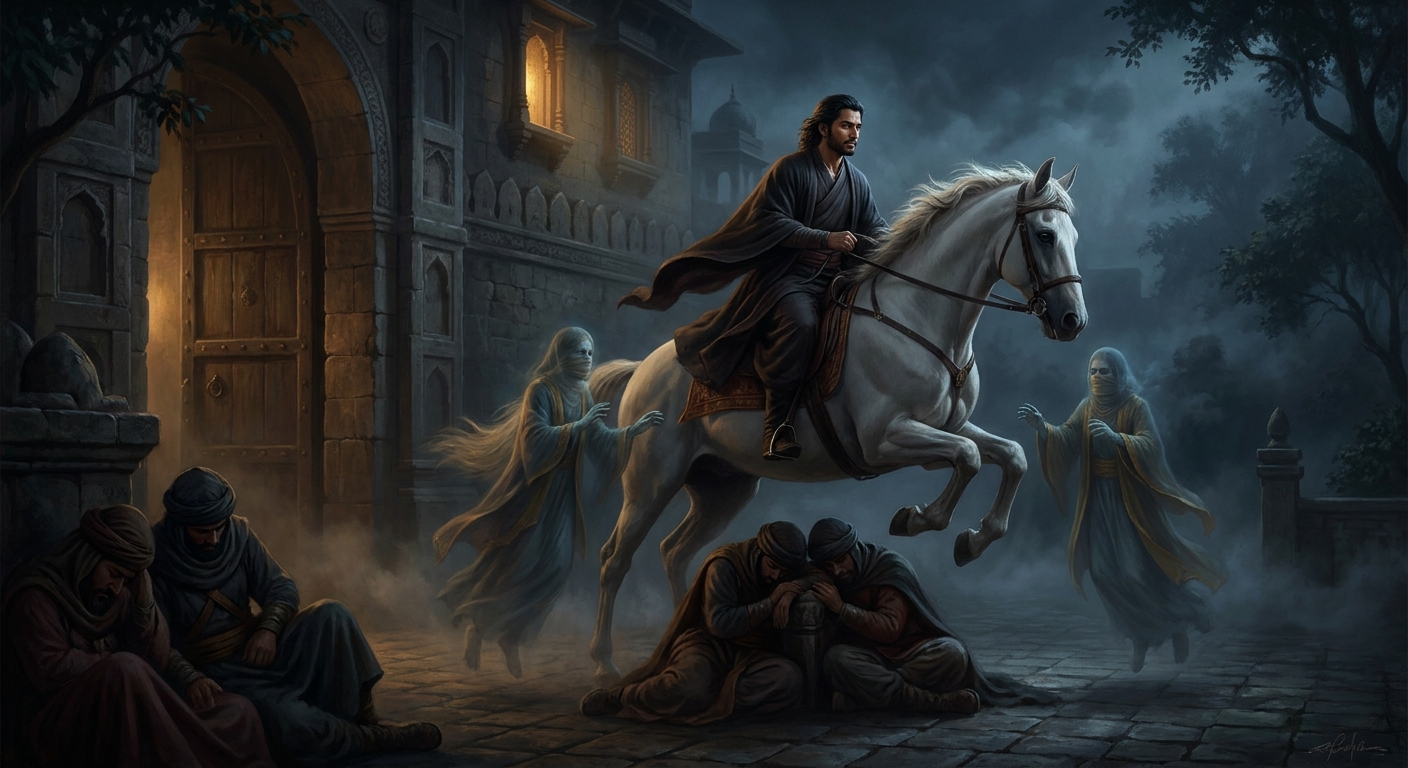
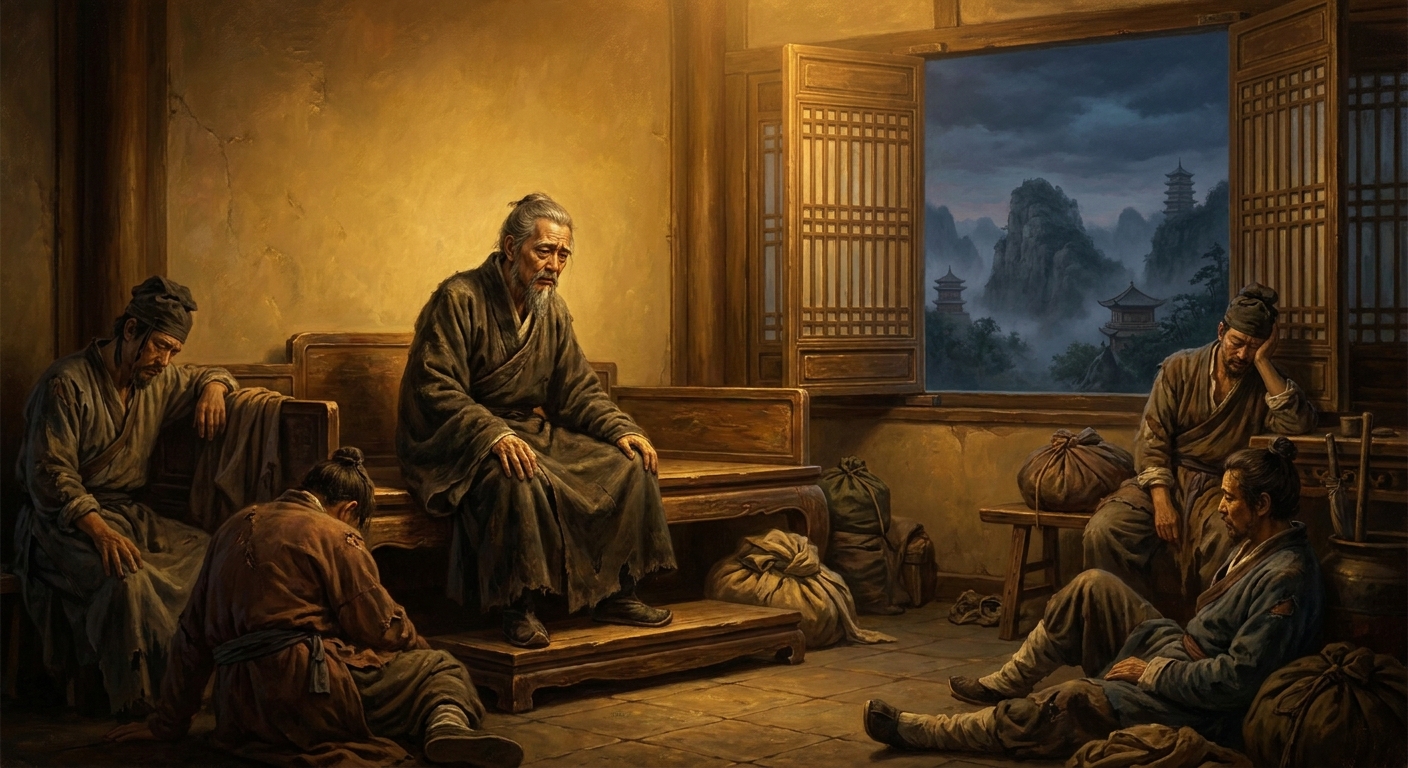
The young man arrives at Mount Huangbo with a shaved head and a borrowed name.
He is the thirteenth son of an emperor and the uncle of the reigning one. His nephew, Emperor Wuzong, is killing relatives systematically and sincerely. The court astrologers have warned that an uncle will replace him; Wuzong has decided to thin the field. The young man — Li Chen, who will one day be Emperor Xuanzong of the late Tang — has shaved his head, put on the patched robe of a wandering monk, and disappeared into the mountains of Jiangxi.
He arrives at Huangbo’s temple in the rain. He kneels in the courtyard. He asks for shelter and instruction. Huangbo looks at him — sees, beneath the rags, the bearing of a man who has never carried his own water — and grunts. Stay. Sweep. Do not speak unless I speak first.
The young man stays. He sweeps. He chops wood. The brothers do not know who he is. He learns, slowly, the way a stone learns water.
He is in the hall one morning when the master is teaching.
Huangbo is gesturing toward the altar — the figure of the Buddha, the bowls of rice, the smoking incense — and saying something the young man cannot follow about how the form is not the form. The young man, forgetting the rule, raises his head and asks, “Master, why do you bow before the Buddha if there is nothing to seek?”
Huangbo turns.
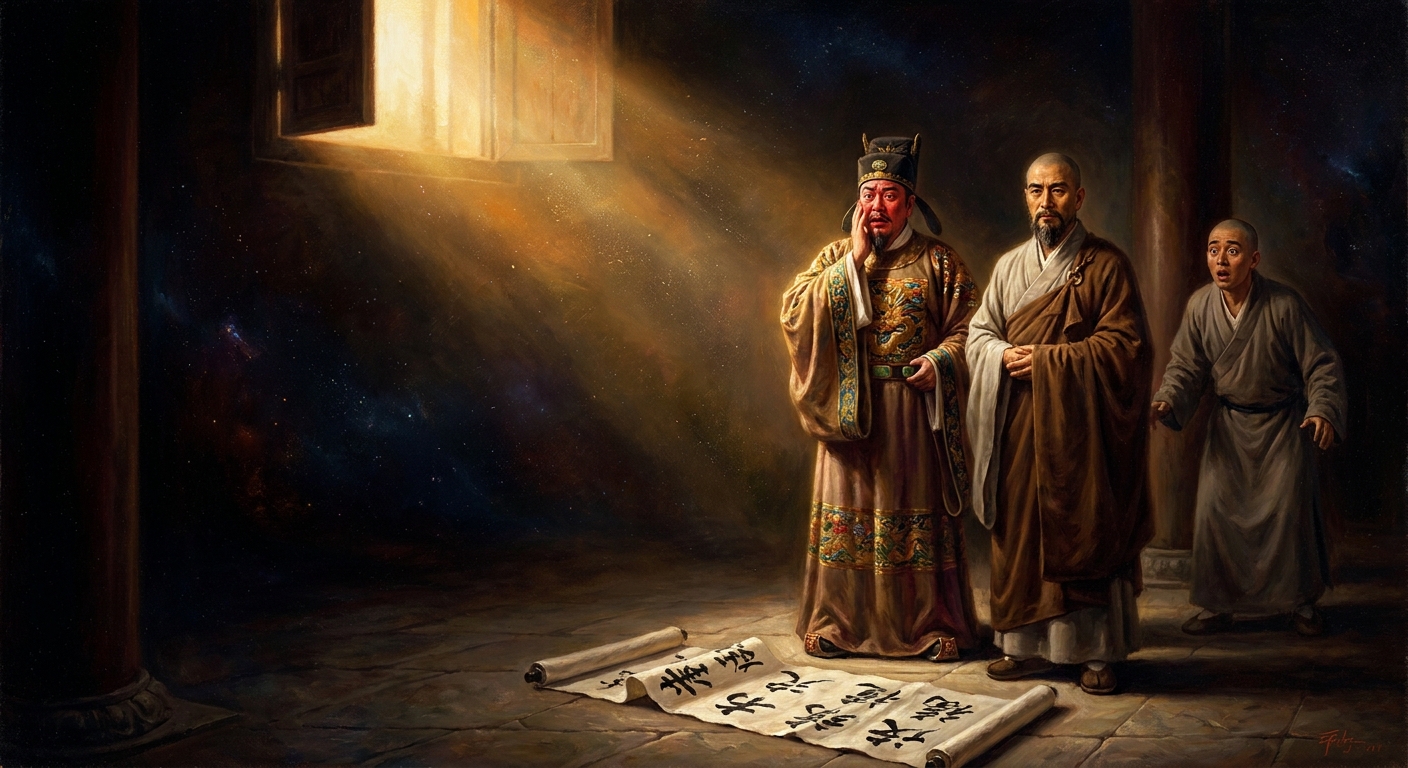
He crosses the hall in three steps. He does not speak. He raises his hand and slaps the young man across the face — once, hard, the sound flat in the wooden hall. The young man’s head snaps. He does not cry out.
“I do not seek through the Buddha,” Huangbo says. “I do not seek through the Dharma. I do not seek through the Sangha. This is what I bow to. Do you understand?”
A second slap. Crack. The young man’s eyes water; he keeps them open.
“Do you understand?”
A third slap. The young man’s cheek is red enough to glow against the gray of his shaved scalp. The hall is silent. The other brothers have stopped breathing. The master waits.
The young man — and this is the part the chronicles record with a kind of awe — laughs. A short, dry laugh, more breath than voice. He bows. He goes back to sweeping.
He does not stay long.
Word of the imperial purge filters up the mountain in fragments. Wuzong has launched the great Huichang persecution — temples burned, monks defrocked, bronze Buddhas melted for coin. Huangbo’s monastery is small enough and remote enough to escape, but the empire is convulsing, and the young man understands, in the practical part of himself the slap has not yet emptied, that his window is closing.
He leaves at dawn. He bows three times in the courtyard. Huangbo, who has somehow always known, says only: the slap is yours. Take it with you.
In 846, Wuzong dies — of mercury poisoning, of his own alchemical hunger for immortality. The court convenes. The astrologers are vindicated. The thirteenth son, the uncle who disappeared, is recalled. Li Chen takes the throne as Emperor Xuanzong of Tang. He is forty-three years old. He is, by all accounts, the most competent emperor the dynasty has produced in a century. He ends the persecution. He restores the temples. He recalls the exiled scholars. The chronicles call his reign the Dazhong restoration.
He has a private room, in the palace at Chang’an, where he keeps no images of his ancestors but a single wooden bowl, a patched gray robe, and a small stick of incense burnt every morning before a name written on a slip of bamboo.
The name is Huangbo.
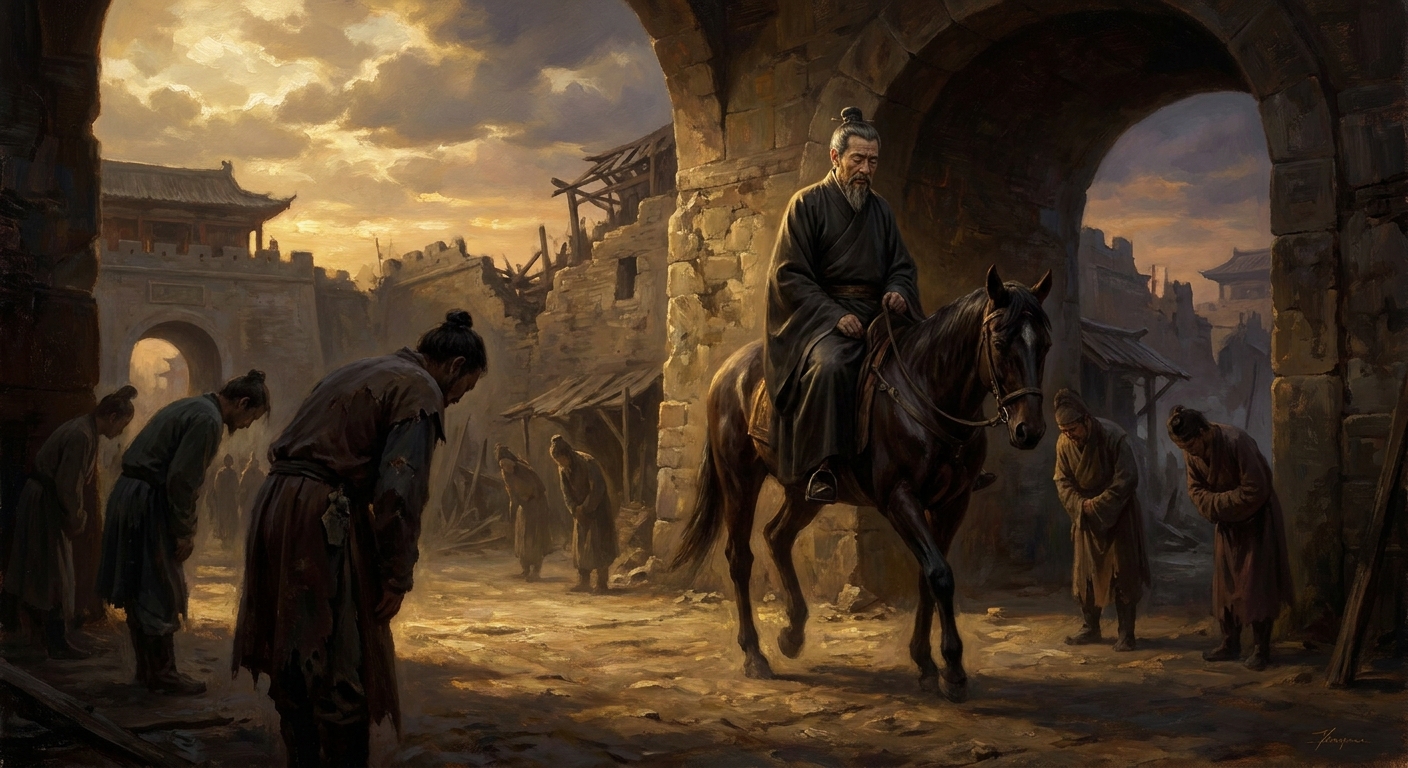
In the third year of his reign, the emperor goes back to the mountain.
He travels light by imperial standards — only three thousand troops, the inner ministers, the canopy and the ceremonial axes. He climbs the road himself, on foot, the last li up Mount Huangbo, in the imperial yellow robe that nobody at the temple has ever seen worn by any human being.
Huangbo is old now. Eighty, eighty-five — the chronicles disagree. He sits in the same wooden chair in the same courtyard. The brothers have prostrated themselves at the news of the imperial approach. The dog at the gate is asleep in the dust. Huangbo has not moved.
The emperor enters the courtyard. The retinue stops at the gate. The emperor walks alone to the master’s chair. He kneels.
“Master,” he says, “do you remember me?”
Huangbo looks at him. The eyes are river-stone. “You ask whether I remember a man I struck. I struck many men. The hand does not remember. The face does.”
The emperor laughs — the same dry laugh, twenty years older. He raises his head. His cheek, in the autumn light, looks for a moment as if it is still red.
“I owe you,” the emperor says, “three things. The throne is one. My life is another. The third I cannot name, but I came up the mountain to thank you for it.”
The story has a coda the chronicles disagree on.
In one version, the emperor offers Huangbo a title — Great Master of Disrupted Defilements — and the master refuses it, saying titles are food for ghosts. In another, the emperor offers him the abbacy of the imperial monastery in the capital, and the master sends back the message that he will come down the mountain when the mountain comes down. In a third — the version the Linji school will quote for a thousand years — the emperor asks Huangbo for a teaching to take back to the palace, and Huangbo says only:
“When you sit on the throne, do not forget the slap. When you wear the dragon robe, do not forget the patched one. The empire is large. The face is small. Both will be gone in a hundred years. Bow to neither.”
The emperor receives the sentence. He bows once. He goes down the mountain. He rules for thirteen more years and dies of poisoning by his own court physicians, having tried, like his nephew, to drink mercury into eternity. The patched robe and the wooden bowl and the slip of bamboo with Huangbo’s name are buried with him.
The lineage proceeds.
Huangbo’s chief disciple is Linji Yixuan — the founder of the Linji school, which becomes Rinzai when it crosses to Japan, which becomes the line of D.T. Suzuki and Hakuin and a thousand modern Western Zen teachers. Linji inherits the slap as technique. He builds an entire pedagogy out of it: shouts, blows, beatings, the katsu roar, the staff cracking the desk. If you meet the Buddha on the road, kill him. That is Linji. The lineage that will not bow.
The slap that landed on the future emperor’s face becomes the slap that lands, by inheritance, on every Rinzai student who has ever sat in a sanzen room and been struck, shouted at, refused, sent away. The hand is Huangbo’s. The cheek is anyone the dharma has chosen to wake.
The slap is not violence. It is grammar.
Power asks for benediction. The Chan master refuses to issue one. Wuzong burned the temples and died of his own poison. Xuanzong respected the temples and died of his own poison. The throne is a way of dying. The slap is a way of living long enough to know it.
John the Baptist refused Herod and lost his head. Diogenes refused Alexander and kept his barrel. Huangbo refused the future emperor and kept the future emperor’s gratitude for the rest of his life. The variations matter. The structure does not.
The robe does not bow to the dragon. That is the whole of Linji Zen, in one sentence, and it has been ringing for twelve hundred years in every dojo where a student is struck for the kindness of being struck.
Scenes
The temple hall
Generating art… Years earlier — the imperial nephew in patched robes, sweeping the courtyard, hiding from the assassins his uncle has sent
 Generating art…
 Twenty years on
 Generating art…
 Echoes Across Traditions
Entities
- Huangbo Xiyun
- Emperor Xuanzong of Tang
- Linji (Rinzai)
Sources
- *Linji Yulu* (*Record of Linji*) — Tang dynasty, compiled later
- Ruth Fuller Sasaki (trans.), *The Record of Linji* (1975/2009)
- Burton Watson (trans.), *The Zen Teachings of Master Lin-Chi* (1993)
- *Chuandeng Lu* (*Transmission of the Lamp*, 1004 CE) — biographies of Huangbo and Xuanzong
- Heinrich Dumoulin, *Zen Buddhism: A History, Volume 1* (1988)
- Andy Ferguson, *Zen's Chinese Heritage* (2000)